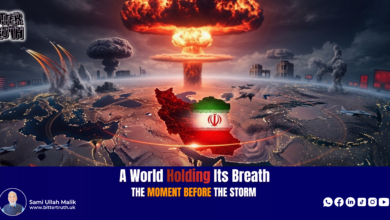

When Justice Sleeps, Nations Crumble: A Reckoning from the East
From Modi to Gutter: The Erosion of India’s Moral Republic

When nations dare to dream, the path to realising those dreams is seldom paved with ease; it winds through the blood-stained avenues of sacrifice, and the unwavering lanes of faith. Pakistan was such a dream—not merely a territory marked by cartographic ink, but a creed, a proclamation, a clarion call that pierced the subcontinental skies after centuries of subjugation. It was a land willed into existence in the name of “Lā ilāha illā Allāh”لَاإِلَـٰهَ إِلَّاٱللَّٰهُ—There is no deity but God—a vision unmarred by the lust for power or the bartering of ideals.
Alas! That dream, once radiant with divine certitude, now lies obscured beneath the dust of expedience, its essence bartered away at the altar of military ambition and political opportunism. Had our political compass been aligned with the Muhammadan ethos—where justice, consultation, and accountability reigned—democracy would not whimper in corners, nor would despotism stride brazenly across the national stage. History bears grim testimony: when nations abandon their ideological moorings, decline becomes their destiny, and foes dance in triumph upon the grave of their unfulfilled aspirations.
At rare intervals in the annals of civilisation, chapters are etched not in ink but in the blood of hearts—inscriptions that resist erasure, engraved upon the parchments of time until the end of days. Pakistan, too, is one such chapter: a state perhaps youthful in geography, yet ancient in its resonances, echoing with centuries of struggle and yearning. This divinely ordained republic emerged from the crucible of Partition—an epochal rupture that sundered not only lands but also minds, cultures, and dreams.
Partition was no mere redrawing of borders; it was a civilisational upheaval. When, on the 14th of August 1947, Pakistan’s dawn broke across the horizon, it bore within its golden rays the glint of a long and arduous Muslim struggle. At a time when British imperial authority waned and Hindu majoritarianism surged, Muslims sought refuge in a distinct political identity—a desperate yet dignified quest to breathe freely.
As Muhammad Ali Jinnah, the founding father, poignantly declared:
“Pakistan came into existence the day the first Hindu embraced Islam.”
Yet the question persists, piercing through decades like a silent verdict: has the state internalised the spirit in which it was conceived? For all the lofty titles—‘Islamic Republic’ among them—Pakistan’s political trajectory has been one of paradox and betrayal. An Islamic order was proclaimed but never enacted; the voice of the people exalted yet routinely muffled. Democracy here has been like a sapling perpetually uprooted by tempests of tyranny.
Was the democratic ideal, then, not gradually lost in the swirling dust of political deceit? Time and again, when the sun of democracy seeks to rise, clouds of authoritarianism gather ominously upon the national firmament. And yet, when dictatorship overextends its shadow, it is the people who kindle the lamps of liberty. Thus, Pakistan’s political landscape resembles a tree whose one bough hosts the chirping birds of democracy, while the other broods with the owls of despotism.
As the world stepped boldly into the 21st century—undaunted in its pursuit of progress, enlightenment, and knowledge—Pakistan stood chastened by four separate bouts of military rule. How strange, how tragic, that in this polity, dictatorship is ceaselessly reborn from the very womb of democracy, while democracy is forced to seek refuge in the bosom of authoritarianism. Here, the mantra that “even the worst elected government is better than the best dictator” has been drilled into the national psyche. And even when corruption, nepotism, and pseudo-civilian autocracy flood the political terrain, self-proclaimed champions of democracy extend open arms to the architects of their own demise.
The true marvel lies not merely in the fact that politicians turned merchants or that generals draped themselves in democratic garb, but in the public’s unsettling acquiescence to this grand masquerade, often in the name of prudence or necessity. In the bazaar of politics, every candidate wears the guise of public service, while harbouring a heart riddled with the poison of power-lust. The democratic opposition, while denouncing the masks worn by the ruling elite, is often found wistfully glancing at the military’s embrace—seeking, perhaps, the same cold comfort they once decried. And when the shadows of dictatorship grow long, the call to elections is once again raised; ‘angels’ and ‘plunderers’ alike convene to perform the ritual prayer of democracy.
This is Pakistan—where politicians trade in commerce and the military dabbles in politics; where religion becomes a commodity in the electoral marketplace, and the so-called “friendly opposition” sits patiently beneath the government’s shadow, waiting its turn. Democracy, in this republic, has often matured not under the light of merit or ideology, but in the shadows of dynastic politics, patronage, and electoral manipulation. The same faces, cloaked in different slogans, repeatedly ascend to power—not by virtue of public service but through mastery of the ‘science of winning elections’. Democracy, meant to be government ‘of the people, by the people, for the people,’ here often manifests as rule ‘of the elite, by the wealthy, for the family’.Hence the opposition awaits its turn, the ruling class grows drunk on power, and the soul of the republic cries out—betrayed yet again by a democracy that serves power, not people.
The story of democracy and dictatorship in Pakistan is a twilight tale—neither fully dark, nor truly illuminated. Each time the nation finds itself in the clutches of a self-proclaimed “saviour”, the result is greater disunity, institutional decay, and geopolitical isolation. The true tragedy lies in the complicity—of political elites, the judiciary, and at times, even segments of the media—all lending moral and legal cover to military regimes.
The shadow of military rule has loomed over Pakistan like the staff of a Pharaoh, suppressing the people’s will under the guise of ‘national interest’, ‘state stability’, and ‘democratic inefficacy’. Whether it was Ayub Khan’s “Basic Democracy”, Zia-ul-Haq’s Islamisation, or Pervez Musharraf’s “Enlightened Moderation”, each promised progress, but delivered regression—one step forward, two steps back. The essential question remains: did military rule ever instil trust among the people, or merely entrench institutional supremacy? History suggests the latter. For while autocracies may impose temporary order, they seldom bequeath enduring prosperity.
The same lessons reverberate in the echo chambers of our eternal adversary, India. The illusion of Indian democracy is, in truth, but a gossamer veil—beneath which the thunder of Khalistan’s rebellion, the anguished cries for Nagaland and Manipur’s independence, the embers of Naxalite insurgency, and the ceaseless calls to prayer from occupied Kashmir have echoed for decades. What New Delhi dismisses as “internal matters” are, in fact, relentless indictments of its so-called majoritarian democracy—a façade stretched too thin to conceal the widening fissures beneath.
These rebellious voices now stand defiantly at the very threshold of the Indian capital, posing an uncomfortable question: can the nation that sought to sow instability within Pakistan remain immune to disintegration itself? Should Pakistan choose to lay bare India’s own lacerations, the fabled ‘unity in diversity’ may well crumble like a castle built upon sand.
Yet if the story of Pakistan is partly stained by the cunning of dictators and the duplicity of politicians, it is also illumined by the struggles of those who fought for the republic’s soul: its movements, its press, and its resilient civil society. From the Nizam-e-Mustafa Movement in 1977, the Movement for the Restoration of Democracy in 1983, the Lawyers’ Movement of 2007, to the more recent confrontations against hybrid rule post-2014—each stands as testament that this nation is no inert mass. Even in its darkest hours, Pakistan has birthed caravans willing to brave the deserts for the oasis of justice.
In the more recent pages of our history, Indo-Pak tensions once more flared, their embers glowing hot upon the domestic canvas. The drums of war not only restored the military’s public prestige but temporarily dampened the dust of internal dissent. The people’s sentiment rallied behind the armed forces and thus emerged a hybrid regime—where military and civilian actors, arm-in-arm, struck a common chord: that of ‘development’.
But this harmony proved to be short-lived. Echoes of rebellion began to haunt the ranks of Pakistan Tehreek-e-Insaf, with charges of sedition levied against its leadership and cadre. The events of 9th May carved deep lines into the national psyche, as one of the country’s principal political forces found itself in the dock. Key figures were imprisoned, and courtrooms became the theatres of new constitutional dramas. The question that arises: Is this the long-awaited realisation of a “New Pakistan,” or merely a fresh chapter in the chronic saga of democratic subversion?
Across the border, too, the halls of Delhi betray disquiet. Following global embarrassment in the latest skirmish, Prime Minister Narendra Modi’s declaration—“Abhi Sandur Operation Khatm Nahin Hua” (“The Sandur operation is not yet over”)—was no mere rhetorical flourish. It was a harbinger of brewing conflict, a metaphor for yet another storm forming over the subcontinent. Modi’s government, battling domestic crises and desperate to redeem its martial image, now appears inclined to wage another war—not necessarily with guns, but through sabotage, subterfuge, and political subversion.
But will Modi dare the risks of full-scale war? Or shall he persist in using terror, espionage, and proxy conflict as tools to bleed Pakistan silently?
In the skirmishes of 2025, Pakistan maintained a defensive posture, but India suffered censure both at home and abroad. Modi’s oft-repeated line—“The operation is not over”—betrayed more than defiance; it revealed a rattled statesman attempting to shield his failure with hollow bravado. His party, the Bharatiya Janata Party, thrives on the extreme ends of Hindutva, feeding its politics with hyper-nationalism, militarism, and deep-seated bigotry.
History suggests that Modi is not above kindling the fires of war during electoral cycles to distract the masses and pose as a warrior saviour. Once again, he parades the dream of regional hegemony before his Western allies, even as his domestic house crumbles. His government, therefore, has intensified covert actions against Pakistan—ranging from meddling in Balochistan through RAW to fuelling unrest in Karachi, Gilgit, and erstwhile FATA.
Yet should Pakistan choose to weaponise India’s internal fractures as a counter-strategy, the consequences for India would be devastating—its ‘unity’ may unravel with the fury of a broken rosary, each bead scattering down a different path.
وَقُلْ جَاءَ ٱلْحَقُّ وَزَهَقَ ٱلْبَٰطِلُ ۚ إِنَّ ٱلْبَٰطِلَ كَانَ زَهُوقًا
And say: “Truth has arrived, and falsehood has perished—for falsehood, by its nature, is ever bound to perish.”
For relations between two nuclear-armed neighbours are no diplomatic waltz—they are a perilous dance upon the edge of a blade, where not only toes, but limbs, may be severed without warning.
If India’s chosen policy is to destabilise Pakistan, can Pakistan respond in kind—in the same coin, with the same steel? The question is not merely tactical, but moral, strategic, and historical. For India, far from the image it sells to the West, is itself beset with insurrections: the Khalistan movement in Punjab, separatist uprisings in Nagaland, Assam, and Manipur, Maoist-Naxalite rebellion in the central belt, and the ever-burning struggle for freedom in Kashmir.
These are not isolated voices—they echo through villages and valleys, fuelled by local grievance and, at times, external sympathy. Should Pakistan choose to highlight these causes on diplomatic forums, they would expose the tattered seams of Indian democracy, revealing a state whose constitutional robe is far too threadbare to hide its wounds.
The world, once beguiled by India’s rhetoric of prosperity, soft power, and democratic institutions, now glimpses a darker truth: that beneath the peacock’s plume lies a bloodstained soil. It is a tragedy of ironies that the very India hailed as a beacon of modern governance now echoes with the wails of the impoverished, the whispers of the oppressed, the muffled rebellion of the downtrodden, and the violated dignity of women.
If the gleaming jewels of democracy are set upon a crown of ignorance, poverty, and dehumanisation, then that crown is no ornament—it is a rusted chain, binding 1.4 billion citizens to an illusion.
Even India’s own surveys and international reports acknowledge an uncomfortable reality: the largest number of the world’s poor reside within its borders. Over 800 million rely on subsidised rations. Millions sleep not just beneath bridges, but upon the blistering pavements and railway platforms of modern Indian metropolises. And this mass slumber is not a rest—it is a silent slap upon the face of the Indian Republic.
Educationally, too, India teeters. According to UNICEF and UNESCO, India is home to the world’s largest population of illiterate adults. Millions of children abandon school each year. In numerous states, the education of girls remains a matter of shame. Behind the high walls of Indian universities and the glimmer of IITs lies a vast hinterland of darkness, where ignorance reigns like an unchallenged monarch.
India Beneath the Cloak of Democracy: A Subcontinent in Decline
In the official records of India’s Ministry of Labour and Employment, a stark and unsettling truth is laid bare: millions of young Indians, clutching their degrees like obsolete currencies, roam the streets in silent despair. Under the Modi administration, unemployment has soared to its highest rate in 45 years. This is not merely an economic anomaly—it is a silent civil war, a systemic betrayal that has driven the youth into the arms of psychological torment and, tragically, suicide.
The tragedy deepens with hunger and humiliation. In a revelation so grotesque it could only be true, Indian media itself has acknowledged that nearly 20 million Indians are compelled to consume rats as their daily sustenance. Indeed, these images—men and women gnawing on vermin—are the unspeakable truths that the Indian media sometimes disguises as “cultural diversity,” and at other times buries under the silence of complicity.
India hosts the world’s largest red-light district. Prostitution, HIV/AIDS, and the open desecration of female dignity are no longer aberrations—they are institutionalised disgraces. India ranks among the top in the global tally of AIDS patients, to the extent that entire trains are dedicated to AIDS awareness. Female infanticide—murder before breath—is a chilling component of India’s so-called “modern” culture.
Sanitation remains a distant dream. Over 70% of India’s rural population continues to be denied access to toilets. Yet perhaps more grotesque is the black market for human organs, now so commonplace that village entrances display notices announcing: “Kidneys for Sale—Every Resident.”
This is not journalistic hyperbole; it is a confession now corroborated by Western survey institutions. Political and religious suffocation has reached such a degree that no fewer than 22 Indian states are simmering with secessionist aspirations. Over 100 armed separatist groups are active in regions like Naxalbari, Khalistan, Kashmir, Manipur, Assam, and Nagaland—internal volcanoes, lying in wait.
An estimated 40% of India now lies beyond the effective reach of the central government. Global financial institutions have begun to expose the illusions of Indian economic grandeur. Over $500 billion in foreign debt weighs heavily upon India’s neck, while $377 billion in forex reserves are, in truth, borrowed funds at 8% interest. This is not development; it is fiscal obfuscation masquerading as prosperity.
Recent skirmishes with Pakistan further revealed India’s military frailty. From the ignominy of grounded NA-32 aircraft during the Kargil conflict to malfunctioning Bofors guns and defective weaponry from overpriced Ukrainian contracts, the myth of military supremacy lies in tatters.The so-called “world’s largest democracy” is, in truth, a union fissured by poverty, ignorance, insurgency, and decline. The veil has been lifted. It is no longer a question of opinion but of historical certainty: the creation of Pakistan was not merely justified—it was inevitable.
To those who cry, “Why has Pakistan lagged behind India?”—look beyond Bollywood’s chromatic illusion. Witness instead the sidewalks where not people but democracy itself lies in a shroud. One must ask: had Pakistan not been born, would we too be consuming rodents? Would we be slaughtering daughters in utero? Would the signboards outside our villages read: “Kidneys for Sale”?
الحمدللّه—Thanks be to God—we are spared such ignominy. Pakistan was not forged merely for a separate territory but for the survival of a distinct conscience, a civilisation, and a spiritual ethos.
History is merciless to nations that forget their foundations. Pakistan was not an accident of geography; it was the collective cry of the Muslim Ummah—a declaration of purpose that propelled millions into migration, emptied cradles, and drenched caravans in sacrifice. Yet the idea lived on.
Should we bury that idea with our own hands, the conspiracies of our enemies will remain unimpeded, and our decline uninterrupted. We must return to the path paved by the justice of Umar, the valour of Ali, the integrity of Abu Bakr, and the wisdom of Hussain.
The question now stares us in the face: shall we uphold the supremacy of institutions, the rule of law, and political transparency? Or shall we continue in this ceaseless spiral of self-deception?
In the lives of nations, rare are the moments that demand introspection drawn from history. That moment has now arrived. If we fail to learn, history will force us to relive its cruelest chapters.
Nations are not forged with tanks. They are born of education, justice, and unity. If we fail to absorb this truth today, tomorrow we shall find ourselves in the ledger of those peoples who, holding torches in their hands, set their own homes ablaze. Pakistan now stands at the threshold of time. It calls upon us:
يَاقَوْمِ اعْدِلُواهُوَأَقْرَبُ لِلتَّقْوَى ۖ وَاتَّقُوااللَّهَ ۚ إِنَّ اللَّهَ خَبِيرٌبِمَاتَعْمَلُونَ
“O my people! Be just; that is nearer to righteousness. And fear Allah. Surely, Allah is All-Aware of what you do.” (Surah Al-Ma’idah, 5:8)
Let justice flow not from the barrel of a gun, but from the conscience of a nation. For when heavens decree justice, no crown is spared, and no throne remains unshaken.