When Justice Sleeps and Conscience Falters
The Last Cry of the Oppressed: A Trial of Nations

When the Pages of History Are Turned
When the annals of history are stirred and its brittle pages turned, there emerge chapters so steeped in sorrow, so grievously marred by injustice, that they strike a brutal blow upon the very soul of humanity. The innocent blood of Gaza, long transformed from a momentary tragedy into a ceaseless downpour of affliction, stains not merely the doorsteps of the Palestinian people but leaves an indelible question upon the conscience of the world.
When the parchment of history is drenched in blood, and the collective conscience of nations begins to mourn the betrayal of its own professed ideals, one may rest assured that a grave and grotesque injustice has been committed. Today, the land of Gaza has become the crucible of our shared humanity—a theatre where the moral fabric of civilisation itself is put to trial.
Even now, that sacred strip of land is soaked in the blood of the innocent: children unarmed, women unguarded, elders undefended—felled by the brutal machinery of modern warfare. The shattered skeletons of buildings, the silent screams of mothers, and the charred bodies of infants compose a dirge audible only to those whose hearts have not yet succumbed to moral decay. The tale of Gaza is not merely a ledger of Israeli aggression—it is a grim indictment of an entire geopolitical architecture, in which powers great and small, notably the Modi regime of India, play a conspicuous and ignominious role.
To disregard India’s complicity in this theatre of torment is to insult the tribunal of history. While Israel hurls its arsenals upon the hapless people of Gaza, India’s sullen silence and occasional theatric gestures of support for Tel Aviv have served only to stoke the infernal blaze. Reports suggest that the Indian government has actively facilitated the recruitment and deployment of nearly one million individuals in service of Israel—directly or obliquely complicit in the massacre of Palestinians. This is not merely a diplomatic failing; it is a moral collapse, a flagrant affront to the very principles of human rights and international justice.
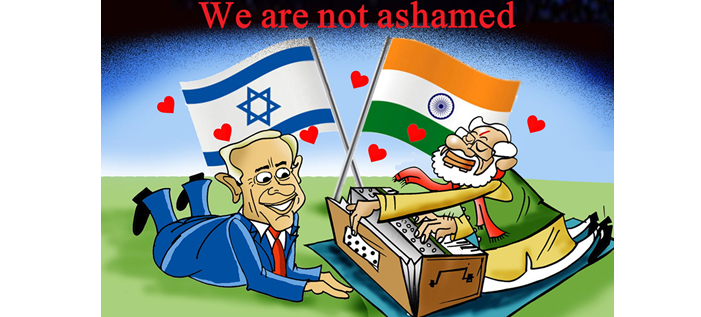
In the broader strategic chessboard, the Muslim world finds itself beleaguered—not only by internal disunity but by a concerted, calculated, and clandestine nexus aimed at its ideological and geopolitical erosion. The growing affinity between Israel and India is not merely a confluence of interest, but an ideological pact—a covenant between Zionism and Hindutva, twin dogmas of ethno-religious supremacy, mutually reinforced by military ambition and cultural arrogance.
The relationship between the two nations, once marked by caution and diplomatic aloofness, has since the 1990s deepened into a robust and multi-dimensional partnership. No longer confined to commercial niceties or sterile protocol, it has evolved into a brotherhood of belligerents—bound by a shared contempt for minorities, a disdain for dissent, and a delusion of invincibility through arms. Under Narendra Modi’s stewardship, this alliance has acquired new vigour: defence pacts, joint military exercises, intelligence exchanges, and high-level arms transactions have coalesced into what can only be described as a strategic entente.
Yet beneath this façade of geopolitical realignment lies the silent agony of the Palestinian people. It is they who bear the true cost of this alliance. India’s assistance to Israel is not limited to matériel; it extends to tactical support, diplomatic shielding, and an ominous silence in international forums. When the skies over Gaza rain fire, and its earth becomes a pyre of the innocent, India’s refusal to condemn—its tacit endorsement—is not neutrality; it is moral abdication.
During the 2023–2024 Israeli offensives, even as humanitarian organisations across the globe sounded the alarm, the Modi government stood firmly by Israel’s side, offering not merely rhetorical endorsement but operational support. Reports indicate that Indian military personnel and intelligence operatives provided strategic services to Israel—services that strengthened the machinery of oppression and further entrenched the suffering of Gaza.
By some estimates, hundreds of thousands of Indian nationals now serve across Israeli institutions, particularly within its security and tech sectors. Some among them are believed to have directly participated in operations conducted within the occupied Palestinian territories. This is not mere circumstantial alignment—it is an undeclared collusion in the apparatus of massacre. A moral bankruptcy of the highest order.
According to intelligence sources, India has supplied nearly one million individuals—including semi-military contractors and former security officials—many of whom operate through private defence firms contracted by Israel. Their contribution is not peripheral but integral—woven deep into the logistics of warfare and the scaffolding of surveillance. They are auxiliaries in the great betrayal of human dignity.
This quiet yet chilling truth—that Indian nationals are embedded within the Israeli war machine—must not be glossed over as a mere extension of bilateral defence cooperation. It marks the emergence of an unholy alliance, not simply between two nations, but between two ideologies that have declared war on justice, dignity, and peace. And the price is being paid by the children of Gaza, with their blood.
The Muslim world, stirred to disquiet, watches in growing alarm. This is no longer diplomacy. It is a conspiracy of silence, of slaughter dressed in the finery of strategy.
The Crescent and the Noose: The Gulf’s Silence and a Gathering Storm
The presence of tens of millions of Indian workers upon the soil of the Gulf, coupled with billions in economic investment, has ceased to be a mere demographic statistic; it has become a source of palpable anxiety. Across the Muslim world, a collective awakening stirs: are we, the Ummah, oblivious to the very elements we have harboured within, which now conspire with our adversaries? Shall fleeting diplomatic niceties and transient commercial interests forever silence our voice against those who bear enmity toward the faith of Islam?
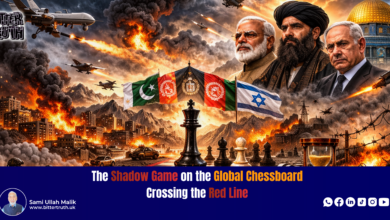
What is unfolding before us is not a series of coincidental events; it is a deliberate orchestration, a grand strategy wherein the alliance of Zionism and Hindutva marshals its forces against the very sovereignty, ideals, and presence of the Muslim world. India’s pledge of one million personnel to the service of Israel, the confirmed participation of Israeli drones and operators in Indo-Pak conflict zones, and the arrest of Indian operatives linked to Israeli networks in both Qatar and Iran—these are not isolated incidents, but strands of a web spun with surgical precision and strategic intent.
The use of Israeli “Harop” kamikaze drones by Indian forces in active theatres of conflict, particularly against Pakistan, is not merely an act of technological exchange but one of overt intervention. It reveals the depth of India’s military pact with Israel. The arrest of eighteen Indian naval officers in Qatar on charges of espionage, subsequently sentenced to death and later released through diplomatic backchannels, is not the tale of misadventure but evidence of covert operations serving mutual Indo-Israeli interests. Likewise, the arrest of Indian agents linked to Mossad in Iran underscores the sobering reality: that India now stands not only as a military partner of Israel but as an extension of its covert architecture within the very heartlands of the Muslim world.
The tragedy, however, lies not only in these strategic maneuvers but in the global reaction—or rather, its calculated absence. Amongst Muslim nations, and particularly in the Gulf, whose economies are interwoven with Indian labour and investment, there prevails a deafening silence. This silence, to the ordinary citizen, is indistinguishable from complicity. In digital arenas and public discourse alike, the leadership of the Gulf is being held to account: For how long shall we clasp the hands of those who draw the sword against us?
Today, the Ummah stands at a fork in the road: on one path lies the lure of national interest, the convenience of temporary treaties, and the illusion of economic gain. On the other, there looms the call of the collective conscience—the sanctity of belief, the clarity of ideology, and the very survival of our civilisation. To stand mute now is to prepare the soil of our cities for the infiltration of those who would hollow us from within.
The hour has struck for the Islamic world—most urgently the leadership of the Gulf—to adopt a resolute and unambiguous stance against this alliance of Zionist and Hindutva ambition. Confronting this axis requires not mere rhetoric but tangible action: economic, military, and diplomatic solidarity forged upon the anvil of collective self-respect.
This verse echoes today as a thunderous clarion in the geopolitical storm, a timeless signal that appeasement shall win no favour, and compromise with those who oppose us ideologically is a perilous delusion. The sword may rest for a time, but its edge is never blunted by our silence.
Islam teaches us to recognise the enemy, to exercise caution, and to guard the interests of the Ummah with vigilance. When the enemy declares war—militarily and covertly—maintaining relations under the veil of normalcy is no longer diplomacy; it is betrayal.
This divine admonition is not a relic of the past—it is a guiding principle for an era in which the ideological lines are once again drawn in sand and blood.
The principles of Islam are unambiguous: the interests of the Ummah are paramount—above trade, above treaties, above nationalism. When the enemy wages open war, whether with bombs or networks, then alliance with him becomes not only folly but forbidden.
It is high time the Muslim leadership spoke with the voice of its people, reflecting the anguish and concern now reverberating across the streets, the screens, and the sermons. The Almighty commands:
يَـٰأَيُّهَا ٱلَّذِينَ آمَنُوا۟ كُونُوا۟ قَوَّـٰمِينَ لِلَّهِ شُهَدَآءَ بِٱلْقِسْطِ
“O you who believe, stand firmly for Allah, as witnesses to justice.” (Surah al-Ma’idah, 5:8)
Let the Gulf States now review, with utmost seriousness, the role of Indian workers, security firms, and corporate entities operating within their borders. Let investment strategies be reassessed through the lens of integrity: those Indian firms found linked to Israeli interests must face divestment, sanctions, or complete disengagement.
Let this wave of public indignation be transformed into policy—through social media, public fora, and the pulpit—so that governments, too, are compelled to reconsider the path of passive appeasement.
The Organisation of Islamic Cooperation must convene an emergency summit without delay. It must formulate not merely a joint statement, but a coherent and actionable policy—a stance that can no longer afford to linger in the chambers of ambiguity.
And what of the international community? The United Nations and the European Union issue their statements of concern, but too often, these utterances teeter on the brink of duplicity. Their condemnations are whispered while the rockets scream. Their resolutions flutter in the wind while Gaza burns.
The truth is bitter, yet it must be spoken: these global institutions have become cogs in a machine that serves the powerful and buries the oppressed. In this theatre of injustice, silence is complicity—and complicity, in the end, is a form of war.
It is the bitter irony of our age that the very nations who furnish Israel with lethal weaponry are the same who table insipid resolutions in the name of peace. Such duplicity has rendered the international system of justice a cruel farce. Where succour ought to be extended to the people of Palestine, they are instead offered the hollow balm of ‘concern’ and ‘monitoring’—phrases emptied of all moral force by their mechanical repetition.
The West, ever eloquent on human rights in Ukraine, falls conspicuously silent when it comes to the plight of the Palestinians. India’s military collaboration with Israel is not only a flagrant breach of international norms; it is an indelible stain upon the conscience of humanity. And yet, the so-called global custodians of liberty and law watch mutely as this alliance unfolds.
A salient feature of the Modi government’s foreign policy is its unabashed tilt toward Tel Aviv. This affinity is not grounded merely in economic or strategic interests, but in a deeper ideological kinship. Hindutva and Zionism, twin expressions of ethno-religious nationalism, mirror each other in spirit and method. The Modi regime is no mere sympathiser of Hindutva; it is its most ardent executor. In aligning with Israel, India is not simply forging an alliance—it is articulating a worldview.
On the domestic front, Muslims are systematically isolated, both politically and socially, under the guise of a nationalist agenda. Internationally, ties with Israel are being deepened to construct a shared front rooted in exclusion, dominance, and control. This unholy alliance exacerbates sectarian divides within India and rings a clarion bell of peril across South Asia.
This vision seeks to transform India into a Hindu state. For its realisation, Israel’s Zionist model has become both blueprint and bedfellow. The two governments, under the garb of statecraft, weaponise state power against minorities, stifle dissent through media subjugation, and promote ideologies steeped in hate. Religious supremacy, communal hostility, and governance through fear are the order of the day.
India’s tacit approval—indeed, participation—in Gaza’s ongoing genocide is the clearest manifestation of this ideological convergence. The Hindu-Zionist nexus is no longer a whisper behind diplomatic curtains; it is a resounding proclamation that reshapes geopolitics in South Asia and the Middle East.
In this climate of global tumult, the issue of Palestine has become a mirror—a revealer of the moral visage of nations. History bears witness: silence in the face of oppression has never paved the path to justice. To stand with Palestine is not merely a political gesture; it is a moral imperative, a religious duty, and a call from the conscience of humankind.
Now is not the hour of silence. The blood that stains the sands of Gaza, the cries of its children, and the indifference of the world cry out in unison. Humanity demands that we raise our voices, oppose injustice, and stand steadfast with the oppressed. This is no longer merely Palestine’s war; it is a battle for the soul and dignity of mankind.
India, self-proclaimed as the world’s largest democracy, by siding with the oppressor, desecrates its own constitutional ideals and becomes a threat to global peace. It is imperative that the international community lays bare India’s role and rallies unequivocally in defence of the Palestinian people.
The tide of history is unrelenting. Though tyrants may enjoy momentary triumph, their fall is as inevitable as the dawn. The blood shed in Gaza shall not have been in vain. The sinister designs of the Modi-Netanyahu nexus shall not remain concealed from the discerning eye of history.
Injustice may claim a fleeting victory, but defeat is its final abode. If we today remain silent, tomorrow our children will ask us: “When did you awaken?” Gaza’s blood cries out, and Modi’s complicity torments every conscience. We must now rise, stand with the innocent, and resist the oppressor. To delay is to desecrate the very soul of humanity.
The Muslim ummah now traverses one of the most fragile epochs in its modern history. Internal divisions, sectarian fissures, and political rudderlessness have rendered it vulnerable, even as external foes conspire—both covertly and brazenly—to dismantle it. The Indo-Israeli alliance—military, intelligence, and economic—is but a strand in the larger imperial tapestry, designed to fracture the unity, security, and sovereignty of the Muslim world.
This is no time for passive observance. The need of the hour is a vigilant and active ummah—one that confronts tyranny, uplifts the downtrodden, and repels every stealthy blow struck upon its soil.
The growing synergy between Zionism and Hindutva is no longer a matter of diplomatic inference but a declared front. Their combined military ventures, intelligence operations, and mutual enmity are not aimed at any one nation, but rather at the very edifice of Islam and the community of Muhammad ﷵ. Should the ummah remain mute, the day is not far when enemies shall preside within our homes and dictate the destinies of our generations.
وَأَعِدُّوا لَهُم مِنْ قُوَّةٍ وَمِنْ رِبَاطِ الْخَيْلِ تُرْهِبونَ بِهِ عَدُوَّ اللهِ وَعَدُوَّكُمْ
“And prepare against them whatever you are able of power and of steeds of war by which you may terrify the enemy of Allah and your enemy.” (Al-Anfal, 60)
The blood flowing through Gaza is not merely the work of Israeli hands but the result of a broader conspiracy: the criminal silence and complicity of those who stand with the oppressor. Modi’s government, by dispatching hundreds of thousands of Indians in military support to Israel, has committed a colossal crime—one for which history shall offer no absolution.
This is the hour of awakening, of unity, and of action. Let us not merely recognise our enemies but confront their schemes with resolve. Let us rally the nations of the world, and the awakened hearts within them, to stand with the people of Palestine before humanity loses its final shred of dignity.
When the silence of the earth becomes a scream, and the azure of the skies turns dark with the smoke of war, this is no longer mere tragedy. It is the dirge of civilisation itself. The wounded walls of Gaza and the lives that tremble beneath them pose an indelible question—a scar upon the brow of the international order, and a solemn indictment upon the soul of mankind.
This atrocity is not confined to mere missiles, shattered buildings, or the silent corpses strewn across the ruins of Gaza. It is, in truth, the brutal evisceration of a global system of justice—rendered paralysed before the cynical designs of the powerful. Modi, who now stands as a stark effigy of fascism in Indian politics, is not merely an accomplice to Israel’s crimes; he is himself a tyrant whose hands remain steeped in the unhealed blood of Gujarat’s Muslims. His dispatch of one million Indian personnel in support of Israel is not simply logistical assistance—it is a convergence of ideologies, a perverse harmony between Hindutva and Zionism, trampling underfoot the universal values of justice, dignity, and compassion.
And when the self-styled sentinels of civilisation—foremost among them, the United States—choose not silence but complicity, arming this tyranny, vetoing resolutions of restraint, and cloaking Israeli savagery in the garb of ‘self-defence’, it becomes abundantly clear: the world stands bifurcated. On one side, the oppressed and those who speak in their defence. On the other, the perpetrators of violence and those who thrust spears into their backs under banners of diplomacy.
What, then, shall the historian of tomorrow ask of us? In what stupor lies the conscience of the world? Are these the values—of liberty, democracy, and human dignity—by which the West once claimed to instruct the world? Is this the democracy that plants its flag upon the graves of Palestinian children and calls it peace?
Let none forget: when the dust of history settles and its pages turn, the lines written in blood cry out for centuries. The shattered alleyways of Gaza, the cries of orphaned children, the sun-scorched, ash-covered mothers—all stand witness to a barbarism not only permitted but emboldened by men like Modi. His regime not only tolerated these horrors but added to their ferocity with a million-strong contribution of ideological soldiers—an augmentation that no code of humanity, reason, or honour can justify.
And the silence of the Gulf states—deafening in its calculated stillness—is no longer mere passivity, but a complicity soaked in diplomatic cowardice. The simmering disquiet within their populations is now beginning to surface, drifting across the deltas of social media like a prelude to a gathering storm. This tempest may one day shake the tented palaces whose foundations rest not on stone but on sand, and in its wrath, the veils of political expediency shall be torn asunder.
These states—guardians of the Haramain, stewards of immense wealth, once anointed with moral and political responsibility—have today betrayed not merely their robes of state, but wounded the collective conscience of the Muslim Ummah. Their refusal to speak even a word in condemnation, their reluctance to voice even the feeblest protest against Israeli aggression, is a moral dereliction history shall not pardon.
Today, their people, from Riyadh to Doha, are raising questions etched in fire. And if these questions hang long enough above palaces and minarets, they may well descend as a flood that washes away the pretence of power.
Yet, in the divine economy of justice, there stands no gatekeeper. Behold Europe—often derided as calculating and hypocritical—where students, scholars, and awakened citizens have exhibited the very moral courage we once expected of the Ummah. The decision of nations such as France to recognise Palestine bears testimony to the fact that when the collective conscience of a people is stirred, even the granite pillars of statecraft tremble.
This, perhaps, is the dawning of a moral awakening. If we fail to nurture it, this flame shall flicker into embers, leaving nothing but the cold ash of regret.
And future generations—when they cast their gaze upon this age of cruelty—will weigh our actions in the scales of truth:
O leaders of the world! What stood your answer to tyranny? O rulers of the Muslim lands! Did you shelter the oppressed, or host their murderers? O people of knowledge and speech! Where were your pens, your voices, your verdicts?
These questions shall not pass us by. We, who today possess the gift of language, of protest, of conscience—if we remain silent now, we shall be counted among those who bartered honour for convenience and named cowardice ‘wisdom’.
Now is the time to inscribe our names among the makers of history, not its silent footnotes. This is not merely the trial of Gaza—it is the very case of humanity, the future of civilisation, and the sanctity of a wounded Ummah.
Whosoever stands silent in the shadow of tyranny today shall stand accused in the court of justice tomorrow.
Yet retribution does not slumber. Students across France, Ireland, and elsewhere have transformed their campuses into sanctuaries of protest. They are the harbingers of change, whose voices have forced even reluctant governments to recognise the rights of Palestine. In the ashes of the Western conscience, some embers still glow—emboldening those willing to light the candle of justice once more.
And when future generations gaze upon this season of suffering, the names of Modi, Netanyahu, and their global enablers shall be written upon the same ignominious scroll where history records Yazid, Hulagu, and Genghis Khan. And those generations shall surely ask: When the breath of humanity was choked—where were you?
If we raise no voice today, our silence shall become our epitaph—etched not in honour, but in shame, buried in the margins of a mourning history.