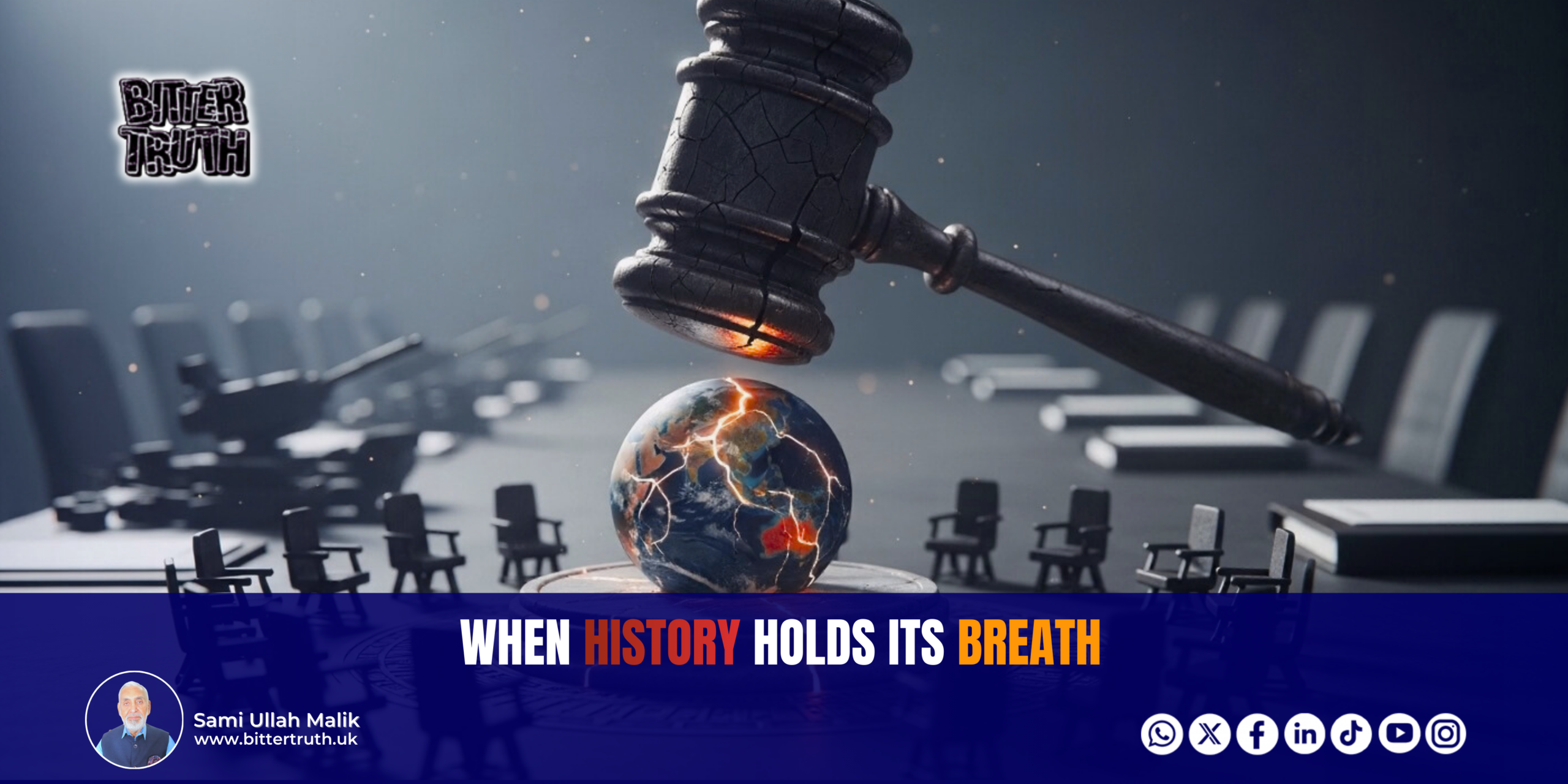
When History Holds Its Breath
The Conscience of a World on Edge

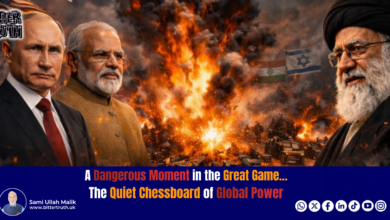
There are turning points in history at which the silence of nations becomes not merely a lapse, but a culpability; when indifference hardens into a verdict upon the age itself. Today, as the air over the Middle East grows acrid with the scent of powder, and as the faint tremor of military preparation may be discerned beneath the polite papers laid upon diplomatic tables, the question is not simply why tensions have mounted between Tehran and Washington. The graver inquiry is this: where now stand the peaceable nations of the world? Where are the multitudes who once filled the streets in protest against the wars of Vietnam, Iraq, and Afghanistan? Where are the scholars and moralists who were wont to challenge the intoxications of power?
It is true that in many Western capitals men and women of letters, professors, and public intellectuals have again raised their voices in warning that the conflagration of war, once lit, may consume more than its authors intend. Yet in the corridors of authority such admonitions are muffled, as though absorbed by the heavy drapery of state. Under the leadership of President Donald Trump, Washington appears to be edging toward a mode of politics that tests not only Iran, but the very architecture of international peace. When an institution such as the United Nations is treated as an ornamental seal rather than as a living forum for the arbitration of disputes, we are compelled to ask whether the grammar of power is once more seeking precedence over the rule of law. The United Nations was established precisely to ensure that conflicts between states might be resolved through counsel rather than cannon; to reduce it to a ceremonial witness is to loosen a principal column of the international order itself.
Some observers discern in the present crisis an echo of that conception of global equilibrium once advanced by thinkers and statesmen such as Henry Kissinger—a vision in which the centres of power are few, and the decisive levers rest in limited hands. If current American policy represents, in practice, a revival of that design, then the question grows sterner still: is the international community prepared once more to bow before a unipolar dispensation, in which might does not merely influence right, but seeks to define it?
For its part, Iran has invoked Article 51 of the Charter of the United Nations, asserting its inherent right of self-defence and sovereignty. Tehran maintains that it will not initiate hostilities; yet it will assuredly respond to aggression. Whether one finds this argument persuasive or otherwise, it is articulated in the language of legality and sovereign entitlement. Should tensions escalate, it is not beyond conjecture that a regional contest might widen into a more comprehensive international collision. History instructs us that world wars have seldom been born of grand design alone; more often they have sprung from a single spark, which, once loosed, sets the horizon alight.
In such an hour, the silence of peaceable nations assumes a more troubling aspect. Have economic interests subdued the conscience? Has the profit of the armaments industry acquired a value exceeding that of human life? Or has global politics descended to a point at which principles are paraded in speeches, while power alone performs the decisive act?
This essay is an echo of that anguish, that interrogation, that historical moment—when we must determine whether we shall remain spectators to events, or dare to exert some influence upon their course.
In contemporary politics there are moments when words cease to be mere utterances and become instead the prologue to what shall be inscribed upon the breast of history. The present strain between Iran and the United States is such a moment: the soft cadences of diplomacy sound in uneasy counterpoint to the iron tread of military might. This dispute is not merely a bilateral disagreement between two states; it is a test of the balance of global power, of the meaning of sovereignty, and of the authority of international law.
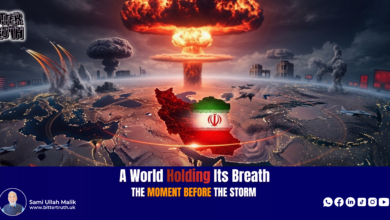
The Islamic Republic of Iran has addressed a formal communication to the Secretary-General of the United Nations, declaring in unequivocal terms that any act of “military aggression” against it would be met with the exercise of its right to self-defence. The letter makes plain that, in the event of conflict, all bases, military facilities, and strategic assets associated with a “hostile power” in the region would be regarded as legitimate targets. Its essence is clear: Iran will not begin a war; but should its sovereignty be struck, it will avail itself of the protections afforded by the Charter. The sword, one might say, remains sheathed—yet the grip upon its hilt is firm.
This was not a mere flourish of martial resolve; it was framed as a legal and moral argument. By explicitly invoking Article 51, Tehran sought to root its prospective actions in recognised principles of international law, presenting any response not as aggression but as defence. In so doing, it has endeavoured to align itself with global public opinion, to secure in advance a juridical warrant for measures that may yet be taken.
Iran has interpreted the pronouncements of President Donald Trump not as rhetorical exuberance, but as indicative of a tangible risk of military action. When the head of a powerful state speaks of force, such words do not remain suspended in abstraction; they acquire the density of policy. The severity and finality in Mr Trump’s tone have persuaded Tehran that Washington is seriously contemplating the military option.
In the lexicon of modern statecraft, statements themselves have become strategic instruments. When a leader of a great power alludes to “bad things,” those words function simultaneously as psychological pressure, domestic signalling, and international warning. By drawing attention to this danger, Iran seeks to caution neighbouring states that any adventurism would not remain confined within its borders; the entire Middle East might be drawn into the vortex.
On Thursday, President Donald Trump reportedly afforded Iran no more than a fortnight—indeed, at one juncture ten days—to reach what he termed a “meaningful agreement” in ongoing negotiations, failing which unspecified “bad things” would ensue. Such temporal compression is a familiar device of psychological diplomacy. By placing negotiations within a narrowing corridor of time, one party seeks to hasten the calculations of the other, to induce decision under the shadow of impending consequence. The offer, outwardly diplomatic, bears within its structure the unmistakable cadence of coercion. Time, thus constrained, becomes not a neutral medium for deliberation, but a pressure chamber in which choices are forced into premature maturity.
There are turning points in history at which the silence of nations becomes not merely a lapse, but a culpability; when indifference hardens into a verdict upon the age itself. Today, as the air over the Middle East grows acrid with the scent of powder, and as the faint tremor of military preparation may be discerned beneath the polite papers laid upon diplomatic tables, the question is not simply why tensions have mounted between Tehran and Washington. The graver inquiry is this: where now stand the peaceable nations of the world? Where are the multitudes who once filled the streets in protest against the wars of Vietnam, Iraq, and Afghanistan? Where are the scholars and moralists who were wont to challenge the intoxications of power?
It is true that in many Western capitals men and women of letters, professors, and public intellectuals have again raised their voices in warning that the conflagration of war, once lit, may consume more than its authors intend. Yet in the corridors of authority such admonitions are muffled, as though absorbed by the heavy drapery of state. Under the leadership of President Donald Trump, Washington appears to be edging toward a mode of politics that tests not only Iran, but the very architecture of international peace. When an institution such as the United Nations is treated as an ornamental seal rather than as a living forum for the arbitration of disputes, we are compelled to ask whether the grammar of power is once more seeking precedence over the rule of law. The United Nations was established precisely to ensure that conflicts between states might be resolved through counsel rather than cannon; to reduce it to a ceremonial witness is to loosen a principal column of the international order itself.
Some observers discern in the present crisis an echo of that conception of global equilibrium once advanced by thinkers and statesmen such as Henry Kissinger—a vision in which the centres of power are few, and the decisive levers rest in limited hands. If current American policy represents, in practice, a revival of that design, then the question grows sterner still: is the international community prepared once more to bow before a unipolar dispensation, in which might does not merely influence right, but seeks to define it?
For its part, Iran has invoked Article 51 of the Charter of the United Nations, asserting its inherent right of self-defence and sovereignty. Tehran maintains that it will not initiate hostilities; yet it will assuredly respond to aggression. Whether one finds this argument persuasive or otherwise, it is articulated in the language of legality and sovereign entitlement. Should tensions escalate, it is not beyond conjecture that a regional contest might widen into a more comprehensive international collision. History instructs us that world wars have seldom been born of grand design alone; more often they have sprung from a single spark, which, once loosed, sets the horizon alight.
In such an hour, the silence of peaceable nations assumes a more troubling aspect. Have economic interests subdued the conscience? Has the profit of the armaments industry acquired a value exceeding that of human life? Or has global politics descended to a point at which principles are paraded in speeches, while power alone performs the decisive act?
This essay is an echo of that anguish, that interrogation, that historical moment—when we must determine whether we shall remain spectators to events, or dare to exert some influence upon their course.
In contemporary politics there are moments when words cease to be mere utterances and become instead the prologue to what shall be inscribed upon the breast of history. The present strain between Iran and the United States is such a moment: the soft cadences of diplomacy sound in uneasy counterpoint to the iron tread of military might. This dispute is not merely a bilateral disagreement between two states; it is a test of the balance of global power, of the meaning of sovereignty, and of the authority of international law.
The Islamic Republic of Iran has addressed a formal communication to the Secretary-General of the United Nations, declaring in unequivocal terms that any act of “military aggression” against it would be met with the exercise of its right to self-defence. The letter makes plain that, in the event of conflict, all bases, military facilities, and strategic assets associated with a “hostile power” in the region would be regarded as legitimate targets. Its essence is clear: Iran will not begin a war; but should its sovereignty be struck, it will avail itself of the protections afforded by the Charter. The sword, one might say, remains sheathed—yet the grip upon its hilt is firm.
This was not a mere flourish of martial resolve; it was framed as a legal and moral argument. By explicitly invoking Article 51, Tehran sought to root its prospective actions in recognised principles of international law, presenting any response not as aggression but as defence. In so doing, it has endeavoured to align itself with global public opinion, to secure in advance a juridical warrant for measures that may yet be taken.
Iran has interpreted the pronouncements of President Donald Trump not as rhetorical exuberance, but as indicative of a tangible risk of military action. When the head of a powerful state speaks of force, such words do not remain suspended in abstraction; they acquire the density of policy. The severity and finality in Mr Trump’s tone have persuaded Tehran that Washington is seriously contemplating the military option.
In the lexicon of modern statecraft, statements themselves have become strategic instruments. When a leader of a great power alludes to “bad things,” those words function simultaneously as psychological pressure, domestic signalling, and international warning. By drawing attention to this danger, Iran seeks to caution neighbouring states that any adventurism would not remain confined within its borders; the entire Middle East might be drawn into the vortex.
On Thursday, President Donald Trump reportedly afforded Iran no more than a fortnight—indeed, at one juncture ten days—to reach what he termed a “meaningful agreement” in ongoing negotiations, failing which unspecified “bad things” would ensue. Such temporal compression is a familiar device of psychological diplomacy. By placing negotiations within a narrowing corridor of time, one party seeks to hasten the calculations of the other, to induce decision under the shadow of impending consequence. The offer, outwardly diplomatic, bears within its structure the unmistakable cadence of coercion. Time, thus constrained, becomes not a neutral medium for deliberation, but a pressure chamber in which choices are forced into premature maturity.
President Donald Trump has spoken of “good meetings” between his special envoy, Steve Witkoff, and his son-in-law, Jared Kushner, with Iranian counterparts, while candidly conceding that a “meaningful agreement” with Tehran would be no simple undertaking. Yet the very existence of such back-channel encounters is itself instructive. It signals that diplomacy has not retreated from the field, but merely shifted its ground. History records that discreet negotiations, conducted beyond the glare of formal plenaries, have at times achieved what public conferences could not—precisely because flexibility and confidentiality are there afforded a freer hand.
The statement of White House Press Secretary Karoline Leavitt further suggests that Washington, though unwilling to remove the military option from the table, continues to profess a preference for diplomatic resolution. It would be “wise,” she intimated, for Iran to conclude a deal; the President, she maintained, remains desirous of a negotiated settlement. Such language appears calculated to keep open the final window of diplomacy, even as the shadow of force lingers at the threshold. Yet some political observers, mindful of Mr Trump’s previous departures from orthodoxy, caution that unpredictability remains an integral feature of his statecraft. In the theatre of global politics, they fear, a sudden detonation cannot be excluded.
At its inception, what has been styled the “Board of Peace” was understood to concern itself chiefly with overseeing an end to the conflict in Gaza between Israel and Hamas. Its remit, however, now appears to have broadened. This expansion lends weight to the impression that the United States may, in certain theatres, be inclined to cultivate parallel diplomatic platforms beyond the formal ambit of the United Nations. Should that prove the case, it would intimate a subtle yet consequential alteration in the balance of global authority. To some commentators, it suggests an attempt—whether deliberate or inadvertent—to sideline the United Nations in favour of alternative mechanisms more amenable to American initiative. If so, we may be witnessing the early tremors of a more profound reconfiguration of the international order.
Consideration of new authorisations for the use of force forms part of this same continuum—a chain of deliberations that could, at any moment, advance into a new and decisive phase. The reported strike upon Iranian nuclear facilities in the preceding year stands as a reminder that military action is not a purely theoretical construct, but a precedent of lived experience. American missiles and aircraft have already tested the boundaries of restraint. Reports that the White House has examined fresh options for further strikes this week underscore the point: the military instrument is not confined to debate; it resides within the realm of practicable policy.
The contest between Iran and the United States thus emerges as something more intricate than a bilateral quarrel. It is, in truth, a dialogue—albeit a strained and perilous one—between power and law, between sovereignty and international pressure, between diplomacy and militarism. Tehran’s tone is one of defensive self-assurance, an insistence upon dignity and the right of self-protection. Washington’s approach appears to blend pressure with negotiation, coercion with conciliation. The Israeli dimension, the presence of regional allies, and the attentive, if cautious, gaze of other great powers further complicate the equation.
This tableau reminds us that history’s heat is not confined by borders. Should diplomacy prevail, this episode may yet be recorded as a testament to prudence under strain—a chapter in which restraint triumphed over impulse. Nations that navigate the rapids of crisis with balance and foresight alone secure honour in the annals of statecraft. But should militarism assert its dominion, the soil of the Middle East may once more be scented—perhaps sullied—by the acrid breath of powder. And if war’s flame is kindled, another dark and dismal chapter will be inscribed. Even then, history will reiterate its stern lesson: that the logic of power must be tempered by the illumination of wisdom, lest darkness envelop victor and vanquished alike. The eye of history watches closely, to discern whether reason’s light or pride’s intoxication shall prevail.
The horizon remains veiled in mist. Yet it is already evident that the coming days may prove decisive not merely for Tehran and Washington, but for the wider world. Should prudence and sagacity gain the upper hand, the lamp of peace will continue to burn. Should hubris triumph, that flame may find itself besieged by gathering tempests.
As we stand upon the brink of this crisis, one cannot escape the sense that history is again testing humanity. The struggle between Iran and the United States is no ordinary dispute; it engages the structure of the international order, the authority of law, and, in a broader sense, the prospects of human security. If decisions are imposed by force, if the United Nations is reduced to a ceremonial relic, then a perilous precedent will be set—one that may embolden future powers to act unilaterally under the guise of necessity.
The silence of peaceable nations is therefore disquieting. War does not respect cartography. A blaze in one region sends its smoke across continents. If the Middle East smoulders today, Europe and Asia may feel the heat tomorrow. Intellectuals may raise their voices; yet unless public sentiment exerts tangible pressure upon governments, such appeals risk reverberating within the chambers of power without effect.
The hour calls for the awakening of the global conscience. It calls for the corridors of power to be reminded that the world is not the preserve of a single ideology, lobby, or state. Should efforts be made to compress international politics into a rigid unipolar mould, resistance will manifest on a global scale. And if the fires of war are loosed, their trajectory will not remain subject to any single will.
History’s gaze rests upon us all. Future generations will ask where the advocates of peace stood when the world approached yet another precipice. Were they mute spectators, or did they raise their voices against the encroachment of force?
Now is the moment for nations, scholars, moral and religious leaders, and citizens alike to strive—before the spark becomes a conflagration—to extinguish the embers. For if this spark should blaze into flame, no international institution, no diplomatic table, and no eloquent appeal may suffice to contain it.
The candle of peace has not yet been extinguished—but the winds gather about it. The decision is ours: whether to shield that flame with steady hands, or to abandon it to the tempests of power.