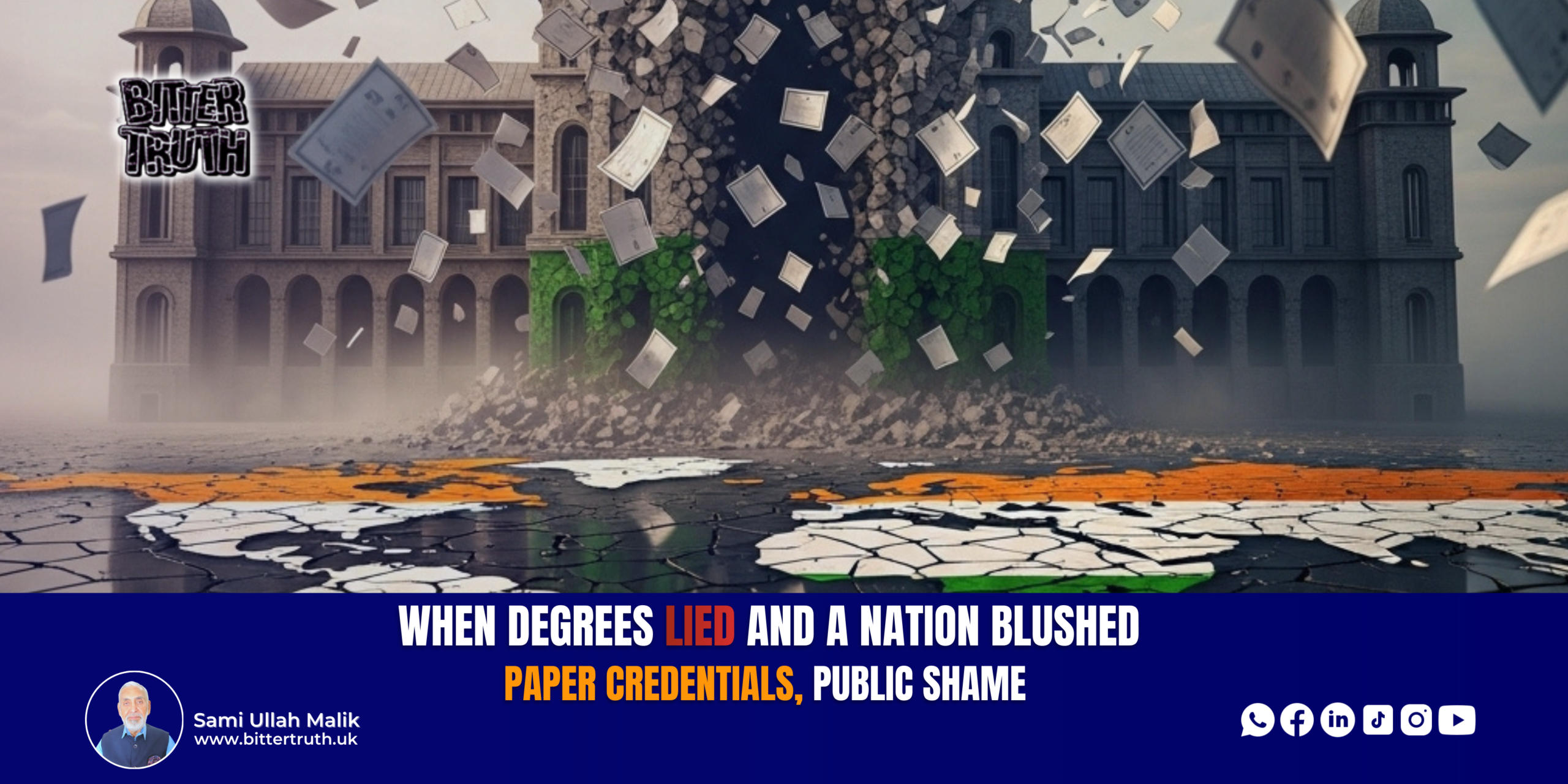
When Degrees Lied and a Nation Blushed
Paper Credentials, Public Shame

Contemporary international politics is embarked upon a vessel that sails not merely through tempestuous seas, but through the far more treacherous currents of human minds, economic dominions, and ideological lobbies. Ours is an age in which the coin of power and the codified boundaries of principle have perpetually collided—and today, that collision has brought the world to yet another decisive juncture. Upon the global map, where the sleight of authority contends silently with the rule of law, principles are too often confined to parchment alone, power dictates outcomes, and the lamps of morality burn faintly, if at all.
It is within this chiaroscuro of light and shadow that India’s recent H-1B visa and fake degree scandal emerges—not as a merely domestic aberration, but as a mirror held up to the international order itself. It is a mirror that tests not only the moral selfhood of a nation, but also unsettles global confidence, transparency, and the credibility of educational standards. For the survival of a nation, much like the stability of a house, rests upon the soundness and integrity of its foundations; and when those foundations are hollowed out, even the loftiest edifices collapse with alarming speed.
The revelation that a small but systematically organised group in Kerala had orchestrated the issuance of forged academic credentials to hundreds of thousands is not simply an episode of educational fraud. It is a historical and intellectual lesson—a looking glass in which a nation’s educational, ethical, and political frailties are starkly reflected. Investigations published by The Commune have cast grave doubts not only upon the transparency of India’s higher education institutions, but also upon its global standing, the quality of its workforce, and the international trust upon which modern mobility depends.
This report, therefore, undertakes to examine the real consequences of these disclosures, to apportion responsibility where it properly lies, and to assess the reputational damage and tangible losses sustained by India. It will demonstrate how this web of deception has shaken not only the domestic economy and educational system, but also the fabric of international relations—standing as a cautionary episode of both political and historical significance.
In Kerala, a coordinated network is alleged to have supplied more than one million individuals across India with counterfeit degrees—credentials used not merely for local employment, but extensively for overseas migration, particularly to secure H-1B visas for the United States. This was no isolated lapse, but a systemic fraud, revealing the depths of institutional weakness and moral negligence. According to The Commune, the network fabricated over one hundred thousand academic certificates across twenty-two universities, complete with counterfeit seals and records. The principal accused, Dhanish—also known as Danny—was reportedly operating a printing facility for fake degrees from his own residence. Law enforcement agencies arrested several accomplices and recovered forged seals and mark sheets from at least twenty-eight universities.
The operation preyed upon aspirants not only within India but also among those seeking employment abroad. Forged qualifications were issued across more than a hundred disciplines—including medicine, nursing, and engineering—with exorbitant bribes extracted, particularly from those pursuing H-1B visas. Indian applicants, it is reported, were compelled to pay substantial sums to navigate this corrupt channel.
Jessica Vaughan, Director of the Centre for Immigration Studies in the United States, described the Indian visa process as having degenerated into large-scale fraud. The network is believed to have sold over thirty-six thousand fake degrees, resulting in the issuance of more than two hundred visas daily—of which an estimated eighty to ninety per cent were entirely fraudulent. Mahwish Siddiqui, an Indian-origin American diplomat, went further still, characterising the Indian consulate in Chennai as the epicentre of the world’s largest H-1B visa fraud operation.
This scandal inflicts a profound stain upon India’s international reputation. A nation’s dishonour is not wrought solely by military defeat or economic collapse; it is equally, if not more enduringly, brought about when the foundations of knowledge and morality are eroded. When a state facilitates—or fails to prevent—the entry of its citizens into foreign labour markets on the basis of forged credentials, it invites scrutiny not only of individual competence, but of its educational institutions and governance itself. The questioning of academic integrity inevitably breeds a deficit of trust on the global stage.
On the strength of counterfeit qualifications, India has exported underqualified professionals to numerous countries, with damaging consequences across healthcare, education, engineering, and technology. In medicine and nursing, inadequately trained individuals have endangered human lives; in engineering and infrastructure, substandard workmanship has inflicted lasting economic and structural harm. This predicament recalls the enduring truth that nations are not sustained by weapons and proclamations alone, but by knowledge, ethics, and collective integrity.
Responsibility for this debacle cannot be confined to the principal accused alone. It exposes a gaping systemic failure—marked by governmental negligence, administrative corruption, and the collapse of oversight in both visa processing and academic verification. Educational institutions have failed in their duty to authenticate credentials; political actors and administrators have turned a blind eye, while bribery has become an unremarkable currency of advancement. Even international bodies, through inadequate scrutiny, bear a measure of complicity.
Taken together, these elements constitute a crisis whose repercussions extend far beyond national borders. Arresting a handful of perpetrators is manifestly insufficient; what is required is the reform of the system itself.
Nor is this scandal limited to India’s internal disrepute. Fraud within the H-1B framework has undermined the integrity of the global workforce, eroded international confidence, and exposed vulnerabilities within immigration systems worldwide. Questions now hang over the legitimacy of recruited professionals, and trust—once shaken—is slow to recover. The lesson is unmistakable: transparency and ethical standards in international relations are not upheld by formalities alone, but by robust institutions, accountability, and internal discipline.
This episode stands as a historical mirror, reflecting the moral frailty of a nation and the failure of its educational system—much as weak states throughout history have declined due to their own internal defects. Nations endure not through cannon and conquest, but through knowledge, moral purpose, and unity. Leadership, institutional clarity, and loyalty are indispensable to state survival; where these falter, internal decay and external disgrace become inevitable.
The H-1B visa and fake degree scandal has thus tarnished not only India’s educational and ethical standing, but also its global reputation, workforce credibility, and international trust. It serves as a solemn reminder that national progress and international esteem rest not upon official proclamations or formal certifications alone, but upon reform, self-accountability, and transparent oversight.
The circle of responsibility is wide: governmental failure, deficient university supervision, fraudulent private networks, and individual moral indifference have collectively engendered this crisis. India’s foremost lesson is plain—without transparency and internal stability, neither educational excellence nor national dignity can be sustained.
Ultimately, this scandal offers a lesson for all nations: trust, transparency, and internal cohesion matter more than the accumulation of power or international influence. Where internal strength prevails, external threats falter; where internal weakness festers, even the greatest power is swiftly undone.
In conclusion, nations stand tall only when their institutions are strong, their leadership vigilant, and their moral foundations secure. This report, as both an investigative and literary document, seeks to present a comprehensive account of the scandal’s dimensions, responsibilities, damages, and political-historical consequences—offering not merely information, but a deeper ethical and intellectual reckoning for the reader.