Victory in Silence: Civilization, Prudence, and the Shift of the Global Axis
Not by Sword, but by Strategy: The Rise and Fall of Empires

This essay chronicles a moment in history where two great civilizations—East and West—confronted one another. The roar of power fell into the background, supplanted by patience, wisdom, and the weight of civilization, reshaping the axis of the world. Here, history is not merely a witness; it becomes a narrator, and every silent moment speaks with profound purpose. This is an era where empires are forged not by gunpowder, but by sagacity and patience, and where the currents of time constitute the ultimate judgment of history.
This essay captures the moment when two great civilizations—Eastern patience and Western speed—faced each other, and silence reshaped the course of history. When the story of the rise and fall of empires was written not by the sword but by strategy, how empires endure and fall not by force alone, but by prudence, patience, and foresight, while history silently decides the outcome.
This piece bears witness to a moment when two world powers—China and the United States—met, dragons and eagles, not just in politics or power, but in a dialogue of civilizations, philosophies, and the measurement of time.
Occasionally, history begets moments that are far more than mere political encounters; they are those rare junctures that pry open the concealed pages of civilization itself. Such moments are seldom recorded, for they transcend the simple rivalry of states to become a dialogue between the very souls of cultures. These are the instants that alter the current of time, wherein power assumes a new guise, and civilization redefines its meaning. Epochs, breaking their accustomed measures, establish new scales; scales that once weighed blood, now measure consciousness, prudence, and economic endurance. These are the moments that once set Alexander in contemplation upon the banks of the Ganges, that silenced Roman envoys before the courts of the Silk Road, that bent even the thunder of Mongol hooves before the wisdom of strategy.
In much the same vein, today’s contest between China and the United States is no mere struggle of two nations; it is the dialogue of two epochs, two philosophies, two currents of history—on one side, a civilization eager to outrun the world through speed; on the other, a civilization that bends time itself to its patient will.
Such a moment crystallized upon the horizon of history when these two contrasting worlds—the swift American and the patient Chinese—stood face to face. This encounter was not merely political; it was history’s own mirror, revealing the contours of the future.
Against the youthful yet prodigiously potent might of America, China presents a civilization endowed not merely with five millennia of consciousness, but with the seasoned authority of the Han courts, the strategic insight of Sun Tzu, and the moral philosophy of Confucius. This confrontation is no echo of the Cold War; it is reminiscent of medieval moments when Europe, lowering its gaze before the Orient, asked its questions, only to receive answers in profound silence.
There was in Trump’s roar a tremor reminiscent of the British Empire in 1857, or of Rome when confronted with Byzantine prudence challenging its supremacy. And when, beneath the veils of compliment and cordiality, he inclined his head, the scene recalled the pages of history where conquerors changed tongue, yet the voice of wisdom remained unbowed. The silence of Chinese leadership echoed that of Zhou Enlai in Geneva, or Deng Xiaoping at the dawn of reform—a quietude in which the heartbeat of the future resounded.
Power in the modern world no longer circulates by the drumbeat of cannon but by the mineral reserves that China, like time itself, has tended with patience. When America, a monarch of technology, comes to this Eastern civilization’s gates seeking raw materials, it is a tableau reminiscent of the first Western ships entering Chinese harbours—not to command, but to learn.
This essay chronicles that journey—where politics acts, but civilization narrates; where the clamour ceases, and silence speaks to the truth that genuine power lies in the elasticity of time, not in the fleeting brilliance of moments. America’s two-and-a-half-century-old tradition, fast, proud, and potent, stands before a civilization forged over five millennia, which regards time not as an adversary but as a tutor, whose philosophy breathes in the continuity of generations rather than in the rotation of days. This is the perennial contest between velocity and profundity: a nation with arms stiffened by the pride of strength, and a civilization whose silence conceals the wisdom of thousands of years.
In this tableau, history is not merely a spectator but a judge, observing that the roar of force wanes while the measured breath of wisdom reshapes the world’s temperament. Against America’s vehement proclamations, China’s centuries-old quietude reveals that the deadliest stroke of power emerges not from noise, but from silence. This confrontation is neither merely of economic models nor political ideologies; it is a collision of temporalities—the impatient, swift time of America against the profound, expansive time of China.
This is the lens through which this essay examines the dialogue: politics may play a role, but civilization narrates. Here, the meaning of power has shifted, and the foundation of the future rests not on the barrel of a gun, but on prudence. The question is no longer who is the superpower, but who possesses the patience to move with time—and time always accompanies those who know how to wait.
It is within these oscillations, these subtle shifts, these civilizational breaths, and these historical signals that this essay dwells—where China is silent, yet the world speaks, and America speaks, yet history lays its hand silently upon its shoulders. On the horizon of history, there emerge moments that are not merely meetings of men, but dialogues of civilizations. These moments alter the pulse of time, where centuries of effort assume new significance in a single instant.
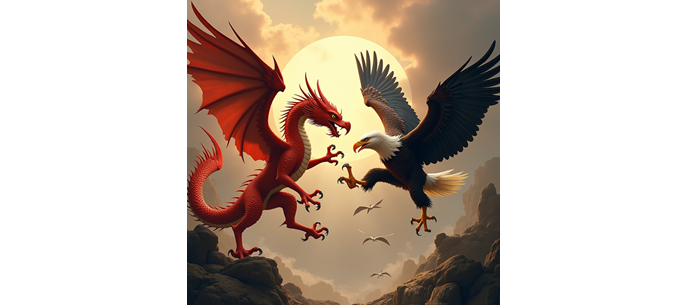
The recent entanglement of China and America is but another link in this chain: on one side, a nation proud of its velocity, and on the other, a civilization triumphant through patience. One embodies the clamour of industry, the other the quietude of wisdom. When 249 years of American history confront 5,000 years of Chinese consciousness, it is not merely a trial of power but a clash of philosophies of time. It is the moment when the Western sovereign steps into the Eastern court, and time, in its ancient judgment, convenes a new trial. The world has watched—the eagle spread its wings, and the dragon rose without a roar.
History’s pages have once more repeated the familiar scene: the magic of power fades, yet the resonance of civilization endures. This essay is the chronicle of that dialogue, where words do not merely serve diplomacy but bear the heartbeat of civilizations; where silence speaks, and a smile inscribes history.
When a civilization scarcely two centuries old dares to meet the gaze of five millennia of Eastern wisdom, history does not merely observe—it smiles. That is the moment when the scales of time are unbalanced: a swift but weary West, a silent but profound East. And the question ceases to be who prevails; it remains who endures.
In the annals of modern history, few moments can rival that rare juncture when a civilization scarcely two-and-a-half centuries old—America—stands opposed to a nation custodian of five millennia of cultural tradition. This is the collision that always occurs between velocity and profundity: on one side, the gleam of modernity; on the other, the roots of wisdom. It is a contest not of mere power, but a dialogue of epochs—Western hubris measured against the patient sagacity of the East. China’s civilization, embodying the teachings of Confucius, the disciplined order of the Han dynasty, and the accumulated wisdom of centuries, does not flinch at transient economic tremors.
This civilization appraises history not in the measure of fleeting decades, but across the continuum of generations. And it is here that the pride of America—nurtured by industrial revolutions and colonial legacies—found, for the first time, the depths of time intimidating.
Trump, once perched upon the summit of arrogance, had proclaimed, “I will crush China’s economy; it shall never rise again.” The cadence of those words recalled the proclamations of colonial governors past—a thunder not of certainty but of underlying fear. History, however, heard these declarations as echoes of a familiar refrain, akin to Rome against Carthage, or Britain against India. For the mighty rarely boast with conviction; true power rests in quiet assurance. This was, in essence, the last vestige of American self-confidence that had asserted itself over the globe since the Second World War. Yet history reminds us that the seed of decline germinates in the very moment of triumph.
Time, as ever, took its turn. The same figure who once towered upon threats now sought refuge in words of praise. The very Trump who yesterday thundered, today found solace in flattery. This was no mere meeting—it was the psychology of power laid bare. Such is the sensation that Napoleon felt before the gates of Russia, or the British Empire encountered upon its withdrawal from Delhi in 1947. Praise, in reality, is the first sign of humility; it is not diplomacy but the decorous bow of submission. “You are great, you are visionary,” he murmured, hesitant yet smiling—words not of triumph, but the silent sigh of concession.
Xi Jinping’s silence, by contrast, was no sign of weakness; it was the mark of civilizational maturity. For centuries, China has learned that the patient nation bends time to its will. This calm mirrors Zhou Enlai’s smile under Western mockery, or Deng Xiaoping’s composed pragmatism when he declared, “It does not matter whether the cat is black or white, so long as it catches mice.” Xi embodies a tapestry of patience—calm on the face, certainty in the eyes—needing neither words nor proof, for history itself speaks through him.
America, once sovereign of sustenance, who had rebuilt Europe under the Marshall Plan and wielded the World Bank like a sceptre, now extended its hand to China, pleading, “Provide soybeans, so our farmers may survive.” Once the arbiter of global commerce, America now solicited relief. This was no mere trade negotiation; it was a shift in the civilizational tableau. Xi’s response was measured: “We shall see how you comport yourselves.” It was history’s most courteous, yet profound, admonition—a tacit acknowledgment of civilizational ascendancy. As the poet might say, silence too speaks, when the decisions of the heart remain unspoken.
The United States, priding itself on technological supremacy, now sought from China the very lifeblood of the modern world: rare earth elements. Materials essential to mobile phones, fighter jets, semiconductors, and artificial intelligence. And all of it lay within China’s grasp. History had issued its verdict: power now emanates not from gunpowder, but from the earth itself. The scales of strength had tipped. When Trump requested, “Give us rare earth elements, so our ships may sail, our factories operate,” he admitted that the industrial heart of the West now beats within Eastern soil. These four words constitute perhaps the most concise rejoinder in two centuries of Western imperial discourse. Where once the West commanded, the East now deliberates. The world perceived that decisions no longer emanate from New York or London, but from Beijing. Power had changed its tongue—not roaring, but silent.
Historically, the West spoke always in the language of sanctions; China replied in the language of cooperation and commerce. Africa, Latin America, and Asia took note—and gradually, the global pivot shifted from the eagle’s talons to the dragon’s grasp. The principle remains as the Seljuk sages once remarked: “He who wields the sword cannot win the heart.” The West licked its wounds, brandishing the instruments of constraint, while China extended its hand—through partnership, through trade. Europe listened; Africa had long been attentive. The world, without celebration, quietly realigned its axis.
The new global order has not shattered; it has merely shifted its pivot. Production, mineral wealth, and transport routes now pass through the East. Just as once the Silk Road carried the lifeblood of economies, so too today does the Belt and Road Initiative revive that tradition in modern form. History returns, yet in new guise. The centre of global gravity has migrated eastward. Rare treasures, industrial capacity, and pillars of resilience all now rest in China’s hands.
“Liberty,” “democracy,” “leadership”—words resonant in the age of Wilson, Roosevelt, and Kennedy—now echo merely as the propaganda of capitalist machinery. The world watches not slogans, but the balance of supply and production. Factories, not philosophy, now determine outcomes. America may still sing of freedom and leadership, but these are the airs of a bygone era, broadcasting on the frequencies of a past age. The new epoch is governed not by slogans, but by the supply chain.
Trump departed this encounter not as victor, but as witness. On his countenance lingered the same impression that once met Roman envoys in Eastern courts: here, wars are not won; time is conquered.
Trump returned from that meeting not as a victor, but as a witness—an observer of a civilization that ascends through discipline, not conquest.
The greatest strength of China’s leadership lies in its dispassionate conduct. This nation speaks little and acts profoundly. It is the principle long inscribed in Chinese philosophy, in the Tao: “He who is quiet is the deepest of all.” Silence, in this context, has become the language of power. Xi need not smile; his silence alone bears the seal of triumph. For true power does not stake its claim in steps or gestures—it diffuses into the air, shaping the world without announcing itself. It is a still force that moves not, yet the world halts without it.
China’s ascent has been neither impetuous nor enraged; it has risen through skill. The eagle—America—still preens mid-flight, yet the currents of the air have shifted. This tableau recalls the turning point in history when Rome, intoxicated by its own grandeur, began to encounter a Byzantium emerging with new insight. The dragon rises not in fury, but in mastery; the eagle, once sovereign of the skies, now circles in uncertainty—no foe before it, no confidence behind.
This encounter tells not a story of defeat, but of the transformation of global consciousness. For perhaps the first time, America realized that power is not measured solely in gunpowder, but in patience. China played not to win, but to endure—and therein lay its wisdom, and its triumph. History will remember this moment, not as a defeat, but as a turning of perception. America did not bow; it comprehended. China did not conquer; it did not need to.
History bears witness: Rome, Spain, Britain—all fell not by the sword, but through exhaustion. Empires do not crumble in explosions, but in silence, like leaves of autumn that make no sound as they fall. Thus, empires are not destroyed; they are gradually transformed. Decline comes not through force, but through prudence; not by fire, but by silence.
The dragon did not defeat the eagle; it merely erased its reflection upon the edge of time. The game of power did not end; only the field of play shifted. In the end, the dragon did not conquer the eagle; it lifted from its dreams the burden of reality. This is the story where history sheathed its sword and lifted its pen, where the triumph of civilization is written not on the battlefield, but in the dialogue of wisdom. The East fell silent, and the world began to listen.
The moral is clear: this is not a tale of clashing might, but of the triumph of prudence. It is the moment when Western eyes were opened in astonishment, and the East, without raising a sword, shifted the axis of the world.
When the dragon spoke, the world fell silent. The scene upon history’s canvas is no longer one of victories and battles, but of awareness and maturity. This is an age where guns lie dormant and books awaken; where the criteria of power have shifted—empires are now forged not by gunpowder, but by wisdom. China has shown the world that victory belongs not to he who exerts force, but to he who knows how to wait. This lesson echoes from the halls of the Han courts to the chambers of Beijing.
And America? It still chants the slogans of “freedom” and “leadership,” yet centuries of politics no longer heed such songs; the world now watches outcomes. The dragon did not defeat the eagle—it measured the expanse of its sky. This is no decline; it is the reassignment of status with elegance. Like the sun, which does not set in the West but rises anew in the East, the map of the world may remain, yet its meaning has shifted.
The centre of power now rests where patience is worship, and silence is strategy. Perhaps this is history’s ultimate justice: when the clamour ceases, silence speaks; when the eagle tires, the dragon rises; and when the world pauses, the East begins its march. The grandeur of history lies not in deciding the future by a single day or a single battle, but by the patience of time, the dignity of civilization, and the character of nations. History writes not in the echoes of gunfire, but in the breaths that reshape the temperament of peoples.
The contest between America and China was such a silent transformation, much like the judgements of the Negus at the Abyssinian court that altered balances between Arab and Persian realms, or the decline of the Ottoman Caliphate that redirected European power. This struggle was not won in battlefields, but in comportment. The decision was made not by gunpowder, but by insight. The thunderous declarations of America, and the quiet yet resolute diplomacy of China, made the world understand that power now resides not in the smoke of cannons, but in the flow of global supply, in silent decisions, in the continuity of industry.
Against the resonating rhetoric of American statesmanship, China’s civilizational quietude presented the same tableau once felt by Genghis Khan: not all lands are conquered by sword—some submit to patience. Trump did not return from this encounter as a victor or Caesar; he returned as a traveller and witness, having for the first time understood that the history of the East is built not on thrones and crowns, but upon character and prudence. He witnessed the weight of civilization, the strength of patience, and the wisdom of silence. It was the same sensation that Roman envoys once felt at Eastern courts, realizing that power is measured not by the sword, but by time. And time always accompanies those who know how to journey with it.
China neither roared in reply, nor enveloped the world in the clatter of threats. It shifted the field of play quietly, on the strength of its principles, its ancient tradition, its industrial ascendancy, and its economic wisdom. This is the silence that triumphs over epochs; the stillness that shapes empires. China reiterated the maxim once uttered by Seljuk sages: “Power belongs not to he who shouts, but to he who needs not to shout.”
America may still recite the refrains of liberty, democracy, and leadership, but the world no longer heeds their tune. Outcomes, not ideals, are now observed. The trajectory of global politics is no longer swayed by slogans, but by the paths of supply. America’s anthems of “leadership” and “freedom” now resemble the dying echoes of empires repeating their past in their final days. The world no longer reads Wilson; it watches containers rise from Beijing’s ports. The Belt and Road Initiative has ceased to be a mere economic project—it has become a historic moment, much like the Silk Road once redirected the currents of the medieval world.
This is not a story of decline, but of realization. The East changed the centre of the world without taking up the sword, and the West saw its position change without being defeated. Now empires are not built with daggers, but with wisdom. And when the pendulum of time changes direction, neither victories make noise nor decline; only the curtains are opened silently.
China has taught the world that power does not belong to those who shout; it belongs to those who move forward with care, thought, and patience. And America? It is still trying to chant its ancient slogans and intensify the echo of songs, but the wisdom of centuries no longer listens to slogans—only sees results. History no longer listens to songs—only reads results.
The dragon has not risen; it has woken up. The eagle has not fallen, it is tired. The dragon has not defeated the eagle; it has only shown over whom the sky is open. And time? It is flowing eastward again, as the flow always goes where the wisdom of centuries has settled in silence and history has not pronounced its verdict—a sign that the modern era is now moving in the direction where the noise has ceased, and silence is speaking. The silence of China is the same silence that Sun Tzu wrote about in the “Art of War” when he gave the true definition of power: “The real victory is that which is achieved without war.” Today, the world is changing under the same principle. The eagle’s flight has not diminished, but the expanse of the sky beneath it has changed. The dragon has not attacked; it has only awakened. And the fear of awakening is always deeper than the attack.