Tolling Bells or Banners of Resolve?
A New Chapter in Indo-Pak History Beneath the Shadows of Pahalgam

When history lifts her pen, she does not merely string together a rhyme of events. Rather, she casts into prose the very pulse of a trembling age. And when the perfumed tresses of history bear the scent of blood, and the brow of politics wears the furrow of gunpowder, then even the smallest tremor may shift the course of destiny.
The Pahalgam incident, far from being a mere military skirmish, unveiled strata of tension lying deep beneath the surface. In one explosive moment, it thrust India and Pakistan—two nuclear-armed neighbours—once again upon the perilous ledge of escalation, where a single word, a solitary bullet, or a flag raised in haste might tremble the very foundations of global peace. This was no mere exchange of fire across tense borders; it was a season of smouldering minds, quickened heartbeats, and narratives forged in the crucible of conflict.
Each point in this account is not merely reportage; it is an echo chamber of the past, a chronicle bearing the weight of bygone reckonings.
At the dawn of 2025, a four-day confrontation unfolded—a tempest that summoned not only the martial will of Pakistan’s armed forces but redefined their strategic persona. No longer confined to reactive defence, the Pakistani military revealed itself as a well-honed strategic organism—coherent, calculated, and confident. This was not without precedent. The wars of 1965 and 1999 stand as solemn testaments to Pakistan’s capacity to withstand and repulse an adversary vastly superior in numerical strength.
India’s encounter this time was with a foe that wielded speed, surprise, and tactical sophistication with unsettling dexterity. In military parlance, it was an exhibition of “shocking operational finesse”—a manoeuvre that caught not only Delhi but Tel Aviv and their allies off balance. It echoed the strategic surprise deployed by Egypt and Syria in the 1973 Yom Kippur War—a calculated defiance against superior forces.
In this recent clash, the Pakistani military exhibited what often resides only in the abstract of military doctrine—an execution of textbook brilliance. Though lacking numerical superiority, the force displayed a theatre-wide presence, jolting Indian expectations. This strategic resonance birthed internal repercussions too, resculpting public and political narratives.
General Asim Munir, once vilified amid the haze of political tumult, emerged as a national icon, a figure forged in the fire of operational success. Under his command, Pakistan not only thwarted hostile incursions but advanced its diplomatic message with precision and poise.
In this geopolitical theatre, China’s doctrine—predicated not on conquest, but calibrated assertion—stood in silent harmony. Eschewing direct confrontation, China prefers to project strength through its allies. In this calculus, Pakistan has become its most potent strategic asset. The implications of this episode echo far beyond the confines of Delhi and Islamabad. Already engaged in icy contestation with India in the mists of Ladakh, China views Pakistan’s military agility as corroborative testimony in its dossier of deterrence.
Whether confronting Taiwan’s American-backed aspirations or asserting naval supremacy in the South China Sea, China now emerges as a “military-technological power”—and Pakistan’s example serves as both shield and sword in this broader campaign.
China’s regional ambitions, seeking to translate imperial reverie into geopolitical reality, find fortification in Pakistan’s martial posture. Amidst simmering tensions with India in Galwan and Ladakh, the Pakistani response—resolute, seasoned, and swift—offered Beijing not merely reassurance, but elevation: a strategic partner whose capacity lends substance to Chinese ascendancy. In the shifting sands of global power, Pakistan’s defiant resolve undergirds the hypothesis that Indian military supremacy in South Asia is now but a shadow of a bygone illusion.
From the Belt and Road Initiative to CPEC, China’s corridors of commerce are slowly transforming into corridors of calibrated control. In this recent engagement, Pakistan’s alertness has handed China a defensive “Claymore”—a weapon not forged in aggression but activated in deterrence. It sends an unequivocal signal to both Delhi and Washington: Asia is no longer unipolar.
It is the same triangle that framed the 1971 overture between the United States, China, and Pakistan, when Henry Kissinger traversed the diplomatic tightrope via Islamabad. The configuration remains; the costumes have changed. Thus, this clash is not an isolated border flare-up—it is a mirror held to the evolving theatre of global alignment.
India, having long adopted a policy of diplomatic distance from Pakistan, now finds itself reluctantly drawn back into the vortex, compelled to answer in direct and discomfiting terms. This is a strategic miscalculation with echoes of the Nehruvian lapse in 1962, when China’s blitzkrieg compelled India into hasty alliances and defensive diplomacy.
In politics, words are weapons, and narratives are missiles—targeting not terrain but hearts and minds. As Prime Minister Narendra Modi invoked “Sindoor” in fevered oratory—his chosen metaphor to arouse the nationalist deity—Pakistan took to the global stage with composure, reminding the world that it is Delhi which marches the region to the brink.
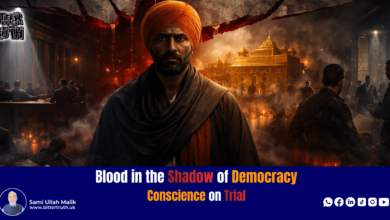
Modi’s rhetorical flourish—”My veins run with Sindoor… eat in peace or face my bullet”—was not mere campaign bombast. It was a slap across the fragile face of nuclear security in South Asia, weaponising faith for votes and inflaming the very fuse he ought to defuse. But history is neither forgetful nor forgiving. It has chronicled such bluster before—and has consigned its authors to the shadows.
Such incendiary, Bazaari language (Morally depraved language)—laced with threat, stripped of statesmanship—is not only a violation of diplomatic etiquette, but a defiance of the very spirit of the United Nations Charter.
In an already volatile region, such rhetoric is not simply provocative—it is perilous. The global press, diplomatic circuits, and peace-seeking nations are left aghast. That a nuclear-armed leader should serenade war in such cavalier tones is not merely concerning—it is profoundly alarming. A Dirge of Diplomacy or the Drumbeat of Dominion?
Embers of Hatred in the Furnace of Rhetoric
History, though replete with defiant oratory and emboldened declarations, seldom bears witness to the transformation of political stagecraft into a theatre of personal vengeance. Even Indira Gandhi—whose rhetoric in 1971 brimmed with resolve amidst the crucible of East Pakistan—maintained, despite her severity, a discernible restraint from descending into the perilous vocabulary of incitement. By contrast, the discourse now issuing from the lips of Narendra Modi has unmoored itself from statesmanlike decorum and cast anchor in the turbulent seas of Hindutva, egoism, and visceral hate.
Modi’s invocations, now cloaked in messianic fervour and uttered with the theatrical cadence of a demagogue, have resurrected the ghost of Gujarat—a sobriquet he bears not as a badge of honour but a scar of infamy. His infamy, earned during the pogroms of 2002, lingers as a dark blot upon India’s democratic fabric, and his recent utterances—echoing with bullets and blood—signal a drift toward fanaticism with apocalyptic overtones.
His threats, couched as they are in electioneering zeal, betray a mind wherein nuclear brinkmanship and personal megalomania converge. It is not merely a failure of diplomacy, but a harbinger of danger to the global order itself. That such incendiary rhetoric may issue from the high office of a nuclear state demands not only censure but alarm. One does not wave the atomic sceptre in jest.
Amidst this crescendo of nationalist jingoism, India’s domestic political actors have sounded a discordant note. The Indian National Congress, no longer mute in the shadow of BJP’s dominance, has decried the collapse of India’s diplomatic edifice—once a pillar of global admiration—now reduced to the rubble of impulsivity and belligerence. Their critique unearths a truth often shrouded in patriotic banners: that foreign policy failures are but reflections of a deeper rot within.
The events of 2002 cast a long shadow; once again, India finds itself beleaguered not by enemy arms alone but by the demons of its own creation. History, it seems, is destined to revisit Delhi with a grim reminder that moral erosion precedes strategic collapse.
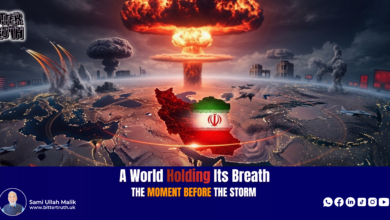
Pakistan and India, both custodians of nuclear arsenals, now stand upon a precipice. The ghosts of Kargil loom large. Then, as now, it required the sober intercession of the international community to draw the swords back into their sheaths. But who shall play the peacemaker now, as clouds gather again over the subcontinent?
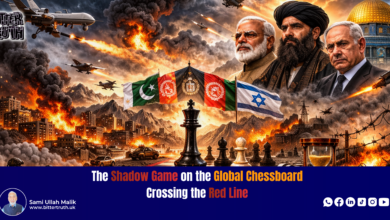
This is no mere clash of iron and fire. The aerial dogfights between French Rafales and Chinese J-10Cs symbolise more than martial posturing—they represent an ideological schism: East versus West, dependency versus sovereignty, automation versus audacity.
From the skies, the cacophony of airstrikes may sound alike, but beneath lies a tale of diverging destinies. The Indo-French alliance, shrouded in commercial pomp, finds itself rattled not by superior firepower but by unexpected resistance. For in the gales of war, it is not always the most expensive blade that cuts deepest.
When Israeli-made Harop kamikaze drones—symbols of military precision and technological supremacy—fell like dead moths into Pakistani soil, the illusion of invincibility crumbled. Pakistan not only intercepted and downed scores of these “ghost drones,” but astonishingly managed to jam and capture several intact—transforming once-feared spectres of destruction into trophies of triumph.
The Israeli military-industrial complex, long emboldened by its own mythos, received a wound not
just to its weaponry, but to its pride. For these drones, touted as harbingers of fourth-generation warfare—where enemies are unseen, and machines whisper the dirges of destruction—had been humbled.
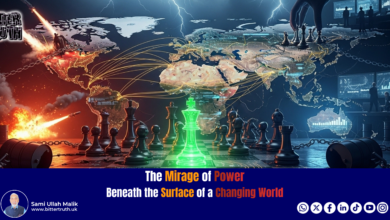
This theatre of modern conflict, where men cede the stage to machines and stealth replaces valour, now plays out over the subcontinent. The rogue path of BrahMos missiles, the incursion of unmanned predators, the contest of jamming technologies—all form the chessboard of future warfare, where each piece is coded and each move digitally ordained.
In the realm of military science, the battle is no longer measured merely by gunfire, but by electromagnetic footprints and satellite whispers. NATO pioneered this doctrine in the deserts of Iraq in 1991; today, South Asia adapts and adopts.
It was during the famed Balakot skirmish that the Pakistan Air Force carved its name afresh in aerial history. With clinical precision, it felled Indian jets and defended its skies with poise and professionalism. Independent observers, satellite evidence, and international reportage corroborated the toll. That humiliation was but a prelude to what has now unfolded.
Modi’s propagandist euphoria—replete with boasts of Lahore’s capture and Karachi’s fall, with imagined arrests of generals and ministers—was torn asunder by the retaliatory sweep of Pakistani airpower. The illusions, conjured through a pliant media, were shattered like brittle glass. Rafales, once brandished as symbols of air superiority, were consigned to their fiery grave on Indian soil.
The debacle was so undeniable that even Modi’s staunchest allies—Israel and the United States—were compelled to intervene. So desperate was the Indian overture that appeals were made to Washington, and pressure exerted upon Paris. Only then did Dassault, the French aircraft manufacturer, reluctantly admit to the catastrophic loss of its aircraft. In war, truth is often the first casualty—but sometimes, reality breaks through even the thickest fog of lies.
The Last Echoes Before the Storm: A Churchillian Reflection on the South Asian Skies
In the veiled theatre of nocturnal combat, where silence is rent by supersonic howls and destinies are shaped not in parliaments but in the firmament, the subcontinent bore witness—once again—to a spectacle both unprecedented and ominous. On that charged evening of May the 6th, as the world slumbered in uneasy ignorance, over a hundred fighter aircraft from India and Pakistan took to the skies, composing what Air Vice Marshal Aurangzeb of the Pakistan Air Force described as “a beyond visual range engagement the likes of which aviation history has never recorded.”
It was a clash not merely of machines, but of militaries, of doctrines, and—more grimly—of national narratives. Forty Pakistani aircraft—JF-17s, F-16s, and J-10Cs—stood in calculated formation against seventy Indian warplanes, including the much-vaunted Rafales. In a battlefield no broader than the heavens and no deeper than human resolve, the rules of engagement were rewritten mid-flight. According to Aurangzeb, India’s deployment of weaponry was met with a surgical counterstrike, and while the Pakistani arsenal included surface-to-air kills, the nature of ordnance such as the Chinese-manufactured PL-15 was tactfully left undisclosed.
In the theatre of geopolitical symbolism, this was not mere aerial choreography. Pakistan’s restraint—engaging decisively yet deliberately avoiding escalation—spoke volumes. “India once claimed,” said the Air Vice Marshal, “that if they had Rafales during Balakot, the outcome would have differed. So, we gave the Rafales their moment—and buried them in their own skies.”
Three Rafale jets were reportedly downed near Bhatinda, Jammu, and Srinagar, while additional losses included MiG-29s and Su-30s. In an era dominated by propaganda, where truth is often garbed in nationalist theatrics, the evidence—satellite imagery, independent analysts, and leaked cockpit footage—stood as stubborn sentinels against India’s orchestrated silence. Even the Indian Air Chief, in an unusually candid admission, acknowledged “some losses under review”—a phrase heavy with reluctant truth.
And so, the ghost of Balakot loomed large. Then, as now, the myth of Indian aerial supremacy was undone by Pakistan’s precision and poise. The legend of M. M. Alam, whose 1965 heroics are etched in the marble of martial history, found its modern echo. Western defence publications, such as Jane’s Defence Weekly and The New York Times, begrudgingly confirmed: the Pakistan Air Force had not merely defended airspace—it had reclaimed strategic altitude. But the battle in the skies is never untethered from the battle on the ground.
The United States, that hesitant guardian of global equilibrium, once again finds itself playing both fireman and arms dealer. While Washington vetoes UN resolutions curbing Israeli aggression, it supplies India with advanced satellite data, strategic weaponry, and unspoken support under the doctrine of “strategic containment of China.” In this great geopolitical ledger, Israel too sees profit: flooding Indian arsenals with high-tech munitions while drawing closer to Pakistan’s borders than ever before.
Thus, the echoes of the Cold War resound anew. The same playbook once used to arm Pakistan as a bulwark against Soviet encroachment now re-emerges—only this time with India cast as the West’s regional proxy. Yet the price may be steep. For each Rafale sold and each drone launched, the subcontinent inches closer to an irreversible polarity. If Washington persists in casting India as its Asian rampart, it should not feign surprise when Pakistan steps fully into Beijing’s strategic embrace.
And here lies the crux of our age: will South Asia learn from its annals of agony?
Or will it, like some cursed oracle, repeat its tragedies with poetic precision—each skirmish a stanza in the elegy of peace? For in these lands, where saints once preached harmony and poets painted unity with ink drawn from the soul, the new anthem threatens to be composed in the dissonance of missiles and the dirges of martyrs.
History teaches us that nations are not merely made by their armies, but by their ability to rise above them. True strength, as Burke might remind us, lies not in the clenched fist but in the calibrated voice of reason. Diplomacy is not the art of concession but of civilised defiance. And leadership is not he who strikes first, but he who knows when not to strike at all.
This region, so often bled, may yet bloom—if its leaders would choose dialogue over doctrine, civility over supremacy, and the ink of treaties over the blood of innocents.
Let the camps of enmity be folded away, and the lamps of peace lit anew. For when blood stains the vermilion, even the purest prayer is refused. The choice remains ours. The question no longer is, “Who will win the war?” but rather, “Who will dare to prevent it?”
—Let wisdom, not wrath, author the next chapter of this land’s destiny.
But why do countless peace-lovers like me fear that the hopes attached to ridding this beautiful world of the infamous enemies of peace are dying? But the question is, what message will we leave for our future generations?