Threat, Silence, and the Verdict of History
Power, Hubris, and Moral Decline

There are regions on the political horizon of the world that seem condemned by fate to be tested at every turning of history. South Asia is one such land—a terrain where borders are no longer mere cartographic lines but living metaphors of ideologies, creeds, and a blood-stained chronicle of collective emotions. In such a theatre, when the head of a state—openly partisan, ideologically inflamed, and vested not only with supreme executive authority but also with a nuclear arsenal—publicly threatens to “gun down” millions of Pakistani citizens from a political platform, the matter ceases to be one of ethics or diplomacy alone. It becomes a question that strikes at the conscience of human civilisation itself: at international law, at the moral legitimacy of global institutions, and at the very architecture of world order.
This recent utterance by Narendra Modi, echoed from the soil of Gujarat, is not merely an election slogan shouted into the wind. It is the manifestation of an ideological frenzy—one that stands ashamed before the mirror of its own history yet seeks survival by incessantly provoking imagined enemies beyond its borders. Such provocations can no longer be dismissed with irony or laughter, for they amount to a conscious attempt to gamble with the future of hundreds of millions of human beings living under the shadow of two nuclear-armed states.
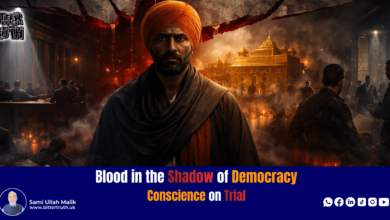
When, at a public rally in Gujarat, the Indian Prime Minister threatened the citizens of Pakistan with annihilation by bullets, he did more than violate the elementary norms of international diplomatic conduct. He exposed a psychological landscape that is actively invested in erasing the very possibility of peace in the region. This threat—standing in stark defiance of morality and human rights—does not merely signify a belligerent temperament; it lays bare the internal political condition of India, where aggression is increasingly being commodified as electoral capital. Such a statement, fundamentally hostile to universal human values, articulates the worldview of a mind enthralled by division and hostility, and therefore poses a grave danger to regional stability and global security alike.
In truth, behind this violent rhetoric lies a wounded conscience, driving its bearer towards the darker arts of political deceit. Reduced to bluster and bombast in pursuit of votes, the Indian leadership now confronts a reality that the world has already begun to recognise: that in the land where nationalist arrogance roars within parliamentary halls, and where power in New Delhi sits draped in the garments of pride and entitlement, the much-vaunted Rafale aircraft—upon which the nation’s treasury squandered both clay and gold—fell ignominiously from the skies, reduced to fire and wreckage before the resolute Pakistani pilots who bore the storm with iron resolve.
When the French manufacturer acknowledged the loss of three such aircraft, a profound silence descended upon the ramparts of Delhi’s pride—like a black standard unfurled not upon the Red Fort of Agra, but within the collective psyche of a wounded state, where tears replaced triumph.
The same Air Marshal A. K. Bharti, whose words once thundered like gathering storms, now found himself offering the pallid consolation that “losses are normal in war”—as though defeat could be wrapped in the silk of semantics, as though bleeding could be concealed with a handkerchief of words. Yet history possesses a sharper gaze: it sees the wound, it hears the suppressed scream.
The Pakistani falcons, whose flight remained within their own sovereign skies, yet whose steel-tipped resolve carved through hostile airspace, were not merely an exhibition of tactical skill. They stood as the embodied wisdom of Sino-Pak strategic coordination. This victory was not solely a testament to Pakistan’s courage; it was an unspoken declaration of China’s commercial foresight and military acumen.
Another cause behind Modi’s fire-breathing rhetoric lies in the embers of a ceasefire where Chinese statecraft quietly placed a spark. While India’s gaze remained fixed westward upon Pakistan, Beijing altered the nomenclature of twenty-seven locations in Arunachal Pradesh into Chinese and Tibetan names—sending a message as old as power itself: maps are not made on paper alone; they are engraved in minds, claims, and the force of will. This was no linguistic exercise, but a literary proclamation of sovereignty. By the time India turned eastward, the mountains bore unfamiliar names, valleys had grown estranged, and the map was no longer entirely its own.
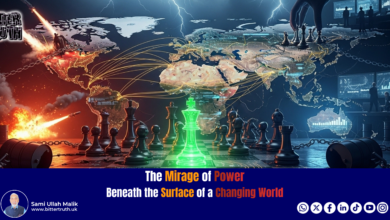
India today finds itself hemmed in by three walls on three fronts—China, Pakistan, and Nepal—three tectonic plates of tension within which it remains trapped like a nation dreaming under illusion. Nepal, small though it may be, has cracked the fortress of Indian arrogance through sheer self-respect. Pakistan is no longer merely a military reality but an intellectual and strategic force; China, a civilisation whose strength is cultural as much as it is martial. It is as though a fragile moth has wandered into the lairs of three lions, mistaking them for passing clouds of the night. Such, indeed, is the present condition of a defeated Modi.
The backdrop to this statement is a region fraught with complexity and strain—where aerial skirmishes, border tensions, and psychological warfare persist between India and Pakistan. The recent destruction of French-built Rafale jets, facilitated by Pakistan’s military strategy and Sino-Pak cooperation, has carried India’s military and political predicament to an unprecedented threshold.
Modi’s threat emerges from this very context: a moment where India’s attempt to parade its military might like a crown jewel has collapsed into humiliation on the global stage, while simultaneously exposing profound disarray and instability within its domestic and foreign policy calculus.
This aggressive rhetoric arises in a region where tensions are at their zenith, where the echoes of missiles and dogfights have recently been heard across contested skies. India’s prior silence was not born of restraint, but of shock—Modi had not anticipated such a decisive response from Pakistan. His latest speech has torn away the veil from that silence, revealing an unvarnished narrative of aggression. This contradiction—between silence and threat—constitutes one of the oldest tragedies in international politics. Is silence truly the emblem of victory, or merely the curtain drawn over defeat?
In global affairs, silence is often mistaken for wisdom and patience. Yet history teaches that wisdom succeeds only when it is timely, proportionate, and fruitful. If an adversary trespasses your borders and you cannot even muster a verbal response, such silence is not prudence—it is cowardice.
Before this statement, India repeatedly chose silence in the face of Chinese military advances along disputed borders—a silence that signified not strategic foresight but fear and uncertainty. In contrast, Pakistan consolidated its position through calibrated military action and diplomatic engagement, while China translated its territorial claims into tangible realities, reshaping the political geometry of the region.
History has taught us time and again that wisdom lies in discerning the moment and responding in a
manner that leads towards victory. Diplomatic silence may be portrayed as strength, but when it degenerates into paralysis and incompetence before an adversary, it ceases to be courage and becomes nothing more than timidity.
India’s muted response to Chinese incursions stands as evidence that such silence is rooted in weakness and a poverty of strategy. Meanwhile, Indian media and military circles—ever eager to issue bellicose proclamations against Pakistan—remain conspicuously mute on China, thereby laying bare their intellectual confusion and strategic incoherence.
At this juncture, the Qur’anic reminder resonates with enduring relevance:
وَلَا تَهِنُوا وَلَا تَحْزَنُوا وَأَنتُمُ الْأَعْلَوْنَ إِن كُنتُم مُّؤْمِنِينَ
“So do not weaken, nor grieve; and you shall prevail if you are true in faith.” (Āl ʿImrān 3:139)
And elsewhere:
إِنَّ اللَّهَ لَا يُغَيِّرُ مَا بِقَوْمٍ حَتَّىٰ يُغَيِّرُوا مَا بِأَنفُسِهِمْ
“Indeed, God does not change the condition of a people until they change what is within themselves.”(Ar-Raʿd 13:11)
These verses speak not merely to faith, but to the immutable laws of history: that arrogance invites decline, that bluster cannot conceal weakness, and that power divorced from moral restraint ultimately devours itself.
Within the architecture of Indian political thought and strategic conduct, one discerns the lingering hues of ancient expediencies—most conspicuously the shadow of Chanakya’s doctrine. It is a worldview in
which power is instantly venerated, bowed to, and sanctified, while weakness is subjected to relentless scrutiny and, when expedient, ruthlessly broken. Operating under this principle, India’s civilisational imagination accommodates a pantheon of innumerable deities—rats and serpents among them—yet when these gods falter, their own worshippers do not hesitate to shatter them without remorse. It is for this reason that India’s religious and political landscape appears perpetually contradictory and entangled: a land of millions of gods, yet one where devotees stand ever ready to revolt against their own idols.
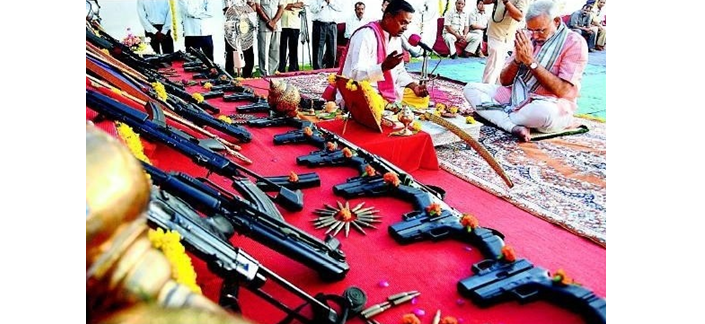
Narendra Modi’s recourse to religious rituals and ceremonial worship in defence of the Rafale aircraft—despite their manifest failure—reveals precisely this opportunistic impulse: a posture of submission before the gods of power, masking a profound inner frailty. The spectacle of worshipping Rafale fighter jets, and broadcasting these rituals to the global media even after their operational humiliation, reflects the deep-seated contradiction within Indian society—swaying uneasily between strength and vulnerability, reason and superstition, intellect and ignorance.
Modi’s sectarian and aggressive pronouncements not only poison relations with Pakistan but also amplify the spectre of instability across South Asia as a whole. In contrast, the restraint and strategic composure demonstrated by Pakistan and China point towards a mature doctrine of statecraft—one that is quietly recalibrating the balance of power in the broader Asian theatre. On the one hand, this approach is reshaping regional equilibrium; on the other, it is steadily isolating India on political and diplomatic fronts. Through his threats, Modi is not merely antagonising neighbours—he is progressively estranging India from a world that increasingly demands peace, cooperation, and collective economic progress. The damage to India’s global credibility is palpable, at a moment when international collaboration has become not a luxury, but a necessity.
The threat to “gun down” Pakistani civilians constitute not only a grave violation of moral, legal, and diplomatic norms, but also an alarming indictment of the contemporary human rights climate. Such declarations provoke deep unease among peace-oriented societies worldwide and heighten the risk of a humanitarian catastrophe in an already volatile region.
Modi’s speech places India’s strategic judgment under a searching light. Is this aggression truly an emblem of wisdom—or of folly? Is it strategy, or merely the unguarded expression of anger born of weakness? History teaches that wisdom is never confined to rhetoric alone; it must manifest in practical solutions and lay the foundations for durable peace.
Pakistan and China, by contrast, have adopted a strategy that is powerful precisely because it is restrained—one that secures victories not only through the thunder of artillery but across political, economic, and psychological domains. It is this very strategy that has elevated Sino-Pak relations into a central pillar of peace and stability in the region.
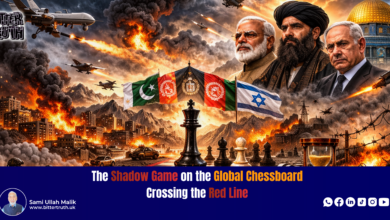
Amidst this escalating tension, Israel’s role introduces a new and exceedingly delicate dimension. According to credible reports, Israeli military specialists stationed in India were operating Harop drones and became casualties of Pakistani missile strikes. This revelation transforms the conflict from a bilateral Indo-Pak confrontation into a chapter of international military chess, wherein the United States, Israel, and India align on one side, while Pakistan, China, and peace-oriented forces across the region stand on the other.
With the exposure of Israeli operators and the circumstances of the attack, a critical question arises: has Israel now become a direct party to this conflict? This is perhaps the most sensitive and consequential aspect of the entire crisis. Reliable sources indicate that India had acquired Harop loitering munitions from Israel, and that dozens of Israeli military experts were deployed at Indian bases to operate them. A Pakistani retaliatory strike reportedly targeted one such base, where Israeli operators were present, leading to credible reports of their deaths.
Unofficial accounts suggest that the bodies of these Israeli operatives were quietly transported from India to Israel in sealed coffins. Both governments sought to suppress the story. When Pakistan determined that Israel’s direct involvement constituted sufficient grounds for retaliation—a right firmly anchored in international law—the calculus of global power shifted. It was precisely at this juncture that the United States, initially presenting itself as “disengaged,” suddenly became active in pursuing a ceasefire.
Thus, the conflict ceased to be viewed merely as an Indo-Pak dispute; it began to be recognised as the opening phase of a proxy confrontation among major military powers—one whose continuation threatened even American strategic interests. Preventing its escalation became, for Washington, a matter of self-preservation.
President Trump initially attempted to assume the posture of an ostensibly neutral mediator. Yet his silence—indeed, his indifference—towards Modi’s subsequent incendiary statements raises troubling questions about the credibility of American mediation. If the United States truly aspires to peace, will it condemn Modi’s threat? And if it remains silent, does that silence not amount to tacit protection of India?
Is it true that under the cover of a ceasefire, Washington sought to shield India and Israel from further military humiliation? According to diplomatic sources and several defence analysts, Indian air power and
Israeli technology had suffered severe losses prior to the ceasefire, giving rise to fears that Pakistan might respond not only to Indian aggression but also to Israel’s involvement. In such circumstances, American intervention appears motivated less by reconciliation than by a desire to spare its allies further disgrace.
Had the Trump administration been genuinely impartial, it would have expressed clear disapproval of Modi’s rhetoric and undertaken tangible diplomatic and defence-related measures. Instead, its silence has deepened global mistrust in American policy, particularly across the Muslim world, where the perception is increasingly entrenched that the rhetoric of “peace” merely disguises a strategy of protecting preferred allies. This, in itself, serves as evidence that the ceasefire was designed to obscure the military setbacks of India and Israel alike.
Now, as Modi once again returns to the language of threats, an urgent question presses itself upon the region: are we on the brink of another war? Will Israel once more seek to intervene in South Asia through India? And will the United States again attempt to rescue its allies under the guise of “mediation”? If Washington persists in silence after Modi’s latest threat, doubt will harden into certainty—that the mediation was never about peace, but about shielding India from deeper humiliation.
The United Nations and international human rights organisations—whose office walls are adorned with lofty proclamations of humanity—have responded to Modi’s statements with either silence or passive observation, like characters in a novel who do not speak, but merely watch. Yet Article 2(4) of the UN Charter unequivocally obliges states to refrain from the threat or use of force against other nations. What is at stake here is moral courage—and history bears witness to the fact that speaking truth to power has never been the forte of the faint-hearted.
If these realities are brought before the world in their full and unvarnished truth, the moment will not merely expose Modi but will also lift the veil from Israeli militarism and American complicity through silence. Delay, however, risks allowing Israeli involvement to open an entirely new front—beyond the capacity of any power to contain.
When an adversary issues open threats and the world remains mute, silence ceases to be wisdom; it becomes the silent accomplice of injustice, cloaked in the garb of prudence. Pakistan, which has consistently advocated peace and articulated its principled stance with diplomatic dignity, now confronts a defining question: will the international community find the resolve to take notice of Modi’s threats?
At such a moment, the Qur’anic admonition acquires renewed moral force:
وَلَا تَرْكَنُوا إِلَى الَّذِينَ ظَلَمُوا فَتَمَسَّكُمُ النَّارُ
“And incline not toward those who commit injustice, lest the Fire should touch you.” (Hūd 11:113)
And again:
إِنَّ اللَّهَ يُحِبُّ الَّذِينَ يُقَاتِلُونَ فِي سَبِيلِهِ صَفًّا كَأَنَّهُم بُنْيَانٌ مَّرْصُوصٌ
“Indeed, God loves those who stand firm in His cause, as though they were a solid structure, joined together.” (As-Ṣaff 61:4)
These verses speak beyond faith alone; they articulate the enduring grammar of history: that injustice thrives on silence, that power without moral restraint corrodes itself, and that dignity—when defended with patience and resolve—outlives the loudest threats.
The open threat issued by Narendra Modi to “gun down” Pakistani civilians constitute a flagrant violation of international law, the Charter of the United Nations, and the most elementary standards of fundamental human rights. This is not the expression of political disagreement; it is the unambiguous proclamation of racial and state-sponsored terror by a nuclear-armed state against the civilian population of another. Article 2(4) of the United Nations Charter explicitly prohibits any state from threatening the use of force against another. Likewise, the Universal Declaration of Human Rights and the Geneva Conventions classify such statements as incitement, provocation, and conduct falling within the orbit of war crimes.
The pressing question, however, remains: will the community of nations take any meaningful action? Experience teaches us that when such belligerent pronouncements emanate from a major trading or defence partner—India being closely aligned with the United States, Israel, and several European powers—the so-called “global conscience” often succumbs to expediency. Yet avenues remain open. The matter can be raised at an emergency session of the United Nations Security Council. Human rights organisations may issue investigative reports. The European Parliament may table resolutions. The International Court of Justice may be petitioned to recognise such rhetoric as war incitement. For all this to materialise, however, Pakistani diplomacy, media, and civil society must act swiftly, cohesively, and with resolve—so that global public opinion is awakened to the dangers of Modi’s martial obsession. International media must frame these statements for what they are: deliberate provocations toward war. Above all, internal political stability, national unity, and social cohesion must be strengthened, for it is unity alone that renders every threat, every assault, every stratagem ineffectual.
Modi’s recent pronouncements are not the empty bombast of electoral rallies; they form part of a mental and ideological architecture designed to upend regional peace. If the world genuinely cherishes stability in South Asia, it must take cognisance of this incitement. Otherwise, should these two nuclear-armed states drift toward war, the fuel will not be South Asia alone—the conflagration may well engulf the wider world.
Pakistan must raise Modi’s statements with full diplomatic force before the United Nations, the Organisation of Islamic Cooperation, the European Union, and the global media. Simultaneously, the concealed alignment between the United States, Israel, and India must be exposed, so that the world may recognise that what is being marketed as “peace mediation” is, in truth, an attempt to draw a veil over potential war crimes.
The path forward demands wisdom, restraint, and adherence to diplomatic norms rather than aggression and hatred. True political leadership lies in de-escalation, in keeping the doors of dialogue open, and in seeking collective solutions for the welfare of the region. The art of statesmanship is not measured by the volume of threats, but by the durability of peace secured.
Modi’s incendiary words may momentarily inflame nationalist passions, yet history will remember them either as a symbol of transient power or as a rainbow that vanishes in the aftermath of a storm. Silence is golden only when it signifies strength; otherwise, it is the harbinger of decline—perilous to both dignity and security.
Accordingly:
The international community must hold India diplomatically and morally accountable, condemning such statements in the United Nations and other global forums, and adopting a collective strategy for the promotion of peace.
The world now faces a crucial test: to caution the Indian leadership against future incendiary rhetoric and to insist upon genuine efforts to preserve regional stability.
Confidence-building measures among regional states must be accelerated, with dialogue prioritised as the principal instrument for resolving disputes and establishing lasting peace.
Positive initiatives must be undertaken to enhance trust among India, Pakistan, and China.
The strategic model of Pakistan and China—rooted in restraint, patience, and calculated diplomacy—should be studied and emulated to enable political stability and economic progress across the region. Broader engagement with the international community should be strengthened to underpin regional stability.
India must accord priority to dialogue with Pakistan and China if a durable path to peace is to be opened.
Educational and media programmes should be designed to foster peace and tolerance among populations, thereby diminishing the atmosphere of hatred and aggression.
Once again, it bears repeating: Modi’s statements are not mere electoral rhetoric; they represent an ideological blueprint that threatens to overturn the peace of an entire region. If the world truly values stability, it must confront this provocation. Otherwise, a conflict between two nuclear powers will not be confined to South Asia—it will endanger the global order itself.
Pakistan must therefore continue to present Modi’s threats robustly before the United Nations, the OIC, the European Union, and the international press, exposing the covert alignment of the United States, Israel, and India, and demonstrating that this is not mediation for peace, but an attempt to conceal culpability for potential war crimes.
At this juncture, the Qur’anic warning speaks with timeless clarity:
وَاتَّقُوا فِتْنَةً لَّا تُصِيبَنَّ الَّذِينَ ظَلَمُوا مِنكُمْ خَاصَّةً
“And fear a trial which will not strike only those among you who have done wrong.” (Al-Anfāl 8:25)
And finally, a parable of wisdom:
When time finds its voice, it turns nations into history;
those who ignore its call are reduced to cautionary tales.
Pakistan and China recognised the moment—
and he who recognises the moment becomes master of the age.