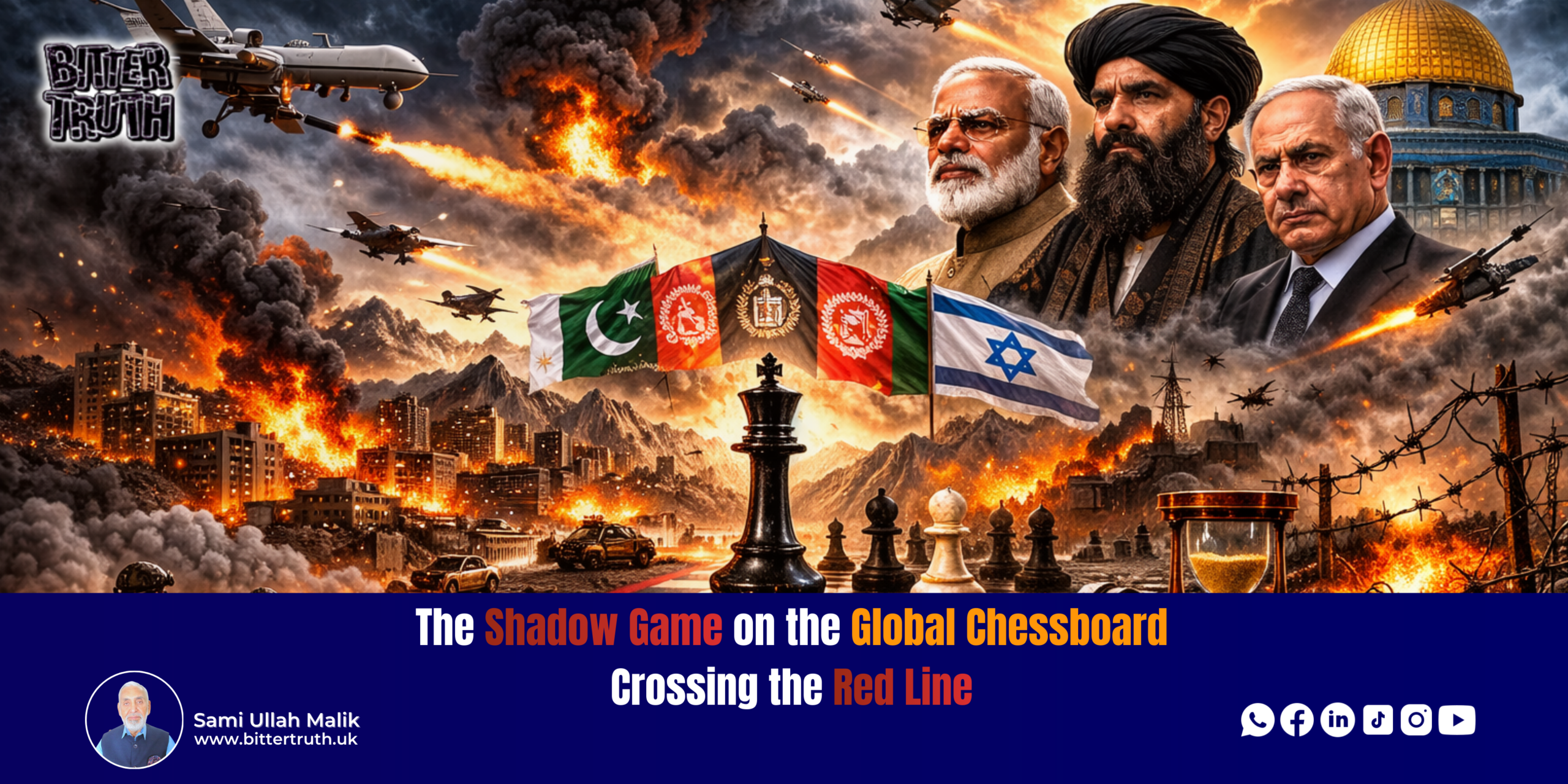
The Shadow Game on the Global Chessboard
Crossing the Red Line

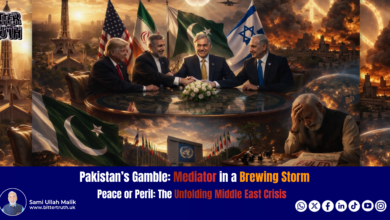
History, when contemplated with sobriety rather than sentiment, is never a mere procession of dates and incidents. It is, rather, a living chronicle of the resolve of nations, the shifting equilibrium of power, and the veiled stratagems through which global politics so often conducts its silent game. When the historian takes up his pen, he does not simply catalogue occurrences; he strives, as far as human insight allows, to draw aside the curtain behind which great powers arrange their pieces upon the board of the world. South Asia and the Middle East have for centuries formed one of the principal theatres of this quiet yet formidable contest—a vast chessboard upon which kings are sometimes checkmated and pawns, with tragic regularity, are sacrificed.
In my article published on 9 March 2026, entitled “The Secret Game upon the Global Chessboard,” I ventured to suggest precisely this: that what appears upon the surface of events in the region is seldom the true game itself, but merely its shadow cast upon the wall of public perception. The argument advanced therein was that Pakistan, during the preceding months, had played a constructive and stabilising role within the region—one that not only forestalled the eruption of a potentially devastating crisis but also helped spare Iran from a fate not unlike that which, in darker hours of recent history, befell Syria.
According to a range of emerging assessments, a covert strategic design had been forming among certain global actors: a design intended to weaken Iran through the calculated encouragement of internal unrest, ethnic insurgencies, and mounting economic pressure, thereby pushing the country towards the precipice of civil strife. The outline of the scheme was disquietingly clear. Militant networks operating in Afghanistan were to be manipulated in order to generate instability along Iran’s frontiers, while internal protests would be fanned into broader agitation, ultimately paralysing the authority of the government in Tehran.
Yet history, which often seems governed by inexorable forces, occasionally turns upon the foresight of a single state. There are moments when prudence exercised in time alters the course not merely of national policy but of regional destiny. In this instance, Pakistan appears to have acted with a combination of diplomatic subtlety and operational vigilance that disrupted the unfolding design.
Reports circulating in security circles suggested that more than twenty-five thousand militants affiliated with so-called “Khorasan” formations within Afghanistan, together with nearly twenty thousand fighters associated with Tehrik-i-Taliban Pakistan, and other irregular elements, were being positioned within a wider plan intended for eventual deployment against Iran. The object was stark: to fracture the country internally and to ignite in the region yet another conflagration akin to the Syrian catastrophe, thereby plunging the wider Muslim world into a further twilight of instability.
Within this broader design, an additional instrument was reportedly prepared—an information campaign conducted through satellite-based digital connectivity. Under this plan, networks linked to Starlink internet systems were to facilitate a coordinated propaganda offensive. It is alleged that more than thirteen thousand specialised devices were intended to be smuggled through Afghan routes into the frontier regions bordering Iran and Pakistan, enabling the orchestration of large-scale agitation through social media and encrypted digital channels. Yet here again, the vigilance of Pakistan’s security and intelligence institutions appears to have intervened in time, exposing and frustrating the scheme before it could mature into a wider crisis.
At that juncture, the architects of the larger design were compelled to recognise that a carefully prepared stratagem had miscarried. History teaches us that when proxy warfare, information campaigns, and the engineering of internal upheaval fail to achieve their intended purpose, powerful states often resort to the final and most perilous recourse—open confrontation.
And thus events began to unfold along precisely the trajectory that earlier warnings had anticipated. When the attempt to destabilise Iran faltered, tensions within the region entered a new and more volatile phase. Various militant organisations operating from Afghan territory were once again activated against Pakistan, and the slow but unmistakable escalation of frontier tensions began to drift toward the possibility of military confrontation.
The developments we witness today—the attempted drone incursions over Pakistani cities, the sharpening of border tensions, and the lengthening shadow of proxy warfare—are not isolated occurrences. They represent, rather, the next movement in that wider geopolitical contest whose pieces are arranged upon the global board. The incidents of the past fortnight alone suggest that the region now stands at a perilous crossroads, where even a minor spark may serve as the harbinger of a far larger conflagration.
Crossing the Red Line: Afghan Taliban Drone Incursions and Pakistan’s Security
It is against this strategic background that the present discussion must be understood. What follows is not merely a tale of a handful of drones traversing contested skies; it is another calculated move within the grander game of international rivalry, a game in which the destinies of entire regions—and the interests of nuclear-armed states—may be quietly placed at stake.
The pages of the subcontinent’s past bear eloquent witness to a recurring truth: that this land has seldom been free from the interplay of power, politics, and ideology. When historians recount the stories of borders in this part of the world, they do not speak merely of lines traced upon a map. They speak of the destinies of nations, the delicacy of diplomacy, and the ceaseless negotiation of power.
The geographical character of South Asia reflects these layered realities with striking clarity. Tribes dwelling in the shadow of mountain ranges, states spread across fertile plains, and the strategic interests of distant powers frequently become entangled in a pattern so intricate that, at times, the air is filled with the fragrance of cooperation—while at others it is darkened by the acrid scent of gunpowder.
At various moments in its long chronicle, the region has served as the stage upon which empires have risen and fallen. At other times it has been the meeting point of civilisations whose encounters opened new intellectual horizons. Yet through this long historical passage one truth has remained unmistakable: whenever the fires of conflict have been kindled across these frontiers, their flames have seldom remained confined to the battlefield. They have spread into the political climate and the social fabric alike.
Relations between Afghanistan and Pakistan form part of this larger historical continuum. On the one hand lies a shared religious and cultural heritage; on the other, the persistent complexities of frontier politics. Over the past several years, clouds of tension have periodically gathered between the two neighbours. Yet recent allegations concerning drone incursions have propelled this uneasy relationship into a new and potentially hazardous phase.
Drone technology, one might say, has become the silent instrument of modern warfare. At a glance it resembles nothing more menacing than a mechanical bird, yet the moment it takes flight it sends ripples of concern through the chambers of international politics. In recent days, alleged drone strikes attributed to Afghan Taliban elements over several Pakistani cities—most notably Rawalpindi, Kohat, and Quetta—have once again illustrated a sobering reality: the face of war in the modern age has changed.
Where once artillery and infantry dominated the theatre of battle, the skies are now shared with technological emissaries—drones that hover unseen yet carry consequences far beyond their size. Though the reported attacks appeared limited in their immediate scope, their political and diplomatic implications are considerably deeper. The intrusion of such aerial systems has stirred debate not only within military circles but across the broader political and social landscape.
The present report, therefore, seeks to examine these incidents with both historical perspective and analytical care—exploring their background, their causes, and the potential consequences they may hold for a region already poised upon a delicate and uncertain balance.
In the conduct of statecraft there exist certain principles which nations regard not merely as policies but as emblems of their dignity. These principles are often described in the language of diplomacy as “red lines”—limits beyond which patience ceases to be a virtue and restraint yields to necessity. The reported attempts to launch drone attacks against several Pakistani cities are now widely being interpreted within precisely this framework. For Pakistan, the matter is not simply the intrusion of a handful of unmanned machines into its airspace; it carries the weight of a symbolic message. Every sovereign state establishes certain inviolable thresholds concerning its security. When an external actor crosses those thresholds, the issue ceases to be merely a military challenge—it becomes a test of national honour itself.
The gravity of the episode is heightened by a simple historical observation. In the past, tensions between Pakistan and Afghanistan have, for the most part, remained confined to remote frontier regions. Yet when the shadow of a dispute stretches beyond those rugged borderlands and falls upon the walls of great cities, its meaning changes profoundly. What had once been a purely military question acquires psychological and political dimensions. It is in this broader light that Pakistan has viewed the alleged drone operations attributed to the Afghan Taliban. Within the corridors of power in Islamabad, an unsettling question has begun to echo with growing urgency: if a neighbouring authority can dare to target Pakistani cities directly, does this not signify that the political landscape of the region is entering an altogether new phase?
Following the incidents reported on Friday, Pakistani authorities declared that the attempted drone strikes had been intercepted and neutralised in time. Yet reports that several civilians were injured by falling debris inevitably stirred public anxiety. The episode also revived a deeper and more troubling question: whether the evolving technologies of modern conflict may in future render Pakistan’s urban centres vulnerable to similar incursions.
Thus the event cannot be interpreted solely as a limited military operation; it was also, unmistakably, a signal—one that has compelled Islamabad to recognise that the strategic currents of the region may be shifting. It brings to mind an old maxim of statecraft: when the vigilance at the frontier weakens, the gaze of the adversary soon reaches the city walls.
Pakistan responded with sharp condemnation, making it unequivocally clear that the targeting of civilians was wholly unacceptable. In the view of Pakistani officials, the Afghan Taliban had crossed a boundary that cannot lightly be ignored. Official statements from Pakistan emphasised several fundamental points.
First, that Afghan territory must not be permitted to serve as a base for terrorism against any neighbouring state.
Second, that the targeting of civilians is categorically unacceptable under any circumstances.
Third, that Pakistan retains the full and unquestionable right to defend its citizens.
These declarations are not merely expressions of national sentiment; they echo the principles of international diplomacy and the doctrine of sovereign responsibility. Under established norms of international law, if a state’s territory is used as a platform for attacks against another country, the injured state may regard such actions as hostile and is entitled to take measures in self-defence.
There is also a historical dimension to this position. In the past, Pakistan has repeatedly urged that Afghan soil should not be allowed to serve as a sanctuary for the banned organisation Tehrik-i-Taliban Pakistan. Should the Afghan Taliban themselves now appear to be directly implicated in actions against Pakistan, the situation inevitably becomes far more complex. Embedded within Pakistan’s policy is a fundamental conception of state responsibility: that the duty of a government extends not only to guarding its borders but also to safeguarding the lives and property of its citizens.
According to Pakistan’s military media wing, the events of 13 March involved an attempt by Afghan Taliban elements to target the cities of Rawalpindi, Kohat, and Quetta using several drones. Military officials explained that the aerial devices were neutralised through two distinct defensive methods.
The first method, commonly described as “soft-kill” technology, involves disrupting a drone’s control system by jamming its electronic signals, thereby rendering it incapable of completing its mission.
The second method, known as “hard-kill” technology, entails directly targeting and destroying the drone before it can reach its intended objective.
Although the drones failed to strike their targets, fragments of wreckage reportedly caused injuries to several civilians, including children. The incident serves as a stark reminder that in the age of technological warfare even relatively small weapons may generate disproportionately large consequences.
While it is reassuring that the attempted attacks were thwarted, a more pressing question inevitably arises: how did these drones reach Pakistani airspace in the first place? That question points to a sobering truth about modern conflict. In earlier eras the danger usually appeared at the frontier; today it may arrive silently through the skies.
For their part, the defence authorities of the Afghanistan asserted that their drones had successfully struck an important Pakistani military installation and damaged a command centre there—an account that stands in stark contradiction to Pakistan’s version of events. In such circumstances, it is not uncommon for both sides to become participants in an information war. In the modern world, narrative itself has become a weapon. Statements, claims, and counter-claims often exert a political impact that rivals—or occasionally surpasses—the tangible outcomes of the battlefield. In that sense, the conflict is being waged not only in physical space but also within the realm of perception.
Within Pakistani society, therefore, a question now commands intense public debate: have the Afghan Taliban effectively extended the theatre of confrontation from remote border zones to Pakistan’s major urban centres? If that indeed proves to be the case, it will signify a transformation in the character of future conflict. Wars would no longer remain confined to remote frontiers and isolated outposts; metropolitan centres themselves might increasingly fall within the range of unconventional attacks. Such a development could represent the prelude to a broader and more dangerous confrontation.
For security institutions—and equally for systems of civilian defence—this possibility presents an entirely new challenge. To cross a red line, in the language of strategy, is to pass a point beyond which the path back to restraint grows perilously narrow.
Military analysts note that many of the drones involved appear to be commercially available systems that can be acquired with relative ease on the open market. Their characteristics are straightforward yet troubling: low cost, the capacity to carry a modest explosive payload, and the ability to strike within a limited but operationally useful range. These devices represent a disquieting trend in contemporary warfare. Because they are comparatively easy to obtain or assemble, they have increasingly fallen into the hands not only of states but also of non-state actors across the world.
Thus, the humble drone—small in size, modest in cost, yet formidable in implication—has become one of the defining instruments of twenty-first-century conflict, reshaping the geometry of war in ways that strategists and statesmen alike are only beginning to fully comprehend.
The authorities of the Afghan Taliban have maintained that these operations were undertaken in retaliation for alleged Pakistani air strikes. Lacking a conventional air force in the traditional sense, the Taliban have, by necessity as much as by design, turned toward drone technology as a substitute instrument of aerial capability. In the asymmetrical conflicts of the modern age, where weaker actors must often improvise against stronger adversaries, such technologies offer a relatively accessible means of projecting force beyond immediate frontiers.
Two principal varieties of drones are said to have been employed. The first consists of so-called suicide drones—unmanned aerial devices designed to strike a target and destroy themselves upon impact. The second involves quadcopters, four-rotor drones broadly inspired by technologies that have emerged from the defence industries of Israel. These are typically used for surveillance or for short-range tactical strikes, offering mobility and precision in confined operational environments.
The increasing prominence of such systems in regional conflicts is not without precedent. During the confrontation between India and Pakistan last May, it was widely alleged that Israeli operators had deployed similar drone technologies remotely from Indian territory. At the time, bold claims circulated in certain strategic circles suggesting that these advanced “kamikaze” drones—self-destructive upon impact—were so sophisticated that even the technological defences of their closest allies, including the United States, possessed no reliable countermeasure. Such assertions were accompanied by the confident suggestion that only a handful of drones might suffice to inflict decisive damage upon Pakistan.
Yet events unfolded in a markedly different fashion. Pakistani defences reportedly succeeded in neutralising dozens of these devices—some accounts placing the number near sixty-nine—while others were brought down intact, allowing their technological features to be examined. In doing so, Pakistan effectively punctured what had been portrayed as an aura of invincibility surrounding the system. The operational centre from which certain drone activities were believed to be coordinated was subsequently targeted and destroyed, an episode that further deepened the shadow of technological rivalry now hanging over the region.
According to one foreign military analyst, it remains possible that the Taliban acquired many of the components used in their drones from external markets. In the contemporary global economy of technology, such components are rarely confined within national borders. Some observers suggest that the parts may have been assembled within Afghanistan itself; others speculate that clandestine networks could have facilitated assembly inside Pakistan. A further possibility is that key elements of the technology were transferred through smuggling channels that traverse the porous frontiers of the region.
There are also scattered reports that external specialists may have assisted the Taliban in refining their drone capabilities. Independent verification of such claims remains difficult, yet the broader geopolitical context makes them difficult to dismiss outright. In South Asian politics, the long and often bitter rivalry between India and Pakistan has consistently been a central factor shaping regional alignments and covert engagements.
Although the recent drone attempts caused no large-scale destruction, their psychological effect within Pakistan has been unmistakable. The reason lies not in the magnitude of the damage but in the precedent it appears to set. For the first time, the Afghan Taliban were perceived to be attempting strikes against major Pakistani urban centres. In strategic affairs, symbolism can at times prove as consequential as physical impact.
Recent political developments have only added to the atmosphere of suspicion. During a visit to Israel by the Indian Prime Minister Narendra Modi, expressions of support for closer engagement with Afghan authorities were widely interpreted by some observers as evidence of a broader strategic alignment. Whether such interpretations are justified or exaggerated remains a matter of debate; yet within Pakistani strategic discourse the belief persists that external actors may seek to exploit regional tensions to their advantage.
It is an old maxim of diplomacy that when two neighbours quarrel, a third often finds an opportunity to advance his own interests quietly. In the perceptions of many within Pakistan’s security establishment, the possibility of indirect involvement by outside powers—particularly India and Israel—cannot be lightly dismissed. At the same time, Pakistan’s military tradition has long emphasised the principle of responding at a time and manner of its own choosing, rather than under the pressure of immediate provocation.
Further reports suggest that the Taliban may also be exploring the development of a missile capability with a potential range of between two and three hundred kilometres. Should such a programme materialise, it could introduce a new and unsettling variable into the strategic balance of the region. The delicate equilibrium of South Asian security—already shaped by nuclear deterrence, ideological rivalry, and fragile borders—would become still more complex.
Statements attributed to the Afghan Defence Minister Mullah Yaqoob have added another layer of tension. He reportedly warned that if Kabul were attacked, retaliation could extend even to Islamabad. Such remarks were widely interpreted not merely as military rhetoric but as a calculated political signal—one that further strained relations between the two states.
Yet one practical question continues to perplex analysts: how did these drones reach the vicinity of Islamabad at all? The Afghan frontier lies at a considerable distance from the Pakistani capital. Their appearance so far inside Pakistani airspace suggests several possibilities. They may have been launched from within Pakistan itself, operated through clandestine networks, or remotely controlled from across the border while navigating concealed flight paths. For Pakistan’s security institutions, the implications of each possibility are serious.
Strategic analysts generally agree on one point: the Taliban are unlikely to match Pakistan in conventional warfare. Pakistan possesses far greater military resources, organisational structure, and technological capacity. The Taliban’s comparative advantage lies elsewhere—in guerrilla tactics, the use of irregular networks, and forms of asymmetric warfare that avoid direct confrontation. Large-scale military engagements would therefore offer them little strategic benefit.
Nevertheless, some analysts speculate that the Taliban could possess a stockpile of hundreds of drones. If that assessment proves accurate, the risk of further incursions cannot be dismissed. For Pakistan, this prospect introduces a new layer of concern within an already complex security environment.
Initially, India appeared reluctant to attach significant importance to the emerging confrontation. Yet more recent developments have prompted renewed scrutiny. Certain observers now argue that India may view the evolving tensions as an opportunity to exert indirect strategic pressure upon Pakistan, potentially through the dynamics of proxy conflict. Indeed, statements from India’s foreign ministry criticising Pakistani actions in Afghanistan as acts of aggression were sharply rebuked by Islamabad, which dismissed the remarks as both unnecessary and hypocritical.
For many experts, the dispute does not appear likely to fade quickly. Pakistan insists upon decisive action against the Tehrik-i-Taliban Pakistan, while the Afghan Taliban appear unwilling to concede to those demands. As both sides hold firmly to their respective positions, the possibility of mediation by a third party has increasingly been discussed.
Recent reports indicate that China has begun quiet diplomatic efforts aimed at reducing tensions between the two neighbours. Beijing’s interest is neither surprising nor purely altruistic. Both Pakistan and Afghanistan occupy important positions within China’s broader economic and strategic projects in the region, and stability between them is therefore a matter of considerable significance for Chinese policy.
Thus, relations between Pakistan and Afghanistan—shaped by decades of historical complexity—now appear to stand at a delicate and uncertain juncture. The drone incidents themselves may seem limited in scale, yet their implications extend far beyond the immediate events.
They serve as a reminder that in the contemporary world, wars are no longer fought solely with artillery and rifles. They unfold simultaneously across the domains of technology, narrative, and diplomacy. Should prudence fail to prevail in the councils of both nations, what began as a series of isolated incidents could gradually evolve into a prolonged confrontation—one capable of igniting a wider fire whose flames might spread far beyond the borders of the two states and cast their shadow across the entire region.
Yet if the path of prudence and reflection is chosen, it remains possible that the present crisis may one day open the way to a new horizon of peace. History, when read with patience rather than passion, teaches us a profound truth: wars are not always concluded by the sword; more often they are resolved by the quieter triumph of judgement and foresight. The survival of nations, in the final reckoning, rests not solely upon strength of arms but upon wisdom, restraint, and the measured exercise of power.
The pages of history repeatedly remind us that conflicts between nations seldom arise in sudden isolation. Beneath the surface of every confrontation lie years—sometimes decades—of preparation, rivalry, and the intricate entanglement of global interests. The growing tension between Pakistan and Afghanistan must therefore be understood within this broader and more complex frame.
At first glance, the attempted drone incursions originating from Afghan territory may appear to constitute only a limited military episode. Yet when examined more closely, they resemble merely a single move within a much larger political game. It is a chessboard upon which powerful states advance their interests with calculated deliberation, while regional actors—sometimes knowingly, sometimes unwittingly—become pieces within a contest whose ultimate design lies far beyond their immediate horizon.
The role Pakistan has played in the region in recent years has not gone unnoticed. Its efforts to prevent the slide of Iran toward the brink of civil war, its operations against militant networks, and its disruption of several designs associated with proxy warfare have all constituted interventions of considerable consequence. Such actions inevitably disturbed certain covert strategic designs pursued by external actors. It is therefore hardly surprising that Pakistan now finds itself confronted with a renewed form of pressure.
The renewed activity of militant groups operating from Afghan territory, the reorganisation of the Tehrik-i-Taliban Pakistan, and the use of modern technologies to penetrate borders all testify to a broader transformation in the character of conflict. Warfare is no longer confined to the trenches of frontiers or the clash of conventional armies. It now unfolds in multiple theatres simultaneously—in the skies where drones drift silently, in the digital networks through which narratives are shaped, and in the informational battles that mould perception across societies.
Another reality cannot be ignored. This region of South Asia contains two nuclear-armed powers. Should tensions continue to escalate unchecked, the consequences would not remain confined to minor frontier clashes. They could develop into a crisis of global significance. For this reason, some analysts have begun to warn that the trajectory of events, if left unmanaged, might gradually incline toward the shadow of a potential nuclear confrontation.
Yet history also presents another, more hopeful dimension. Again and again, it has shown that when crises reach their most dangerous intensity, they sometimes become the very point from which new paths to peace emerge. When the fog of confrontation begins to lift, nations often rediscover a simple but enduring truth: that wisdom and restraint carry greater strength than displays of raw power.
Pakistan and Afghanistan are bound together by the immutable realities of geography. Their destinies have long been intertwined by mountains, trade routes, culture, and history. A perpetual hostility between them would not only harm both nations but would endanger the stability of the entire region. It is therefore imperative that the heat of emotion be tempered by the cooler winds of diplomacy, and that the present tensions be prevented from hardening into a conflict capable of engulfing the wider region.
For if the verdict of history had been determined solely by artillery and missiles, the world would still be wandering through the endless darkness of war. Yet the true judgements of history have most often been rendered by intellect, prudence, and the quiet authority of reason.
That, indeed, is the deeper lesson concealed within the dust of the present crisis: that the true test of power is not fought upon the battlefield alone, but in that decisive moment when a nation, standing upon the very threshold of war, still possesses the wisdom to choose the path of reason.
There are moments in history that rise above the level of mere events and become echoes engraved upon the conscience of an age. The clouds that gather today upon the horizon of South Asia are not simply clouds of gunpowder; they are the mists of a global politics in which the great halls of power have too often treated the future of humanity as pieces upon a chessboard.
To interpret the growing tensions between Pakistan and Afghanistan solely through the narrow lens of border skirmishes or isolated drone incidents would therefore be to diminish the truth. What we are witnessing is another calculated move within a wider geopolitical contest whose unseen players seek to shape the destiny of the region in accordance with their own designs—sometimes in the name of counter-terrorism, sometimes through the theatre of proxy warfare, and sometimes through the subtle instruments of informational influence.
Yet history bears witness to another enduring reality. When nations pass through moments of severe trial, the true character of their resolve is revealed. The resilience and foresight with which Pakistan has navigated the crises of recent years suggest that it is capable of meeting not only the test of battle but also the more demanding trial of prudence and statesmanship.
To have helped avert a potential civil war in Iran, to have dismantled complex networks of militancy, and to have frustrated designs that threatened the stability of the region—these were not trivial achievements. They inevitably unsettled certain players upon the global chessboard. It is perhaps for this reason that Pakistan now finds itself standing at the threshold of yet another trial.
The new storm rising from Afghan soil may appear, on the surface, as little more than the flight of a few drones. Yet the political tempest concealed behind it possesses the capacity to engulf the entire region. If the embers of this confrontation are not extinguished in time, the present tensions could evolve into a wider conflict whose shadow might extend even toward the spectre of nuclear confrontation.
But there is also another truth inscribed in the chronicles of history: however formidable the forces of intrigue, deception, and coercion may appear, it is ultimately the nations sustained by unity, conviction, and collective resolve that emerge with honour from the storms of adversity.
The soil of Pakistan has endured many trials before. At times it has been thrust into the flames of terrorism; at others it has faced attempts at economic isolation or diplomatic marginalisation. Yet each time the passage of events has demonstrated that the spirit of this nation is not easily broken.
If, therefore, the architects of geopolitical manoeuvres imagine that conspiracies and proxy conflicts can compel Pakistan to yield, they may well be forgetting a lesson that history has repeated through the ages: the strength of nations lies not merely in their weapons, but in the steadfast resolve of their people.
This, then, is the moment at which the leadership of the region must confront a decision of profound consequence: whether to advance further along the perilous road of hostility and war, or to choose instead the path of prudence and diplomacy, thereby bequeathing to future generations the promise of a more secure tomorrow. For once the gates of war are opened, the flames seldom remain confined within the narrow limits of frontiers. They spread outward, consuming not only the immediate combatants but the entire region that lies within their reach. Yet if the lamp of wisdom is lit in time, the very crisis that now darkens the horizon may yet herald the dawn of a new and more durable peace.
In the tribunal of history, the judgement of nations is rendered not solely upon the measure of their strength but also upon the depth of their foresight. The days ahead will therefore determine which actors upon this South Asian chessboard prove to be little more than expendable pieces—and which, through the exercise of wisdom and restraint, succeed in inscribing a new chapter upon the ledger of history.
Whenever the destinies of nations are written upon the horizon of time, they are not determined merely by the clang of swords or the thunder of artillery. They are shaped in that solemn moment when a people, standing before the storm of adversity, refuse to allow the flame of their resolve to be extinguished. Today the lands of South Asia stand at precisely such a crossroads, where each passing hour carries within it the seed of tomorrow’s verdict.
The winds that rise from the mountains of Afghanistan, the drones now hovering above the skies of Pakistan, and the hidden stratagems conceived in distant councils of global power—these are not isolated accidents of history. They are signals within a larger contest in which the merchants of power advance their pieces across the board in pursuit of interests that seldom acknowledge the human cost.
Yet the court of history has rarely shown favour to arrogance sustained by force alone. The palaces of ancient tyrants have crumbled into dust; the empires of once-mighty rulers have vanished into the shifting sands of time. What endures is the nation that preserves within itself the strength of faith, unity, and collective resolve—one that keeps alive the lamp of hope even amid the darkest trials.
The story of Pakistan itself bears witness to this truth. Across the decades it has faced repeated attempts to undermine its stability and challenge its very existence. At times it was thrust toward the flames of terrorism; at others it endured the pressures of economic constraint or the designs of diplomatic isolation. Yet on each occasion the people of this land demonstrated that nations endure not by weapons alone, but by the power of shared conviction and collective will.
If, therefore, certain actors upon the global chessboard imagine that proxy conflicts, drone
incursions, and covert intrigues can weaken Pakistan beyond endurance, they may well be overlooking a lesson that history has repeated through the centuries: the strength of nations does not lie merely in the arsenals they command, but in the courage and resilience of their people.
The present hour thus demands a choice from the leadership of the region. Will they allow the fires of animosity to burn more fiercely, or will they summon the wisdom to dispel the darkness through the light of reason? For if the door to war is flung open even once, the flames it unleashes may spread far beyond the confines of disputed borders, threatening the stability of the entire region.
Yet if prudence and insight prevail, the present crisis might become the starting point of a new historical chapter—one in which nations turn from hostility toward cooperation, and in which the region is illuminated not by the fires of conflict but by the light of peace.
Time, after all, is never a silent witness. It records the choices of nations with unerring fidelity upon the pages of history. The days that lie ahead will reveal who, upon this South Asian board, proves to be merely a transient piece—and who, through wisdom and foresight, succeeds in shaping a new narrative upon the horizon of history.
For perhaps this is the final lesson that nations must remember: wars are seldom won solely upon the battlefield; they are first won in the hearts of a people. And the nation whose spirit is sustained by conviction and purpose is one that no army of history can easily defeat.