The Sanctity of the Vote and the Deceit of Power
When Democracy’s Balance Tilts

The Timeless Struggle for the Scales of Justice
Throughout the annals of human history, the contest for power has, in every age, sought to tip the scales of social justice. When the shadow of fraud and the theft of ballots falls upon the field of politics, it is not merely the hopes of the people that grow dim, but the very lamp of democracy itself begins to flicker. Where the measure of reason and justice grows heavy and unbalanced, the crown of governance becomes no more than an ornament of deceit.
In every corner of the world, the ship of democracy sails only upon the river of public trust. It shines with its own light and casts its own shade. When it serves as the guarantor of both public confidence and the transparency of the state, when its timbers are fastened with the nails of integrity and probity, it can withstand even the fiercest tempests. But let the hull be breached by the fissure of treachery, and the shoreline’s promise, once within sight, is swiftly transformed into the depths of disaster. In such moments, shadows thicken and doubts multiply. Today, the politics of the Indian subcontinent — and India in particular — stand upon precisely such a perilous brink.
In recent days, allegations of ballot theft, the inclusion of fictitious names in electoral rolls, and the removal of genuine voters have shaken the democratic conscience of India. This is not a mere partisan quarrel; it is a mirror held up to the covenant of democracy in a nation that once styled itself as the world’s largest democratic republic. It is not, in essence, about statistics and numbers, but about a sacred trust — a trust folded into the frail parchment of a voting slip, yet mighty enough to shape the destiny of millions. In such moments, the “right to vote” ceases to be a sterile clause in some legislative compendium; it becomes a moral and historical covenant. When this covenant is broken, the foundations of democracy quiver — as the flame of a lamp trembles at the first gust of an approaching storm.
There come times in the life of nations when the decisive battle is not fought upon the battlefield, but in the tribunal of the collective conscience. Modern India, it would appear, now stands before just such a trial: on one side, the lamp of public trust still burns; on the other, the howling gales of Mr. Modi’s political machinations strive to snuff it out.
In this charged climate, the charges of stolen ballots, fabricated voters, and the disenfranchisement of lawful citizens have rattled the very pillars of India’s political edifice. The following narrative is a chronicle of this contest — a record that will unfold in numbers, accusations, denials, and the sobering context of history — so that each reader may judge for himself where truth resides, and where the mask of deceit is worn.
In the early days of last week, opposition leader Rahul Gandhi, addressing a press conference in the shadow of the forthcoming 2024 general elections, levelled accusations of electoral fraud against the ruling Bharatiya Janata Party (BJP). According to Mr. Gandhi, in just one assembly constituency in Karnataka, at least one hundred thousand fictitious voters have been inserted into the rolls. More astonishing still, among the so-called “first-time voters” are thousands whose ages are recorded as between eighty and ninety years. This, he suggested, was the sign of a long-brewing political malaise, in which the most sacred pillar of democracy — the sanctity of the vote — stands imperilled.
Opposition parties — among them the Congress, the Aam Aadmi Party, and the All India Majlis-e-Ittehadul Muslimeen — allege that the Election Commission has presided over a vast fraud in the electoral registers. They fear that in past parliamentary and state elections; similar manipulations have been employed to grant unfair advantage to the ruling party. Bihar provides a telling example: merely three months before elections, the Election Commission commenced a special revision of the voter rolls — the so-called “Special Intensive Revision” (SIR) — which ran from 25 June to 26 July. Under this process, millions of citizens were required to produce documents to confirm their citizenship — passports, birth certificates, and proof of residence among them.
The opposition claims that the transparency of this process is deeply suspect. Sanjay Singh, an MP from the Aam Aadmi Party, asserts that while the Commission struck off 6.5 million names from the rolls, not a single new name was added — a statistic which, if true, speaks volumes about the underlying intent. Asaduddin Owaisi, leader of the AIMIM, has urged Muslims, Dalits, and other marginalised communities to keep at hand the eleven documents now deemed necessary, lest their citizenship be imperilled.
This is not merely a contest of arithmetic; it is a trial of public trust, democratic conscience, and the fundamental rights of minorities. The literary style of this narrative insists that every political and social episode must be seen against the long horizon of history. The metaphors and imagery in these lines are not mere ornamentation; they bear witness to the truth that words carry moral and intellectual weight. The Islamic note in this reflection reminds us that justice and transparency have spiritual foundations no less vital than their legal formulations.
Such is the present reality of India’s political theatre, where allegations of stolen votes, forged electoral lists, and the exclusion of lawful voters have shaken the public to its core. Historically, the integrity of the electoral register in India has always been shadowed by doubt. From the 1950s onwards, disputes over voter lists have repeatedly poisoned the political atmosphere. Even during the Emergency of 1975, accusations of manipulation in the rolls surfaced — and today’s crisis feels like the latest chapter in a long, troubling saga.
The first and most serious question in any discussion of electoral transparency is this: have names been deliberately falsified or inserted into the voter register? The opposition asserts that this was no accident, but the work of a calculated design to grant the ruling party an unearned advantage.
In such moments, the Qur’anic injunction resounds across the centuries:
إِنَّ ٱللَّهَ يَأۡمُرُكُمۡ أَن تُؤدُّوا ٱلۡأَمَٰنَٰتِ إِلَىٰٓ أَهۡلِهَا ﴿النساء: ٥٨﴾
Indeed, Allah commands you to render trusts to whom they are due. (Surah al-Nisāʾ, 4:58)
And herein lies the heart of the matter: the ballot is not merely a slip of paper; it is an amānah — a trust. To betray it is to tilt not only the scales of politics, but the scales of justice itself.
This Qur’ānic injunction bears directly upon the democratic creed, for the ballot paper is no mere scrap of paper — it is a trust, a sacred charge. The Election Commission maintains that every inclusion and exclusion from the electoral rolls has been executed in accordance with statutory procedure. Yet history counsels us that such allegations are hardly novel in the annals of Indian politics. The disputes of 1971, 1989, and 2004 stand as testimony; each time, the quest for truth dissolved into the mists of political obscurity.
Only last week, Congress leader Rahul Gandhi unveiled the electoral roll for a constituency in Karnataka, alleging the presence of no fewer than one hundred thousand fictitious voters. Strikingly, some thirty thousand entries bore no address at all, while thousands more were listed as “first-time voters” despite recorded ages of eighty or ninety years. The BJP dismissed these claims as nothing more than political chicanery. Yet one cannot help recalling that mordant maxim: when politics abandons the path of justice, it dons the garb of stratagem and deals in deception.
Rahul Gandhi’s analysis of the voter roll seemed almost a case study in the old adage: where darkness grows deep, the light of truth itself appears dimmed. Congress, adopting the slogan “Vote Chor, Gaddi Chhod” — “Thief of the ballot, relinquish the seat” — has announced a nationwide protest. The BJP and its allies counter that these measures are necessary to curb the menace of illegitimate votes. Yet, in the mind of the citizen, an unsettling question persists: Is my vote still in my hand, or has it slipped into another’s pocket?
The Opposition contends that this is not an isolated incident but part of a continuum, a pattern of tampering with the electoral rolls witnessed in both recent general elections and state polls. The government insists it is nothing more than the “purification” of the rolls. Here, the Persian proverb comes to mind: چو دزدی با چراغ آید، گزیدهتر برد کالا — When the thief comes bearing a lamp, he carries off the choicest of the goods.
So it is, they argue, with the so-called rectification of the electoral lists. In Bihar, barely three months before the polls, the Election Commission embarked upon a sweeping “Special Intensive Revision” (SIR) of the rolls, running from 25 June to 26 July. In its wake, some 6.5 million names were struck off. The Opposition claims that not a single new voter was added — a revelation they say betrays the Commission’s true intent. Under this process, millions were called upon to furnish proof of citizenship: passports, birth certificates, and residency documents. Critics argue that for the poor and illiterate, these papers are neither easily acquired nor readily understood, rendering them liable to be disenfranchised without cause.
The matter took a sharper turn when, in the same season, Aam Aadmi Party’s Sanjay Singh characterised the SIR as not transparency but a political purge. The Commission demurred, insisting the measures were lawful and impartial, while opponents maintained they were designed to sap the strength of a particular vote-bank.
Asaduddin Owaisi, leader of the All India Majlis-e-Ittehad-ul-Muslimeen, urged Muslims, Dalits, and other marginalised communities to keep at the ready their passports, birth certificates, caste certificates, and eleven other prescribed documents. Without them, he warned, their very citizenship might be imperilled and their franchise lost. Here the metaphor bites deep: when the voice of a single voter is silenced, it is not merely one citizen’s right that is extinguished — the lamp of democracy itself burns the dimmer.
The government, for its part, has presented these measures as no more than a bid for transparency. Yet among the public, an apprehension is swelling: might such procedures become fetters upon the rights of the citizen?
وَإِذَا قُلْتُمْ فَاعْدِلُوا وَلَوْ كَانَ ذَا قُرْبَىٰ
“And when you speak, speak with justice, even if it be against a close relative” (al-Anʿām: 152).
Viewed through the lens of history and global precedent, electoral malpractice has shaken the very foundations of democracies across the world. In the United States, the presidential election of 2000 became mired in dispute over the voter lists in Florida. Across several African nations, opaque voter registration processes have drawn scrutiny from domestic and international observers alike. And now, in India, the spectre looms again: the massive verification drive for voter documentation appears to tilt the balance, fuelling public grievance. The echoes of similar discontent can be heard from Pakistan as well.
This global tableau teaches a single lesson: that the pillars of democracy rest not solely upon the letter of the law, but upon the public trust and the integrity of the processes that give that law life. Should those pillars begin to sway, not only elections but the entire edifice of civic and political order is placed in jeopardy.
Article 324 of the Indian Constitution confers upon the Election Commission sweeping powers to ensure elections are conducted fairly and impartially. Yet when the rolls undergo vast alterations, one must ask whether the spirit — if not the letter — of the Constitution is being honoured. The SIR process, lawful though it may be, has been marred in the eyes of many by a want of transparency, casting a long shadow over the credibility of the democratic exercise.
When an institution charged with safeguarding justice and transparency becomes itself the focal point of public suspicion, the fundamental principles of democracy stand in peril. The moral and operational weight of such a body is as critical as its legal authority. This controversy is no mere wrangle over statistics or procedural sleight-of-hand; its social and psychological ramifications are profound. Millions deprived of the vote through lack of documents or bureaucratic entanglement will suffer not only the loss of a democratic right, but a wounding of their civic trust.
For minorities, for the disadvantaged, for the unlettered citizen, this disenfranchisement threatens to harden into a long-term estrangement from the political order itself. And in that alienation lies a danger more corrosive than any single flawed election — the slow, silent erosion of the democratic covenant between the governors and the governed.
At this juncture, both Islamic wisdom and political sagacity remind us that the foremost duty of the State is to guarantee justice and equity to every individual. Should the rights or voice of even a single group be trampled underfoot, the democratic health of the entire nation is imperilled. Such electoral malpractice is not merely a stratagem in the game of politics; it is an affront to the very edifice of social justice. The denial of rights sows seeds of fear and despondency in the hearts of citizens—seeds which, if left to germinate, may one day choke the future of the nation itself.
In light of the Opposition’s apprehensions, millions of illiterate citizens may well find themselves stripped of their most fundamental rights. This is a matter that merits deep reflection in the light of the Qur’ānic injunction:
وَأَقِيمُوا الْوَزْنَ بِالْقِسْطِ وَلَا تُخْسِرُوا الْمِيزَانَ
“And establish weight in justice, and do not make deficient the balance.” — Sūrat al-Raḥmān: 9
Such manipulation is, alas, no novelty in Indian politics. History teaches us that the quest for power has ever been accompanied by deceit and stratagem. From both a historical and a literary vantage, wherever the light of justice wanes, the gales of power extinguish every remaining truth. So too today, as spurious names are injected into electoral rolls, casting an ominous shadow upon the integrity of the vote.
The Election Commission avers that the revision process seeks nothing but the cleansing of the rolls. Yet, according to the Opposition, names have been deliberately struck off to secure electoral advantage. Legally and politically, this spectre of malpractice has bred a profound distrust among the public, its echo resounding through every chamber of political debate.
These facts and accusations alike bear witness to a grim reality: that democracy’s foundation rests upon the trust of the people. When that trust crumbles, crisis spreads to every pillar of the State. Let it be remembered: the true wealth of democracy is the people’s will; when that treasure is plundered, the State’s every other asset is rendered barren.
The Qur’ān reminds us once more:
يَا أَيُّهَا الَّذِينَ آمَنُوا كُونُوا قَوَّامِينَ بِالْقِسْطِ شُهَدَاءَ لِلّهِ وَلَوْ عَلَى أَنْفُسِكُمْ أَوِ الْوَالِدَيْنِ وَالأَقْرَبِينَ
“O you who believe! Be steadfast in justice, witnesses for Allah, even if it be against yourselves, or your parents, or your kindred.” — Sūrat al-Nisāʾ: 135
This verse points unerringly to a truth: that the standard of justice can never be tailored to the whims of personal interest.
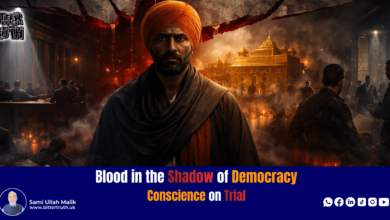
This is not the chronicle of a petty electoral dispute; it is a test of the very soul of the Constitution—a flame upon which rest the hopes of over a billion souls. The ballot paper, a mere slip of paper to the unthinking eye, is in reality the balance wherein are weighed both the claims of power and the trust of the people. Should the scales be tilted before the contest has even begun, the remainder is but a tawdry pageant—a “mockery of democracy” masquerading as the genuine article.
Today, Indian politics stands at a crossroads where the line between truth and falsehood has been wilfully blurred, and powerful hands labour to thicken the fog. Whether in the slogans of the Opposition or the protestations of the Government, the question that rings in every discerning mind are the same: “Is my vote still in my own hand, or has it been spirited away into another’s pocket?”
Let us not forget that when trust is betrayed, a nation loses not only its rights but also those chapters of its history that might have been inscribed with honour and dignity. The Qur’ān warns:
وَلَا تَكْتُمُوا الشَّهَادَةَ ۚ وَمَنْ يَكْتُمْهَا فَإِنَّهُ آثِمٌ قَلْبُهُ
“And do not conceal testimony; for whoever conceals it—his heart is indeed sinful.” — Sūrat al-Baqarah: 283
Nations do not flourish in the shadow of the gun, but in the shade of justice. If we fail to safeguard the sanctity of the vote today, then in the morrow’s textbooks, “democracy” will be but a lifeless word. This is the moment when every citizen must decide whether to remain a mute spectator or to inscribe their name upon the roll of those who stood in defence of democracy. For if we lose this battle, the future will question us—and we shall have no answer worthy of its hearing.
Indian democracy now teeters upon a fragile brink. The absence of transparency in voter lists, the needless entanglement of bureaucratic formality, and the partisan intrusion into the electoral process together shake its very foundations. This is no mere political affair; it is a moral and intellectual trial. The preservation of democracy lies not only in statutes and institutions, but in the consciousness of the people, the practice of justice, and the integrity of the process.
Should we fail to meet these challenges with resolve and swiftness, the generations yet to come will not only record us as culprits in history’s ledger but will see their brightest democratic dreams dimmed beyond recall. Now is the hour to make justice, transparency, and public trust the bedrock of the democratic order, and to ensure that every citizen enjoys unfettered freedom in the exercise of their franchise—so that the nation’s politics may advance towards a horizon illuminated not merely by power, but by moral clarity and intellectual purpose.
In the sum of all facts, charges, and analyses, one truth stands stark: the landscape of Indian elections has assumed a shape at once complex and contentious. The Opposition’s misgivings, the public’s waning trust, and the spectre of manipulation in electoral rolls cast a long shadow upon the democratic institutions of the State. This is a moment destined to be chronicled in history’s ink: when the people’s voice was disregarded, the very spirit of democracy was wounded. Every power that presumes to rule would do well to remember—without justice and transparency, the pillars of the State will crumble, and every act of fraud becomes a national scar. Hence it is not merely our right but our solemn duty to raise our voices against electoral malpractice, and to labour tirelessly to fortify the very principles upon which democracy itself is founded.