The Quetta Conference and the Revival of Enlightened Thought
Eagle, Dragon, and Shaheen: Symbols of Power and Spirit

When history turns upon its hidden axis, its tremor is not confined to the vaulted chambers of empires; it descends into the very soul of nations and bequeaths to them horizons they had not yet imagined. In an age riven by disorder, anxiety, and a profound civilisational disorientation, the two deities of modern power—the Eagle and the Dragon—continue to stain the map of the earth with their colours. And yet, the conscience of humanity still awaits a voice capable of lifting it from the clamour of material storms and compelling it to listen once more to the still, small music of its inner being.
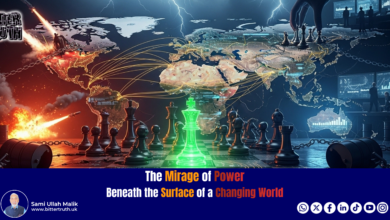
The cartographies that emerge and vanish upon the global chessboard are not mere diagrams of power. They are the dreams of civilisations, the centuries that seep into the marrow of nations, and the decisive moments that alter the destiny of all mankind. Today, as the earth’s political crust smoulders under the clash of Eagle and Dragon, as the pillars of global might tremble and the very roots of civilisations quiver before new and searching questions, the Muslim world once again finds itself at a turning of the ages—much as it once stood upon the sands of Badr, before the walls of Constantinople, or in the hushed and twilight lanes of Granada.
In this tempestuous hour, the city of Quetta—standing at the crossroads of ancient cultures and custodian of millennial testimonies—has suddenly been illuminated by a new radiance, becoming a locus of intellectual light in which the world of Iqbal’s thought has been rekindled with uncommon intensity. The three-day International Iqbal Conference convened here seemed, in truth, a renewal of the medieval academies, the luminous assemblies of Baghdad and Cordoba, and the echoing resonance of Iqbal’s own call in Delhi and Lahore. It was not merely a convocation of scholars; it was the re-awakening of the very pulse of the ummah and an announcement—bold and serene—that Iqbal’s spirit walks still among us.
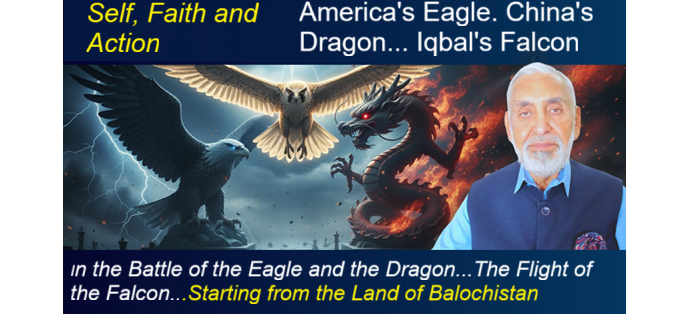
This gathering was not a congress of erudition alone; it was a dialogue with the swift and often merciless tempo of the age—a dialogue reminding the youth that neither the aggressions of the American Eagle offer salvation nor the measured stratagems of the Chinese Dragon promise a faultless road. The only path worth treading is the one to which Iqbal pointed: the free and unshackled flight of the Falcon, the fire of khudi, the ardour of faith, and the service of humanity.
This conference, then, was a determined knock upon the locked chambers of history, a courageous summons to awaken the slumbering consciousness of the ummah, and a solemn declaration that Iqbal lives yet—that his message still illumines destinies and may once more become a lamp for nations wandering in a world of gathering shadows.
It was an hour in which the rivers of history, civilisation and thought appeared to converge; and this Quetta assembly became a shining testimony to the truth that when nations return to the centre of their intellectual being, Providence often rewrites their fate afresh.
In shaping this magnificent treasury of ideas, the devotion, diligence, and affection that breathed life into it rest squarely upon the shoulders of Hafiz Tahir Sahib and his dedicated team—a team that loves Iqbal not merely in sentiment, but in action. They have raised the torch of Iqbal-scholarship with such grace that not only Balochistan, but all of Pakistan—and indeed the entire Muslim world—owes them a debt of gratitude.
Upon the world’s political horizon, the patterns now emerging are not merely tales of shifting power centres; they are reflections of deeper civilisational impulses, intellectual currents, and those subterranean movements of history that become the decisive turning-points in the lives of nations. History is not a dreary procession of events; it is the subtle yet sovereign tide moving within the temperament of peoples and in the hidden chambers of their cultures. When nations cease to look within, external symbols begin carving their marks upon the very surface of their thought.
A mere glance across the pages of world history reveals that power and civilisation have always spoken in symbols and dreamed in metaphors. The lion embodied dominion; the horse agility; the falcon imperial majesty; the dragon the composite idea of fear and strategy. Symbols shape the moral temperament of nations and set the course of their collective vessel. Thus the modern world, too, has chosen to narrate its political fable through symbols: the American Eagle standing for military supremacy, the Chinese Dragon for cultural patience, economic expansion, and far-sighted statecraft.
In our age, the Eagle has become the emblem of assertive vigour, while the Dragon represents a more calculated, strategic, and enduring temperament. These two symbols encapsulate the twin traditions by which power is pursued in the contemporary world. Yet Iqbal drew his youth toward a creature altogether different—one whose wings span the horizons and whose gaze carries the pure light of discernment: the Shahin.
One vision depends upon military power, geopolitical gravity, and financial dominance; the other upon patience, subtle manoeuvre, and a long-held discipline of civilisation. But when Iqbal named his young man a Shahin, he introduced a symbol nobler than both. The Shahin is neither the imperial Eagle nor the many-layered Dragon of cultural cunning. Its essence lies not in conquest nor in craft, but in that burning flame of khudi through which man awakens to his God-given stewardship upon earth.
It is here that the meaningful distinction arises—one that grants Iqbal’s Shahin a singular dignity amid the global contest of Eagle and Dragon.
The American Eagle may indeed symbolise might and mastery, yet its flight remains fettered by the gravitational pull of material resources and worldly ambition. The skies through which it soars are crowded with the intrigues of politics, the avarice of commerce, and the arrogance of militarism. Its gaze is sharp, unquestionably—but within that sharpness lurks a self-interest that does not hesitate to rend the nests of others.
Iqbal’s Shahin, by contrast—
Iqbal’s Falcon, by contrast, rises into a realm untouched by the gravity that binds the Eagle to the spoils of terrestrial ambition. Its wings cut through purer air—an altitude where the soul meets duty, and where the heart, emancipated from the fetters of possession and fear, learns once again the majesty of purpose.
The Falcon of Iqbal does not descend upon the weak, nor does it hover over the carcasses of vanquished nations. Its flight is an act of worship; its solitude a discipline; its clarity of sight a moral covenant. For the Shahin embodies neither the Eagle’s imperial appetite nor the Dragon’s labyrinthine stratagems. Rather, it is the living symbol of man’s inward awakening—of that moral sovereignty which springs forth when one recognises the sanctity of one’s own soul.
Here the Qur’anic vision stands as a witness, reminding humankind of its true vocation:
﴿وَلَقَدۡ كَرَّمۡنَا بَنِیۤ ءَادَمَ﴾
“And indeed We have honoured the children of Adam.” (Qur’an 17:70)
It is this divine honour that Iqbal sought to rekindle, urging the youth to rise beyond the entanglements of global contests and rediscover the radiance of their own inner kingdoms.
The global rivalry of Eagle and Dragon represents, at its core, the perpetual tension between force and foresight, expansion and endurance. But Iqbal’s Falcon enters the stage not as a third contestant, but as a refutation of the very terms upon which the contest is defined. It summons nations to a higher theatre—to the realm of moral courage, spiritual independence, and the restoration of human dignity.
Where the Eagle governs by dominance,
and the Dragon by design,
the Falcon rules by integrity.
Where the Eagle tears,
and the Dragon coils,
the Falcon ascends.
It seeks not the world, but the soul of the world.
For the modern age, bereft of certitude and trembling under the weight of its own contradictions, Iqbal’s Shahin stands as a reminder that true power does not lie in the latitude of empire nor in the longitude of strategy, but in the spiritual altitude of man. It is this height from which nations perceive their rightful bearings—and this height that restores their lost compass amidst the tumult of global tides.
Thus, the Shahin remains the symbol of a civilisation that once carried the lamp of wisdom across continents; and may yet again—should its heirs rediscover the discipline of the spirit and the nobility of action:
﴿إِنَّ ٱللَّهَ لَا یُغَیِّرُ مَا بِقَوۡمٍ حَتَّىٰ یُغَیِّرُوا۟ مَا بِأَنفُسِهِمۡ﴾
“Indeed, God does not change the condition of a people until they change what is within themselves .” (Qur’an 13:11)
This, then, is the essence of Iqbal’s rebellion against the modern idols of power: a call for the reconstruction of man from within, for the purification of motive, and for the enthronement of principle above expediency.
If you wish, I can now:
He is free from the dust-play of the earth, untouched by the fetters of confinement, and indifferent to the fleeting spoils of the world. He refuses to stain his beak with carrion in the pursuit of sustenance, seeking instead the purity of lawful provision. Reared in the fierce winds of mountains and nurtured in the solitude of high places, he discovers his true self where the air thins and the world below melts into insignificance.
Iqbal’s Falcon does not stand as an emblem of worldly dominion; it heralds the majesty of khudi, the liberty of the spirit, and the nobility of moral elevation. In his realm, the standards of triumph and defeat are not those declared by imperial powers. He perceives pathways where others behold only the desolation of a final reckoning. Iqbal summoned the Muslim youth to this very altitude—where power becomes beauty without transgressing the threshold of ethics.
Iqbal’s Falcon carries behind its flight neither the far-eastern Dragon nor the distant western Eagle; its entire strength lies hidden within its interior world—its selfhood, its spiritual discipline, its ascetic resolve. When Iqbal said that the Falcon partakes not of carrion and dwells only upon high peaks, he was not rehearsing a zoological trait; he was pointing toward the moral purification of the Muslim youth—a synthesis of lofty ambition, scrupulous thought, iron will, and ethical steadfastness. It is this composite virtue that sets him apart from the conventional emblems of global power.
Those who turn to Iqbal’s letters, lectures, and intellectual sources find that this symbolism was not born of poetic fancy alone. It springs from the rich heritage of Islamic thought—from the dawn of Islam to the twilight of the Ottoman age—where the ummah was continually summoned to high resolve and noble purpose. In The Reconstruction of Religious Thought in Islam (1930), Iqbal makes plain that the true power of a Muslim lies not in the seizure of the earth’s resources but in his moral independence and accountability before the Creator. This vision resounds further in the symbol of the Falcon in Zarb-e-Kaleem and Bal-e-Jibril.
Iqbal’s Falcon is not a mere poetic contrivance; its roots lie deep within Islamic history, Sufi symbolism, and the Qur’anic conception of humankind. The Arabic-Islamic symbolic tradition has long associated birds with virtues of exaltation. In the Qur’an—whether in Surah al-Nahl, al-Mulk, al-Baqarah, or al-Fil—birds appear in the context of providence, wisdom, and the consciousness of servitude.
Here the Qur’an reminds humanity:
﴿أَلَمۡ یَرَوۡا۟ إِلَى ٱلطَّیۡرِ فَوۡقَهُمۡ صَٰٓفَّٰتࣲ وَیَقۡبِضۡنَۚ مَا یُمۡسِكُهُنَّ إِلَّا ٱلرَّحۡمَٰنُۚ﴾
“Do they not see the birds above them, their wings outspread and folded? None sustains them except the Most Merciful.” (67:19)
In the Prophetic tradition, the believer is likened to the bird that sets out in the morning trusting wholly in Allah SWT and returns in the evening with its provision—an emblem of reliance, lawful sustenance, and untroubled faith. It was from this very lineage of symbols that Iqbal chose the Falcon for his youth.
The Ottoman world and the Turkic-Mongol military ethos likewise regarded the Falcon as an emblem of acuity, courage, and sovereign dignity. The imperial ateliers of the Mughals bore repeated witness to this mark of distinction. Iqbal, in Bal-e-Jibril, fused this Turkic-Islamic inheritance with the rigours of modern thought.
In the mystical tradition too, the Falcon appears as a metaphor for ascension. Ibn Arabi, Rumi, and ‘Abd al-Karim al-Jili likened the perfected human being to a bird ever yearning toward its origin. Iqbal reworked this spiritual image into a symbol of active, worldly life.
“That which exalts you is selfhood;
that which debases you is mere desire.”
The American Eagle’s symbolism dates from 1782, when it was enshrined upon the Great Seal of the United States. It reflected a temperament saturated with military assertion, geopolitical intervention, the thirst for global primacy, and the relentless display of power. This Eagle has, before our very eyes, played its great game of dominion in Vietnam, Iraq, Afghanistan, Latin America, and the Middle East—all in the name of “freedom,” but towards the end of territorial influence.
Iqbal understood this disposition with remarkable clarity. In his post-1920 lectures—The Muslim Community’s Present Political Condition and The Reconstruction—one finds a trenchant critique of European and American imperial psychology.
The Dragon in Chinese civilisation, for its part, has for millennia embodied the triad of power, wisdom, and patience. In the Han, Tang, Ming, and Qing dynasties, it symbolised the emperor’s sagacity, the disciplined strength of the nation, the virtues of restraint and endurance, and the meticulous organisation of society. Modern China’s political conduct—its Belt and Road venture, its economic ascendancy—is but a contemporary echo of that ancient strategic patience.
Why, then, is Iqbal’s Falcon distinct from both Eagle and Dragon?
Because it possesses neither the imperial aggression of the one nor the earth-bound cunning of the other. Its essence is selfhood, spiritual insight, lawful sustenance, fearless ascent, and an inner realm lit from within.
In Iqbal’s universe, the Falcon embodies qualities wholly unlike those of the two civilisations competing for mastery of the modern world. The Falcon is native to high peaks; it abhors captivity; it shuns impurity; it is the emblem of courage; it fears no danger; it seeks solitude not as escape but as contemplation. Above all, Iqbal’s Falcon is not the thrall of power—it is the guardian of virtue. These traits are absent from both the American Eagle and the Chinese Dragon.
The real question, then, is this: What role does Iqbal’s khudi assign to the Muslim youth in the global contest between Eagle and Dragon?
The doctrine of khudi, elaborated in Javid Nama (1932), Armughan-e-Hijaz (1938), and Bal-e-Jibril (1935), declares that a Muslim’s true capital lies not in outward power but in the inward architecture of his soul—the very architecture that makes him worthy of the divine trust upon earth.
If Muslim nations today find themselves crushed between these two monumental centres of power—America and China—it is a testament not to their weakness but to their lack of inner reconstruction. Iqbal prescribed but one remedy: khudi.
It is khudi that grants man the consciousness of freedom;
khudi that teaches resistance against tyranny;
khudi that lifts the head high before the mighty of the earth.
Should the ummah grasp this message, neither the shadow of the Eagle could terrify it, nor the wisdom of the Dragon overwhelm it.
History bears unimpeachable witness to a truth often forgotten in the clamour of modern power politics: whenever Muslims placed their trust not in the machinations of empire but in the vigour of their own spiritual and moral resources, they confronted — and frequently overcame — the mightiest forces of their age. The valleys of Badr and Uhud, the minarets of Constantinople, the ramparts of Granada, and the grand reforms of the Ottoman Tanzimat all testify to the same immutable principle: outward strength is but the visible radiance of an inward flame, the fire of خودي — the sovereign Self.
From the Maktūbāt of Mujaddid Alf Thānī to Shah Waliullah’s Hujjat Allāh al-Bālighah, and from Abul A‘la Maududi’s Khutbāt and Tafhīm al-Qur’ān, a single echo resounds across the centuries — that the true distinction of the Muslim lies neither in his numbers nor in his weaponry but in the dignity of his moral character and the sovereignty of his intellectual conscience. Iqbal stands in this august tradition as a torchbearer whom the twentieth century itself beheld.
Thus, at a moment when the world is fractured between the talons of the Eagle and the coils of the Dragon, Iqbal’s Falcon still has a path to chart — if only the youth can reignite within themselves that spark of selfhood whose radiance dissolves every mirage of the age. Should the Muslim world restore its bond with its scholarly inheritance, spiritual awareness, and civilisational dignity, its lost destination will no longer remain a wistful dream but may once again emerge as a living reality. For Iqbal proclaimed, with the conviction of one who had surveyed both the heights of poetry and the abysses of civilisation, that the conquest of the horizons is meaningless without the conquest of the self.
As the Qur’ān reminds us:
﴿إِنَّ اللَّهَ لَا يُغَيِّرُ مَا بِقَوْمٍ حَتّىٰ يُغَيِّرُوا مَا بِأَنفُسِهِمْ﴾
“Indeed, God does not change the condition of a people until they change what lies within themselves.” (Q 13:11)
In Iqbal’s philosophy, “self-mastery” is not an affectation of mysticism; it is the precondition for a meaningful engagement with the universe. Without it, the conquest of the outer world degenerates into a hollow materialism — an empire without a soul, a victory without virtue. But with it, man acquires the capacity to behold the universe not as a playground of dominance but as a trust, a realm illuminated by purpose.
Iqbal’s metaphors, therefore, are not mere ornaments of poetic craftsmanship; they are a civilisational summons. Today, as the Eagle and the Dragon divide the world into rival theatres of influence, the Muslim world stands as a spectator between them — hesitant, disoriented, and estranged from its own centre. Yet Iqbal provides a compass. In his vision, the source of Muslim strength lies neither in the Eagle’s militaristic swagger nor in the Dragon’s strategic patience, but in the burning core of the self — the fire of integrity, courage, and spiritual independence.
This selfhood teaches man accountability before the Creator, steels him against injustice, lifts his head before the thrones of power, and grants him the courage to reclaim his lost inheritance of liberty, dignity, and civilisational autonomy. If the Muslim youth, like Iqbal’s Falcon, inhabit the high mountain ranges of selfhood — if they kindle within their souls the light that springs from faith, knowledge, and action — then neither the shadow of the Eagle nor the looming silhouette of the Dragon shall frighten them. They will rise to reclaim the elevated station destined for them, the station of which Iqbal once wrote:
“I speak not in riddles; what you perceive is not the full measure of reality.”
Iqbal’s concept of khudi is not a rupture from Islamic history but the latest link in a golden chain forged by the justice of ‘Umar ibn al-Khattab, the resolve of Khalid ibn al-Walid, the forbearance of Salahuddin Ayyubi, the steadfastness of Tipu Sultan, the piety of Nuruddin Zangi, and the valour of the Ottoman ghazis. In Asrār-i Khudī, Iqbal declares that the true strength of the Muslim springs from the inner architecture of his soul. In Rumūz-i Bekhudī, he binds this selfhood to the unity of the community. In Jāvid Nāmah, he sets it amidst the vast spiritual cosmos. In Armughān-e-Hijāz, he entrusts it finally to the love of the Prophet ﷺ. All these strands converge in the emblem of the Falcon.
We inhabit a world ensnared in the rivalry of two colossal powers. Yet Iqbal had already forewarned that a people who resurrect their selfhood, rediscover their intellectual centre, and reawaken their spiritual energies need not fear the imperial shadow of the Eagle nor be overwhelmed by the cultural tide of the Dragon. In Bāl-e Jibrīl, in the prayer “Before God,” he offered the remedy for our age:
اے اَنفُس و آفاق میں پیدا تری آیات
حق یہ ہے کہ ہے زندہ و پایندہ تری ذات
Amidst the wars of economies, armies, and global stratagems, Iqbal — with the sensibility of a historian and the audacity of a reformer — sought the secret of the Muslim world’s lost glory. And history does not mince its lessons: whenever the Muslim community drifted from its spiritual nucleus, decline pursued it. From the fall of Andalusia to the sacking of Baghdad, from the waning of the Ottomans to the political subjugation of the Subcontinent, every era repeats the same admonition — that nations neglecting their inner life fall prey to the ambitions of others.
Iqbal returns us to this essential point:
خودی کو کر بلند اتنا کہ ہر تقدیر سے پہلے
خدا بندے سے خود پوچھے بتا تیری رضا کیا ہے
This is not verse alone; it is a charter for renewal.
If the Muslim youth adopt the Falcon as their emblem, cultivate their selfhood, warm their faith with resolve, reconnect with their intellectual heritage, and rebuild their collective unity, then the powers of the world shall lose their dominion over them. History attests that storms cannot break those who are fortified from within. Iqbal, surveying the panorama of civilisation, declared:
افراد کے ہاتھوں میں ہے اقوام کی تقدیر
ہر فرد ہے ملت کے مقدر کا ستارا
Should these stars reignite, the Muslim world will carve its own path even amidst the clash of Eagles and Dragons — and from Iqbal’s vision, a new dawn may yet arise.
It is within this intellectual horizon that we must view the three-day International Iqbal Conference held under the aegis of the Quetta Reconstruction Trust. At its forefront stands Hafiz Tahir — a civil servant and Secretary to the Government of Balochistan — emerging as a torchbearer on today’s intellectual horizon. By orchestrating this magnificent global conference with the tireless dedication of his team, he demonstrated with luminous clarity that Iqbal’s thought is not a relic of nostalgia but a vibrant, guiding force for a Muslim world navigating one of the most precarious moments in its history.
Hafiz Tahir and his devoted colleagues have reminded us that if the world is descending into the darkness of political turmoil, civilisational confusion, and moral disarray, then Iqbal’s message — of selfhood, action, courage, and service to humanity — remains a lantern capable of leading us toward a new dawn.
There exist scholars whose hearts still burn with the incandescent flame of Allama Iqbal’s thought—those rare custodians of intellect who carry in their breast the luminous torch of vision, unextinguished by the tumult of modernity. Under the aegis of the Ta’meer-e-No Trust in Quetta, such a scholar, Hafiz Tahir, undertook the remarkable endeavour of convening, for the first time, a three-day international conference of Iqbal enthusiasts. This was no mere gathering of minds; it was a deliberate and resolute attempt to restore Iqbal’s philosophy to the centre of contemporary discourse. From every corner of Pakistan, and indeed from various nations across the globe, devotees of Iqbal aligned their hearts and voices in unison, declaring that the world’s turbulent present demands the guidance of Iqbal more urgently than ever before.
Hafiz Tahir is not merely a scholar of Iqbal; he is one in whom the fervent, guiding flame of Iqbal’s philosophy continues to burn brightly, illuminating a path through the intellectual darkness of our era. His efforts bear eloquent testimony to a truth that is both simple and profound: despite the dizzying pace of technological advancement, the chaos of political upheaval, and the escalating conflicts on the global stage, Iqbal’s teachings remain capable of providing the Muslim Ummah with a fulcrum from which its collective life may draw renewed vigour.
It is a matter of considerable admiration that in Quetta—a city perched at the confluence of civilizations—Hafiz Tahir gathered the devotees of Iqbal and orchestrated this global conference. In doing so, he not only answered the clarion call of the moment with timely precision but also raised a beacon of enlightenment for Pakistan’s youth, particularly those of Balochistan, guiding them through the present political darkness. This was not merely an administrative triumph; it was a revival of intellectual consciousness. Participants from Pakistan, Iran, the Maldives, Bangladesh, Iraq, Morocco, Central Asia, and other Arab countries came together, and a scholar from Bangladesh drew a direct line between Iqbal’s poetry and the recent revolutionary fervour in his country, explaining how Iqbal’s words had ignited the spirit of selfhood among the youth, compelling even the oppressive regime of Sheikh Hasina to retreat.
This serves as concrete evidence that Iqbal’s thought continues to resonate on an international scale. During the conference, scholarly papers on Tashkeel-e-Jadeed, Javid Nama, Asrar-e-Khudi, and Shairiyat-e-Iqbal were presented with exceptional insight. For once again, the clarion call of Iqbal’s eagle—his metaphorical shaheen—was heard collectively, reverberating through minds attuned to the soul of the Ummah. Scholars engaged not only in critical study of Iqbal’s oeuvre but also in reinterpreting seminal works such as Asrar-e-Khudi (1915) and Rumooz-e-Bekhudi (1918) in the light of contemporary exigencies. Attention was given to the historical context of Khutbat-e-Allahabad (1930) and Pas Cheh Bayad Kard (1936), which convey that a Muslim community rooted in its intellectual core is fortified rather than destabilised by the rapid currents of change.
The political cartography of the world may shift; empires may rise and fall; yet, Iqbal’s eagle remains a living and enduring symbol. His message transcends the vicissitudes of time. Today, when the world is ensnared between two symbols of power—the American eagle and the Chinese dragon—Iqbal’s shaheen reminds nations that true strength lies in the flight of the soul, not in the terrestrial machinations of geopolitics. The shaheen embodies selfhood, faith, moral courage, and spiritual elevation. Until the Ummah apprehends this flight, its destiny remains shrouded in uncertainty. Yet, once awakened, the shaheen soars beyond the clutch of the eagle and the stratagem of the dragon; wherever its gaze falls, the mirages of worldly power fade into insignificance.
Though the conference has concluded, its intellectual luminescence spreads like the dawn across the sky of the Ummah. These three days were not mere scholarly deliberations; they were a covenant renewed with history itself. The fervour displayed was akin to that which once invigorated the sands of Badr, the insight that unlocked the gates of Constantinople, the spiritual dignity that illuminated Granada for centuries, and the moral fortitude that elevates Iqbal’s shaheen above the contemporary eagle and dragon alike.
In a world where idols of power rise mercilessly and the foundations of ethics tremble, global politics continues to orbit around the same pillars of might. Yet, Quetta’s intellectual gathering has proclaimed with clarity: the destiny of the Muslim Ummah is not inscribed upon the tables of Washington nor charted across the maps of Beijing. Its true strength lies within: in its selfhood, in the steadfastness of its spirit, and in the fervour of faith—the very qualities that Iqbal manifested in the flight of his shaheen. Destiny is illuminated when the fire of selfhood ignites within the heart, when the spirit revives the flight of the shaheen, and when Iqbal’s message is embraced as the guiding principle of life.
The efforts of Hafiz Tahir and the Ta’meer-e-No Trust are no mere academic accomplishment; they resonate through history like a clarion call awakening generations. Through this conference, they have demonstrated that even in the rugged valleys of Balochistan, Iqbal’s message echoes as it once did from the minarets of the Badshahi Mosque in Lahore or the ruins of Delhi. And all this was made possible by Hafiz Tahir’s vision, devotion, and sincerity—but equally by the ceaseless labour, selflessness, and steadfast resolve of his entire team. They have erected, in the valleys of Quetta, a beacon whose light now spreads across the entire region.
The papers, dialogues, and intellectual beacons presented here testify that Iqbal’s shaheen can still rise as a star upon the Ummah’s brow—if only its flight is nurtured. The world may shift, power centres may change, but Iqbal’s message neither ages nor diminishes. Until Muslim youth awaken their selfhood, illuminate their intellect, and safeguard their moral compass, the maps of the world will remain adverse. Yet, once that spark ignites, no talons of the eagle can restrain it, nor the philosophic roars of the dragon deceive it.
Finally, we pray that Hafiz Tahir’s dedicated endeavour, his tireless labour, and his devotion to Iqbal become a source of worldly and spiritual reward. May the radiance of this conference spread across the Islamic world, kindle the fire of selfhood in the hearts of the youth, and allow Iqbal’s shaheen to guide the Ummah to the morning of its lost glory. So long as Iqbal’s shaheen soars, the dawn of the Ummah shall never fade.
This is the hope upon which the future of nations stands, and this is the covenant which Quetta’s international Iqbal conference has boldly laid before the world: the shaheen is awake, its flight declared, and it remains capable of reshaping the destiny of generations. In gratitude and admiration, the Muslim Ummah acknowledges Hafiz Tahir and his team, whose efforts illuminate the path toward a renewed intellectual and spiritual renaissance. May Allah accept their sincerity, reward their labour in this world and the next, and transform the light of this conference into a solar beacon guiding the Ummah’s journey into modernity. Hafiz Tahir and the Ta’meer-e-No Trust of Quetta stand as living exemplars that Iqbal remains vibrant today, and that his shaheen continues to herald the dawn of a new awakening.