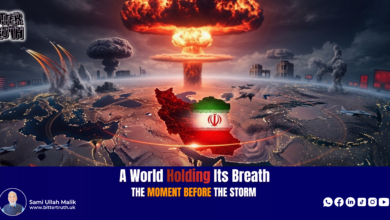

The Nuclear Threat, Pakistan’s Resolve, and the Battle for Peace
Pakistan's Message: Strength, Dignity, and Unity

At the Crossroads of Time: A Call to Conscience in South Asia
By a Voice from the Soil
Today, I take the solemn liberty to address not merely my fellow countrymen, but the custodians of thought, the keepers of the pen, and all those whose hearts still beat for this sacred earth. For we find ourselves not in an ordinary moment of history, but upon a milestone — where time itself seems to draw breath before leaping into the unknown.
The winds that sweep across South Asia today are no ordinary gusts. They carry with them the mourning of time, the echoes of centuries long past. These are the very breezes that once sowed the seeds of civilization along the banks of mighty rivers, and yet, at times, bore away the wreckage of war-torn galleys.
This is no mere passage of fleeting hours. It is a charged instant, a solemn reckoning — the kind of moment that etches its imprint upon the forehead of nations. It is that fateful cusp where words are not spoken but unsheathed; where decisions are not cast in ink alone, but carved into the conscience of peoples.
This is no ordinary hour — it is one in which words outweigh gunpowder. A single sentence now echoes louder than cannon fire; a stray remark may carry the force of a battalion’s march. The very cadence of speech has grown sharper than steel, more piercing than the sword. In such moments, history dips its quill, and fate begins to script the future in indelible ink.
The clouds that loom over the South Asian horizon are not merely of political tension — they are the unsettled dust of antiquity, stirred once more by the collapse of civilizations past. The air is thick not just with debate, but with the sighs of time itself — an aching remembrance of what was, and a trembling forewarning of what may yet come.
India and Pakistan — these are not merely two states but twin memories, two histories, two dreams that once shared a single vision. The tensions that now rise between them are not matters of mundane diplomacy. They are the same ancient strains that once echoed from the peaks of the Himalayas to the depths of the Indus Valley. And let it be known — we remember. Everything.
When two nuclear powers unleash not their arsenals but their tongues — charged with the fire of rhetoric — know that the danger is not confined to borders alone. It is the very edge of our collective civilization that now trembles. India and Pakistan today speak not merely with passion, but with peril. This is not diplomacy — it is destiny wielding a blade.
And now, when one side threatens to “stop the water,” it is not merely the rivers they seek to dam — it is the very fountain of our shared civilization. The Ganges and the Indus are not mere rivers; they are the arterial lifeblood of a people. To obstruct them is not hydro politics. It is a desecration — a defiance of the very soil that was nurtured by sacrifice and sealed with the blood of generations. It is a rebellion against history.
Prime Minister Modi’s statement — that intruders will be punished beyond imagination — is not a
policy position. It tolls like a bell of hubris. That very bell once echoed through the annals of tyranny — tied, in its time, to the boots of Nimrod, Pharaoh, and Hitler. And now, it reverberates ominously across the subcontinent.
When Pakistan’s National Security Committee declares that any disruption of the Indus Waters Treaty would be deemed an act of war, it speaks not merely for a cabinet — but for 220 million hearts. It is the echo of a nation that once found its spirit in the verses of Iqbal, and its strength in the deeds of its soldiers.
Not so long ago, in the fields of Chawinda, our sons stood their ground against the world’s largest tank assault — and turned the tide with such valour that their adversaries reversed their tanks rather than face their resolve. What Iqbal envisioned in verse; the enemy recorded in fact:
خودی کو کر بلند اتنا کہ ہر تقدیر سے پہلے
خدا بندے سے خود پوچھے، بتا تیری رضا کیا ہے۔
“Raise thy selfhood so high that God Himself may ask thee: ‘Tell me, what is thy will?’”
Let us, then, revisit the origins of this hydrological fault line.
The Indus Waters Treaty, signed in 1960 under the auspices of the World Bank, was not merely a legal instrument — it was a compact of peace between two postcolonial siblings. It awarded the three eastern rivers — Sutlej, Beas, and Ravi — to India, and the three western rivers — Indus, Jhelum, and Chenab — to Pakistan. Despite wars and crises, the treaty held firm — a slender thread binding the subcontinent’s sanity.
Yet now, we hear voices in India that seek to review, revoke, or reinterpret the treaty. There are whispers of full utilisation of western rivers by India — rivers upon which Pakistan’s agriculture and survival depend. To weaponise water is to flirt with environmental apocalypse.
India’s construction of hydroelectric projects like Baglihar, Kishanganga, and Ratle has already raised alarms. Though these do not overtly divert flows, they give Delhi strategic control over seasonal water releases — enough to cripple crops and shake economies. Pakistan has raised objections at the United Nations and other international fora but has been met with delay and deferral.
And so, we arrive at this moment — tense, trembling, and teetering on the edge.
Two nuclear nations now trade threats not across trenches, but through tweets. Yet let none mistake rhetoric for mere noise. It is thunderclouds cracking across the conscience of the world. If this storm breaks, it shall not respect borders. It shall not choose sides. It will simply consume — indiscriminately, irreversibly.
Let us not allow language, that noble vessel of human dignity, to become the carriage of catastrophe.
Let India and Pakistan remember these are not times to unsheathe swords of pride, but to forge ploughshares of peace. Let the rivers flow as they have for millennia — not just through valleys, but through hearts.
For it is not too late — history still holds its breath.
The Waters of Destiny: A Reflection on Sovereignty, Conflict, and Conscience
As we are all too aware, the economic lifeblood of Pakistan flows through the furrows of its fields. Agriculture is not merely an occupation here—it is the pulse of the nation. And water, the quiet architect of our harvests, is the sine qua non of this pulse. Without its continuous and reliable flow, crops wither, livelihoods suffer, and the nation trembles. It is thus that the Indus Waters Treaty is not just a diplomatic document—it is the vein through which the life of a nation courses.
Many of Pakistan’s hydroelectric endeavours hinge upon the uninterrupted generosity of these rivers. A disruption of their flow could plunge not only our power sector into disarray but shake the very foundations of our environmental and economic equilibrium. The Delta of Sindh—once cradled by the tides—is already beginning to taste the salt of its undoing.
For years, there lingered a disquiet—a growing sense that the present Indian regime, draped in the ideological garb of Hindu nationalism, might one day use water not as a gift of nature, but as a weapon of coercion. Today, that once-dormant suspicion has awakened into the chill certainty of reality.
The Indus Waters Treaty, hailed by the international community as a beacon of bilateral endurance—has survived the cannon-smoke of four wars. That it has never been weaponised is a testimony not only to its diplomatic resilience but also to the quiet wisdom of both nations. But now, alas, there looms a shadow—a whisper of Chanakyan machination. It appears the present Indian government, in its pursuit of electoral victories and nationalist fervour, may well risk the incineration of the entire region. Recklessness, it seems, now masquerades as statesmanship.
Before we peer into that abyss, let us—if only briefly—pause and look back. Have we forgotten the fall of Rome? Have we not heard the echo of Baghdad’s burning libraries in our dreams? Do Hiroshima and Nagasaki not haunt the trembling conscience of every thinking man?
Let us remember: an atomic bomb is not a mere explosion—it is a silence that speaks through generations. Once the ash descends, no call to prayer stirs the air, no church bell chimes, no mother sings, no child laughs. It is a silence that pierces beyond the grave.
So, O dwellers of this ancient subcontinent—can we truly afford to see the day when our skies blacken, our lands burn, and our rivers run red?
When a nation threatens to stop the flow of our rivers, it does not simply deny us water—it seeks to sever the very artery of our existence. It is an act not of policy, but of provocation. It is not hydro politics—it is hydraulic warfare.
The recent declaration of Pakistan’s National Security Committee—that any interruption of our waters shall be viewed as an act of war—was no careless rhetoric. It was a solemn oath—carved not merely in the voice of a government, but in the breath of 240 million souls who know too well the cost of silence and submission.
This is the same Pakistan that wrested freedom from the jaws of empire, that counts its martyrs’ blood not in sorrow but in honour, and whose soil is steeped not in compromise but in resolve.
We know what nuclear war means. Not merely ruin—but obliteration. Not only battlefields—but barren wombs. Radiation does not distinguish between soldier and infant. It does not halt at borders. It lingers, it poisons, it silences—forever.
And so this is not a time for sabre-rattling. It is a moment that demands wisdom, dignity, and restraint. We are not the custodians of conflict—we are the heirs of peace. We believe in the pen, not the blade. But should our sovereignty be assailed; our silence shall roar like thunder from the heavens.
We do not desire war—but neither shall we purchase peace at the cost of national dignity. We are ambassadors of knowledge and reason—but should the need arise, our unity shall echo louder than any bomb.
Now is the hour to unite—as stones stand firm against the river’s force, so too must we stand against every stratagem that seeks to divide or debilitate us. Let us rise above sectarianism, above linguistic and political divides, and present to the world a Pakistan that is not only a nuclear power—but a moral force, a cultural beacon, and a citadel of conviction.
If India, drunk on power, wishes to test us—it must remember: this nation has never bowed, and it shall not now. But let the world also understand—should nuclear war erupt; it will not be merely Delhi and Islamabad that suffer. It shall be the funeral of civilisation itself.
To those who hold the reins of power, let conscience be their counsel. Let them not forget—the fate of nations is not written at negotiation tables but carved into the stones of graves.
To the United Nations, to the powers of the world, to the so-called defenders of human rights—where are you? Do you rouse only when oil fields are threatened? Is the peace of millions so trifling in the calculus of your diplomacy?
If today you remain silent—then tomorrow only silence shall remain. And to the conscience of the world, let this be said: your complicity shall not be forgiven by history.
Pakistan—shall remain. Until the end of time—Pakistan shall endure. With its knowledge, with its resolve, with its colours flying not just from flagpoles, but from every pulse that beats in defiance.
Let us not desire to see that dreadful day—when cities are cloaked in shadows, when the ghost of Hiroshima revisits our lands. We do not seek war—but if it is thrust upon us, let the world know: this shall not be a war between nations. It shall be a war against the very soul of humanity.
This is the moment. The moment when we, the people of Pakistan—and the world entire—must build a new fortress of words, not weapons. For when language falls, so does civilisation. Let us remember wars are fought not only in fields—but in minds. And should we lose that intellectual front, even our atom shall remain a silent giant—mighty, but blind.
To the People of Pakistan: A Clarion Call in the Shadow of Storm
O compatriots, a spectre looms upon our horizon — a harbinger not of certain doom, but of grave warning. War edges closer, yet peace, though fragile, is not beyond reach. If only we do not extinguish the lamp of reason; if only we do not abandon the lessons etched in the stone of history; if we resolve to wield not the sword but the torch of peace — then perhaps, even from this enveloping dusk, we might summon a dawn anew.
Let us then, make not of our words cannons nor of our rhetoric swords, but rather fashion from them melodies — harmonies that echo reconciliation, reverberate with the cadence of history, and whisper the quiet promise of a future where dignity is our right, and survival is not bartered at the altar of aggression. Let those who conspire to sever the thread of our existence be reminded: the yearning to live grants no license to play god with another’s breath. Tyranny, like a candle in the storm, may burn for a time, but it is destined to gutter out.
O people of this sacred land, we must arm ourselves — not with weapons wrought of steel, but
with the arsenal of knowledge, the ramparts of character. We must mount the high ground of moral clarity, and let our unity be the banner under which we march — undivided, unbowed, unyielding. Let it be known to the world that this nation — forged not merely in territory, but in belief — shall not be broken, bought, or banished.
Rise then, O Pakistan! Like a fortress of molten lead, cast aside petty divisions — of language, of sect, of politics. Today, we must forge a chain of unity stronger than the currents of rivers, firm enough to dam the flood of discord. Today, we must declare to the world: we are not merely a nuclear power, we are a moral power, an intellectual nation, a civilisation rooted in decency and determination.
Let this be etched into the conscience of all:
When our waters are blocked, it is not mere irrigation that is choked — it is breath itself. And we shall not remain silent.
Though armed with atomic might, our truest strength lies in unity, dignity, and justice.
The soil of Pakistan is imbued with honour, not compromise.
Should silence prevail now, tomorrow shall echo only with emptiness.
We shall neither bend nor barter. For Pakistan, every sacrifice shall be embraced.
This land is not a mere coordinate on a map — it is an idea. And ideas cannot be erased.
Pakistan is the resting place of martyrs; and every martyr is a crown upon our heads.
A nuclear war would scorch not just two nations — it would disfigure humanity itself. It would be apocalypse before the apocalypse.
To our stewards in power, a sacred duty is upon you:
Raise this matter — not in anger, but with unflinching resolve — in the courts of diplomacy.
Improve the stewardship of our waters at home, lest scarcity breed strife.
Invest in the promise of the sun and the whisper of the wind — in clean and renewable energy.
Let regional and international platforms not be idle monuments, but instruments of peace and justice.
And before I conclude, allow me to summon once more the soul-stirring voice of Iqbal:
نہیں ہے ناامید اقبال اپنی کشتِ ویراں سے
ذرا نم ہو تو یہ مٹی بڑی زرخیز ہے ساقی
“Nahin hai na-umeed Iqbal apni kashte-veeran se,
Zara nam ho to yeh mitti bohat zarkhez hai, Saqi.”
Iqbal is not hopeless with his desolate land. If it is a little moist, this soil is very fertile, Saqi.
Let the soil of this land, moist with the tears and toil of its people, birth not despair, but destiny.
Let the banner of Islam and of Pakistan rise ever higher, God willing — for this nation is not of death, but of resolve; not of war, but of will. And our will shall not falter.