
The Jugular of the Homeland Shall Not Be Bartered
The Chessboard of Empire and the Promise of Truth

(الانفال:60)”وَأَعِدُّوا لَهُم مَّا اسْتَطَعْتُم مِّن قُوَّةٍ”
“And prepare against them whatever force you can muster, and steeds of war, to terrify thereby the enemy of God and your enemy…” — Al-Anfāl: 60
My Lords, this verse is not merely an injunction preserved upon the sacred pages of the Qur’ān; it is an everlasting summons to every nation that values its honour and understands the steep ransom of survival. The world today stands at a precarious juncture, where the destinies of peoples are shaped not solely in the clash of arms, but within the chanceries of diplomacy, upon the scaffolding of economic strength, and along the battlements of alliances.
Upon the troubled horizon of our subcontinent there gathers not a gentle breeze, but a tempest—a tempest that uproots the frail tents of the unprepared and tempers into steel the bastions of the resolute. History’s pages testify: when nations awaken the springs of their power, even the proudest empires have bent the knee.
In this age of swift and sudden turns—where the fate of nations may change in an hour, and where contests are waged as often behind the thick curtains of diplomacy as in the open field—a fresh chapter has been opened. At its centre stand men of the field, their gaze unshackled by the tyranny of time and place, their stride sure even in the fog of circumstance.
It was thus that the air of Delhi quivered of late—not from street protests, but from within India’s own martial citadels. Serving and retired generals alike dared to utter a truth seldom voiced: that the security of a realm is not merely the charge of cannon or the flash of sabre, but rests equally upon the solidity of its economy, the wisdom of its statesmen, and the trust of its people. This candour travelled to the very court of Prime Minister Narendra Modi—a court too often intoxicated by the vintage of authority to heed even the murmurings within its own ranks.
Meanwhile, Pakistan’s Chief of Army Staff, Field Marshal General Asim Munir, returned from his second visit to the United States in six short weeks—not as a petitioner, but as an architect of relations renewed. At the headquarters of United States Central Command in Tampa, during a dignified change-of-command ceremony, he stood as Guest of Honour. There, General Michael Kurilla commended his role in breathing new vigour into the bonds between our two nations—a clear sign that Pakistan stands today as a steadfast, dignified, and active force upon the global stage.
(العمران:139)”وَلا تَهِنُوا وَلا تَحْزَنُوا وَأَنتُمُ الأَعْلَوْنَ إِن كُنتُم مُّؤْمِنِينَ”
“So do not weaken, nor grieve; you shall be the uppermost, if you are believers.”
Bloomberg, in its analysis, called this visit a milestone in the reconstruction of bilateral ties, with the prospect of trade agreements opening the gates to investment as welcome as rain upon parched earth. Yet, amidst this warmth, the skies are not free of storm-clouds. General Munir’s warning was stark: India has brought the region to the brink of dangerous conflict, and Pakistan will respond to any aggression in full measure. Kashmir, he reminded us, is neither India’s “internal matter” nor shall it ever be; it remains an unfinished question in the annals of the world—echoing the words of Quaid-e-Azam Muhammad Ali Jinnah: “Kashmir is the jugular vein of Pakistan.”
At Tampa, he unmasked India’s claim to be Vishwaguru as a mirage, its reality being the chief agent of instability in the very region it pretends to lead. Our recent triumphs, he said, are the fruits of God’s grace, of our nation’s collective effort, our political leadership’s foresight, and the professional mettle of our armed forces. The question before us is not whether we shall rise, but how swiftly, and with what strength.
It was the BBC’s own Verify service that confirmed three videos purporting to show the wreckage of a French-built Rafale in Indian service—one geolocated to Bathinda in Punjab, with uniformed personnel gathering the debris. A respected Chinese think-tank ridiculed the Indian Air Chief’s belated claim and rebutted it with solid evidence. International defence analysts have openly called this fabrication a fresh humiliation for Mr Modi’s government.
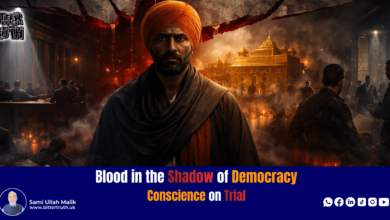
But, my Lords, this is but one link in a darker chain. Across continents, the clandestine footprints of India’s Research and Analysis Wing are evident: the assassination of a Sikh leader in Canada; the shadowed trial of eight Indian naval officers in Qatar; and the grim dossier of Kulbhushan Jadhav.
On 18 June 2023, in the car park of a gurdwara in Surrey, British Columbia, Hardeep Singh Nijjar was cut down. Canadian security agencies, discerning the shadows of Indian state agents, launched an inquiry of the gravest kind. Prime Minister Justin Trudeau demanded cooperation from New Delhi. In 2024, the Royal Canadian Mounted Police arrested three men of Indian origin on suspicion of involvement. The consequence was rupture: envoys expelled, High Commissioners withdrawn, and the courteous lexicon of diplomacy replaced by the sharper idiom of accusation. CSIS called the killing a new and dangerous escalation in transnational coercion; Australia, Britain, and the United States voiced concern.
The second act unfolded in the Gulf. In August 2022, Qatar seized eight former Indian naval officers, accusing them of espionage for Israel. The initial verdict was death—a thunderclap in New Delhi. Through urgent legal and diplomatic manoeuvre, the sentences were commuted by December 2023; by February 2024, seven were repatriated. Yet the full judgment remains under seal, and the affair still whispers of maritime secrets and Gulf intrigue.
The third truth lies in the dust of Balochistan, where in 2016 Kulbhushan Jadhav was seized. Tried and sentenced to death for espionage and terrorism, he confessed to orchestrating violence in Pakistan, with hundreds of lives lost. India called the trial unlawful; the case went to The Hague, stirring debates on sovereignty, justice, and the limits of international law.
These three cases—Nijjar, the Qatari officers, and Jadhav—are not isolated curiosities, but links in a single chain, each forged in covert action, each sending tremors through the world’s diplomatic seismographs. From the snows of British Columbia to the warm waters of the Gulf and the arid hills of Balochistan, the trail is the same: a nation that aspires to the title Vishwaguru while undermining the norms it professes to uphold.
My Lords, the hour demands not mere rhetoric but resolve—the resolve to meet falsehood with fact, aggression with vigilance, and instability with the steady hand of principle. For history’s ledger will not be balanced by boast or pretense; it will be settled by truth, and by the judgement of nations whose patience is not infinite.
Thus, these three episodes—occurring in disparate places, under differing circumstances—bear witness to one immutable truth: that in the politics of this region, the intelligence services are not mere backstage whisperers, but at times the very hand that overturns the chessboard itself. And with each such move, the great game of diplomacy, law, and international reaction enters a fresh and perilous phase.
History, in its unblinking record, testifies that when nations abandon the firm foundations of justice and surrender to the intoxication of power, their steps slip from the ṣirāṭ al-mustaqīm. As the Lord Almighty has declared:
وَلَا تَبْغِ الْفَسَادَ فِي الْأَرْضِ إِنَّ اللَّهَ لَا يُحِبُّ الْمُفْسِدِينَ۔۔۔(القصص:77)
“Do not commit abuse upon the earth, for indeed Allah does not love the corrupters.”
India, which aspires to anoint itself the Vishwaguru of the world, now fans the flames of bloodshed, mistrust, and explosive discord in this region through its clandestine hand. In the snowbound quiet of Canada, the bloodstains of Sikh leader Hardeep Singh Nijjar bear enduring witness that no matter how shadowed the stratagem, it will one day stand exposed beneath the midday sun. When Ottawa’s intelligence reports hinted at the complicity of Indian agents, the gentle fabric of diplomacy between the two capitals tore into threads of acrimony. Envoys were expelled, words became poisoned, and the conscience of the world was confronted with the question: can a state that claims the mantle of democracy also speak fluently in the language of assassination?
From the waters of the Gulf emerged another chapter: the Qatari courts pronounced the death penalty upon eight Indian naval officers, convicted of espionage on behalf of Israel. The judgment fell upon Delhi’s politics like a thunderbolt. Eventually, Prime Minister Modi’s personal intervention secured a commutation, yet the question remains—if there was no crime, why intervene? And if there was a crime, why pardon? History will keep those questions alive.
But the starkest truth lay buried in the sands of Balochistan, where Kulbhushan Jadhav, with his own lips, confessed all that marks the enemy’s spy—designs of terror, the sacrifice of innocent lives, and the intent to tear the fabric of Pakistan’s peace. His death sentence stood not merely as a measure of justice, but as a message to the world: that Pakistan shall tolerate no aggression upon its soil.
O people of discernment! These three episodes are not mere items in a news bulletin—they are wounds upon the very soul of the region. They are a reminder that bāṭil ever weaves its web of conspiracy for survival, yet of ḥaqq the Lord of the Worlds has pledged:
بَلْ نَقْذِفُ بِالْحَقِّ عَلَى الْبَاطِلِ فَيَدْمَغُهُ فَإِذَا هُوَ زَاهِقٌ (الأنبياء:18)
“Rather, We hurl the truth against falsehood, and it crushes its skull, so it perishes.”
Before the world’s eyes, the machinations of India’s intelligence service, RAW, are being laid bare—the assassination of a Sikh leader in Canada, the affair of the eight naval officers in Qatar, and the damning testimony of Kulbhushan Jadhav all stand as witnesses. At United States CENTCOM, General Munir cast aside India’s Vishwaguru pretensions as a mirage, declaring that our successes are the fruit of divine succour, the resolve of our people, the vision of our leadership, and the skill of our armed forces. The question is not whether we shall rise, but with what swiftness and with what strength.
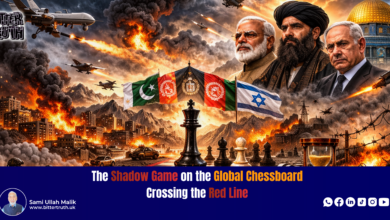
It is a truth universally acknowledged that the wheel of time is pitiless in its turning. The moment a nation lets slip is often transmuted into the loss of centuries. Today, as the world’s political map is redrawn with fresh lines each month, the pawns upon the subcontinental chessboard stand poised for a new and dangerous game.
Pakistan stands at a juncture where every step shall be inscribed upon the scroll of history. This is the moment when the Qur’ānic promise stands before us:
إِن تَنصُرُوا اللَّهَ يَنصُرْكُمْ وَيُثَبِّتْ أَقْدَامَكُمْ:(محمد:7)
“If you support Allah’s cause, He will support you and plant your feet firmly.”
It seems the pieces on the subcontinent’s board are shifting once again. At this critical turning point—where the ruthless stratagems of power on one side are matched by the glimmers of hope on the other—the condition is this: that we adopt national resolve, intellectual unity, and practical wisdom as our standard. The pen of time has already begun a new chapter; it lies in our hands to decide in what colours and with what light its words shall be inscribed.
The sands of time are within our grasp; if we hold them firmly, they shall be etched into history in letters of gold. If we let them slip, they shall become the dust of centuries lost. Today, we stand in a single rank—soldier upon the frontier, diplomat in the world’s councils, and citizen within the fortress of his prayers and his resolve. This is a moment of trial for every soul: to decide whether we shall be mere ink upon the pages of history, or the very authors of its chapters. Our sentinels guard the borders, our envoys uphold the banner of Pakistan in the world’s assemblies, and our people must stand united as one. This is the hour when the Almighty’s pledge resounds:
إِن يَنصُرْكُمُ اللَّهُ فَلَا غَالِبَ لَكُمْ (آل عمران:160)
“If Allah supports you, none can overcome you.”
Remember this: the river of time never returns a lost moment. If we fail to unite our ranks, history will record us only as an example. But if we stand as one, our story shall become a hymn of faith, sacrifice, and honour for the generations yet unborn. The demand of the hour is that we remain not as spectators, but as players in the arena—our sword the force of reason, our shield the bond of unity, and our provision the certainty of faith. If India’s RAW sharpens the blade of its dagger, we shall harden the steel of our resolve. This contest is not merely for land—it is for the conscience itself. And history has ever inscribed victory upon the side of the just in battles of the soul.
Come then! This is the very hour to stand as one people, under one tongue, one heart, and one flag, declaring: we shall never barter away our jugular vein; our lifeline shall remain secure, our banner forever aloft, and our generations breathing free. We shall guard the future of our children; we shall bear high the flag of our liberty, In shā’ Allāh—whatever trials of time we must endure.
Pakistan shall endure, Pakistan shall prevail, and the flag of Pakistan shall fly—unto the end of days.