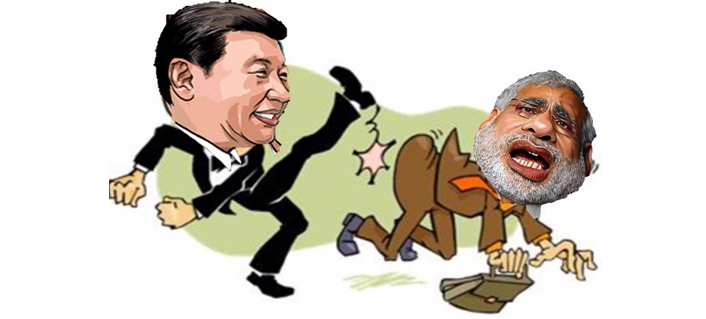
The Geography of Cowardice, the Strategy of Steel
Where Maps Speak Louder Than Missiles

The Turn of Time, the Whispers of History
Nations seldom perceive the moment when time turns upon its axis; those seated upon thrones are often the last to notice the tremors beneath them. Peoples live in dreams; history, however, is etched in the clarity of collective consciousness. And in our time, history no longer ambles — it gallops. The destinies of nations are no longer decided solely upon the battlefield, but are shaped equally by strategic narratives, diplomatic finesse, and the semiotics of geography. A nation is not known by its rhetoric, but by its resolve. When nations thunder slogans in times of peace but fall mute when the theatre of action is set, history interrogates them thus: Were you mere merchants of rhetoric, or did you possess the artistry of deed?
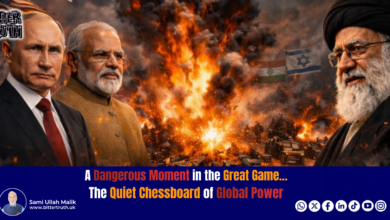
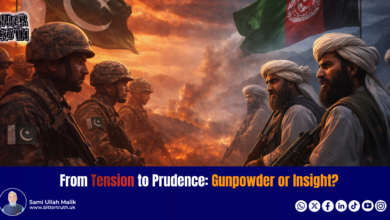
The recent aerial skirmish between the two titans of the Subcontinent — Pakistan and India — appeared, on the surface, as yet another episode in the long saga of regional tension. Yet, beneath this veneer, a quieter, subtler power manoeuvred with measured grace. The People’s Republic of China, without firing a shot, emerged not as a spectator but as a silent architect of a new geostrategic epoch — a feat that demands a historian’s scrutiny and a statesman’s attention.
For the discerning eye, the engagement was no parochial affair. It was not merely inscribed upon the skies of South Asia, but upon the broader canvas of Asia’s strategic future. Whether the unseen hand that sketched this turning point belonged to Beijing or Islamabad remains a matter of interpretation — yet its impact is beyond dispute.
This was not a mere duel between two nuclear neighbours. It was, rather, a live demonstration of China’s burgeoning defence industry, a manifestation of a new creed of fervent nationalism, and a testament to diplomatic acumen. The world — not just Asia — took note. The question echoed in capitals from Brussels to Brasília: In this new alignment of superpowers, where stands the ironclad friend?
While Indian generals beat the drum of war on Pakistan’s frontier, their armies stood hushed before the icy heights of China’s frontier. The real question was not why their guns fell silent, but whether that silence was the cloak of defeat.
This essay seeks to establish — through the prism of recent aerial confrontations — that the true victor, in more than just military terms, was China, with Pakistan as both beneficiary and brother-in-arms. The analysis that follows will examine the strategic depth of India–Pakistan tensions, the discreet yet decisive Chinese role, the market reception of Chinese military aviation, the cartographic and symbolic implications of renaming in Arunachal Pradesh, and India’s precarious entanglements on three fronts with its immediate neighbours.
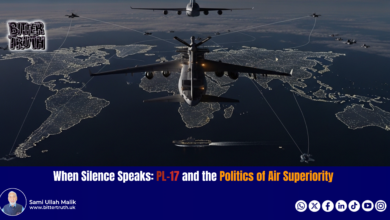
Though the duel took place in the heavens, its echoes were heard in the bazaars of the world. When Pakistan deployed its JF-17 and J-10 fighter jets — the fruit of Sino-Pak collaboration — these were no mere aircraft. They were the airborne ambassadors of a confident alliance, heralding a message to the world: the craftsmanship of Pakistan’s military and the People’s Liberation Army is no longer confined to ceremonial parades — it is battle-hardened and combat-proven.
As Colonel Zhou Bo of the PLA observed with scholarly precision, it was as if a new page of history bore China’s signature. This was not simply a military sortie — it was a campaign of global advertisement, not written in pamphlets, but in sorties and sorties alone. For the first time, Chinese aircraft were tested under the unforgiving conditions of live combat — and true to Eastern wisdom, it is only when steel moves that lines are etched into stone.
The crescendo of conflict rose when India launched its operation under the name Sindoor, employing its French Rafales and Russian fighters. Pakistan, with precise restraint, responded with missiles and aircraft that never crossed the frontier, yet allegedly felled six Indian fighters. While Delhi offered a muted rebuttal, it was Dassault — the Rafale manufacturer — that quietly confirmed the loss of three aircraft, an acknowledgment as weighty as a shift in diplomatic tides.
Faced with international scrutiny and plummeting share prices, Dassault’s CEO was compelled to concede that while they could manufacture aircraft, they could not manufacture valour. In stark contrast, the shares of Chengdu Aircraft Corporation — the makers of the J-10 — soared by 40%. It was not just a dogfight won in the skies, but a victory claimed in the stock markets of the world. The message was unequivocal: credibility in defence is no longer a Western monopoly.
India’s media, ever ready to declare a new Pax Indica over Islamabad or Kabul, grows curiously mute when Beijing’s shadow looms over Ladakh. The silence of guns becomes louder than any war cry. Former Foreign Secretary Shyam Saran’s admission — that the Indian Army either lacks the will or the means to act — stands as a chilling confession. The voice that once thundered over Pakistan now quivers before China. Why?
Colonel Zhou Bo again voiced the unspoken truth: the aerial combat served as China’s grand unveiling. This was the first time its aviation platforms were blooded in battle. The market responded accordingly — shares in Chengdu soared, trust in Chinese weaponry expanded across Asia, Africa, the Middle East, and Latin America. The demonstration was live, the results indisputable.
Air Marshal A.K. Bharti’s remark that “losses in war are normal” was, in its studied brevity, a tacit surrender. In the absence of triumphant communiqués, with confirmation from global media and defence manufacturers themselves, it became evident: facts had begun to eclipse narratives. And in that moment, China’s diplomacy prevailed — not through boasts or barbs, but through silent outcomes. This, indeed, is diplomacy of the Mandarin kind: austere, strategic, and victorious in its quietude.
The Quiet Triumph: Beijing’s Victory Without a Shot Fired
The vaunted Rafale jets of the Indian Air Force—procured at a cost so monumental as to shake the very sinews of economic prudence—were brought to heel not by an overwhelming armada, but by the steely precision of Pakistani missiles. The confirmation of three jets lost, uttered almost in hushed tones by the spokesperson of the Rafale manufacturing firm, echoed like a muted dirge within the corridors of New Delhi. It was as though the Red Fort of Agra had donned a widow’s veil.
Air Marshal A. K. Bharti’s laconic observation that “losses in war are but routine” was less a statement of fact than a veiled concession, an embroidered shroud designed to wrap around a wounded nationalism. His words betrayed the truth: the wound could be covered, but the blood would yet seep, and the world would see it bleed.
The Pakistani aircraft—never having crossed their own territorial bounds—proved that lethality knows no borders. Their missiles reached across the divide to deliver not just strategic blows, but a symbol of an unspoken doctrine: the unheralded synergy of Pakistan and China. This was more than a military skirmish—it was a marketing campaign for the Chinese defence industry, conducted not in exhibition halls but in the unforgiving theatre of real war. The consequent 40% surge in the shares of Chengdu Aircraft was not merely a financial blip, but a thunderous bell rung in the bourses of the world: the age of military branding had arrived.
When Indian Defence Minister Rajnath Singh sombrely admitted that large contingents of Chinese forces had transgressed the Line of Actual Control, it was not merely a border breach—it was the trampling of Indian geographical pride beneath the frostbitten boots of an assertive rival. This was not a skirmish—it was a psychological conquest. And, strikingly, the only thing absent from this strategic drama was India’s military response. The tongues that once flamed with fire against Pakistan fell silent beneath the chill of Chinese diplomacy.
In the midst of this geopolitical theatre, former U.S. President Donald Trump offered mediation with all the gallant naivety of a sovereign seeking to broker peace among restive princes. Yet, China spurned the gesture with a quiet dignity, as though to say, “We govern our affairs; yours is not the sceptre we recognise.” It was a statement writ not in words, but in presence. Self-sufficient, self-assured, and self-governing—this is the poise that positions Beijing as the unchallenged arbiter of Asian balance.
It is here that Pakistani leadership must glean wisdom. The shackles of Bretton Woods institutions must be cast off, just as Pakistan once dared to shift its gaze from a dispassionate West to a more receptive East. The results are now etched in both ledger books and history alike.
Following the ceasefire, China unfurled a new kind of offensive—subtle, symbolic, and starkly psychological. While India remained engrossed on its western frontier, Beijing redrew reality by renaming twenty-seven locations within Arunachal Pradesh in Mandarin and Tibetan. Mountains, rivers, settlements—each rechristened not by force, but by assertion. This was cartographic diplomacy of the highest order. It declared that maps are not forged in printing presses, but in minds that rule.
And thus, soft power sharpened its blade. These name changes were not linguistic trifles—they were territorial proclamations cast in iron diction. Made precisely when Indian military attention was diverted, they were whispers that thundered: when you next open your maps, your words may no longer be your own.
India, flanked by Nepal, Pakistan, and China, now finds itself confronting friction on three fronts. But what dream emboldens New Delhi to open multiple theatres of tension? Nepal, though diminutive in size, has grown majestic in its diplomatic defiance. Pakistan, firm in ideology and military resolve, stands ever resilient. And China—China is no longer a rising power. It has risen. Militarily, economically, diplomatically—it has eclipsed the subcontinent’s pretensions.
India, it seems, has ventured into a lion’s den, thinking itself a passing cloud. But this is no monsoon—it is a monolith it faces.
To the untrained eye, these recent skirmishes may appear as mere Indo-Pakistani antagonism. But history’s more discerning gaze reveals something else: the masterstroke of a trilateral strategic symphony—played by Pakistan, composed by China.
On the military front, Pakistan’s deft deployment of J-10 and JF-17 fighters served not just as battlefield instruments but as live demonstrations of Chinese aeronautical prowess. On the diplomatic front, silence became weaponry—while India tangled with Pakistan, China quietly altered maps. And in the realm of perception, Beijing emerged not merely as an arms manufacturer, but as a curator of conflict narratives. This was victory by proxy—and it was won without the discharge of a single Chinese round.
Pakistan’s operational success is not to be diminished. Its bravery shone in the skies. Yet the true laurels, if one must choose, are to be placed at the feet of Beijing. For in this conflict, it expended no soldier, no fuel, no direct provocation—yet its arms gained prestige, its companies wealth, its political vision clarity, and its cartographic ambitions subtle substance.
This is the high craft of Eastern statecraft, where silence wields more power than speeches, and where a name on a map may cut deeper than a missile. In this arena, victory does not march—
Wars are not won by steel alone. They are won by minds that know how to read the temperament of time. China and Pakistan, in calculated unison, understood this moment. They did not raise their voices—they shifted the narrative.
And perhaps, that is how the world changes: not with a roar, but with a recalibration of the map.
The Final Reckoning: Silence, Sovereignty, and the Spectre of Power in South Asia
Some within India’s strategic circles may be tempted to dress silence in the robes of wisdom. But history, that stern and incorruptible judge, reminds us that prudence is not the absence of words, but the presence of timely, decisive response — and one that culminates in victory. If an adversary crosses your threshold, and you dare not even utter a word in resistance, what you claim as composure shall be read as cowardice.
The same Indian generals and broadcast demagogues who trumpet war-songs against Pakistan with daily fervour seemed, when faced with China, to have taken a ceremonial dip in the Ganges — emerging not cleansed but curiously mute. Their silence is not born of diplomacy, but of dread; not of discernment, but of defeat. The lesson is simple, and it echoes through the ages: one must not merely assess the enemy — one must learn to recognise him.
India’s stony reticence in the face of Chinese provocation does not reflect the topography of silence but rather the enduring philosophy of Chanakya — that ancient political schemer — whose maxims taught generations to fall in prostration before the powerful as if they were gods, and to shatter them without mercy once they seemed weak. Hence, in a land where millions of deities are revered — even rats and serpents finding a place in the pantheon — the act of deification is but a momentary tactic, not a sacred devotion.
It was not lost upon the global media when Prime Minister Modi was shown offering ritual obeisance before an arsenal of missiles, nor when India’s Defence Minister placed eggs and offerings beneath the tyres of French Rafale jets — invoking divine protection over matériel as if to substitute mysticism for military strategy. These rites, though theatrically patriotic, cast an almost medieval shadow over modern geopolitics, and serve as a stark reminder: when media becomes servile, when politics is reduced to slogans, and when the public is subdued into silence — a nation drifts not towards glory, but towards delusion.
In the snow-draped valleys shared by Pakistan and China, no cannon may have spoken — yet truth, like time, finds its voice even in the frost. And history speaks clearly: here is a state that growls at the meek but grovels before the mighty; that lays claim to territory yet fails in the cartography of strategy; that threatens Pakistan with rhetorical thunder, and salutes China in hush-toned reverence.
India’s belligerence toward Pakistan, juxtaposed with its meek diplomacy before China, reveals not strength but schizophrenia — a schizophrenia that destabilises the region and exposes the contradictions of its strategic doctrine. In this unfolding equation of power, the balance tilts — not westward, but decidedly eastward. And the friendship between Pakistan and China now rises like an unclouded sun, illuminating not just the East but casting its golden hue across the historical architecture of South Asia itself.
The analysis of this broader engagement reveals a profound truth: in the recent military standoff, Pakistan did not merely demonstrate technical superiority; it displayed national unity, political restraint, and moral resolve. Under the banner of Operation Bunyān al-Marsūs, the nation, irrespective of internal divisions, stood as a bulwark — humbled before God, but unyielding before man.
Yet one must equally acknowledge the invisible architect behind this symphony of strategy — Beijing. China, without firing a shot, waged a campaign of remarkable sophistication: marrying military industry, geographical ambition, and diplomatic subtlety in a manner rarely seen since the classical epochs of statecraft. It is now imperative for Pakistan to preserve this hard-earned unity. The fires of political discord must be doused; the foundations of domestic consensus fortified — not by coercion, but by conviction.
As we have laid the groundwork for fraternal ties with our neighbours — clasping hands, embracing our friends in Turkey and China, and setting aside grievances — we must now summon a sincerity worthy of divine blessing. For the Almighty has declared that believers are brethren unto one another. And only through this bond of sincerity, not just sentiment, can the Muslim world rise as one.