
The Eclipse of Strategy and the Rise of Fate
When Power Forgets Wisdom

When nations make their moves upon the chequered board of history, there come moments when destiny itself becomes a pawn and plays its own inscrutable game. The tale of India’s withdrawal from the Ayni Air Base in Tajikistan stands as one such turn of fate — a question suspended between strategy and destiny, between the arrogance of power and the irony of consequence.
As history inscribes new lines upon its ageless parchment, the designs of men are often erased by the invisible hand of fate. The saga of Ayni — India’s solitary military outpost beyond its borders — tells a story where politics outwitted militarism, and geography humbled strategy.
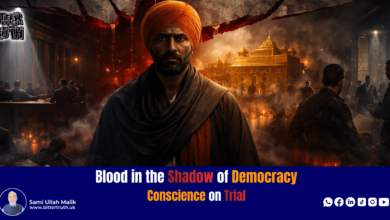
Once, amid the lofty valleys of Tajikistan, Ayni was regarded as a proud emblem of Delhi’s ascent into the heart of Central Asia. Today, that same air base is remembered as a monument to the Modi government’s most grievous strategic failure. Within the corridors of Delhi, clamour abounds; the Opposition calls it a diplomatic debacle, a retreat masked in rhetoric, while defence analysts deem it the inevitable wage of miscalculation.
This is one of those hours when political design collapses under the weight of time, and the conceit of power turns to dust between one’s fingers — when history itself seems to whisper that eternal truth:
﴿تُؤْتِي الْمُلْكَ مَن تَشَاءُ وَتَنزِعُ الْمُلْكَ مِمَّن تَشَاءُ﴾
“Thou grantest dominion to whom Thou wilt, and Thou withdrawest it from whom Thou wilt.” — Āl ʿImrān 3:26
There are decisions that, long after the ink of policy has dried, remain etched upon the conscience of nations. The evacuation of the Ayni Air Base is one such indelible mark — a lapse that Delhi’s own critics now call a strategic undoing. It was once the outpost from which India unfurled its banner over the Central Asian horizon. Yet, when time turned its tide, the lamp of design flickered and went out.
﴿وَمَا تَشَاءُونَ إِلَّا أَنْ يَشَاءَ اللَّهُ﴾
“And ye will not, save that God willeth.” — Al-Insān 76:30
Nearly twenty-five years ago, India had planted its solitary flag of military presence upon Tajik soil — a base conceived not merely as a fortress of flight, but as a citadel of influence. Nestled at the crossroads of Afghanistan, Pakistan, and China, this was geography turned to strategy, and strategy elevated to diplomacy. From its runways, India sought not only air routes, but a symbolic ascendancy over the heart of Asia.
For two decades Delhi poured some ten million dollars into the base’s renewal — reconstructing Soviet-era remains into a modern bastion with a vast runway, fuel depots, and a tower of command. It was the architectural metaphor of ambition: the fortress from which India might proclaim its aerial eminence. Yet the enterprise that began in the high skies of Tajikistan ended, in melancholy fashion, upon the horizon of disillusion.
The loss was not merely military, but psychological — a fracture in the mirror of India’s regional self-confidence. For Ayni had come to symbolise more than power; it embodied the belief that geography could be mastered by intent. But history, that relentless tutor, has once more reminded man that hubris is no substitute for insight.
Tajikistan, lying between Afghanistan, China, and Pakistan, was never merely a nation; it was the linchpin of a delicate geopolitical triangle. From there, India had sought to encircle Pakistan in a web of regional influence. Yet the episode has shown that geography is not drawn upon maps alone — it pulses within the politics of nations.
When news broke that India had vacated the base, Delhi’s political heartland was thrown into agitation. Congress leaders branded the act a strategic failure; their lament carried the tone not merely of opposition but of wounded national pride. For twenty years, the state had invested, built, and adorned the base — a Soviet relic reborn in Indian hands — yet, despite the millions spent and the policy papers written, the outcome was ignominious.
Reports suggest that Tajikistan had long signalled its intent for India’s gradual withdrawal, yet Delhi persisted in its delusions. In the end, despite every stratagem, the retreat was unceremonious. To defence observers, it was a diplomatic blow and a military surrender in equal measure — the penalty of overreach dressed in the robes of formality.
Foreign Ministry spokesman Randhir Jaiswal declared that India’s bilateral agreement with Tajikistan had “simply run its course.” The phrasing was elegant — a diplomatic veil laid gently over a bruised reality. But to the discerning ear, it was less a conclusion than an epitaph.
Ayni had once stood not only as an air base but as a monument to a moment in history. In the early 2000s, India established a hospital there to aid the Northern Alliance — a gesture born of the first Taliban ascendance. It was in that same region that Ahmad Shah Massoud, mortally wounded two days before the tragedy of 9/11, was brought to his end — pronounced dead by an Indian doctor. Thus, upon that austere soil, India had opened its chapter in Central Asia. Time, however, in its inexorable turning, has closed it.
When the news of Ayni’s closure broke, the Opposition in Delhi sharpened its criticism. To them, it was more than a policy lapse — it was a national humiliation. Analysts like Rahul Bedi called it the offspring of neglect, while Sanjeev Srivastava reminded readers that Ayni was born in the crucible of anti-Taliban strategy — a project that once carried the pride of purpose, now reduced to a parable of decay.
Thus ends, for now, the story of Ayni: a relic of ambition, undone by time, pride, and providence. History, it seems, has once again whispered across the mountains of Tajikistan that ancient warning — that power without balance is but splendour poised upon sand.
After the cataclysm of 9/11, when the United States toppled the Taliban regime, the chessboard of Central Asia was redrawn. Power shifted across Afghanistan’s rugged frontiers, and India, ever alert to opportunity, moved swiftly to consolidate its presence. Yet when the Taliban returned to power in 2021, the foundations of Delhi’s entire edifice of policy — built upon the sands of anti-Taliban strategy — crumbled into futility.
Today, in a striking reversal, channels between New Delhi and Kabul stand open once more. The recent visit of Foreign Minister Amir Khan Muttaqi to India is emblematic of this new alignment — a gesture that would have been unthinkable a decade ago.
Congress leaders have reminded the nation that Ayni’s location once offered India an unblinking eye upon the entire region. From there, Delhi’s gaze could stretch from Afghanistan’s passes to the high plains of Central Asia. It was this vantage that inspired grand designs of expanded influence — but the wheel of time has turned, and those dreams now lie in shards, like shattered glass scattered upon the map of ambition.
﴿وَتِلْكَ الْأَيَّامُ نُدَاوِلُهَا بَيْنَ النَّاسِ﴾
“These are the days We alternate among mankind.” — Āl ʿImrān 3:140
Thus, the revolving days of history have compelled India to sit upon the ashes of its own design. Four years ago, Tajikistan had gently intimated that Delhi might begin winding down its operations. Despite negotiations, monetary overtures, and diplomatic persistence, India was at length compelled to depart — an outcome defence analysts have called a grave diplomatic wound, casting long shadows upon the nation’s strategic prestige.
In April, the Taliban government’s condemnation of an attack in Kashmir’s Pahalgam marked a subtle yet significant shift — a calculated tone of civility replacing enmity. Muttaqi’s week-long sojourn in India testifies to a change of heart on both sides: a nation that once likened the Taliban to bloodstained beasts now extends a hand of pragmatic cooperation. Such are the capricious turns of politics, which can transfigure foes into partners and friends into wary strangers.
Reports suggest that India has offered the Taliban financial and technical assistance to construct a dam on the Kabul River — a project whose downstream implications would tighten Pakistan’s water supply. In the same breath that it lost Ayni, Delhi sought to rewrite its strategic playbook. But, as ever, the reshuffling of pieces on the board cannot alter the will of fate.
Analyst Rahul Bedi reminds us that Ayni was a joint endeavour of the Indian Air Force and the Border Roads Organisation — institutions long regarded as the backbone of the nation’s defence architecture. Yet, through political neglect, that spine was allowed to bend. Sources intimate that both Moscow and Beijing exerted pressure upon Dushanbe to reclaim the base, declining India’s offers of investment. Thus the decision was not merely Tajik, but emblematic of a new Asian order. Power’s axis has shifted: no longer does Delhi set the rhythm; the region now breathes to the measured cadence of Moscow and Beijing.
Bedi observed, pointedly, that this was not an air force failure but a failure of government — a dereliction of will. It is such lapses, born not of weakness but of complacency, that steer nations toward the poverty of purpose.
﴿إِنَّ اللَّهَ لَا يُغَيِّرُ مَا بِقَوْمٍ حَتَّىٰ يُغَيِّرُوا مَا بِأَنْفُسِهِمْ﴾
“Indeed, God does not change the condition of a people until they change what is within themselves.” — Al-Raʿd 13:11
Where once the roar of Indian jets echoed through the valleys of Tajikistan, silence now reigns — a silence that speaks of vanished ambition. The dream of a Central Asian presence has been consumed by the delicate intrigues of diplomacy and the failures of political foresight.
﴿فَاعْتَبِرُوا يَا أُولِي الْأَبْصَارِ﴾
“So take heed, O you of insight.” — Al-Hashr 59:2
India’s outreach to Central Asia faltered not for lack of aspiration, but for want of wisdom. The Modi government, so swift to exalt economic ties, displayed an equal haste in neglecting strategic prudence. The closure of Ayni is not merely the shuttering of a base, but the extinction of an idea — a failure both intellectual and strategic.
It is a mirror held up to India’s foreign policy, reflecting an enduring truth: that power rests not in
armament alone, but in the triad of confidence, balance, and foresight. Over the silent mountains of Tajikistan there lingers a question, haunting yet necessary: was this merely the fall of a fortress — or the funeral of a dream?
The decline of Ayni marks more than a military withdrawal; it signifies the waning of a vision. Delhi’s silence today carries the murmur of history, whispering that the pride of power is ever the prelude to the fall of reason.
Global strategists already call it the first tremor in the unravelling of India’s foreign policy equilibrium; the Opposition, more bluntly, names it the greatest strategic blunder of the Modi era.
﴿فَسَيَعْلَمُ الَّذِينَ ظَلَمُوا أَيَّ مُنقَلَبٍ يَنقَلِبُونَ﴾
“And soon shall the wrongdoers know to what end they shall return.” — Ash-Shuʿarāʾ 26:227
From the hushed valleys of Tajikistan there arises a solemn reminder: that power inclines always toward those who place discernment above pride, wisdom above might. The demise of Ayni is not merely a military episode, but a moral parable — a warning inscribed upon the wind that arrogance cannot endure the weight of its own conceit.
﴿وَلَا تَفْرَحُوا بِمَا آتَاكُمُ اللَّهُ﴾
“Exult not in what God has given you.” — Al-Ḥadīd 57:23
India’s strategic undoing thus stands as a lesson writ large upon the map of fate: that nations endure only when their action is tempered by intellect, their ambition by humility, and their policy by vision. Wisdom must accompany will; prudence must walk with power. Yet, alas, in the intoxication of authority, Prime Minister Modi appears to have mistaken dominion for destiny — and in doing so, has set the sun of his imagined “Akhand Bharat” upon the distant waters of the Indian Ocean.