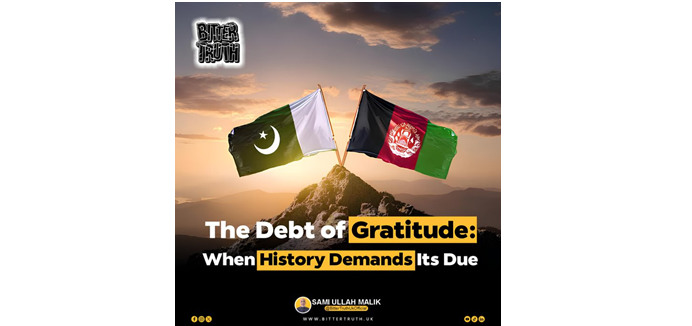
The Debt of Gratitude: When History Demands Its Due
The Silent Wounds of a Guardian Nation

The tale of Afghanistan and Pakistan is one of proximity and contention, with roots that penetrate deep into the region’s layered past. Time and again history teaches us that whenever clouds of tranquillity gather above these plains, some storm — sometimes sown from beyond our borders, sometimes brewed within our own hills and valleys — will rise to scatter them. Flames of conflict are lit by foreign fuel or by the fervour of local factions; often by both.
When the dawn of independence kissed the brow of South Asia and new polities took their place upon the map, the bond between the two neighbours was spoken of in terms of brotherhood. Yet successive episodes of internecine strife, the play of vested interests and the manoeuvres of power have all conspired to bind that fraternal tie in the ropes of suspicion and misunderstanding.
Pakistan has borne burdens in the long fight against violent extremism which few nations can rival; her sacrifices over decades have been profound and indisputable. Yet the malign root of militancy persists in seeking fresh soil to deepen its hold. It was in response to this bitter truth that a process of diplomacy between Pakistan and the Afghan Taliban was set in train: the aim, plain and honest, to turn the torrent of blood spilled on battlefields into speech at a table. But the light of hope, first kindled in Doha and later carried to the ramparts of Istanbul, was dimmed by obstinacy and by a dogmatic zeal that brooked no compromise.
The talks convened in Istanbul were intended to impart direction to an otherwise interminable tragedy. But no practicable scheme emerged; no harvest of agreement was reaped. Afghanistan’s silence hangs in the air like an unanswered question — and before the dust of the recent frontier strains had even settled, Pakistan announced that the conference-room doors were effectively closed. The “talks” that stirred Istanbul’s chambers issued only dust and echo: no road-map was endorsed, no course was set. Why Kabul keeps its counsel remains a matter to which there can be no easy answer — is it prudence or pique? Coincidence or a deliberate repudiation?
How, too, are we to explain that hopes, so briskly renewed in Doha, should have withered in Istanbul? And who, ultimately, is to be held answerable for the grim consequences of a fruitless diplomacy?
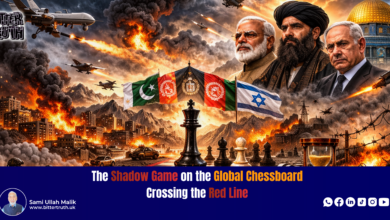
It is a matter of record — and of bitter suspicion — that a neighbour, long intent upon keeping Pakistan embroiled in manoeuvre and strain, continues to play its part in the larger game of regional balance. In the wake of the setback sustained in May 2025, and in the bruising glare of international embarrassment that followed, New Delhi appears anxious to ensure that Pakistan remains preoccupied with low-intensity, persistent conflict. The present strategy emanating from Kabul, on its face, seems to play to that very tune. The conduct of the Afghan Taliban, at times, reads as if calibrated to serve interests that lie elsewhere. The contest for supremacy in this neighbourhood is not merely the grappling of arms; it is also a contest of commerce, diplomacy and minds.
A question now heads every debate: why do the Afghan Taliban pause when the moment arrives to act decisively against the Tehreek-e-Taliban Pakistan? Why does the hand that ought to strike the hydra of terror tremble? Within the leadership’s councils there persists a perplexity over when, how and at what cost to confront the TTP. For them this is not solely a matter of security; it is entangled with creed, with loyalties and with long memories of mutual obligation.
Pakistan presented documentary evidence — concrete, incontrovertible — and not only was this corroborated by third-party hosts but the proofs were acknowledged as valid. Yet the Afghan delegation would not furnish assurances; they allowed the discussion to drift from the very subject that had summoned them to the table. It was as if one were to stroll past a wall standing obstinately between two parties and assume, quite wrongly, that the wall had already fallen.
The toll Pakistan has paid over four years is not a ledger of statistics alone; each fatality records the extinguishing of a household light, the silencing of a story. After bearing such losses, the nation’s patience has run to its limit. The security of its people is the primary charge of any sovereign; accordingly, the state has declared — with unambiguous purpose — that it will root out every nest of terror by every lawful means. No sanctuary shall remain, no patronage shall endure, and no support shall be tolerated.
Intelligence and security analysts note that the Afghan Taliban appear to be operating under a parallel programme which, if unchecked, poses a grave danger to regional tranquillity. If the orientation of intention changes, so too will the path that follows; for conduct is the child of intent. Sources close to the matter say that the Taliban’s rationale is frequently divorced from the realities on the ground and from the sober logic of statesmanship — suggesting, as those analysts warn, that some other agenda lurks behind the scenes, an agenda inimical to the peace of the region. The progress of negotiations now waits upon a reckoning of Taliban intent and disposition.
Minister Khawaja Asif put the matter in blunt terms: the desire for peace is no admission of weakness. If the impulse to assault our capital takes root, those who lift a hand against Islamabad shall find themselves bereft even of sight — a phrase not of personal vindictiveness but of the state’s legitimate right to defend its citizens. He declared, plainly, that if parleys fail then open confrontation shall not be an idle threat.
Afghan scholars of politics observe that the Taliban’s senior leadership treats the TTP as a kindred ideological phenomenon. Bonds formed in the crucible of the 1980s and 1990s have woven relations that are not readily sundered by mere diplomatic fiat. Both movements have, in effect, batted in the same innings upon the pitch of history; for the Taliban to act forcibly against the TTP would be, to their judgment, tantamount to raising a hand against their own.
This ideological affinity, therefore, often acts as a brake upon concrete operations against the TTP. Where mind and heart are aligned to a common cause, the sword tends to shake in the hand. All too often such kinship becomes a rationale for inaction; when the line between right and wrong becomes blurred, the grievous error of confounding violence with righteous struggle can take hold — and this is the single most formidable obstacle on the road to a lasting peace.
﴿وَمَنْ أَحْيَاهَا فَكَأَنَّمَا أَحْيَا النَّاسَ جَمِيعًا﴾
“And whoever saves a life it is as though he had saved all mankind.” (Qur’ān 5:32)
This verse, cited here with due reverence, underscores the moral imperative at the heart of the debate: shelter, succour and the preservation of human life are not merely acts of statecraft but of conscience. They define the measure of nations and the content of true civilisation.
Pakistan once regarded the Afghan jihād as both a spiritual bulwark and a strategic bastion; in consequence it offered sanctuary and political succour to the Taliban. Yet history, with its ironic smile, returns debts on its own schedule: the very policy that was thought to be a shield now casts a long shadow across the thresholds of national security. The reckoning has come to stand at the door. In the court of time, every choice is called to account.
The Haqqani faction within the Taliban has maintained operational links with the Tehrīk-e-Taliban Pakistan. These are ties of an order not readily sundered. Were heavy-handed measures to be applied, there exists a real fear that the TTP might be driven further into the arms of the so-called Islamic State; and it is this fear — that robust action may open a new door for a still more virulent adversary — that restrains the Taliban from taking decisive steps. Thus malice, once loosened, would find a new channel; and there lingers too the very prospect that such upheaval might unseat the present regime in Kabul. There are, in fact, factions within the Taliban poised — in patience or in impatience — to see this administration to its denouement.
In Kandahar the leadership still nurses bitter recollections: the arrest of Mullah Baradar and the death of Mullah Mansour in a US strike are not chapters consigned to the past, but thorns lodged within the present policy. These events circulate in the veins of power as sources of enduring grievance. Hence prudence and pique travel together through the pages of their strategic calculus.
Pakistan, for its part, has not been idle. Cross-border operations have struck at TTP centres; trade in Afghan consignments has been curtailed; key trade corridors have been suspended; and a crackdown on irregular Afghan residents has been set in motion. These measures are not mere rhetoric: they are deeds that convey, in a language more eloquent than words, that patience has reached its limit. This is a message of action, not of mere diplomatic bravado.
Yet the fundamental question — and the one that refuses to leave the front benches of policy debate — remains: will pressure, whether military, economic, or political, compel the Taliban to marshal themselves against the TTP? Will Pakistan’s measures drive them to practical action? Or will Kabul find some fresh rationale, some novel exegesis, to drift once more from the straight path?
Many Afghan hardliners still interpret the duties of governance through the prism of doctrinal orthodoxy; in their calculus the TTP is not an enemy to be annihilated but, at worst, a ‘reformable ally’. This posture is the gravest of misconceptions on the road to peace. Analysts point out that Pakistan’s policy is clear and unambiguous, but the Taliban do not yet view themselves as bearers of a conventional, international responsibility. Whispers of ISIS’s influence and internal schisms foment hesitation; fears of sectarian fracturing and the spectre of ISIL stunt the will to strike — and for now, concerted operations against TTP remain deferred.
Findings
The Afghan Taliban’s decision-making remains governed by the temperament of a movement rather than by the duties of statecraft.
The Taliban–TTP nexus is not solely military; it is bound up in ideology and sentiment.
The recent rise in terrorist incidents across the region is propelled, in part, by tactics adopted by certain regional actors.
Pakistan’s actions have increased political and economic pressure but have not yet produced decisive change.
Progress at the negotiating table depends upon the Taliban’s acquisition of political maturity and a recognition of international responsibilities.
Recommendations (Practical and Forward-Looking)
A — Diplomatic strategy for regional tranquillity
• Elevate the issue within multilateral forums: the United Nations, the Organisation of Islamic Cooperation and the Shanghai Cooperation Organisation.
• Leverage economic assistance for Afghanistan in exchange for concrete security guarantees.
• Consider the establishment of a bilateral joint force for border management.
B — Practical measures to dismantle terrorist infrastructure
• Deepen intelligence-sharing and institute real-time operational coordination.
• Target the TTP’s financial and technical networks to sever their lifelines.
• Render untenable any cross-border launch-pads and sanctuary zones.
C — Narrative and ideological contestation
• Expose, through scholarly and theological engagement, the fallacies that sanctify violence.
• Reform educational curricula and ensure that young people receive instruction that foregrounds peace and coexistence.
• Use responsible media to forge a national narrative of cohesion and shared destiny.
D — Fair and humane repatriation of Afghan refugees
• Combine respect for human rights with a restored rule of law.
• Alleviate Pakistan’s socio-economic burden through international assistance.
• Seek funding and logistic support from global institutions to manage returns.
E — Confidence-building measures
• Form joint committees, implement border mechanisms and maintain rapid consultation channels.
• Keep the windows of communication perpetually open to dispel misapprehensions.
• Cultivate ties with moderate elements in Taliban leadership.
For the cause of peace I offer, moreover, a few pragmatic proposals which I commend to the conscience of statesmen in earnest:
Pakistan should seek a coordinated diplomatic campaign with friendly nations;
Bilateral cooperation must be deepened to foster political and economic stability in Afghanistan;
Expedite the reform of seminaries and sharpen border security;
Persuade global powers that terrorism is no parochial malady but a regional and international scourge;
Present the accumulated evidence of state-level complicity — where it exists — before the international community to break the cloak of impunity;
Stoke the flame of enlightenment in society so that ignorance yields to knowledge.
﴿يَوْمَ تُبْلَى ٱلسَّرَائِرُۭ﴾
“On the Day the secrets will be exposed.” (Qur’ān 86:9)
This sombre warning reminds us that concealment is temporary and that the ledger of deeds will in time be made manifest. Policy conceived in the light of such accountability must therefore combine firmness with justice, deterrence with means of reconciliation.
O my homeland — your skies are veiled in the toil of blood and sweat, yet your generosity gleams with a radiance undimmed by trial. In an age of dislocation and sorrow, you opened not merely your gates but your very heart — offering refuge, sustenance, education, a marketplace of hope — and above all, dignity. For four long decades you stood as a bastion of compassion, your soil embracing strangers as kindred, your homes becoming their sanctuary.
History has preserved the record of this unfaltering hospitality through the United Nations High Commissioner for Refugees — a testament both enduring and unblemished.
There was a time when borders trembled with grief, when families crossed into you with trembling hands yet unbroken hope; when children carved their first footprints upon this earth that nourished their years into youth. And today, some who were nurtured in your soil — once indebted to your benevolence — have chosen to forget, lured by external whispers orchestrated beyond the mountains. This betrayal pierces the conscience like an unhealed wound.
We are reminded of the solemn vow declared by that once-revered leader, Mullah Omar:
“We can never repay Pakistan’s kindness till the end of time;
wherever your sweat shall fall — we shall offer our blood.”
These were not the fleeting promises of politics, but pledges carved deep into faith and fraternity. Hibatullah, then a young man, stood witness to those words — and Mullah Yaqub, a child of five, once heard in his father’s voice the echoes of loyalty and sacrifice.
And yet — the tides have shifted.
New alliances take shape; investment, waterworks, and diplomatic courtships emerge with calculated charm. One cannot help but ask: Are these harbingers of stability — or omens of a storm preparing to break?
Pakistan’s chapter of compassion cannot be erased by the carelessness of others, nor can its nobility be dimmed. A nation that extended refuge amid turbulent seas remains proud of its heritage of magnanimity. But fidelity must not be weighed against fleeting gain — rather against responsibility, truth, and the sacred trust of neighbourly honour.
If generosity becomes merely a relic, devoid of prudence and equity — then history will again exact its dues with a harsher hand.
Therefore, the traditions that once birthed unity must rise anew — not merely as rhetoric, but as the living customs of justice and human decency. Those whose voices now sound like ours, whose youth was shaped in our schools and streets — their destiny must be guided by principles both lawful and humane.
For Scripture reminds:
﴿وَإِنْ جَنَحُوا لِلسَّلْمِ فَاجْنَحْ لَهَا﴾
“If they incline toward peace, then incline to it also.” — (Al-Anfāl 8:61)
Thus — mercy tempered with vigilance, law enriched by compassion — only then can a peace be built to withstand the tempests of time.
Let us not, in the season of hostility, abandon the warmth of humanity. Even if foreign patrons and their agents repay kindness with deceit — we must secure our foundations: defence first, dialogue next, justice enduring throughout.
Where courage and wisdom must stand shoulder to shoulder, we shall not shrink — for defending one’s home is both a legal right and a moral duty.
This report, therefore, is not a lament, nor a mere critique — but a clarion call. Facts alone do not shape the destiny of nations; it is their fears, their hopes, their honour and resolve that direct the pen of history.
If we fail to guard regional peace with sober strategy, shared trust, and unflinching realism —
tomorrow’s chronicles may grow darker still.
Yet remember — peace is that singular battle where both sides may triumph. Pakistan’s intent remains firm and sincere. But peace cannot flourish by unilateral will; it demands the covenant of responsibility from all.
May this land — long shrouded in the smoke of conflict — rise anew in the light of knowledge, industry, commerce, and humanity.
Āmīn.
Let history’s gaze remain awake, let the flame of clemency burn steady, and let justice keep its balance true. Only then will this great human test be remembered with dignity — not regret.
Our past may both sear and safeguard us —
let us not squander its light.
May future generations write of us with pride —
not reproach.
And so, with a heart earnest in its plea, let us resolve that history’s eyes remain vigilant, the flame of mercy retain its warmth, and the scales of justice be guided solely by the hand of fairness. Only then may we remember this immense trial of humanity with honour rather than remorse.
Our history has the power to scorch – and still does. Let us not dim its light. Let us not waste its light. Future generations will write of us with pride. Not reproach. Let us fulfill our duties in such a way that history will testify that we chose the path of forgiveness even when revenge was firmly in our grasp.