
The Dawn of the East: A New Axis of Power
In History’s Mirror: The Light of the East

O ye men of learning and discernment, O witnesses to the chronicles of time! We stand today upon the very threshold of a new dispensation, where the scales of global power begin to incline towards an axis hitherto unseen. The supremacy of the West—an authority that for centuries dictated the destinies of nations—now bends before the rising sun upon the Eastern horizon. This dawn is not merely the trumpet-blast of martial might, but a herald of civilisational renewal, of political sagacity, and of historical consciousness.
The assemblies of leaders from Pakistan, Russia, China, and North Korea, the spectacle of their common cause upon the world’s stage, the redrawing of maps that chart the course of international relations—these are not the sterile notations of diplomacy or the arid arithmetic of protocol. They are, rather, the foreshadowings of an epoch yet to be inscribed. As the Qur’an admonishes:
(الأنفال: 60) وَأَعِدُّوا لَهُم مَا اسْتَطَعْتُم مِّن قُوَّةٍ
“And prepare against them whatever force you can muster.”
This verse reminds us that the endurance of nations and the conduct of global affairs require not strength alone, but strength married to wisdom. And so, we are witnesses to a moment where Pakistan, with its Eastern confederates, proclaims the advent of a new balance in the world’s design.
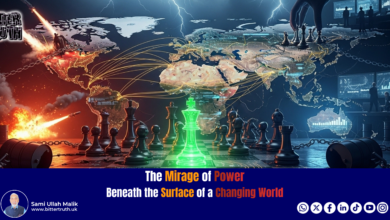
When history inscribes anew the tale of East and West, when it traces the lines that bind or divide, such a moment stands as a testament, like ink upon the parchment of time. The recent meeting between President Vladimir Putin of Russia and Prime Minister Shehbaz Sharif of Pakistan testified to a truth most clear: that the orbit of world politics revolves not solely upon the fulcrum of power, but equally upon the ligaments of alliance, relation, and mutual interest. At the very hour when Prime Minister Narendra Modi had returned from his parleys in China, with many variables in motion upon the world’s chessboard, this encounter lent the global stage a new contour. Not only did it fortify the bond between two nations; it declared, too, a re-alignment of forces in South Asia, a signal that the convergence of Pakistan, Russia, and China might well become India’s gravest challenge.
In this meeting it became plain that Pakistan intends not merely to preserve its traditional ties with Moscow, but to invigorate them—through new accords of understanding, through commerce, through defence, and through a fellowship fashioned of shared aspiration. The spectacle thus reveals that the axis of world politics is determined not only by arms or treasure, but by alliances, by trust, and by the weight of international confidence. When sovereigns declare their stance before one another, such moments are like marginalia inscribed in the great volume of history, often presaging the redrawing of the world’s map.
Again, the Qur’an admonishes:
(المائدة: 2) وَتَعَاوَنُوا عَلَى الْبِرِّ وَالتَّقْوَى وَلَا تَعَاوَنُوا عَلَى الْإِثْمِ وَالْعُدْوَانِ
“And cooperate with one another in righteousness and piety, and do not cooperate in sin and transgression.”
This verse enjoins us that the foundations of true power and enduring fellowship are laid not upon the sands of expedience or the iron of coercion, but upon righteousness, upon justice, upon
principles that endure. Where hands are clasped in virtue, there influence spreads.
The mind returns to an earlier age— to the year 1955, when the Soviet Union stood unshaken upon its foundations. Nikita Khrushchev, in Srinagar, pledged to India that Moscow would stand by her in every adversity, even, as he declaimed, if the call came from the mountain’s peak. Yet time’s wheel halts for no man. The Soviet Union is no more, and the balance of the world has shifted.
Khrushchev’s pledge remains but a monument of memory, while a new era, with new alignments and fresh principles of accord, has taken its place. The year is no longer 1955; nor does the Soviet might of yesteryear endure. The geography of history has altered; the stratagems of politics have been refashioned. That pledge of Khrushchev no longer reverberates in the relations of today’s Russia and India.
Old bridges cannot withstand the tempests of new storms. Thus, are we reminded that power, policy, and alliance are ever in flux. The past is but a tale concluded, and the Russia of our age now carves its policies in accordance with its own national and global imperatives. The tide of time does not heed the mountains; it shifts the shoreline.
(الرعد: 11) إِنَّ اللَّهَ لَا يُغَيِّرُ مَا بِقَوْمٍ حَتَّىٰ يُغَيِّرُوا مَا بِأَنفُسِهِمْ
“Indeed, God does not change the condition of a people until they change what is within themselves.”
Herein lies the truth: that the alteration of global or regional courses reflects not only external compulsion but the inner resolve and choices of nations themselves.
Since the dissolution of the Soviet Union, Russia’s policy upon the Kashmir question has undergone a marked revision. Once, Moscow’s sympathies were more attuned to India; yet today it perceives more clearly the character of India’s Chanakyan politics—ever ready to alter its course for the sake of expedience. Russia has tasted the bitterness of such betrayal, and thus it has adapted its stance. The modern Russia, though still attentive to Indian interests, is no longer bound by the echoes of Khrushchev’s assurances.
This is the way of Chanakyan statecraft: every move calculated, every gesture marked by guile. It demonstrates that the transformation of power’s axis in world politics is not wrought merely by arms or wealth, but by political intelligence, by cunning, and by the ordering of interests. Even mountains, with time, shift their shade.
The recent meeting between President Vladimir Putin of Russia and Prime Minister Shehbaz Sharif of Pakistan unfolded a new layer in the fabric of regional relations. In this exchange, President Putin made it plain that Pakistan remains a traditional partner of Russia. He acknowledged Islamabad as a steadfast associate, while both leaders conferred on bilateral ties, commercial intercourse, and cooperation within the region. On this occasion, Prime Minister Sharif avowed Pakistan’s resolve to cement relations with Moscow, and as these words were uttered, President Putin nodded in assent—a gesture small in form, yet profound in meaning.
According to the communiqué of Pakistan’s Foreign Office, President Putin expressed his sorrow for the hardships borne by the Pakistani people in the wake of recent floods and natural calamities, and he commended Prime Minister Sharif’s leadership. This encounter was more than a meeting; it was the herald of a shifting equilibrium in world politics. For as relations between Pakistan and Russia grow firmer, a new front emerges for India. Where two banks meet, the river’s course is altered.
President Putin extended to Shehbaz Sharif an invitation to the forthcoming SCO summit in Russia this November. To this, the Prime Minister replied that Pakistan and Russia are moving together to strengthen their ties, not only to serve the welfare of their peoples but also to foster peace and prosperity throughout the region. Upon the road of friendship, even mountains yield to the tunneller’s hand; and in times of trial, the clasp of a friend is the most precious possession. The Prime Minister affirmed his desire to deepen bonds with Russia, while also respecting Moscow’s relations with India. Putin’s nod, once more, bore the weight of affirmation. A nod of assent is, in truth, the cornerstone of confidence. This dialogue was not rhetoric but substance, a manifestation of balance and reconciliation in the theatre of world affairs, opening the doors to fresh possibilities of peace and cooperation.
Analysts declare that in the emerging global order, the axis of power has shifted to the Global South. Within this tableau, India is compelled to recognise that cooperation with Pakistan, China, Russia, Iran, and others is the prerequisite for the collective advancement of the region. Yet Mr Modi, still smarting from the humiliation of the brief Indo-Pakistani war of May 2025, seems more intent upon avenging his disgrace than upon learning its lessons. For in a matter of days, Pakistan dispelled the illusion of India’s inevitable ascension as a global power.
Meanwhile, Pakistan, discerning the course of events, has readied itself for a new role upon the stage of international relations. Hence President Putin’s expression of sympathy for the destruction wrought by floods, and his recognition of Pakistan’s resolve under Sharif’s leadership to rebuild. This was more than courtesy; it was the mingling of human sympathy with political foresight, a reminder that even amidst suffering and calamity, the dictates of strategy cannot be ignored.
(الشورى: 30) وَمَا أَصَابَكُم مِّن مُّصِيبَةٍ فَبِمَا كَسَبَتْ أَيْدِيكُمْ وَيَعْفُو عَن كَثِيرٍ
“Whatever misfortune befalls you is by what your own hands have wrought—and yet God pardons much.”
Once more, Putin invited Sharif to the SCO summit in November—an invitation not ceremonial alone, but a message of consequence for the balance of power and the future of world affairs. For in this call resided an acknowledgment that Pakistan now stands with stature in the regional and global arena, ready to play an active role in the forging of durable cooperation. The meeting bore witness to a larger truth: that great powers are sustained not solely by arms or wealth, but by politics, by alliances, and by the cement of trust. An invitation is but a lantern—casting light even in the deepest dark.
Thus, Pakistan and Russia advance together, their hands joined to strengthen ties for the benefit of their peoples, and to nurture peace and prosperity across the region. The image circulated upon social media—a video showing Prime Minister Sharif, President Xi, President Putin, and Chairman Kim Jong Un meeting with former Chinese soldiers—was emblematic of Pakistan’s position upon the front stage of world affairs. It proclaimed to the world that Pakistan is no longer a spectator at the margins, but a protagonist upon history’s very boards. At this frontier of time, Pakistan is as a vessel which, even amidst tempests, refuses to forsake its course.
Commentators, meanwhile, lament India’s plight: that it stands in urgent need of a Prime Minister educated, informed, and attuned to global realities. For its present foreign policy has rendered it constrained and unstable within the region. Defence experts echo the chorus: the axis of power is moving southward, and unless India adapts, it risks marginalisation. The call is clear—that only with wise leadership can New Delhi address its internal maladies and carve out an effective role in the region.
Following the meeting, Prime Minister Sharif declared that Pakistan and Russia would together work to fortify relations, thereby serving not only the welfare of their peoples but also the peace and prosperity of the region. This pronouncement underscored a cardinal truth: that power in world politics is not exercised solely by force of arms or the shadow of coercion, but also by shared interests, by resilient ties, and by the creation of trust.
(آل عمران: 103) وَاعْتَصِمُوا بِحَبْلِ اللَّهِ جَمِيعًا وَلَا تَفَرَّقُوا
“And hold fast, all together, to the rope of God, and do not be divided.”
This verse is a timeless reminder: that stability in world affairs rests upon unity and cooperation.
Thus, defence specialists and political analysts alike attest that the new pivot of global power inclines toward the Global South—a transformation that is at once a challenge and an opportunity for India and others. In the dawning world economy and the emergent balance of power, this new centrality cannot be ignored. In their dialogue, Prime Minister Sharif reminded Putin that bilateral trade had risen markedly in the past year, owing to oil imports from Russia. Further agreements were concluded in agriculture, steel, transport, and within the Belarus-Pakistan corridor. And let it be remembered: the bridges of commerce are ever linked to the bridges of amity. The sun does not linger forever in one quarter of the sky; it rises now in the West, now in the East.
This metaphor reflects an eternal truth: that the seasons of power are never permanent; with time, fronts are reshaped, and new alliances are forged.
The strengthening of ties between Pakistan and Russia casts a new light upon the balance of the region and the prospects of peace. This encounter was not the mere meeting of two leaders; it was the proclamation of a fresh chapter in world politics. In the mirror of history, it stands as testimony that the balance of power and the direction of global leadership incline ever more towards the East.
In this new landscape, India must recognise that the path of development in the Global South demands cooperation with Pakistan, China, Russia, Iran, and others. The age of unilateral dominion is over; only a climate of collaboration can guarantee the peace and prosperity of the region. Where hands clasp, even the flow of rivers changes its course.
In the course of their meeting, Prime Minister Sharif disclosed that the surge in bilateral trade during the past year was chiefly the result of oil imports from Russia. New accords have also been concluded in agriculture, steel, transport, and along the Belarus–Pakistan corridor.
Analysts note that Pakistan has demonstrated, by its conduct, its readiness for peaceful relations with India—even in pursuit of poverty alleviation across the region. Yet in the Chanakyan lexicon of Indian politics, deception against the adversary is accounted not as vice but as virtue. Thus, it is that Mr Modi now stands disrobed before the community of nations. Meanwhile, the image posted on X, wherein Shehbaz Sharif shakes hands with President Xi, President Putin, Chairman Kim Jong Un, and former Chinese soldiers, bears witness to Pakistan’s active participation in global politics and its role as a builder of trust within the region.
Shehbaz Sharif stands upon the front stage with these eminent figures, a sign that Pakistan is enhancing its stature in world politics and consolidating its position vis-à-vis India. In his post, he declared that by standing alongside Putin, Xi, and Kim upon the front stage, Pakistan has shown the world that it is an equal player among the powers of the region. This tableau reflects both the consequences of Narendra Modi’s ruinous foreign policy and the emergence of a new balance in South Asia. To stand upon the front stage is akin to being a principal actor in the play; the lamp of leadership, bereft of knowledge, flickers and dies in darkness.
Prime Minister Sharif was among those distinguished guests invited to the Victory Day celebrations—while Mr Modi was notably absent. In the company of Putin and Kim, Sharif’s presence was a message writ large: that Pakistan is recognised as an effective partner in the world’s affairs, while India’s role is ever more confined.
Pakistan is not only cultivating ties with Russia and China but maintains proximity to the United States. Yet it is its presence upon the world stage alongside Moscow and Beijing that has heightened its significance. This reality underscores that Pakistan’s importance among the great powers is now tangible and consequential. A bond woven with prudence is the finest and strongest weapon of diplomacy, yet it demands ceaseless vigilance; a moment’s neglect can sweep away years of toil as chaff before the wind. One need only recall how Prime Minister Modi, chest inflated and neck stiff, addressed President Trump as “my friend,” as though they had been cradled in the same nursery—forgetting the lessons of India’s own history, where the Pandavas’ protracted wars of interest consumed the lives of multitudes.
Dr Tanvi Madan, Senior Fellow at the Brookings Institution, shared on X a clip of Shehbaz Sharif’s dialogue with Putin, remarking that while memes have their place, the reality behind them is of another order altogether. It was a sober reminder that beyond the images and caricatures lies the substance of international politics.
President Putin, balancing upon many fronts at once, affirmed to the Pakistani Prime Minister that Russia valued its relations with Pakistan and was resolved to strengthen and vitalise them further. This is diplomacy as equilibrium, a gesture towards stability in a region much in need of confidence.
This, indeed, is no novelty. After the attack at Pahalgam, Russia’s disappointment with India passed largely unnoticed, overshadowed by other tempests in world affairs. It served as an illustration of a subtle truth—that in the arena of international politics, the most significant facts often move unseen, beneath the veil of strategy, awaiting their moment.
Alexey Zakharov, a Russian expert on India–Russia relations at ORF, observed that after Mr Modi’s return from China, the subsequent dialogue between Putin and Shehbaz Sharif carried profound implications for the future of Pak–Russia relations. The meeting, he noted, was emblematic of trade, cooperation, and stability, with the potential to ripen into enduring partnership. For in politics there are no eternal friends, nor perpetual foes.
Putin went so far as to call Pakistan a “traditional partner,” signalling not only the expansion of trade but a pledge of cooperation in the United Nations Security Council, and extending an invitation for the Prime Minister to visit Moscow. For his part, Sharif reiterated that the surge in bilateral trade was driven by energy imports, and that new agreements in agriculture, steel, transport, and the Belarus–Pakistan corridor were buttressing economic relations. These measures stand as concrete exemplars of cooperation in the region.
Sharif thanked Putin for supporting Pakistan and for affording it the opportunity to play a balanced role in South Asia. He added, “We respect your relations with India; that is entirely proper. Yet we too seek to cultivate strong ties with Russia.” In the field of power, the weight of every hand is felt, and the bridge of relations is the strongest bridge of all. This declaration embodied the principles of reconciliation, respect, and equilibrium in global politics.
And now to the final, decisive note. Before the ink was dry upon Mr Modi’s visit to China, India’s Chief of Defence, General Anil Chauhan, tore the veil from the diplomatic stage. The Prime Minister’s presence at the SCO summit had not been mere ceremony, but a move upon the shifting chessboard of the region. And scarcely had it ended when General Chauhan declared China and Pakistan to be “challenges”—an admission that the smiles around the conference table were one thing, and the glint of daggers at the frontier quite another. His assertion that the border dispute with China remains India’s greatest challenge revealed the truth: that the snowbound ridges of the Himalayas still stoke fires in Indian hearts. And thus it is around this frozen tinder that the storms of the future may yet gather.
To label the proxy war with Pakistan as the “second greatest challenge” is merely the continuation of an entrenched mindset within India’s military thinking. To deride Pakistan with the rhetoric of “a thousand wounds” is, in truth, a veil cast over one’s own internal injuries. History bears witness: those who castigate others for their wounds often never heal their own.
After the attack in May at the tourist site of Pahalgam—attributed by India to Pakistan—a campaign was launched under the name “Operation Sandur.” In General Chauhan’s words, the army was granted full latitude, yet, despite this freedom, the operation appeared scattered in its strategic execution. Claims of destroying “terrorist camps” proved mere exercises in numerical bravado.
Pakistan strongly repudiated the allegation, and when India fanned the flames of “Sandur,” the response came in the form of an engagement that laid bare India’s military strategy. In the aftermath of defeat, recourse to a ceasefire was the only option. It was a moment when the arrogance of power was humbled by the dust of reality.
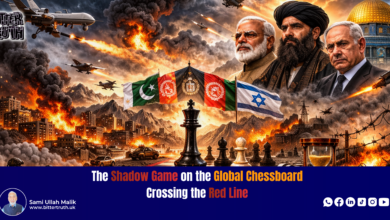
General Chauhan’s commentary emerged even as the SCO conference in Tianjin displayed signs of warmth between India and China. Yet diplomatic smiles and the harshness of the battlefield are two very different realities. Pakistan was represented at this summit by Prime Minister Shehbaz Sharif, who, according to international observers, executed a chess-like manoeuvre in diplomacy that left India’s pieces immobilised.
Deputy Army Chief Rahul Singh struck another note of critique, targeting the China–Pakistan alliance. According to him, China treated the India–Pakistan conflict as a “live laboratory,” observing how its supplied weaponry performed. This statement reveals, above all, the anxieties of India’s military leadership. Following Operation Sandur, General Anil Chauhan alleged during the Shangri-La Dialogue that Pakistan may have utilised Chinese commercial satellite assistance—a charge clearly intended to divert blame from India’s own failures. Despite the absence of evidence, it was suggested that technology had tipped the scales against India.
In an interview with Bloomberg TV, General Chauhan remarked, “The important matter is not that a plane was downed, but why it happened.” In this fog of words, truth was obscured. He refrained from disclosing the number of aircraft lost—a silence that spoke volumes. History, at times,
teaches that the most telling admission is the one left unspoken.
All this unfolded as China voiced its concerns over India’s trade practices. Opposition to a fifty-percent tariff evidences that, alongside the battlefield, the marketplace too has become a theatre of a new Cold War.
And now, observers, the moment has arrived: history has turned its page, and the pen of the future has been entrusted to the East. The emblem of a new axis of power, the cohesion of Pakistan with the Eastern alliance, and the herald of balance in global relations—all affirm that the era of unilateral leadership has passed.
The decline of the past—whether the twilight of the Roman Empire in the Levant, the sunset over Andalusia, or the waning of the British Empire—illuminates today’s lesson: every nation, every age, and every power sees its sun rise and set. Today, the East rises with renewed resolve, perseverance, and wisdom—a sun that not only guides the leaders of the East but signals a new equilibrium for the world at large.
(آل عمران: 139) وَلَا تَهِنُوا وَلَا تَحْزَنُوا وَأَنْتُمُ الْأَعْلَوْنَ إِنْ كُنْتُمْ مُؤْمِنِينَ
“Do not weaken, nor grieve, for you shall be superior if you are true believers.”
This timeless injunction resonates with today’s global theatre: the East, through its strength, wisdom, and unity, has commenced the journey of global leadership. We now stand at a historical juncture, a moment when the tide of history turns, and the hand that shapes the future belongs firmly to the East.