The Cry of the Oppressed, the Conscience of the World
Palestine: From Subjugation to Sovereignty

The Scorched Soil of Gaza: A Lamentation in the Age of Silence
Even now, the soil of Gaza smoulders — not merely from the firepower unleashed upon it, but from the funeral pyres of justice itself. The very winds that traverse its battered alleyways are laced with the acrid scent of gunpowder. The sky, burdened with the muffled sobs of orphaned children, hangs heavy like a mourning shroud. And the earth, soaked in the tears of bereaved mothers, stands as a silent witness — shamed, not by defeat, but by the world’s indifference.
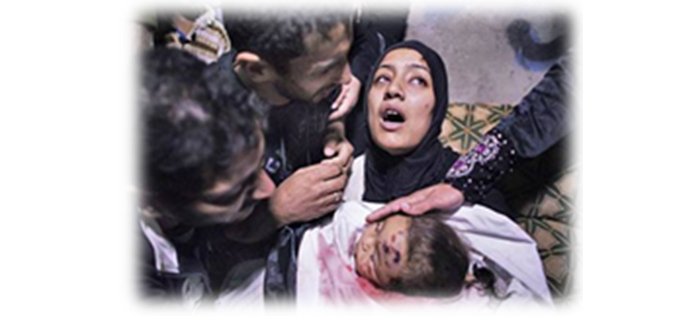
The Israeli bombardment has not only eviscerated bodies; it has rent the very soul of our shared humanity. In Gaza, a mother stands still before the lifeless body of her child. Her eyes no longer weep — for her tears have run dry. Her mouth utters no cry — for cries are futile in a world that has forgotten how to listen. Beneath the rubble lie not combatants but children — limbs limp, toys broken, futures unbegun. And echoing through the debris are the dirges of mothers who have buried more than their offspring — they have buried hope itself.
The cameras of the world, its reporters, its heads of state, and the gilded chambers of the United Nations have all borne witness to these scenes. Yet what remains unseen — or worse, deliberately overlooked — is the river of blood coursing through Palestinian soil; the shattered homes, the wounded children, the wailing women, and the sky cloaked in smoke. This is no accident of war. It is not the collateral damage of miscalculated strikes. It is, rather, the harrowing outcome of systematic racism, intentional marginalisation, and the chilling silence of diplomatic hypocrisy. It is, in truth, the requiem of humanity — mourned in silence, endured in shame.
The soil of Gaza is once again soaked with the blood of the innocent. Unarmed children, women, and the elderly are subjected to the ferocity of precision-guided weaponry and incendiary munitions. According to The Guardian, the death toll of Palestinians has surpassed 64,260. With long-term effects such as starvation, disease, and the decimation of healthcare infrastructure, this figure may tragically multiply to 186,000 — a cataclysm by any moral reckoning. Among the slain are over 19,000 children and more than 12,500 women. The Lancet and the World Health Organization affirm that these numbers likely fall short of the true scale of death — when one includes the unregistered casualties of illness, famine, and despair.
وَلَا تَحْسَبَنَّ اللَّهَ غَافِلًا عَمَّا يَعْمَلُ الظَّالِمُونَ
“Never think that Allah is unaware of what the wrongdoers do.” (Qur’an 14:42)
But the agony is not confined to bombs and bullets. It festers in the long shadows of siege — in the starvation that creeps slowly like an invisible executioner, in the collapse of hospitals, in the obliteration of sanitation, water, and shelter. The crisis is not merely immediate. It is structural, sustained, and systemic — a total war on the very idea of a dignified Palestinian existence.
Nor is the guilt solely Israel’s. Complicity has its apostles, and among them, the Indian government under Narendra Modi stands accused of morally unconscionable collaboration. Reports indicate that nearly one million individuals have been mobilised, either directly or by proxy, in support of Israeli operations. This alliance is not a diplomatic alignment — it is an ideological fellowship forged in the crucible of ethnonationalist ambition. What India offers Israel is not mere ammunition, but moral vindication — and what it receives in return is the shared currency of impunity.
This great crime is no longer shrouded in ambiguity. The world has seen such architecture before — in the dusty suburbs of Soweto, in the segregated councils of apartheid South Africa, where a white minority imposed its rule upon a dispossessed majority. Gaza, today, is our Soweto. And as Soweto rose, so too shall Gaza endure.
وَلَقَدْ كَتَبْنَا فِي الزَّبُورِ مِنۢ بَعْدِ ٱلذِّكْرِ أَنَّ ٱلْأَرْضَ يَرِثُهَا عِبَادِيَ ٱلصَّـٰلِحُونَ
“And We have written in the Scripture after the Reminder: My righteous servants shall inherit the earth.” (Qur’an 21:105)
On 21 March 1960, the bullets rained down in Sharpeville. On 16 June 1976, the children of Soweto were gunned down for daring to march. In 2018, the same fate befell Palestinians in Gaza, their bodies riddled as they marched for their right to return. And in 2023 and 2024, the violence intensified, its mask cast aside. The world watched — again — as the machinery of occupation operated with the precision of impunity.
Just as apartheid South Africa denied black citizens their fundamental rights — freedom of movement, political representation, access to health and education — so too does Israel deny these same rights to Palestinians. Citizenship is withheld. Employment is curtailed. Travel is barricaded. Healthcare is shattered. Gaza has become a prison without parole — an open-air pen of despair, where the punishment for being born Palestinian is lifelong captivity.
International institutions have, albeit belatedly, begun to echo this reality. In 2024, numerous agencies declared Gaza “uninhabitable.” Medicine is non-existent. Water is toxic. Infrastructure lies in ruins. And still, the siege continues. This is no longer merely a humanitarian crisis — it is the systematic annihilation of a people’s capacity to live.
Those who still defend Israel’s policies — like Richard Goldstone once did — find themselves increasingly isolated. As Archbishop Desmond Tutu warned: “Israel’s treatment of Palestinians mirrors the apartheid we fought in South Africa.” The consensus grows. The veil thins.
In 1948, some 700,000 Palestinians were expelled from their ancestral lands — a trauma of forced exile whose echoes have yet to fade. Their descendants now live in Gaza, Jordan, Lebanon, Syria, and the West Bank — stateless, rightless, and rootless. When they attempt, under international law, to reclaim their homes — their right of return — they are met not with justice, but with gunfire.
Yet a new tide rises. From the lecture halls of American universities to the parliamentary chambers of Europe, a new solidarity is taking shape. In these last two years — 2023 to 2025 — pressure has mounted, voices have risen, and the term “apartheid” is no longer taboo in diplomatic parlance. A reckoning is approaching, slow perhaps, but inexorable.
The Winds of Reckoning: Europe, Palestine, and the End of Silence
The question confronting the world today is no longer, “What should Israel do?” Rather, it is, “How much longer shall the world endure this brutality in mute complicity?” If Israel remains recalcitrant toward the two-state solution, then the only path remaining is that of a unified state — akin to post-apartheid South Africa — wherein Jew, Muslim, and Christian may share equal citizenship, equal dignity, and equal justice. Yet herein lies the central paradox: it is Israel’s own leadership, most pointedly Prime Minister Netanyahu and his far-right coalition, who stand as the greatest impediment to that egalitarian vision.
The settlements erected in Jerusalem, the West Bank, and the Negev in 2024 were not acts of benign urban development; they were declarations of strategic displacement — stark signals that Israel seeks not coexistence but conquest. The war of 2024 did not merely shake Gaza; it shattered its soul. Hospitals were bombed, schools turned to rubble, and places of sanctuary desecrated. Thousands perished — women, children, the elderly — with testimonies etched into the collective conscience of a watching world. And the world did watch.
Through the lens of global media, through the tremors of social platforms, and through the searing witness of first-hand accounts, the horror unfolded — unfiltered, unedited, undeniable. No longer can it be said that the world did not know. And now, from the corridors of Western academia to the public squares of European capitals, the tide has turned. A new generation, including Jewish youth, is rising — defiant against the traditional Zionist narrative. Campus protests, boycott movements, and civic unrest have compelled once-complacent politicians to reconsider their loyalties.
Europe, once Israel’s discreet patron, has begun to speak with a new voice — a voice not of vengeance, but of conscience. Nations such as France, Spain, and Ireland have extended formal recognition to the State of Palestine. This is not mere diplomatic gesture; it is the world’s trembling answer to the blood-stained toy of a murdered child. It is a belated benediction to the unmarked graves that history could not ignore. This is no longer merely Palestine’s story — it is the story of every human being whose existence has been flattened beneath the juggernaut of occupation, whose identity has been criminalised, whose homeland has been exiled.
وَقُلْ جَاءَ ٱلْحَقُّ وَزَهَقَ ٱلْبَـٰطِلُ ۚ إِنَّ ٱلْبَـٰطِلَ كَانَ زَهُوقًۭا
“And say: Truth has come, and falsehood has perished. Indeed, falsehood is bound to perish.” (Qur’an 17:81)
This is not the end of the tale, but perhaps — mercifully — the beginning of a new chapter. Under the weight of public opinion, civic mobilisation, and the moral urgency of student movements, Europe has found its voice. The far-right policies of Netanyahu’s government, the unbridled violence in Gaza, and the strategic ambiguity of the United States have together catalysed a tectonic shift. Europe now charts its own diplomatic course — no longer merely echoing Washington’s whisper but speaking in its own sovereign tongue.
The soot that rises from Gaza’s ruins has yet to clear, but upon the global horizon, a new dawn hesitantly breaks. The formal recognition of Palestine by France, Spain, Ireland, Norway, and others is not a symbolic ripple — it is a diplomatic revolt. A long-standing orthodoxy, in which Israel’s narrative reigned unchallenged, now totters. What we witness is not an aberration but the stirrings of a seismic realignment.
For France to extend recognition to Palestine is no ordinary manoeuvre. It is the crack of dissent within the ranks of Israel’s long-standing allies. A nation that has traditionally balanced its transatlantic loyalties with cautious neutrality now signals that it can no longer stand idly by in the face of overwhelming moral indictment. The carnage wrought by Israel’s campaign in Gaza — an orgy of civilian slaughter — has jolted the global conscience into wakefulness.
وَمَا رَبُّكَ بِغَـٰفِلٍ عَمَّا تَعْمَلُونَ
“And your Lord is never unaware of what you do.” (Qur’an 27:93)
Beyond Europe, voices from the Global South — Brazil, South Africa, Indonesia, Turkey — have risen in unison. These states have become vanguards of Palestinian solidarity, not only through words but through assertive stances in the United Nations and other global forums. The paralysis of American foreign policy, riven by internal discord and the erosion of moral authority, has afforded Europe the impetus — and the necessity — to act independently.
No longer does diplomacy wait on Washington’s nod. Europe has begun to forge decisions of its own, and the recognition of Palestine is but the first herald of a broader awakening. A growing chorus of states now stand on the side of justice — and in doing so, have begun to isolate Israel on the international stage. Within Israel itself, dissent simmers. The government finds itself beleaguered — diplomatically constrained abroad, politically challenged at home.
What once seemed a faded dream — the two-state solution — now stirs again in the imagination of global diplomacy. Palestine is increasingly recognised not merely as a territory, but as a legitimate state — a moral subject, not an object of pity. The prospect of renewed negotiations, though faint, breathes once more.
The divergence between the United States and Europe is no longer a whisper in diplomatic parlours — it is the headline in global discourse. Europe’s recognition of Palestine marks a new autonomy in Western foreign policy, and a reshaping of alliances that may prove irreversible.
As more powers acknowledge Palestine’s statehood, a new moral legitimacy is conferred upon the Palestinian people — and their resistance, long demonised, now gains the character of a lawful and organised movement for liberation. This is no longer merely about survival — it is about sovereignty.
We are witnessing not only a geopolitical shift, but a moral renaissance. The collective conscience of humanity, dormant for decades, now awakens. The cruelty inflicted upon the Palestinian people can no longer be sanitized for Western consumption. The architecture of silence is collapsing.
If this trajectory continues — if momentum is maintained — it is no longer inconceivable that Palestine will secure full membership in the United Nations in the coming years. Such a prospect, once ridiculed as utopian, now emerges as entirely within reach.
And so, Israel is left with a fateful choice: accept the two-state solution or reconcile with a shared-state vision that guarantees equal rights for all — Jew, Muslim, and Christian alike. Should it fail to do so, then today’s diplomatic revolt may become tomorrow’s global movement — as once occurred in the struggle against apartheid South Africa.
A Moment of Moral Reckoning: The Shifting Faultlines of Power, Conscience and Resistance
In the corridors of power, where phrases are often weaponised and silence becomes complicity, the Israeli government — under the increasingly embattled stewardship of Prime Minister Netanyahu — has chosen to characterise the European recognition of Palestine not as diplomacy, but as the “triumph of terrorism.” Such language, charged with moral panic and rhetorical violence, belies a deeper anxiety within the Israeli establishment: the erosion of its once-unquestioned global narrative.
Yet even within Israel itself, dissenting voices grow louder. Former ambassadors, retired generals, and public intellectuals have begun to break ranks. Among the younger generation of Israeli Jews, a moral question stirs uncomfortably: Do we truly stand for equality — or supremacy?
Across the Atlantic, the United States finds itself increasingly out of step with its European allies. On the one hand, Washington reiterates its unwavering commitment to Israel’s security. On the other, it now faces a new and autonomous Europe — no longer content to shadow American policy. The State Department walks a diplomatic tightrope, strained by the contradictions of its own making: urging Gulf nations to normalise ties with Israel, while those very allies in Europe now openly recognise Palestine and question the legitimacy of continued occupation.
In 2020, Jared Kushner — playing a modern-day Lawrence of Arabia in tailored suits — brokered what came to be known as the Abraham Accords. Under this American initiative, the United Arab Emirates, Bahrain, Morocco, and Sudan extended formal recognition to Israel. This was heralded in Washington as a dawn of peace, a new architecture of stability in the Middle East. But for the Palestinian people, it was a betrayal in brocade — a diplomatic veneer masking the festering wound of dispossession.
Behind the smiling photo-ops and gilded banquet halls, the objectives of the Abraham Accords were never opaque. They sought to: isolate Iran regionally, embed Israel within an Arab geopolitical framework, boost U.S. arms sales and defence contracts, and most grievously, bypass the Palestinian question altogether — all under the guise of “normalisation.” It was, in essence, an attempt to pave the road for a Greater Israel, unshackled from moral scrutiny.
But history has its rhythms, and the war on Gaza in 2024 jolted the global conscience from its anaesthetised slumber. Images of bloodied children, pulverised hospitals, and shattered neighbourhoods flooded the world. For the first time, international human rights organisations began to name what had long been whispered: Israel is practising apartheid. The United Nations, the International Court of Justice, and a growing chorus of investigative journalists confirmed what moral clarity had already recognised — that the policies pursued by Israel were not merely aggressive, but deliberately dehumanising.
وَلَا تَكُنۡ لِّلۡخَآئِنِينَ خَصِيمٗا
“And do not argue on behalf of those who betray.” (Qur’an 4:105)
In this volatile moment, an astonishing proposal emerged — allegedly from former U.S. President Donald Trump: that Gaza be placed under American administration and transformed into a “model city” for international tourism, complete with luxury hotels and recreational paradises. As fantastical as it may sound, there were reports of corporations being courted, construction blueprints drafted, and foreign governments nudged to resettle the existing Palestinian population into neighbouring Arab countries.
This surreal vision — of bulldozing the trauma of a people and replacing it with beachfront resorts — reveals not only a catastrophic ignorance of history, but a profound contempt for memory. For even in ruins, Gaza is a homeland, not real estate.
From 2023 to the present, Palestinian resistance has undergone a metamorphosis. No longer dismissed as marginal, it now occupies the centre of a global moral reckoning. The world is watching Gaza — not as a theatre of chaos, but as a crucible of conscience. The machinery of occupation may persist, but its moral scaffolding is rapidly corroding. Boycotts, sanctions, protests, and global scrutiny intensify with each passing month.
Today, comparisons between the Palestinian struggle and the anti-apartheid movement in South Africa are no longer metaphorical — they are strategic. As Pretoria’s system of racial domination collapsed under the weight of international censure and internal resistance, so too may Israel’s policy of ethno-nationalist superiority face its historical reckoning.
But the counter-forces are not asleep. In the United States, the influence of powerful lobbying entities — AIPAC, the ADL, and others — has redoubled. These groups exert immense pressure on policymakers and media institutions, seeking to neutralise Europe’s bold shift. They aim not only to block momentum toward Palestinian recognition, but to delegitimise it altogether. The State Department, for its part, has issued mild diplomatic reservations — careful not to openly oppose Europe, lest the fragile transatlantic alliance fracture.
Behind closed doors, however, levers of informal pressure are being deployed. NATO, G7, and other trade and security platforms may serve as conduits to discourage European nations from further assertiveness on Palestine.
Should the United Nations move to grant Palestine full membership — a possibility now closer than ever — the United States is likely to wield its veto, as it did in 2011, in defence of an untenable status quo. Simultaneously, Washington is expected to escalate pressure on Gulf nations — particularly Saudi Arabia, Oman, and Qatar — urging them to deepen ties with Israel and dilute the diplomatic aftershocks of European recognition.
The strategy is twofold: silence Arab criticism and restrain Palestinian resistance. Intelligence cooperation, cyber-security, arms deals — all are now tools of conditional diplomacy. Yet herein lies a critical miscalculation.
The winds have shifted.
For if Saudi Arabia, in pursuit of geopolitical expediency, were to normalise ties with Israel while forsaking Palestine, its long-cherished leadership within the Muslim world would be gravely imperilled. The people of the Gulf are not blind to the symbolism of betrayal — and in this age of digital dissent, political cost is increasingly measured in public sentiment, not palace proclamations.
وَأَنَّ ٱللَّهَ لَا يُضِيعُ أَجْرَ ٱلْمُؤْمِنِينَ
“And Allah does not let the reward of the faithful be lost.” (Qur’an 3:171)
The challenge facing Arab regimes is no longer diplomatic but existential: whether to yield to transatlantic coercion, or to stand in solidarity with a dispossessed people whose cries echo across the ruins of history.
Conclusion: The Weight of History and the Whisper of Conscience
History rarely announces its turning points with fanfare. They arrive quietly, like a wind changing course, or a candle refusing to be extinguished. Today, the struggle for Palestine stands not merely as a regional conflict, but as a moral mirror held up to the world. Europe has seen its reflection — and recoiled. The question now is not whether Israel will face accountability, but how long it can forestall the inevitable.
If the arc of the moral universe indeed bends toward justice, as Dr. King once said, then perhaps — just perhaps — that arc now passes through the narrow streets of Gaza.
From Oppression to Recognition: The Turning of the Moral Tide
Across the Atlantic, a constellation of powerful lobbying groups — the American Israel Public Affairs Committee (AIPAC), the Anti-Defamation League (ADL), the Jewish Institute for National Security of America (JINSA), and Christians United for Israel — now stir with unmistakable agitation. A response, both strategic and symbolic, is rapidly taking shape.
Resolutions may soon be tabled in both the Senate and the House of Representatives, condemning the recent European recognitions of Palestinian statehood as reckless and “one-sided.” In the corridors of Capitol Hill, where legislative power often dances to the rhythm of donor interests, Israel’s advocates seek to transform European conscience into American censure.
The media, ever susceptible to orchestrated influence, may well become the next theatre of persuasion. Through outlets such as CNN, Fox News, and The New York Times, a new narrative is likely to be spun — one in which Palestinian recognition is not a triumph of international law, but rather a capitulation to terror, a strategic misstep cloaked in moral language.
Candidates for the upcoming American elections are being warned: only those who pledge unflinching loyalty to Israel shall find favour among the gatekeepers of political patronage. Campaign funds, endorsements, and media access — all hang in the balance.
Moreover, AIPAC and its allied forces are expected to exert pressure on transatlantic defence arrangements, particularly within NATO. There may be subtle attempts to strain military-industrial cooperation with European states that have recognised Palestine. Investment frameworks and arms deals could be reviewed — not through formal sanctions, but through the invisible hand of geopolitical discomfort.
Yet the world is no longer what it was. The Palestinian people are no longer defined merely by stone and rocket; they have emerged as ambassadors of conscience — wielding not just resistance, but law, diplomacy, and the collective weight of global public opinion.
Israel now stands at a crossroads: it must either accept a two-state solution, grounded in equity and dignity, or reconcile itself to a single, binational state in which Jews and Palestinians share equal civil rights — a scenario once unthinkable, now inevitable. Just as apartheid South Africa could not long resist the tide of moral reckoning, so too must Israel understand that the blood of the oppressed is not shed in vain.
وَلَا تَحۡسَبَنَّ ٱللَّهَ غَافِلًا عَمَّا يَعۡمَلُ ٱلظَّـٰلِمُونَ
“Think not that Allah is unaware of what the oppressors do.” (Qur’an 14:42)
In the year 2025, the formal recognition of Palestine by France, Spain, Ireland, Norway, Belgium, and others constitutes a seismic rupture in the diplomatic terrain — a blow to the spirit of the Abraham Accords and a rebuke to the fiction of normalisation absent justice. It signals not merely a legal endorsement, but a moral reckoning — an indictment of Israeli policies and a validation of Palestinian nationhood.
It is also a mirror held up to the Gulf states and other Muslim-majority nations: how long can relationships with an expansionist, ethno-nationalist Israel be sustained without confronting an internal collapse of moral authority? The world has taken notice — of the aggressive settlement expansions in the West Bank, the relentless siege of Gaza, and the systematic Judaisation of Jerusalem.
These actions, far from preserving peace, are steadily eroding international sympathy. Europe’s recent move marks the beginning of a paradigm shift — from passive observation to principled action. The question is no longer whether the Palestinians deserve statehood. The question is: when will it be implemented, and at what political cost to its adversaries?
If the United States and Israel still harbour any genuine desire for peace, then they must now listen to the voices they have long ignored — the dispossessed, the occupied, the silenced.
The recognition of Palestine is not a mere procedural step in foreign policy. It is a ray of justice piercing through decades of diplomatic dusk — a trumpet blast against the inertia of indifference. If more nations follow Europe’s lead, Israel will be compelled to revisit its supremacist doctrines. Otherwise, it will march steadily toward isolation — diplomatic, economic, and moral.
This is no time for spectatorship. The world must take a stand — in favour of law, humanity, and historical accountability. Perhaps, in the tear-filled eyes of Palestinian mothers, the dream of a brighter dawn may begin once more to glimmer.
Today, Palestine is no longer the name of a dispossessed nation alone. It is the name of justice uncompromised, of resistance dignified, of principle undeterred.
And just as apartheid in South Africa eventually crumbled under the weight of its own iniquity, so too shall the scaffolding of racial supremacy in Israel be consigned to history’s refuse. The blood of the innocent may have been deemed expendable by power, but now it stands at the threshold of the world’s conscience — demanding not revenge, but remembrance, reckoning, and redemption.
The Undying Flame of Justice: Palestine and the Awakening of the World’s Conscience
The candle of truth and justice, which now flickers defiantly in the storm-laden skies over Palestine, can no longer be extinguished by the choking winds of oppression. Its glow is not confined to geopolitical boundaries or the hollow rhetoric of diplomacy; it is a universal impulse—an awakening of conscience that reverberates through the collective soul of humanity. The very conscience that had remained dormant for centuries, silenced by the clamour of empire and the inertia of self-interest, now rises with a cry of truth.
وَمَن يَقْتُلْ مُؤْمِنًا مُّتَعَمِّدًا فَجَزَاؤُهُ جَهَنَّمُ وَخَالِدًا فِيهَا
“And whoever kills a believer intentionally—his recompense is Hell, wherein he shall abide eternally.” (Surah An-Nisa, 4:93)
This sacred verse is not merely a warning; it is a moral thunderclap, a declaration of war against tyranny and injustice.
This is the same Palestine where the innocent laughter of children has been silenced by bullets, where the laments of mothers echo endlessly, and where the stones themselves seem to cry out in defiance. But today’s struggle is not fought by stones and rockets alone; it is waged also in courtrooms, diplomatic halls, and the battlegrounds of global media. The spirit of resistance now wears robes of law and diplomacy, its voice amplified not just by protest but by principle.
History stands witness: the ramparts of cruelty crumble inevitably. Be it apartheid South Africa or the occupied lands of Palestine, the architecture of injustice is never eternal.
Let it be remembered—Palestine is no longer merely a theatre of grief and torment. It has become an immortal emblem of patience, moral fortitude, and divine steadfastness. The blood of its martyrs has not been shed in vain; it is inked upon the pages of time as a sacred covenant.
لَن تُغْنِيَ عَنْهُمْ أَمْوَالُهُمْ وَلَا أَوْلَادُهُم مِّنَ اللَّـهِ شَيْئًا ۚ أُولَـٰئِكَ أَصْحَابُ النَّارِ ۖ هُمْ فِيهَا خَالِدُونَ
“Neither their wealth nor their children will benefit them against Allah whatsoever. They will be the companions of the Fire; they will abide therein forever.” (Surah Al-Mujādilah, 58:17)
This is the moral weight—of blood shed in sacrifice, of truth spoken in peril—that tips the balance of history.
No longer can the facts be concealed by the veils of power. Just as the anti-apartheid struggle once stirred the slumbering conscience of the world, the Palestinian cause is now rousing the same spirit of moral reckoning. The question is no longer whether Palestinians deserve statehood, but rather: when shall justice prevail, and at what cost shall the world finally recognise its duty?
To stand with Palestine today is not merely a political act—it is a test of our humanity, our ethics, and our shared future. This is not a reckoning for governments alone; it is a summons to the world’s soul.
Now is the time for global leaders—those who hold in their hands the quills that draft humanity’s fate—to heed the call of justice and awaken their sleeping consciences. There is but one path forward: justice. Whether it be through the vision of two equal states or a single nation where every man, woman, and child is accorded dignity by virtue of their humanity, the road leads to equity. Otherwise, the fate of all oppressive regimes shall be repeated—the walls will fall, and light shall pierce through the darkness.
This is the hour for Islam’s eternal values—equality, justice, peace—to illuminate the corridors of global power. As the Qur’an declares:
وَأَن لَّيْسَ لِلْإِنسَانِ إِلَّا مَا سَعَىٰ
“And that man shall have nothing except what he strives for.” (Surah An-Najm, 53:39)
The Palestinian struggle is not merely the striving of a nation—it is the striving of humankind. It is a voice that transcends the walls of occupation and the borders of politics, crying out against injustice in the universal language of resistance.
In a world riddled with the intrigues of the powerful and the hypocrisy of false alliances, now is the moment for the nations to cast aside the cloak of indifference and rise in defence of what is just. The path may be perilous, haunted by echoes of betrayal and past complicity, but a dawn of justice is inevitable. In every tearful eye of a Palestinian mother, the dream of justice endures—a dream that shall not fade.
Palestine is not merely the name of a people; it is a lamp raised aloft to shatter the darkness of tyranny, to uphold the banner of truth, and to declare that justice shall not be bought nor buried. As apartheid was consigned to history’s grave in South Africa, so too shall Israel’s policies of racial domination crumble under the weight of global truth.
The blood of the Palestinians is no longer cheap—it is a question posed to the conscience of the world. And until justice is served, until the architects of these crimes are brought to account, the wound shall remain open.
Indeed, history does not absolve the oppressors. One day, the chains of tyranny are broken, not by force, but by the awakening of the collective conscience. The Palestinian struggle—rooted in faith, liberty, and moral conviction—stands as a light for all mankind, a defiant cry that every wall of injustice shall fall.