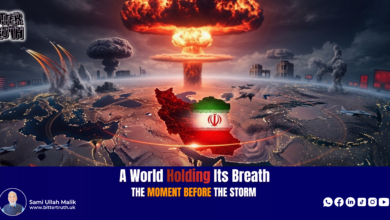

The Crown of Leadership: Beijing’s Proclamation to the World
Twilight in the West, Dawn in the East

The Turning of the Tide
O peoples of the earth, have you not perceived the stream of history altering its course? Have you not discerned the waves of time recoiling, rolling back from the Occident towards the Orient? For centuries the sun of power rose above the colonnades of Rome, the palaces of London, and the citadels of Washington. Yet lo, its beams have shifted: rays that once glittered across the Atlantic now dance upon the restless waters of the South China Sea.
Ask thine own heart—are these but the drums and thunders of artillery? Or is this the proclamation of history itself, that the reins of leadership are slipping from Western hands? Is this but a martial parade, or the compass by which the destiny of ages is fixed? Xi Jinping has spoken, and the world has hearkened: the centre of gravity is changed. The vassal of yesterday is the master of to-day; the wounded of yesteryear stands as the victor of the dawn. This hour, this spectacle, this clarion call—shake the nations and declare that the current of power has veered Eastward.
History, as ever, does not flow in one direction. The river of time, in its eternal turbulence, has at times borne the sceptre westward, and at others laid it gently in the bosom of the East. Rome held it; then the Turks; then Europe, borne aloft by conquest and empire, claimed it; and at last, after the second great war, America strode forth as undisputed arbiter of mankind. Yet now, history turns another page. The reins slacken in Washington’s grasp; in the skies of Beijing, a new dawn kindles.
This is not merely the clang of arms, but the clash of civilisations. Not merely the rumble of tanks and roar of engines, but the annunciation of a political age. Xi Jinping’s parade has made plain what the centuries obscured—that the East, long scorned as feeble and shackled, now stands upright, girded to assume command of the world’s destinies. America, erstwhile author of the world’s decrees, now beholds the scales of history tilt against her, as a new equilibrium emerges.
There are moments in the journey of nations when events are no longer mere occurrences, but epochs that determine the fate of generations. The morning in Beijing was such an hour. It was no idle pageant, but the handwriting upon the wall, the herald of a new dispensation. The cannon, the squadrons, the serried battalions—these were but the outward vesture; the inward substance was the proclamation that history had shifted its axis.
For centuries China endured humiliation at the hands of Western dominion: from the Opium Wars to the cruel rapacity of Japan. Yet the China of to-day is no prisoner of its past, but candidate for the stewardship of the future. Such was the true burden of Xi’s words, such the silent thunder of his armies’ march.
“وَتِلْكَ ٱلۡأَيَّامُ نُدَاوِلُهَا بَيۡنَ ٱلنَّاسِۗ”
“And such are the days, which We distribute among mankind in turn.” (Āl-ʿImrān 3:140)
The parade was more than a military demonstration; it was the overture of a new age upon the stage of world politics. For power always carries a double aspect: the material—armaments and divisions—and the moral—its message, its impression, its claim to legitimacy. Beijing that day conveyed both: the gleam of steel and the intimation of destiny.
Across the Atlantic, a storm-tempered voice arose. Donald Trump, in his accustomed whirlwind manner, took to his electronic rostrum, proclaiming that Xi, Putin, and Kim conspired against America. Yet this was no sober analysis, but the cry of a wounded pride, the shriek that escapes when authority ebbs away. His words were the mirror of a nation’s inward anguish, the wrath of one who finds himself no longer the axis of the earth.
In Trump’s fury was revealed the old American temperament—that none but itself may lead, that sovereignty must remain indivisible in its hands. His outburst was the echo of a people who hear, faint but inexorable, the footfall of decline. It was both menace and lament, a vow not to surrender the crown of supremacy without a struggle. Yet the world is changing, and his defiance only underscored the reality: that the sceptre trembles in the Western grasp, while the East advances to claim it.
The Silent Geometry of Power
Xi Jinping’s oration and the martial pageant in Beijing disclosed a truth beyond mere armament: it was a civilisational proclamation. Cannon do not fire bullets alone; they discharge messages into the conscience of nations. Tanks do not merely turn their iron wheels; they redirect the very current of history. China declared her resolve to transmute centuries of fracture and humiliation into the diadem of triumph.
When Xi placed Putin at his right hand and Kim Jong-un at his left, he uttered a wordless statement. It was not the triviality of protocol, but the symbolism of politics—the announcement of a triangle of power. In the theatre of statecraft, silent emblems often pierce deeper than the loudest oratory.
To the right, Russia’s martial sinews; to the left, Korea’s defiant audacity—thus the Eastern alliance spread its wings around Xi, the axis of the moment. The tableau spoke plainly to America: “We are not solitary; we are a confederation.”
Thus the seating itself became speech, more eloquent than a thousand communiqués. Was this, then, mere happenstance? Or a deliberate contrivance designed to sting the pride of a man like Trump—whose nature is tempestuous, whose will abide another in the centre of the stage? History’s pages may never disclose the full intent, yet this is clear: China knocked upon the heart of her rival, wielding not arms alone but stratagem, not strength only but subtlety.
“وَأَعِدُّوا۟ لَهُم مَّا ٱسۡتَطَعۡتُم مِّن قُوَّةٖ وَمِن رِّبَاطِ ٱلۡخَيۡلِ تُرۡهِبُونَ بِهِۦ عَدُوَّ ٱللَّهِ وَعَدُوَّكُمۡ”
“And prepare against them whatever force you can muster, and steeds of war, by which you may strike terror into the enemies of God and your enemies.” (al-Anfāl 8:60)
Xi did not stand merely as a President, but as a pivot—the hub about which the Eastern constellation revolved. The message was unambiguous: the age of unilateral command is past. Trump’s erratic policies had shaken the confidence of the world; Xi’s choreography sought to draw the gaze of nations eastward—and he succeeded. His unspoken declaration seemed to be: if the West trembles, the East stands assured.
Thus, was revealed the paradox of our age: a West disoriented, an East ascendant. The world
witnessed not China alone, but China enshrined at the head of an Eastern phalanx, daring to challenge the hitherto unchallenged supremacy of America. It was a proclamation that strength would no longer be confined to defence but harnessed for leadership.
Xi emerged not as a solitary ruler, but as the axis of an alliance, the lodestar of an Orient intent on breaking the spell of Western hegemony. The occasion, though clothed in the garb of remembrance—the eightieth year since Japan’s defeat—was in truth a declaration of victory, a transmutation of old wounds into a crown of sovereignty.
To transfigure the scars of defeat into the laurels of command—this is the prerogative of great nations. And China, once the patient of humiliation, now strode forth as the physician of her own destiny. No longer the victim of history, she stood revealed as the herald of the future. What the world beheld that day was not a parade alone, but the resurrection of a civilisation, the metamorphosis of memory into mandate.
The Herald of the Eastern Seas
The army massed behind Xi Jinping was more than a parade of steel; it was a warning to the world. These were not battalions alone, but a philosophy embodied: that the balance of power was about to be altered. The West had long imposed its dominion by force of arms. Yet on this day, China declared, with mute eloquence, that she bows to no master. The legions arrayed upon Tiananmen were not merely soldiers; they were the embodiment of a vow—that upon sea and sky alike, the scales would tilt eastward.
Arms are never iron and powder alone; they are also conviction, confidence, and creed. The columns upon the Square of Heavenly Peace testified that China’s armaments had been forged not only to equal the West but to surpass it.
Upon that same square stood three men: Xi, Putin, and Kim. Their presence was not happenstance; it was a tableau of a new era. For the first time, the rulers of China, Russia, and Korea stood shoulder to shoulder, writing upon history’s page a sentence that cannot be erased: the Orient shall now chart its own course.
That square—where Mao Zedong in 1949 proclaimed the People’s Republic, where Khrushchev once stood beside Kim’s grandfather—has ever been a witness to history’s turning. Xi gave it a fresh meaning, closing one circle and opening another. As the ages revolve, history returned to its own axis, and at Tiananmen a new chapter began.
Europe and America, beholding these scenes, felt a tremor within their breast. The scales of power shifted before their eyes, and the familiar confidence of supremacy gave way to unease. What they feared was not only political, but civilisational. For the West, long accustomed to dominion, now heard, faint yet inexorable, the herald of decline.
“وَتِلْكَ ٱلۡأَيَّامُ نُدَاوِلُهَا بَيۡنَ ٱلنَّاسِۗ”
“And such are the days, which We distribute among mankind in turn.” (Āl-ʿImrān 3:140)
Xi’s words were uncompromising: by 2035 Taiwan would return to China. This was no passing boast, but a declaration of heritage, of pride, of unfinished destiny. For Taiwan, it was menace; for China, it was promise. And the instruments of force displayed that day bore eloquent witness—especially the ships and squadrons—that the seas around Taiwan were to be girded as with iron. What was once a strait became a signal; what was once a blockade became the whisper of a storm.
Meanwhile, the West was absent, entangled in the Ukrainian war. China’s presence, set against the void of Western leaders, told its own tale. Their absence was no accident; it was a confession. The Occident, ensnared in its own crises, could not stand upon the stage. The Orient advanced, while the West faltered.
China’s fleets, her sixth-generation aircraft, her ceaseless manoeuvres—all proclaimed a single truth: she is resolved to break the American “chain of islands” that long sought to fetter her in the Pacific. Britain once ruled by command of the seas; America too by her fleets. Now China reaches for the same diadem. This is no idle dream, but the very knocking of the future upon the world’s door.
For mastery of the oceans has ever been the first condition of empire. He who holds the waves commands the world. When a nation lays claim to the sea, it lays claim to infinity itself.
The arithmetic of power speaks with an eloquence that no orator can rival. America commands 219 warships; China, 234. Yet these figures are not mere digits upon a naval ledger: they are the cipher of history, whispering that the balance is shifting, the scales of dominion tilting eastward. If this trajectory holds, in the years to come the diadem of maritime supremacy shall be set, not upon the brow of the West, but upon that of the Orient.
The parade in Beijing was no ordinary pageant of arms. It was a proclamation—a trumpet-blast declaring that the axis of power is no longer immutably lodged in the Atlantic world. The dawn is breaking in the East; the twilight descends upon the West. Xi Jinping’s message was unambiguous: China is not merely a nation of might, but a standard-bearer of a new civilisation, prepared to unite the East and challenge the hegemony of the West. History will record this hour not as spectacle, but as watershed.
Tiananmen, once consecrated by Mao’s proclamation of the Republic, became again the theatre of destiny. What the world beheld was not choreography, but a covenant—that the helm of leadership is passing from Washington to Beijing. The West, which for centuries presumed itself master, now finds its grip loosening; the East, once the subject, now rises as sovereign.
This moment recalls the fall of Rome, the dusking of Andalus, the ebb of Britain’s empire. Every age has its sun: it rises, it burns at zenith, it sinks. The American sun, long radiant, is now inclining from its noon; upon the horizon of the East, another orb ascends with gathering fire.
As the Qur’ān reminds us:
﴿وَتِلْكَ ٱلۡأَيَّامُ نُدَاوِلُهَا بَيۡنَ ٱلنَّاسِ﴾
“Such are the days: We apportion them among mankind in turn.” (Āl ʿImrān 3:140)
Xi’s parade declared that the reins of the world will not remain in Western hands. This was not merely a display of battalions and fleets, but a solemn annunciation of succession. The clang of armour, the surge of ships, the choreography of alliances—all conspired to herald a transfer of authority.
O dwellers of the world! How long will you avert your eyes? Do you not perceive the tremor in Washington’s chambers, and the composure in Beijing’s squares? Do you not hear the tolling of history’s bells—the same that tolled for Rome in its ruin, for Andalus in its twilight, for Britain at the sinking of its empire? They toll now at America’s gate.
Behold! Upon the horizon of the East a new sun has risen, its rays glinting in the steel of cannon, in the wake of fleets, in the resolve of an alliance. The sceptre is passing; the crown is set. The proclamation is unmistakable: the mantle of leadership has been transferred to the East.
And hear this, O nations of the West: your day is spent, your pride broken. History has turned her page, and the chapter of the future shall be written not in Washington’s ink, but by the hand of Beijing.