
The Citadel of Faith
Land of Belief

There are days in the life of nations which transcend the confines of a mere calendar; they become the very sinews of their existence, the roots of their collective consciousness, the eternal lamps burning in the depths of their soul. The birth of Pakistan in 1947 was not an ordinary political occurrence, nor merely a rearrangement of maps; it was, in truth, a spiritual and civilisational upheaval. Out of the long travail of partition, there emerged—by the Word of the Kalimah—a state miraculous in its conception, that altered not only the lines of geography but also the very rhythm of the beating hearts of its people.
This republic was conceived beneath the banner of “Lā ilāha illa Allāh”—“There is no deity but God”—and in that testimony it found a fortitude, an unshakeable stability, which no other modern movement has been granted. It stood as a solemn declaration that Muslims could not, and would not, survive without their distinct civilisation, their religious identity, and their ideological foundation. The state was not an accident of history; it was the manifestation of destiny.
Yet, the day this providential state took form, its adversaries began weaving webs of conspiracy against it. The Hindu leaders of India never reconciled themselves to this reality. To them, partition was but a temporary dislocation; Pakistan, a passing “accident,” destined sooner or later to be erased. For them, its presence was a canker upon their breast, and so they sought, at every juncture, to efface it—sometimes by open war, sometimes by the dark hand of proxies and terror, and at times by turning the very gifts of nature into weapons of malice.
The refrain of their statesmen was persistent: “Pakistan is a mistake of history.” From this sentiment arose the fevered dream of “Akhand Bharat”—an undivided India whose ambition is not content with Pakistan alone, but lays claim upon Nepal, Bhutan, Sri Lanka, Bangladesh, and indeed every nation washed by the waters of the Indian Ocean. Thus, their vision is nothing less than to cast the entire region upon the altar of their expansionist appetite.
The Qur’an had long forewarned mankind of such forces of disruption:
(البقرۃ: 217) ﴿وَلَا يَزَالُونَ يُقَاتِلُونَكُمْ حَتّٰى يَرُدُّوكُمْ عَنْ دِينِكُمْ اِنِ اسْتَطَاعُوا﴾
“They will not cease to fight you until they turn you back from your faith, if they are able.”
India’s ceaseless stratagems against Pakistan are but the contemporary visage of this verse. Yet history, that stern arbiter of human affairs, has always rendered the same verdict: when a nation stands firm upon its faith, no power of falsehood can ever vanquish it.
This is not a tale merely of battles and borders; it is the epic of belief and unbelief, of oppression and justice, of brute force pitted against conviction. Its echoes resound with the cries of Badr and Hunayn, its lessons gleam with the steadfastness of Karbala, and within its pages reverberate the prayer of Iqbal and the resolve of Quaid-e-Azam. Again and again, Pakistan has been bathed in its own blood, yet each time it has arisen with a courage renewed.
Consider, then, that night of 6th September 1965—a night etched in sombre hues upon the scroll of history—when across the plains of the subcontinent, a tempest of aggression sought to extinguish the fragile flame of Pakistan. In the cloak of darkness, India, six times mightier in size and resources, launched its treacherous assault. Its commanders dreamt that Lahore would be trampled beneath their boots before the morning sun had risen. They imagined that by noon the city would be festooned with their banners, and that this “mud-house of a nation” would scatter in the storm.
But they forgot: this was no ordinary soil. This was the land of the heirs of Badr and Uhud. The soldiers of Pakistan flung their very bodies before the steel of enemy tanks, standing as immovably as Khalid ibn al-Walid stood at Yarmouk against the legions of Rome. By dawn, it was evident that Lahore was not a mere collection of bricks and stones; it was a citadel of faith, a fortress built of the hearts of lovers of the Prophet ﷺ. Its streets and alleys were charged with the voice of Iqbal and the dreams of the Mujahideen.
That day the youth of Pakistan laid their breasts before the armoured monsters; its warriors shook the enemy’s heart with their cries of “Allāhu Akbar.” The dream of Iqbal and the message of the Quaid were baptised in blood, and a new life was proclaimed. The Hindu baniya had miscalculated: he thought Lahore was mortar and clay; he did not know it was the city of lovers. He did not reckon with a people who sold their jewels to support the front, whose children carried water to the soldiers, whose entire nation rose in one voice to cry “Pakistan Zindabad.”
For seventeen long days the war raged. Time and again the aggressor struck; each time, the sons of Pakistan swore by the Qur’an and repelled the blow. The defeat of the enemy was so searing that even now, decades later, the wound festers in its heart. And the world beheld the spectacle: the flag of Pakistan soared, the designs of the enemy were ground into dust, and it became manifest that Pakistan was not a mere geography—it was a fortress of faith.
Yet the adversary, still smarting from its humiliation, has never relinquished its sinister designs. From that day until this, with every new stratagem, it remains bent upon obliterating the existence of Pakistan.
The wound inflicted upon India in that fateful conflict never truly healed. Rather, it festered into a smouldering fire of vengeance—a fire that, to this day, has not been extinguished. It was of such sentiments that the Qur’an spoke when it declared:
(محمد: 7) ﴿إِنْ تَنْصُرُوا اللّٰهَ يَنْصُرْكُمْ وَيُثَبِّتْ أَقْدَامَكُمْ﴾
“If you aid Allah, He will aid you, and He will plant your feet firmly.”
Thus, after those seventeen days of war, the adversary retreated, scarred and humbled. Yet within its heart it resolved that if the field of battle was denied to it, then other, darker avenues of intrigue must be sought.
Time passed, but the plots did not cease. Realising that in open combat the lions of Pakistan would trample them underfoot, the foe turned, with coward’s cunning, to internal subversion. When their armies faltered, they sought to kindle discord from within. And so, a new front was opened: the shadows of terrorism were loosed upon Pakistan. The soil of Balochistan, the valleys of Khyber Pakhtunkhwa, and the marketplaces of her cities were stained with innocent blood. Mosques were bombed, madrasa students were slain, and the lanes of Pakistan ran red.
But these were no ordinary brigands. They were the proxies of India, known today by the Pakistani people as fitnat al-Khawārij and fitnat al-Hind—the twin evils unleashed upon the
faithful. They declared lawful the blood of Muslims, turned the sanctuaries of worship into slaughterhouses, and spread rivers of gore through bazaars. The world saw, with grim clarity, at whose behest these outrages were committed.
Yet, the enemy forgot the lessons of history: that the nation which survived Badr after exile, which endured the wounds of Uhud and did not perish, which upheld the banner of patience at Karbala, would not surrender its identity to terror.
Thus was fulfilled once again the prophecy of the Qur’an concerning such mischief-makers:
﴿إِنَّ شَرَّ الدَّوَابِّ عِندَ اللّٰهِ الَّذِينَ كَفَرُوا﴾
“Indeed, the worst of living creatures in the sight of Allah are those who persist in disbelief.”
And of the Khawarij, the Prophet ﷺ himself had forewarned:
(صحیح بخاری) يَخْرُجُ فِي آخِرِ الزَّمَانِ قَوْمٌ أَحْدَاثُ الْأَسْنَانِ، سُفَهَاءُ الْأَحْلَامِ، يَقُولُونَ مِنْ خَيْرِ قَوْلِ الْبَرِيَّةِ، يَقْرَءُونَ الْقُرْآنَ لَا يُجَاوِزُ تَرَاقِيَهُمْ، يَمْرُقُونَ مِنَ الدِّينِ كَمَا يَمْرُقُ السَّهْمُ مِنَ الرَّمِيَّةِ
“In the latter days there will emerge a people, young in years, foolish in thought, who recite the Qur’an, but it does not go beyond their throats. They shall pass out of the faith as an arrow passes through its target.”
These terrorists were but the living embodiment of that hadith—men who shed Muslim blood at the command of foreign masters. Yet Pakistan, with patience, courage, and sacrifice, foiled even this sinister plot.
The adversary’s proxies sought to weaken the nation, but even in the blackest of nights, the people of Pakistan kept the lamp of hope aflame. Soldiers, citizens, and institutions stood together, and once more history bore witness that a people founded upon faith cannot be buried beneath the dust of terror.
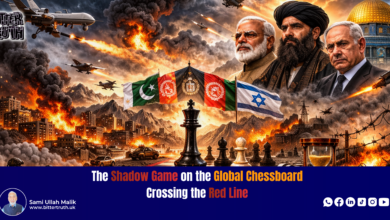
So came the spring of May 2025, and with it another chapter destined for golden letters in the chronicles of time. Once more the enemy dreamt of subjugating Pakistan. In unholy alliance with Israel, India forged a grand design to bend Pakistan’s knees. Emboldened by technology and bristling with modern armaments, they boasted that within hours Pakistan would sue for peace in humiliation.
But they misjudged the strength that lies not in iron or fire, but in the human heart steeled by faith. When the soldiers of Pakistan strode into the field with the cry of Allāhu Akbar upon their lips, the tanks and aircraft of the foe were humbled to dust. Israeli weapons, Israeli technology, and storms of propaganda—all were scattered like chaff before the steadfastness of the Pakistani warrior. Their courage evoked Yarmouk and Qadisiyyah, recalling the words of Saʿd ibn Abī Waqqās (RA): that when the soldiers of God place their trust in Him, no army on earth can bar their path.
And so, history itself testified: the soil girded by the shield of faith can never fall to falsehood. The world beheld, in astonishment, that even with Israel at its side, India was driven to its knees. And, at last, in a moment of bitter disgrace, its leaders turned to the President of the United States, Donald Trump, pleading for aid and begging for a ceasefire. It was the darkest hour in India’s history—a day of shame that shall forever stain its annals.
Having failed in war and failed through terror, the enemy then sought to weaponise the most precious gift of nature: water itself. Thus began a new chapter of hydrological terror. India diverted the waters of its dams to flood Pakistan. In summer, the rivers were dammed to parch the fields; in the monsoon, torrents were unleashed to drown villages, all under the duplicitous guise of “natural calamity.” It was not merely hostility towards Pakistan; it was a crime against the law of nations. Where civilised peoples regard water as life, India sought to make it an instrument of death.
Yet even in these deluges, the people of Pakistan endured with patience and resilience. And though the foe cloaked its perfidy as “acts of nature,” every discerning eye perceived them for what they were—another conspiracy born of enmity.
He imagined that by cloaking his schemes beneath the guise of “natural calamities,” he could conceal the hand of malice. In his conceit, he mused that the deluge of waters might sweep away an entire creed. Yet he remained blind to the eternal truth: no tempest can ever extinguish the foundations of the Kalima of Truth.
This stratagem is but a revival of an ancient delusion. Did not Pharaoh once dream of wielding dominion over the Nile? Yet, in the irony of fate, the very waters he sought to command became the tide of his destruction. As the Qur’an solemnly declares:
“فَأَخَذَهُ اللّٰهُ نَكَالَ الْآخِرَةِ وَالْأُوْلَىٰ” (النازعات: 25)
“So Allah seized him as an example for the later and the former generations.”
Thus does the Divine writ testify whosoever trifles with the ordinances of nature shall himself be ensnared in its chastisement.
The Modi regime strained every sinew to enfeeble Pakistan. Yet before his very eyes the United States, upon whom he had leaned so heavily, began to recoil from his designs. Modi—once eager to lay his brow upon Washington’s threshold—now, rebuffed by Trump’s indifference, cast anxious glances towards Moscow and Beijing. The American President not only turned away but, in a gesture laden with symbolism, spurned the “Quad” convocation upon Indian soil, speaking with unvarnished candour of his distaste for India’s belligerence. At that instant, the avenues of world politics began to close upon New Delhi.
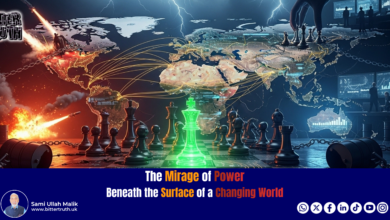
For Modi, this was a moment of rupture and disillusion. Bereft of honour at home and abroad, he was compelled to supplicate before Russia and China, not as a partner but as a pawn. These powers, pursuing their own grand designs, regard India not as an ally but as a mere instrument—an expendable piece upon the chessboard of geopolitics. For India, this pivot is nothing more than the frail plank of a sinking vessel.
Trump’s rebuke resonated far beyond Washington. It emboldened voices within India itself, where public ire and discontent swelled against his faltering leadership. In that hour of disarray, the old mirage of “Akhand Bharat” once more haunted his rhetoric. The claim—that the entire rim of the Indian Ocean, from Sri Lanka and Nepal to Bhutan, the Maldives, and even Pakistan itself, are but fragments of an imagined “Greater India”—betrays the same Chanakyan creed wherein deception and force alone are the currency of statecraft.
Yet history has delivered its verdict time and again. From the invasions of Mahmud of Ghazni to the onslaughts of Ahmad Shah Abdali, the Indian heartland has proved brittle before the hammer of destiny. Today, too, the dream of “Akhand Bharat” is no more than a mirage—a hollow boast, destined to wither by Modi’s own hand.
The world has begun to discern India’s true visage. Its proxy wars, its terror by stealth, and its weaponisation of rivers stand unveiled. Even Washington, erstwhile patron, has now declared India’s aggressions intolerable, making plain that it shall not abet this perilous course. Thus begins India’s slow march into isolation, while Pakistan, amidst trial and tribulation, has succeeded in stirring the conscience of the world.
The chronicle of Pakistan is not one of geography alone, but of faith, sacrifice, and resolve. From the battlefields of 1965 to the conspiracies of 2025, the enemy has sought repeatedly to erase its name from the map. Yet each assault has summoned forth not demise but renewal. Whether amidst the clash of arms, the shadows of terror, the floods of rivers, or the intrigues of global politics—each storm has been transmuted into a dawn of resilience.
This land is not a mere territory; it is an idea. It is the fulfilment of Iqbal’s dream, the consummation of Quaid-e-Azam’s struggle, and the sacred trust of martyrs who watered its soil with their blood. All schemes against it have failed, for Pakistan yet stands, its shield the eternal creed of Lā ilāha illā Allāh.
The Qur’an affirms this immutable law of history:
“كَمْ مِنْ فِئَةٍ قَلِیْلَةٍ غَلَبَتْ فِئَةً كَثِیْرَةً بِاِذْنِ اللّٰهِ” (البقرہ: 249)
“How many a small company has overcome a mighty host by the permission of Allah.”
Pakistan’s very existence is the living testament to this verse. Against all arms, all intrigues, and all empires of deceit, this land—founded upon the Word of God—shall endure. Its banner shall remain aloft till the end of time, for it is not merely a nation but the embodiment of a truth eternal.
The lesson resounds with clarity: when a people cling steadfastly to their faith, no power on earth can overcome them. Pakistan shall abide, for it is rooted in the Kalima of Truth. And against that Truth, all the arsenals of falsehood are but dust upon the wind.