The Chessboard of Power and the Test of Wisdom
The Roar of Power, the Voice of Peace

**Policy Options for Pakistan amid Escalating Iran–United States Tensions:
A Strategic Appraisal and the Prospective Response of the Islamic World**
In the widening shadow of escalating tensions between Iran and the United States, the following observations are advanced to offer a comprehensive appraisal of policy options available to Pakistan, alongside an assessment of potential reactions within the Islamic world. The purpose of this document is not rhetorical alarmism but strategic clarity: to furnish decision-making institutions with viable pathways that shield Pakistan from military entanglement while simultaneously reinforcing regional stability, internal security, and diplomatic credibility.
The recommendations herein are anchored in principled realism, active diplomacy, defensive preparedness without belligerence, and a calibrated role for Pakistan as a potential mediator within the Islamic world—a role consonant with both its history and its moral capital.
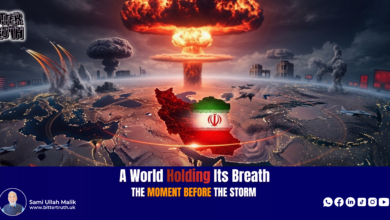
Pakistan is not a direct party to any prospective confrontation; yet geography, as history repeatedly reminds us, is seldom neutral. Iran’s immediate neighbourhood, proximity to Afghanistan, access to the Gulf sea lanes, and the convergence of great-power interests place Pakistan unavoidably within the crisis’s gravitational pull. In the event of armed conflict, the secondary and tertiary effects—refugee flows, energy shocks, sectarian tremors, and economic disruption—would not remain abstract theories; they would materialise directly upon Pakistan’s security and economy.
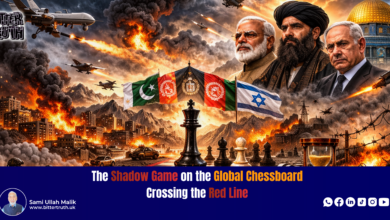
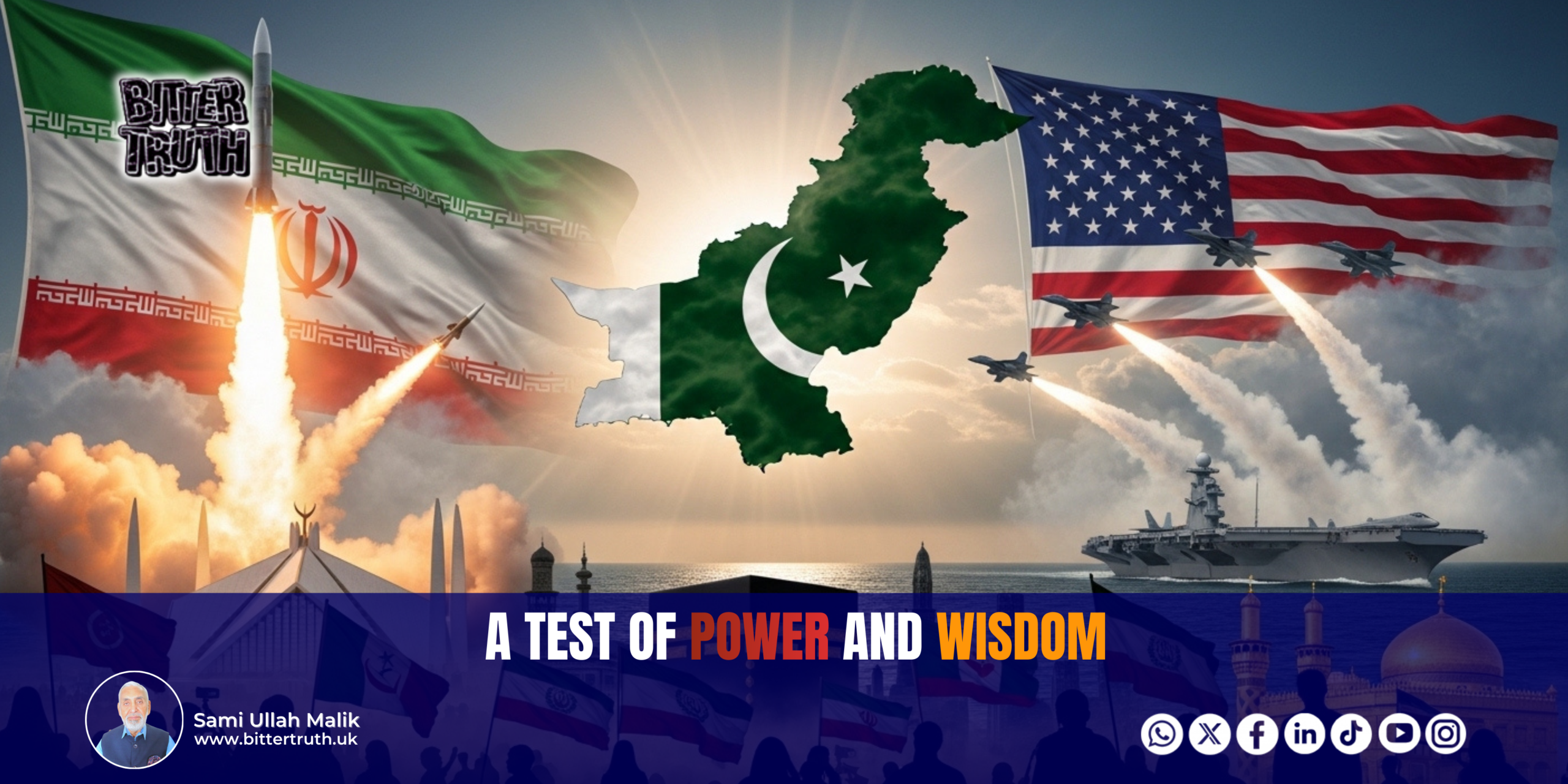
The presence of the USS Abraham Lincoln in the Indian Ocean is not a mere episode of naval manoeuvre; it is a sentence written in the grammar of global power—a language often inscribed with steel rather than ink. Although the absence of an immediate, unequivocal decision from the American President creates an impression of pause, history teaches that powerful states frequently prepare the theatre long before the curtain rises. According to highly credible sources, the deployment of a US carrier strike group in the Middle East resembles a chessboard meticulously arranged: every piece stands ready, though the game itself has not yet concluded.
While the Abraham Lincoln’s positioning signals a tightening American military grip in Iran’s vicinity, maritime history cautions against premature conclusions. Colossal vessels at anchor do not invariably herald war. Rather, this deployment appears designed to exert psychological pressure upon Iran and to keep the region in a state of controlled military anxiety—a deliberate suspension between threat and action.
President Donald Trump’s statements deepen this strategic ambiguity. Deliberation continues, yet decision remains veiled behind the curtain of fate. The carrier group operates under CENTCOM’s jurisdiction; an immediate strike is not deemed necessary, but rapid-response capability has been markedly enhanced. The message is dual-edged: a signal to Iran and reassurance to allies. Pakistan, the Gulf states, and India alike interpret these developments as a heightened security alert rather than a declaration of war.
The carrier strike group itself is a roving embodiment of modern warfare, where air, sea, and electronic domains merge into a single operational continuum. The aircraft carrier forms its heart, missile cruisers its vigilant eyes, and destroyers its defensive shield. Endowed with overwhelming air superiority, integrated missile defence, and naval dominance, this formation has become a source of profound regional anxiety—not merely because of its firepower, but because of the potentially unbearable political cost its actual use would entail.
Reports from international media underscore mounting pressure from allied states, reminding Washington that between the display of power and the employment of power lies a narrow yet decisive distance. Counsel from allies urging restraint highlights an enduring truth of statecraft: military might must remain subordinate to political wisdom.
Within Iran, streets and crossroads are now inscribing chapters of history in blood. Public spaces have ceased to be mere arenas of protest; they have become maps of collective anguish. The loss of thousands of lives can no longer be contained within the bounds of domestic sovereignty—it summons the conscience of the international community and generates moral pretexts for external intervention.
The rising death toll resulting from state crackdowns on demonstrators has evolved into a lament that unsettles global sensibilities. The United States and Europe increasingly frame the situation as a human-rights crisis, presenting grim statistics—whether provisional or verified—as evidence before the court of world opinion. These figures testify to a widening chasm between state and society, one perilous enough to be invoked as justification for intervention under the banner of humanitarian responsibility.
Here, the Qur’anic warning resonates with sombre relevance:
وَتِلْكَ ٱلْقُرَىٰٓ أَهْلَكْنَٰهُمْ لَمَّا ظَلَمُوا۟ وَجَعَلْنَا لِمَهْلِكِهِم مَّوْعِدًۭا
“And those towns—We destroyed them when they committed injustice, and We appointed for their destruction a promised time.” (Qur’an 18:59)
President Trump’s rhetoric—simultaneously threatening and invitational—reflects a long-standing duality in American foreign policy: the stick and the handshake, the sword displayed alongside the olive branch. His assertion that “we are open for business” appears, on the surface, as an overture to diplomacy; yet beneath it echoes the reverberation of power. It may equally signal the opening of a new chapter in back-channel diplomacy, aimed at drawing Iran to the negotiating table on American terms—an interpretation lent credence by recent indications of Iranian willingness to engage following the President of Iran’s reported telephonic exchange with the Saudi Crown Prince.
On the walls of Tehran’s Enghelab (Revolution) Square, murals serve not as mere public art but as visual exegesis of the national narrative. Likewise, warnings issued from the pulpit during Friday prayers fuse religion, state, and resistance into a single voice. Addressing the United States from the sermon is emblematic of Iran’s political culture, wherein faith and governance recite from the same script.
This language—deeply embedded in Iran’s ideological consciousness—appears designed both to fortify domestic morale and to construct a religiously infused justification for psychological warfare against the United States and its allies. In this domain of narrative contestation, the Iranian discourse has thus far demonstrated notable resilience.
Indeed, the rigidity of Iran’s official narrative functions as a verbal armour of defensive resolve. The
assured tone of the Foreign Ministry’s spokesperson conveys a clear message: the movement of warships does not shake national will. Iran’s strategic messaging—rooted in missile deterrence, military readiness, and ideological steadfastness—speaks in the voice of a nation that does not merely fear war, but regards it, if forced upon it, as the price of survival.
Here again, the Qur’anic ethos invoked within Iranian discourse finds expression:
كُتِبَ عَلَيْكُمُ ٱلْقِتَالُ وَهُوَ كُرْهٌۭ لَّكُمْ ۖ وَعَسَىٰٓ أَن تَكْرَهُوا۟ شَيْـًۭٔا وَهُوَ خَيْرٌۭ لَّكُمْ
“Fighting has been prescribed for you, though it is hateful to you; yet it may be that you hate a thing while it is good for you.” (Qur’an 2:216)
The Long Shadow of War: Escalation, Deterrence, and the Architecture of the Next Conflict
Every war, history reminds us, leaves behind not peace but preparation—an apprenticeship for the next confrontation. Iran’s clash with Israel proved to be not merely a battlefield encounter but a strategic laboratory. The claims emanating from Tehran after the twelve-day war in June are a reminder of an enduring historical rhythm: each conflict refines the instruments of the next. The barrage of missiles and drones was not solely a military manoeuvre; it was a political communiqué, delivered in fire and trajectory, conveying a single message—that the reckoning remains unfinished.
It is for this very reason that Iran, far from slowing its martial tempo, has accelerated it. In the aftermath of the conflict, Tehran has further consolidated its missile programme, refined its drone technology, and refused to allow its war-readiness to lapse into complacency.
Iran’s principal strength now lies less in artillery than in technology—silent, long-range, and lethal. Its mastery of remote warfare, its accumulated missile stockpiles, and its expansive drone network form the central pillars of its military doctrine. Their presence beyond Iran’s borders underscores a defining feature of modern warfare: geography is no longer a prison. Medium-range and intermediate-range ballistic missile technologies—many equipped with non-conventional payload capabilities—have become instruments Iran will not hesitate to deploy in defence, should war be imposed upon it. It bears remembering that such systems are not the monopoly of a single power; they are possessed by China, North Korea, Iran, India, and Pakistan alike.
In pursuit of asymmetric advantage, unmanned aerial vehicle (UAV) technology will inevitably be brought to bear. Should this threshold be crossed, humanity may find itself embarking upon a terrifying journey of destruction—one whose momentum could suffice to ignite the spark of a global war.
The statement issued by the commander of Iran’s Khatam al-Anbiya Headquarters constitutes an unambiguous declaration: in the event of war, the theatre of conflict will not remain confined. This is the precise juncture at which defence transforms into pre-emption. The warning effectively threatens to drag the conflict to the very doorstep of the region, rendering every American interest a potential target.
In practical terms, American bases across Iraq and the Gulf can no longer be regarded as insulated from Iranian retaliation. Their defence would require extraordinary force deployments, imposing an immense financial burden upon the United States and its Western partners—one capable of straining already pressured economies under the weight of sustained military readiness.
Iranian warnings thus ring alarm bells not only in Washington but across allied capitals in the region. Pressure exerted by Gulf Arab states upon the United States reflects a sobering reality: wars are often fuelled from allied soil, and allies are frequently the first to burn in the fires of a powerful friend’s conflict—before the flames eventually engulf all. It is precisely this fear of cascading regional instability that has driven Gulf states into relentless, day-and-night lobbying efforts to prevent a potential American strike, seeking to extinguish the embers before they erupt into an uncontrollable inferno.
Iran’s web of regional proxies constitutes a core component of its strategic depth—a silent army, ostensibly non-state yet unmistakably custodians of state objectives. While some of these actors have been weakened, others remain well-armed and ideologically committed. It is this very unpredictability that renders them most dangerous. Hezbollah, though significantly degraded, has not been extinguished. The broader proxy network has yet to be fully dismantled, leaving the region vulnerable to the harsh truth that even a minor spark can detonate vast stockpiles of combustible grievances.
The statement by the commander of Kata’ib Hezbollah is not mere bravado; it is a declaration of ideological mobilisation. “This will not be a walk in the park”—a sentence that distils the psychology of resistance into a single phrase. It is less a formal declaration of war than a summons to belief, sacrifice, and alignment.
Such an appeal is sufficient to activate those groups who stand poised, lives in hand, awaiting nothing more than a signal to plunge into battle. Once unleashed, the alarm bells for American interests worldwide would ring loudly indeed.
Every state seeks distance from this fire, yet flames respect no neighbourhoods. Threats to target American bases in Gulf states, coupled with overtures to Saudi leadership, illustrate a volatile equilibrium—suspended uneasily between diplomacy and war. Saudi Arabia’s pre-emptive distancing reflects a cautious doctrine of self-preservation, while the silence of other states invites uneasy speculation. Saudi neutrality, the ambiguity of Qatar and the UAE, and the intense pressure bearing down upon Pakistan have together plunged the region into a peculiar and precarious moment.
Rumours concerning the use of Pakistani airspace or territory in Balochistan are not merely military conjecture; they represent a sensitive chapter in geopolitical calculation. For Pakistan, this is not a binary choice of “yes” or “no,” but a question that touches national security, regional equilibrium, and internal cohesion. It is a decision for which Pakistan must answer simultaneously to history, geography, and its people.
In the event of refusal, anxieties surrounding separatist elements in Balochistan recall the darker chapters of history, where indirect pressure proved more effective than open warfare. When the rifle does not fire from the front, conspiracy advances from behind. The carefully ambiguous signals from the US Secretary of State appear to echo this established tradition. The “Balochistan card,” played amid existing unrest, transforms hybrid warfare into a lurking predator—poised to strike.
Should Iran be attacked, the Pakistan–Saudi defence agreement will face a delicate and defining test. Its trial will not lie in waging war, but in preventing it. Balance, quiet diplomacy, and discreet consultation will prove decisive. Direct military intervention appears unlikely, yet the necessity for intensive behind-the-scenes coordination is beyond doubt—and almost certainly already underway.
Turkey, as a formidable regional actor, is unlikely to remain a silent spectator—though it will reach
for the scales rather than the sword. Its response will likely revolve around diplomatic pressure, regional mediation, and the protection of its own strategic interests. As a key NATO ally, Ankara is already positioning itself to perform a calibrated and balancing role.
On the other hand, Russia’s silence may yet prove more eloquent than any proclamation. Should it persist, it may represent another instance of strategic bargaining—Ukraine exchanged for quiet elsewhere. History abounds with examples of great powers converting silence on one front into advantage on another. Moscow, cloaked in strategic ambiguity, appears content to watch the Middle Eastern chessboard while calculating gains in its Ukrainian gambit.
Here, the Qur’anic reminder acquires renewed resonance:
وَٱتَّقُوا۟ فِتْنَةًۭ لَّا تُصِيبَنَّ ٱلَّذِينَ ظَلَمُوا۟ مِنكُمْ خَآصَّةًۭ ۖ
“And fear a trial which will not afflict only the wrongdoers among you.” (Qur’an 8:25)
The Invisible Front, Strategic Restraint, and the Imperative of Collective Wisdom
The episode surrounding Afghanistan’s Batagram airstrip and the alleged cyber conflict stands as a defining metaphor of the modern “invisible war.” It was a confrontation without gunpowder—yet its consequences could easily have been incendiary. Iran’s timely countermeasures underscore a central truth of contemporary conflict: wars are no longer fought solely on physical battlefields, but within networks, signals, and algorithms.
In the recent cyber engagement, coordinated efforts involving Pakistan, Iran, and China/Russia played a decisive role in neutralising the covert designs attributed to Starlink-linked operations. As a result, the objectives sought through the unrest inside Iran suffered a severe strategic reversal—demonstrating that informational and cyber theatres can decisively shape outcomes without a single shot being fired.
The failure of such indirect measures heightens the risk of a dangerous shift toward direct military action and intensified pressure on neighbouring states. The region appears outwardly silent, yet behind the velvet curtain a diplomatic chess match is underway, driven by a singular objective: to extinguish the flames before they erupt, for fire recognises no borders. Once again, the region stands at the threshold of history—where a single misstep may burden generations. In this precarious moment, the need for collective diplomacy to prevent war and de-escalate regional tensions has never been more urgent.
Any American request for airspace or ground facilities would confront Pakistan with an exceptionally high-risk decision. The potential benefits would be limited; the dangers, virtually unbounded. Granting access could inflame internal security challenges—particularly in Balochistan—while refusal could invite diplomatic coercion and hybrid threats. In any external military escalation, Balochistan would likely become a primary target for proxy violence and information operations. As Iran–US tensions intensify, the risks of cross-border pressure, illicit arms and funding flows, and the reactivation of separatist narratives increase correspondingly.
The most immediate consequence of any external military cooperation would likely manifest in heightened militant activity within Balochistan. The state must therefore integrate counterterrorism, intelligence coordination, and political reconciliation into a single, coherent response.
Given Balochistan’s internal security vulnerabilities, it is imperative for the state to define clear red lines, non-negotiable thresholds, and practical rules of engagement. These measures are essential to deter external interference, hybrid warfare, and internal destabilisation in a timely and proportionate manner—while simultaneously safeguarding civil rights, political processes, and national cohesion.
Such red lines and rules of engagement are not instruments of brute force alone; they are mechanisms for preserving state authority, public trust, and national unity in tandem. It is this delicate balance that can shield Pakistan from the spreading flames of an external war.
Pakistan’s long border with Iran, coupled with significant energy and trade potential, necessitates a diplomacy marked by caution and foresight. Escalation would endanger border security and undermine economic initiatives. Accordingly, Pakistan’s policy must rest upon non-aligned realism, cooperation for peace rather than war, humanitarian assistance, the offer of diplomatic mediation, and strict avoidance of military entanglement.
An atmosphere of regional conflict would also amplify risks to CPEC. Pakistan must therefore sustain robust strategic communication with China to safeguard shared economic interests.
Defence and economic ties with Saudi Arabia and the Gulf states remain vital; yet for Pakistan, acting as a bridge rather than a bloc member offers greater strategic dividends. Without entering direct combat, Pakistan must nonetheless maintain full preparedness in air and border surveillance, cyber security, and internal stability.
At this juncture, it is incumbent upon the Organisation of Islamic Cooperation (OIC) to reaffirm the principles of the United Nations Charter and Islamic fraternity, to express grave concern over rising military tensions in the Middle East, and—upholding sovereignty, territorial integrity, and the sanctity of human life as foundational values—to exert coordinated diplomatic pressure in pursuit of the following concrete measures:
٭Approval for the establishment of a high-level OIC mediation committee.
٭Formulation of practical, actionable proposals urging all parties to the Iran–US dispute toward immediate de-escalation and restraint from the use of force.
٭Active encouragement of direct negotiations aimed at eliminating the risk of war in the region.
A collective commitment by all regional states to deny their territories for use in any aggressive action.
٭Support for independent investigations into human rights violations and civilian casualties, under a joint UN–OIC mechanism, while also exposing and countering foreign conspiracies operating behind civil unrest.
٭Condemnation of regional proxy wars and firm opposition to the use of non-state armed groups, alongside collective measures against states that fuel such conflicts.
٭Adoption of a unified diplomatic stance at the United Nations and other international forums.
For Pakistan, the following red lines must be articulated with absolute clarity:
٭Any attempt to mobilise armed movements under the guise of sectarianism or nationalism shall be treated as a hostile hybrid operation.
٭Any cross-border infiltration or logistical support by foreign intelligence services, military assets, or proxy networks will be deemed intolerable.
٭Any attack on Gwadar, CPEC projects, gas installations, ports, or communication infrastructure will elicit an immediate and decisive state response.
٭The discovery of any foreign financial or military assistance through any channel will trigger the strictest legal and security action.
٭In its concluding affirmation, the OIC—together with the United Nations—must reiterate a solemn resolve: that for the Islamic world in general, and this region in particular, collective wisdom, diplomacy, and unity remain the sole path to averting yet another catastrophic war.
For the Islamic world, collective prudence and mediation are not optional virtues; they are existential necessities. And for Pakistan, the clearest course lies in active peace diplomacy—neither a silent bystander nor a belligerent party. Wisdom demands that Pakistan become a voice for peace amid the din of war. For the wider Muslim world, the moment calls for guidance by reason rather than emotion.
History bears witness: wars may begin with power, but their endings are always written by reason.
Here, the Qur’anic counsel offers its final, enduring reminder: