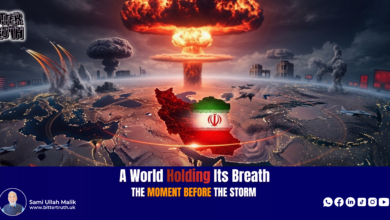

The Chessboard of Power
Echoes of Bagram

At times, the chronicles of history open to chapters where the scenes of decline and ascendance stand entwined, as though fortune herself delights in paradox. History, in its vast amphitheatre, stages spectacles at once majestic and tragic. A fortress, battered and broken, may yet become the seat of empires; a barren outpost may, for a fleeting moment, be exalted as the fulcrum of imperial statecraft. One and the same stronghold may, in one age, be the pride of a dominion and, in another, the tombstone of an empire’s arrogance.
The tale of Bagram Airbase belongs to this very genre of history’s ironies. It has witnessed, turn by turn, the encampments of those powers who fancied themselves the arbiters of destiny. Here the Soviet Union once unfurled the sinews of its iron arm; here the United States proclaimed its martial supremacy; and here once more the gaze of global powers converges, each measuring its designs against the immutable laws of time.
Bagram is not merely a military installation. It is history’s tribunal, where every haughty empire has been summoned, tried, and humbled. The timeless resonance of the Qur’an still echoes:
﴿وَتِلْكَ ٱلۡأَيَّامُ نُدَاوِلُهَا بَيۡنَ ٱلنَّاسِ﴾ (آل عمران 140)
“Such days We distribute among mankind in turn.”
Thus, the rise and fall of nations is no accident of chance, but the perpetual ordinance of the Almighty. The struggle at Bagram today is but another commentary upon that eternal decree. The pressing question now is: with what vision, with what wisdom, shall Pakistan, the Muslim world, and the wider Ummah discharge their responsibility in this theatre of fate?
President Donald Trump, through his social platform Truth Social, declared that unless Afghanistan restores Bagram Airbase to its “true architects,” namely the United States, grave consequences would ensue. This was no idle flourish of rhetoric; it betrayed the restless dream of Washington to replant its standard in the very heart of Afghanistan. Repeated on British soil during his visit to London—where, with the aplomb of a showman, he branded it “breaking news”—the threat acquired the tenor of a confession: America still covets its lost outpost in Central Asia. To the American mind, Bagram remains a right, though in fact it has passed irreversibly into Afghan sovereignty.
Standing beside the British Prime Minister, Sir Keir Starmer, in a press conference, Mr Trump admitted that the United States is actively seeking to reclaim Bagram. The very door that the Biden administration had so deliberately shut, its successors now seek to force open once more. The contradiction is patent: an exit once vaunted as triumph now recoils as humiliation, compelling the same power to retrace its faltering steps. What was heralded as victory has become a prelude to return.
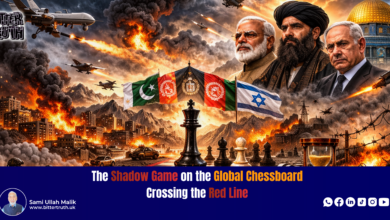
Mr Trump justified this ambition by invoking geography: Bagram, he reminded the world, lies but an hour’s flight from China’s nuclear facilities. The veil thus slips, and the true design is revealed. Afghanistan is but the stage; China is the target. Bagram is prized not for Kabul but for Beijing; it is envisaged as the bastion of a new “Great Game,” in which the spectre of China’s nuclear ascendancy haunts the strategic calculations of the United States.
Time and again Mr Trump has lamented that America should never have relinquished Bagram. The lament is more than nostalgia; it is a tacit confession of failure, an admission that American arms met their “Fall of Kabul,” a defeat recorded in history’s ledger alongside Saigon and Suez. That shame speaks of a miscalculation so grave that it allowed the Taliban to trample upon American prestige with impunity.
Yet Bagram is not merely a fortress—it is a city in arms, sprawling over seventy-seven square kilometres, with barracks and dwellings sufficient for ten thousand soldiers. For two decades it was the very hub of America’s war on al-Qaeda and the Taliban. Its significance may be gauged by the fact that three American Presidents—George W. Bush, Barack Obama, and Donald Trump—have all trodden its soil; Joseph Biden himself, as Vice-President, paid his visit in 2011. In this sense, Bagram has served as much as a political symbol as a military bastion.
Its origins stretch back to the 1950s, when the Soviet Union established it in the province of Parwan. By the 1980s it had become the citadel of Soviet dominion in Afghanistan. Yet fate, with its cruel irony, ordained that the fortress from which Moscow defied the world became the very prelude to its downfall. In time, the same base passed to American hands, only to become the depot of coffins and the scene of their own ignominious retreat. Today, once again, it commands the world’s attention.
The lesson of Bagram is plain. To every empire it has been the gateway to Afghanistan, and to every empire it has proved the gateway to ruin. The Soviets displayed their might from its ramparts, only to suffer defeat. The Americans, with all their technology and treasure, made it the fulcrum of their “war on terror,” only to withdraw in humiliation. Now the spectre of China has entered the calculus, and Bagram is once more cast as a forward trench in the great struggle for supremacy. Afghanistan—oft styled the graveyard of empires—seems destined, once again, to host the tournament of imperial ambition.
The question posed is stark: will President Trump’s recent declaration intensify pressure upon Pakistan to provide ground access for the United States to seize Bagram? The prospect is all too plausible. Once again, Pakistan may find itself ground between the millstones of global coercion. Yet past experience counsels caution: despite manifold tensions with Kabul, Pakistan is not the pliant instrument it once was, and it will not readily be beguiled by Washington’s blandishments. The pressing query remains, however — is Pakistan prepared to resist by saying no, to refuse America’s demand and thereby brace itself for a fresh round of regional confrontation?
In the present strain of diplomacy Islamabad has sent Kabul an unequivocal message: abandon your association with the TTP, or refrain from converting Pakistan into an enemy. Behind that blunt injunction lies a more intricate chessboard. One must ask whether the United States and India are quietly manoeuvring pieces behind the curtain. Attention falls, in particular, upon New Delhi’s conduct: allegations abound that India has used the TTP as a proxy. Evidence, it is claimed, tying acts of terrorism to Indian intelligence — to RAW — has, according to Pakistani sources, been communicated to international authorities. The salient question therefore becomes: is America a co-player in this design, or merely a spectator? Such suspicions draw Islamabad’s anxieties close to the realm of plausible reality.
Seen through this prism, the crucial strategic question is whether Washington will compel Pakistan to facilitate a land corridor to Bagram. Geography, as ever, makes Pakistan an unavoidable factor in the designs of great powers: its terrain and position turn it into an irritant in the eye of global strategy and, at the same time, into a prize. Should Islamabad concede and grant transit, it risks embroiling itself in fresh internal and regional turbulence. Should it refuse, the external pressure — diplomatic, economic and perhaps more coercive — will be redoubled.
Equally significant is the new defence accord between Pakistan and Saudi Arabia, a development that, according to certain quarters, alarms the policy-makers in Washington, Tel Aviv and New Delhi alike. Those three capitals, it is argued, prefer a regional balance that undermines pan-Islamic solidarity and preserves a distribution of power favourable to their interests. One must therefore ask whether the design to reassert control over Bagram is not, in part, a manifestation of this very calculus — a trilateral design whose strategic logic is to fragment Muslim unity and restore leverage in the region.
It would not be surprising if the next session of the United Nations witnessed, in private corridors, a Pakistan–U.S. exchange on Bagram. World diplomacy is frequently conducted in closed rooms: agendas shaped and decisions sown behind iron doors, then presented to the public as settled facts. Such is the rule of great-power dealings — the principal determinations are hatched in secrecy and seldom aired in full before an expectant populace.
Consider, too, Washington’s announced investment in mineral exploration in Baluchistan. On its face, American capital in Pakistan’s southwestern province might be welcomed as an opportunity for development. Yet the announcement arrives against the backdrop of persistent insurgent violence — violence which Islamabad alleges is fomented under the patronage of a neighbouring state. Thus the benign language of investment takes on a harder edge: might this influx of funds be employed as leverage, a subtle instrument of pressure to bend Pakistan’s defence and regional policies to the contours of U.S. strategic preference? The prospect cannot be lightly dismissed.
We must also recall the bitter lesson of recent history. A condominium of global puissance once forced many European capitals to their knees, imposing satellite regimes and instilling a prolonged dread — yet that same military colossus failed in Afghanistan, suffering a humiliation that shredded its prestige and left its polity rent and diminished. Thereafter, the solitary superpower assumed the mantle of unchecked supremacy and, in its hubris, fixed its sights upon Afghanistan as the next theatre for intervention. Decades, trillions of dollars and a panoply of modern instruments later, America too met a chastening defeat and an ignominious withdrawal. That episode — the fall of Kabul — is etched now as a blemish in the annals of contemporary power politics.
It is worth pausing to recount one notorious chapter of that conflict, for it illuminates the character of modern warfare and the moral queries it provokes. On 13 April 2017, United States forces employed a massive conventional munition in eastern Afghanistan’s Achin district of Nangarhar province — the device popularly dubbed the “mother of all bombs.” Deployed against a network of tunnels and cave systems allegedly used by the so-called Islamic State Khorasan Province, the weapon was described by military authorities as tailored to penetrate subterranean defences and reduce the exposure of ground troops. Weighing approximately 21,600 pounds (roughly 9.8 tonnes), it held the distinction of being the largest non-nuclear, air-delivered explosive in the U.S. inventory. Its first battlefield use was proclaimed as a tactical necessity; yet, to many observers, it also symbolised the brutish logic of overwhelming force and the troubling calculus that equates technological supremacy with moral rectitude.
Such episodes are reminders that strategy cannot be disentangled from consequence. If history teaches anything, it is that the instruments of power often outlive the prudence of the policies that conceived them. And so, the question returns with renewed insistence: in the looming struggle over Bagram and the wider contest for influence in Central and South Asia, will Pakistan choose accommodation or resistance? Will it trade away agency for short-term security guarantees, or will it assert, with measured firmness, the sovereignty that past wounds demand?
These are not abstract dilemmas; they are the tests by which nations are judged. The decisions Islamabad takes now will cast long shadows over the region’s stability and over Pakistan’s own future posture in a world where the ambition of great powers collides with the vocation of smaller states to preserve dignity and self-determination. The stage is set; the players return. The question is whether wisdom and restraint will prevail over the old habits of imperial expectation.
The American side announced the execution of the operation, and President Trump was swift to extol it, declaring that he had granted his forces full authority. Yet speculation lingered in the press: had the President himself endorsed every detail, or had the practical order emanated from the senior echelons of the chain of command? Analysts and journalists alike questioned the locus of decision — was this a verdict of the White House, or an initiative of the generals?
Afghan military officials initially claimed that dozens of combatants had been slain. Later reports spoke of thirty-six; some Afghan sources spoke of nearer ninety. The fog of war thickened. Independent verification was elusive, for without impartial scientific surveys on the ground, the true human cost could not be tallied. The local population testified only to the deafening blast and its terrifying reverberations.
This single detonation sparked not only physical shockwaves but a moral and legal tempest in international circles. To some it was a necessary stroke against militants; to others it represented a troubling escalation, a deployment of overwhelming ordnance whose compatibility with the principles of civilian protection and human security was at best questionable.
The weapon in question — the so-called “mother of all bombs” — required specialised loading onto an aircraft, thereafter released through a precise aerial drop. Reports indicated that such devices were borne aloft by modified C-130 cargo planes, released by drag parachutes into their fateful descent.
President Trump, in his confidence, sought to convey a message beyond the battlefield: that America, in the flush of its pride, would brook no delay in employing its arsenal, and that both militants and observers must reckon with its prowess. To foes it was intended as terror; to the watching world, as theatre. Yet when human rights groups and international bodies raised their doubts, Washington hastened to claim that this immense ordnance posed no hazard to local populations or civilian infrastructure. The International Committee of the Red Cross and other case studies sought to supply reassurance by debating its legal and ethical implications — but the attempt rang hollow.
On the ground, the strike temporarily dislodged ISIS-K militants from their entrenched positions. Yet the larger morass of Afghan politics and war remained stubbornly intact. Its strategic impact was fleeting: the shock altered the tactical flow but secured neither lasting stability nor enduring peace. It was a thunderclap, not a turning of the tide. America’s wider defeat was merely deferred, not denied.
At that moment, when the mountains reverberated and the skies flamed, the spectacle was not merely military action but a smithy of power’s display. The “mother bomb” revealed itself as a pageant of intent — that in the twenty-first century, imperial powers still speak through the language of aviation and explosive force. Yet history demands its reckoning: when the blasts of war grow larger, so too do the political, moral, and human consequences. And this was the true question the detonation left ringing in the conscience of mankind.
From 2001 to 2021, America and its allies imposed upon Afghanistan a regime of devastation. Now, in 2025, during his visit to Britain, Donald Trump has proclaimed that China is the true quarry, heralding the dream of retaking Bagram with the flourish of “breaking news.” Yet the lessons of three preceding decades testify otherwise: Afghanistan has been, and remains, the graveyard of empires. Still, with a strange inevitability, each new power feels compelled to test its fortune in that indomitable valley.
﴿وَلَا تَهِنُوا وَلَا تَحْزَنُوا وَأَنتُمُ ٱلۡأَعۡلَوۡنَ إِن كُنتُم مُّؤۡمِنِينَ﴾ (آل عمران 139)
“Do not weaken and do not grieve; you shall indeed have the upper hand, if you are believers.”
This verse reminds the faithful that worldly powers rise and fall, but true ascendancy lies in faith and resolve.
Allah the Almighty has also said:
﴿وَيَمْكُرُونَ وَيَمْكُرُ ٱللَّهُ ۖ وَٱللَّهُ خَيْرُ ٱلْمَـٰكِرِينَ﴾ (الأنفال 30)
“They scheme, and Allah schemes; and Allah is the best of schemers.”
Here we are taught that however intricate the webs spun by worldly powers, the divine decree supersedes them all.
For Pakistan, the lesson is urgent: its foreign policy must shun the peril of granting America renewed passage and instead strive for a balance that safeguards regional harmony. The bonds with Saudi Arabia and other Muslim states must be not only consolidated but widened — to draw in Iran, Turkey, and the Gulf. Only by weaving together the threads of Muslim solidarity can Pakistan ensure that it is not cast once more into the furnace of imperial intrigue, but stands as a sovereign actor guided by faith, prudence, and the hard lessons of history.
In the troubled borderlands of Baluchistan, where the shadows of India’s proxy networks lengthen across the mountains, the first recourse must be diplomacy. Yet diplomacy alone must not be an end in itself. With clarity and resolve, Pakistan must once more enlist the counsel and partnership of its steadfast ally, China, to make plain that President Trump’s recent declaration—naming China as his intended quarry and hinting at Bagram as the stage upon which this new drama might unfold—has irrevocably raised the stakes. The simmering tensions between Kabul and Islamabad no longer admit of superficial remedies; what is demanded is a durable, deliberate settlement—one that neutralises Indian intrigues and answers her proxies through channels as lawful as they are firm.
Here the eternal words of the Almighty sound with clarion certainty:
﴿وَيَمْكُرُونَ وَيَمْكُرُ ٱللَّهُ ۖ وَٱللَّهُ خَيْرُ ٱلْمَـٰكِرِينَ﴾ (الأنفال 30)
“They plot and plan, but Allah too devises His design; and Allah is the best of all planners.”
This verse serves to remind us that no stratagem, however subtle, of the worldly powers can outwit the design of Providence. The tale of Bagram is not merely the chronicle of an airbase, but the allegory of the rise and fall of empires, the theatre where the vanity of human ambition is weighed in the balance of history. Again and again, the mighty have cast their covetous gaze upon this stark soil; again and again their designs have been scattered to the winds.
The Soviet bear advanced with tanks rumbling like iron thunder yet crumbled into fragments like broken idols. The American eagle descended with its fleets of aircraft and the gilded rhetoric of “liberation” yet found ignominy and retreat its only inheritance. And now, as Washington turns once more towards this forsaken fortress, it does so not with the assured stride of victory but with the weary step of one sifting through the ashes of its own defeat in search of embers not yet cold.
Bagram, then, is no mere military garrison; it is a monument to a universal law—that Pharaohs, Caesars, and Kaisers may strut and scheme, but in this land of hard mountains and harder men, they are brought low. Here, the fates of empires are written in dust, and the lessons of history are etched in ruin.
For Pakistan, and for the Muslim world more broadly, this moment is both a trial and a summons. If we can meet it with prudence, foresight, and the steadfastness of faith, this region may yet rise—not as a chessboard for imperial contests, but as a tower of dignity, resilience, and self-determination.
And thus, the Qur’ān exhorts:
إِن تَنصُرُوا ٱللَّهَ يَنصُرۡكُمۡ وَيُثَبِّتۡ أَقۡدَامَكُمۡ﴾ (محمد 7)﴿
“If you aid Allah, He will aid you, and will plant your feet firmly upon the ground.”
This is the covenant to which history points us: that palaces of power may totter, that the tides of time may shift, but a nation girded with wisdom and faith endures. The bricks and walls of Bagram whisper a stern admonition—that the torrent of time may sweep away thrones and empires, yet those who stand anchored in belief and in sagacity remain, unshaken, to inherit the dawn.