The Chessboard of Politics and the Decree of Destiny
Lamps of Possibility and Chains of Fear

Politics is never merely the signing of treaties or the convening of conferences; it is that inscrutable script inscribed upon the parchment of destiny by the fingers of time and the choices of nations. Thrones and crowns at times conspire as companions, while brethren of the same lineage may, with equal suddenness, turn upon one another as rivals. Such is the tragedy of politics, and such too is the grandeur of history.
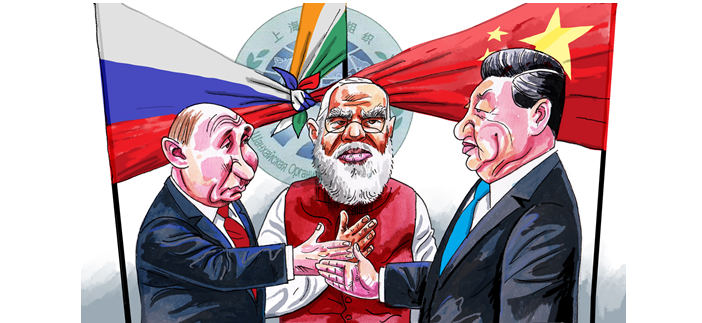
Today, upon the winds that sweep across Asia, a new chapter is opening. When Narendra Modi and Xi Jinping—emissaries of two of the world’s most ancient civilisations—sat face to face upon the soil of Tianjin, the chambers of diplomacy stirred with a restless murmur. Some heralded the dawn of a fresh beginning; others dismissed it as but a fleeting mirage of expediency. Yet the truth remains: each such encounter casts a stone into the river of history, and the ripples travel far.
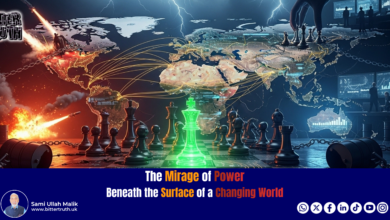
For Pakistan, the question is stark: does this Delhi–Beijing intimacy foretell new perils, or herald fresh possibilities? Is it but another move upon the chessboard of power, where friendship and enmity alike are but the span of a single gambit?
World politics seldom treads a straight path. It is the gaming ground of existence, where kings are at times reduced to pawns, and pawns on occasion ascend the throne. The present spectacle is no exception: Delhi’s hand clasped with Beijing’s has unsettled the balance of the region’s skies. This meeting has etched a great question mark upon the firmament.
Some are swift to call it a new beginning, yet history teaches us that the deepest wounds are not healed by the mere brushing of palms. Though diplomatic in form, the encounter cannot be dismissed in substance; its implications for the regional equilibrium are neither trifling nor ephemeral. Does Delhi’s growing closeness to Beijing portend a shadow over Islamabad’s horizon, or is it but a tactical flourish, soon to be swept aside by the winds of time?
Tianjin itself reverberated with the voices of the Shanghai Cooperation Organisation. Within its halls, both Delhi and Islamabad took their place—an augury that the pivot of regional politics lies not in the West’s marble corridors but upon Asia’s restless soil. Here, symbolism jostled with substance: as Modi extended his hand in greeting, Xi passed on, leaving it momentarily suspended in the air. Yet, in another part of that same city, Pakistan’s Prime Minister revived, with solemn cadence, the tale of Sino-Pakistani friendship in the university halls—an evocation of camaraderie both enduring and hallowed. Thus the summit was no mere ceremonial parade but a mirror of shifting balances, where two parallel lines—Islamabad and Delhi—were inscribed upon the page of history side by side.
President Xi’s opening words rang with the tremor of the age: “The world is in chaos”. These were not the homilies of a preacher, but the sober reflection of a statesman upon a trembling world order. His words recalled that medieval season when empires waned and new powers stirred restlessly in their cradles. The war in Ukraine, the tinder of the Middle East, and the tremors of economic instability—all found their echo in that one utterance.
Xi reminded his listeners that China and India are heirs to two venerable civilisations—that the Dragon and the Elephant must learn not to be enemies but partners in the dance of destiny. It was a line that might have slipped from the pen of a poet, yet beneath the metaphor lurked a fateful question: will this dance be one of harmony, or of rivalry? Shall it be the graceful duet of civilisational partners—or the convulsions of an earthquake shaking the earth beneath our feet?
Mr Modi, in reply, invoked the fate of 2.8 billion souls, binding their future to such cooperation. Yet history whispers a sterner lesson: nations are not fashioned by numbers alone, but by faith, endurance, and sacrifice. So the question returns: is this dance a fellowship of friendship, or but a precarious acrobatic feat upon the swords of power?
The agenda’s central spectre was none other than the United States’ tariffs—the true backdrop to the drama. Washington’s punitive imposition of a fifty per cent levy upon Indian goods, in retaliation for Delhi’s purchase of Russian oil, is more than a commercial quarrel. It is but the old imperial stratagem in modern guise: once it was the thread of cotton that ensnared, today it is the founts of energy. Pressed thus, Modi’s gaze turned towards Beijing—a direct consequence of Washington’s tightening embrace.
Experts warn that these tariffs are a blight upon Delhi’s industries, an affliction gnawing like a canker at the roots of manufacturing, threatening livelihoods, and unsettling India’s domestic politics. Yet the same burden clouds Beijing’s ambitions. For the obstruction is not India’s alone, but also China’s—standing athwart Xi’s grand designs for the flows of trade and energy across continents. Hence Beijing’s eagerness to draw Delhi closer, even while wary of Modi’s balancing act—seeking leverage upon Russia and China even as he extends his hand once more towards America.
And so the question persists: are these two ancient civilisations joined merely by the compulsions of circumstance, or by the true desire to draw nearer in spirit?
The shadows of 1962, and the bitter memory of Galwan Valley, still linger over the troubled frontier. The question presses: after bloodied disputes and border skirmishes, are Beijing and Delhi truly prepared to construct a new edifice of relations? Or is this but a fragile cord of necessity, liable to snap at the first gust of adversity?
Some analysts, in their optimism, call it a “turning point.” Yet history warns us that the distance between a turning point and a treacherous U-turn is but a single instant. Others speak of a “critical juncture,” but the peril remains the same—that Delhi’s hand may be guided less by principle than by expediency. Water disputes, the issue of the Dalai Lama, the scars of border conflicts—these wounds lie veiled but unhealed. And no wound, untended, ever heals of its own accord.
The eyes of the world often rest upon Sino-American relations; yet what if Beijing and Delhi do clasp hands? Will their scars truly mend, or will embers of hostility smoulder beneath the ash? For Pakistan, the question is sobering: does this intimacy ring an alarm, or might it be an opening—where Beijing draws Delhi close not to estrange Islamabad, but to soften the frost between the two South Asian rivals?
Global politics revolves largely around the axes of Washington and Beijing. Within this sphere, can Moscow and Beijing truly permit Delhi to come too near? Both know Mr Modi’s mercurial nature too well. Russia, once his steadfast partner, has witnessed how swiftly he bent the knee to Washington; and trust, once broken, is not easily repaired.
The fault lines remain: the waters of the great rivers, the restless figure of the Dalai Lama, the vast schemes of dams and diversions. Upon such fissures trust cannot easily be built. Water, as sages have foretold, may become the casus belli of the next century. Meanwhile, Pakistan’s Prime Minister, with words grave yet tender, proclaimed an oath of fidelity: “Our friendship has been tested like pure gold, and found true in every trial.” This was the language of diplomacy, but beneath it lay the testimony of history: when China stood isolated, Pakistan stood by; when Pakistan staggered beneath pressure, Beijing upheld the bond.
Observers maintain that Delhi’s entente with Beijing is ephemeral. It lacks the depth of the Sino-Pakistani bond, which is not the offspring of commerce but the fruit of shared need and harmony of heart. Pulwama remains a wall of bitterness between Delhi and Islamabad, and its shadow touches Delhi’s ties with Beijing, for China esteems Pakistan as a strategic partner.
The tragedy of the region is clear: India’s relations with most of its neighbours are strained, while China, through trade and investment, has woven links of trust with Pakistan, Bangladesh, Sri Lanka, and Afghanistan. India, by contrast, flits from door to door—knocking at Washington, clinging to Moscow, and sitting, when pressed, in Beijing’s court. But the Qur’an has spoken with timeless clarity:
مَثَلُ الَّذِينَ اتَّخَذُوا مِن دُونِ اللَّهِ أَوْلِيَاءَ كَمَثَلِ الْعَنكَبُوتِ اتَّخَذَتْ بَيْتًا ۖ وَإِنَّ أَوْهَنَ الْبُيُوتِ لَبَيْتُ الْعَنكَبُوتِ ۖ
“The likeness of those who take protectors besides Allah is as the likeness of the spider that makes for itself a house; and lo! the frailest of houses is the spider’s house.”
The lesson is sharp: alliances founded on opportunism are cobwebs—dissolved by the faintest breeze.
Thus the question persists: is Delhi–Beijing intimacy an omen of peril for Islamabad, or merely a passing clamour, whose echo soon fades? It need not be a threat. Indeed, Beijing may employ its influence to temper Delhi, and even to clear a narrow path towards “working relations” with Islamabad. For Pakistan, the true wisdom lies not in dwelling upon fears but in discerning opportunities.
On social media, a trivial question gained currency: who was received with greater pomp in Tianjin—Modi or Shehbaz Sharif? Yet the true measure of statecraft is not the clamour of welcomes, but the weight of policies. Honour is not reckoned by protocol, but by depth of relationship. Ultimately, the destiny of nations is not penned in Beijing’s palaces, nor in Washington’s halls. The Qur’an proclaims the enduring law:
إِنَّ اللّهَ لا يُغَيِّرُ مَا بِقَوْمٍ حَتَّى يُغَيِّرُوا مَا بِأَنفُسِهِمْ
“Indeed, Allah does not change the condition of a people until they change what is within themselves.”
It is not in the favour of foreign courts, but in the resolve of a nation—in its honour, its faith, its willingness to sacrifice—that destiny is wrought.
In his address, Pakistan’s Prime Minister affirmed once more that Sino-Pakistani friendship is not a diplomatic confection but a living testament of trust, love, and sacrifice, proven in every trial. “A friendship tested and triumphant,” he declared—a phrase not of rhetoric, but of history distilled.
Experts concur: India’s flirtation with Beijing cannot dim the depth of Sino-Pakistani relations. For this bond is not transactional but fated—strategic, profound, and enduring. Observers hold that India and China cannot become true strategic partners; their companionship will remain brittle, their history too charged, their rivalries too fundamental. For deep wounds are not concealed by the stain of henna.
For many years Mr Modi avoided attending the summits of the Shanghai Cooperation Organisation; yet now, with Washington grown restless and relations strained, Delhi suddenly remembers the road to Beijing—and bows, too, upon the threshold of Moscow. This is not the prudence of “alternative strategy”; it is the craft of opportunism. Modi’s design was to signal to Washington that Delhi possesses other cards to play. But President Trump, with unerring swiftness, laid bare the grimace behind the mask, exposing Modi’s duplicity to the watching world.
Yet the truth remains that the fissure with America is, at root, economic: the outsourcing of American jobs, the purchase of Russian oil, the marginalisation of Washington in the ceasefire between India and Pakistan—all provoked the ire of the Trump administration. Much, then, of Delhi’s overture to Beijing is little more than theatre. The deeper currents of trade still flow between Delhi and Washington, while with Beijing they remain shallow and tentative.
The structural differences between India and China are strategic, and enduring. Their relationship cannot be built upon trust; it is forever poised above a powder-keg. India aspires to the mantle of global power, yet regards China as the chief impediment to that dream. Hence Delhi alternately reclines in the lap of the West and knocks upon the portals of the East, never fully committing itself to Moscow or Beijing.
Nor does Delhi’s fractious diplomacy with its neighbours strengthen its cause. India’s ties are strained with nearly all who share its frontiers, while China has bound the region with chains of commerce. Above all, the China–Pakistan Economic Corridor has aligned the markets of the world upon a single axis, entwining Beijing’s future prosperity with Pakistan’s geography. No substitute for Pakistan exists upon the map, and this—let us say without hesitation—is a blessing bestowed by Providence. Upon this gift, Pakistan’s stewards must frame their policies with prudence, stepping with caution, and guarding with foresight.
After seven years, Modi’s visit to China is not triumph but compulsion—a political necessity. Once, fearing American displeasure, he declined to tread Chinese soil, and in the Quad he sought to challenge Beijing with postures of superiority. Now, after Washington’s rebuke, he circles Moscow and Beijing alike, murmuring songs of reconciliation, as though apology might be spun into strategy. Yet analysts in both capitals are agreed: the meeting’s effect is transient; its deeper consequences, unlikely.
For Islamabad, however, there are possibilities. Beijing desires stability in the region. It is conceivable that Delhi’s dialogue with Beijing may, in turn, open some narrow passage towards the restoration of a working relationship between India and Pakistan. What seems at first a peril may, paradoxically, become an opportunity—for China will not pursue Delhi to estrange
Islamabad, but rather to bring the region nearer to peace.
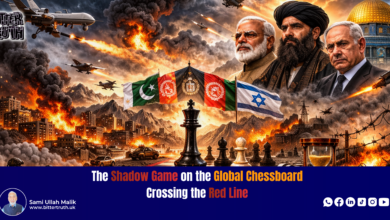
Thus the board of global politics is a complicated chess match, where each player shifts his pieces continually: India now as Washington’s partner, now saluting at Beijing’s door. But for Pakistan the lesson is plain: we must play our own game by our own strength. For upon the page of destiny is written not what others dictate, but what nations inscribe by their resolve and their will. The moves of politics change with each day; but the last move is always history’s. And history’s law is stern: those nations triumph who draw their sustenance from within, not from the shadow of others.
Hence the true message for Pakistan is this: break the chains of fear, light the lamps of possibility, and write your own page of destiny. For all evidence points to this conclusion: Delhi–Beijing intimacy is circumstantial and compelled. Pakistan must look not to shadows but to horizons. Our bond with China is not a matter of mere diplomacy, but of destiny.
History itself testifies: the true fount of strength lies not in the avenues of Washington, nor in the palaces of Beijing, but in the unity of a people, in their trust in their own resources, and in their faith in the promises of their Lord. Sino–Indian rapprochement may be spectacle, or it may be trial; but Pakistan must not remain a bystander to the decisions of others—it must become the architect of its own fate.
The Qur’an has spoken with decisive clarity:
﴿إِن يَنصُرۡكُمُ ٱللَّهُ فَلَا غَالِبَ لَكُمۡ﴾ (Āl ʿImrān: 160)
“If Allah supports you, none can prevail against you.”
Therefore, our gaze must rest not upon fears but upon possibilities. The Delhi–Beijing embrace is passing; but the Pakistan–China friendship is a covenant of fidelity. In the shifting theatre of politics, that friendship is our shield and our strength.
So let us say: fear is a chain, possibility a lamp. And the nation that kindles its lamps shall find the road out of darkness, and into the light.
Sunday, October 5, 2025