The Case of Jerusalem
The Call to Awakening

The Balfour Paradox: A Dagger in the Heart of the Orient
When the land of the prophets—once custodian of divine revelations—falls prey to the talons of conspiratorial design; when the walls of the First Qibla are streaked with the blood of innocents; when the melodic call to prayer is drowned beneath the thunder of bombs—then history is no longer a chronicle confined to dusty pages. It transforms into a lament—an elegy of nations, a requiem for justice.
The State of Israel, forged in the embers of colonial ambition, stands as a dagger thrust into the very heart of the Middle East—intended not merely to carve borders, but to shackle every heartbeat in servitude, and bind every breath within the iron coils of imperial dominion. Its creation is not a political event in isolation; it is a festering wound upon the collective memory of the Muslim world—a perpetual affliction that bleeds through generations and startles the conscience of every age.
This is no mere historical account; it is a clarion call—an invocation of resistance. Within its strains echo the sorrow of Karbala and the resolute clang of Salah al-Din’s sword. It speaks not only to the past, but to the ever-unfolding tragedy that shapes the conscience of an entire civilisation.
The declaration of support for a “national home for the Jewish people” in the sacred land of Palestine was, in truth, the imperial masquerade of British policy—a policy in which foreign settlement upon the lands of native peoples was not a moral question but a matter of strategic cunning. The Balfour Declaration was not simply a message to the Arab Muslims of Palestine—it was a proclamation to the entire Islamic world: that the spiritual and historical bastions of your civilisation were now open grounds for Western experimentation, unburdened by shame, law, or legitimacy.
When colonialism, under the guise of civilisation, strips man of his liberty, what emerges is not progress, but a bankruptcy of thought and the despotism of culture. And concerning such moral alignment, the Qur’an delivers its warning:
وَلَا تَرْكَنُوۡۤا اِلَى الَّذِيۡنَ ظَلَمُوۡا فَتَمَسَّكُمُ النَّارُ ۚ وَمَا لَكُمۡ مِّنۡ دُوۡنِ اللّٰهِ مِنۡ اَوۡلِيَآءَ ثُمَّ لَا تُنۡصَرُوۡنَ
“And do not incline towards those who have wronged, lest the Fire touch you. And you will not have besides Allah any protectors; then you will not be helped.” (Surah Hud, 11:113)
The birth of Israel was never merely a redrawing of cartographic lines. It was, and remains, a clash of civilisations, a collision of theological psychologies, and a calculated alignment of imperial designs with political self-interest. It was no spontaneous revelation of diplomacy but a long-nurtured outcome of centuries of ambition—concealed behind veils of diplomacy, prejudice, and colonial duplicity.
The year 1948 did not simply see a new nation emerge; it witnessed the realisation of a deeply entrenched, meticulously plotted scheme—rooted in promises whispered in the salons of empire, in the theology of entitlement, and in a supremacist worldview that cloaked theft in the vestments of legal procedure.
Palestine, once a sanctuary for prophets, was cast to the wolves of Zionist expansionism.
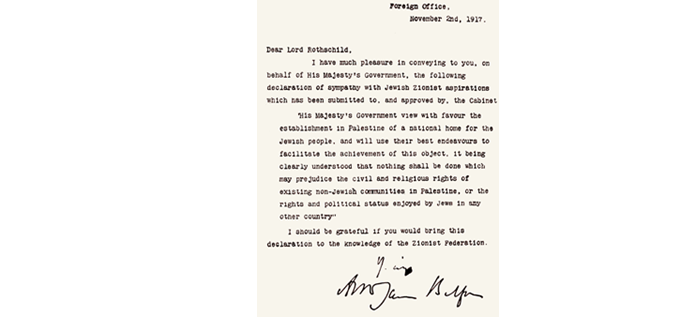
And at the heart of this theatre of transformation stood a deceptively modest text—thirty-eight words of intoxicating promise, the infamous Balfour Declaration, penned by the hand of His Majesty’s Foreign Secretary, Arthur James Balfour, to Lord Rothschild, a scion of British Jewry.
Foreign Office,
2nd November 1917
Dear Lord Rothschild,
I have much pleasure in conveying to you, on behalf of His Majesty’s Government, the following declaration of sympathy with Jewish Zionist aspirations which has been submitted to, and approved by, the Cabinet:
“His Majesty’s Government view with favour the establishment in Palestine of a national home for the Jewish people and will use their best endeavours to facilitate the achievement of this object, it being clearly understood that nothing shall be done which may prejudice the civil and religious rights of existing non-Jewish communities in Palestine, or the rights and political status enjoyed by Jews in any other country.”
I should be grateful if you would bring this declaration to the knowledge of the Zionist Federation.
Yours sincerely,
Arthur James Balfour
This single epistle—curt in length yet calamitous in consequence—was not merely a diplomatic communiqué. It was a stroke of the imperial pen that redrew not only borders but fates; that ruptured the organic unity of the Muslim world and inaugurated an era of geopolitical fragmentation that persists to this day.
To read the Balfour Declaration as a historical footnote is to misread its venom. One must not simply read it but feel it—pass it through the heart of the Ummah, and in doing so, one recognises it not as a paper of promise but as a blade that cuts anew with each generation.
Those thirty-eight words echo not with sympathy but with sovereign presumption. They carry not hope but dispossession. For what greater travesty could there be than for a power, possessing neither ownership nor ancestral claim, to gift away a land—holy to millions—as though it were a pawn in a greater imperial game?
It was, metaphorically, as if a stranger offered the key to a home he did not own, and did so without asking the keeper of the door.
Empire, Hypocrisy, and the Balfour Mirage: A Testament to Imperial Duplicity
The Balfour Declaration was, in truth, not a mere diplomatic overture, but the inaugural chapter in the West’s transformation of faith into a currency of imperial barter. Cloaked in the garb of goodwill, it was in reality a parchment of betrayal—a sanctioned erasure of one people’s identity to fulfil the settler’s dream of another. Here was a promise steeped in piety yet sullied by power; the script of a colonial morality plays where the villain was dressed as a messiah and the stage draped in sanctimony.
In its pristine calligraphy and polished prose, the Declaration bore all the marks of moral earnestness. Yet behind its careful phraseology lurked the cynical cunning of Empire. Far from offering justice, it inaugurated a theatre of civilisational conflict—partitioning the political imagination of the world along sectarian and linguistic lines, and sowing the seeds of discord under the noble banner of peace.
With the collapse of the Ottoman Caliphate, Britain laid its hands upon Palestine, not as a custodian but as a cultivator of Zionist ambition. This letter, often mistaken for diplomacy, was in fact the cornerstone of colonial engineering—a silent yet seismic act of cartographic violence committed with the ink of bureaucracy and the seal of imperial authority.
At its core, the Declaration was shaped not merely by philosophical conviction, but by geopolitical calculus. Britain, mindful of the waning strength of the Ottomans and the shifting balance of power post-World War I, sought favour with powerful Jewish circles—particularly in the United States—to fortify its own wartime position. It was less a statement of principle than a bid for allegiance; a solicitation wrapped in scripture.
And yet, the lofty words which danced across that page have, over time, revealed themselves to be little more than scaffolding for duplicity. The solemn guarantees offered to the “non-Jewish communities”—the native Palestinians, who were in fact the rightful inheritors of that sacred land—were hedged in cautious ambiguity. They were granted rights in the Declaration as though they were guests, not owners; as though their ancestral claim was secondary, conditional, and forever provisional.
Such wording betrays not diplomacy but disdain; not balance but betrayal. It casts the Palestinian people not as stakeholders in their own homeland but as shadows—conjured in a parenthetical clause and promptly dismissed by the machinery of colonial realpolitik. Indeed, one might say that in this compact, what was promised was not protection but pretext; not justice, but a quiet, sanctified dispossession.
If land is the soul of a people, then no foreign power—however civilised—has the moral charter to alienate it in favour of a settler elite. And yet, the Declaration did precisely this. It granted the Jewish people—unconditionally—a status of global recognition, while offering the Palestinians only conditional assurances, framed in such diluted terms that they could be reinterpreted, ignored, or outright denied.
This, then, is the heart of the matter: a proclamation veiled in justice but drenched in hypocrisy. A document in which civilisation masquerades as conquest, and where empathy is but a servant to power.
Such duplicity could only arise from the moral paradox at the centre of Western imperial thought—a paradox that bestows lofty rights upon one race, while offering the other the bleak dignity of silent endurance. The Declaration promised the Jews a sanctuary of clouds; to the Palestinians, it handed over the storm.
This philosophical contradiction lies at the root of modern political conflict. It is the echo of the same racial hierarchy that lit the fuse of two world wars and continues to animate the selective conscience of the United Nations, the rhetoric of human rights, and the moral compass of the global press. One sees, even today, the ghosts of this imperial logic stalking international forums—privileging victimhood based on identity, and crafting narratives to suit the victors.
And in a final irony, this Zionist dream was not even unanimously shared among Jews themselves. Numerous Jewish communities—most notably Neturei Karta—condemned the establishment of Israel as a sacrilegious act, a political rebellion against divine will. According to their doctrine, no Jewish state may exist before the advent of the Messiah. The very act of establishing Israel, they argued, was not a fulfilment of Judaism, but its profanation.
Yet political Zionism—armed with modern tools of propaganda and diplomacy—succeeded in shackling the faith of an ancient people to the ambitions of a modern colonial movement. Religion, once a moral compass, was conscripted into a geopolitical enterprise.
To describe European Jewish expulsion simply as a consequence of irrational prejudice is to indulge in historical amnesia. For centuries, Jewish financial monopolies, usurious enterprises, and covert involvement in the political architecture of Europe provoked backlash—not merely as scapegoats, but as players in a complex drama of cultural and economic friction. From France and Germany to Poland and Russia, expulsions were often preceded by periods of entrenched power, secretive influence, and public resentment.
Such dynamics were not without spiritual precedent. The Qur’an speaks of those who sow discord and undermine the moral fabric of society:
يُفْسِدُونَ فِي الْأَرْضِ
“They spread corruption in the land.” (Surah Al-Baqarah)
Indeed, this spirit of subversion appeared once more when Jewish financiers approached the Ottomans with a proposition: the settling of Ottoman debts in exchange for Palestine. The empire, worn thin by European encroachment and internal disarray, might well have considered the offer.
But Sultan Abdul Hamid II—undaunted and upright—responded with the unwavering resolve of spiritual sovereignty. His refusal was not a matter of diplomacy, but of dignity:
“I will not sell my land like a man selling milk in a pail. I will not have my body wounded and then accept salt from the enemy to heal it.”
Thus spoke the Caliph—his words now etched in the annals of resistance. Palestine was not sold; it was sanctified.
And so, we ask: is Israel merely a homeland for a persecuted people? Or is it an outpost—a garrison state crafted not for peace, but for permanence? A standing sentinel of Western power perched upon the oil-laden heartlands of the East?
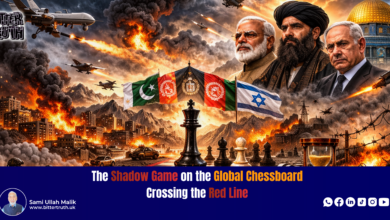
There is, today, little pretence: Israel serves as the permanent military enclave of American interests in the region. It is not justice that is sought, nor peace that is preserved. Rather, the project is simple—divide and dominate; keep the Muslim world entangled in conflict while its resources are siphoned away. The State of Israel is not merely a refuge. It is a rented soldier, a strategic gatekeeper, a proxy in perpetual readiness—tasked with extinguishing every flicker of indigenous power before it can catch flame.
A Fortress, A Market, A Phantom: Israel and the Politics of Imperial Paradox
Through the creation of Israel, the West did not merely redraw the cartographic contours of the Middle East; it erected within the region a standing fortress, a permanent garrison to safeguard its military-industrial complex and maintain the temperature of conflict high enough to keep its arms markets brisk and bustling. Under the shadow of this constructed menace, Muslim states were coerced into pouring their sovereign wealth into the coffers of Western defence industries — the price of fear, paid in gold.
With masterful precision, Zionist lobbies—chief among them the American Israel Public Affairs Committee (AIPAC)—have embedded themselves into the very sinews of Western power. Be it the banking system, judicial appointments, media narratives, or the glittering dream factory of Hollywood, their reach is both pervasive and persistent. It is no hyperbole to suggest that the pulse of Capitol Hill now beats in rhythm with the ambitions of Tel Aviv. The United States, once a global arbiter, now finds its policymaking increasingly guided—if not dictated—by the interests of a foreign power to which it funnels billions in aid annually.
Israel, once the recipient of Western favour, has become the overseer of its very patrons. The United Nations, once the moral conscience of the world, has been reduced to little more than a marionette—its resolutions tangled in strings pulled from Jerusalem and Washington alike.
There was a time, not long ago, when American presidents could exercise independent will. In 1956, during the Suez Crisis, President Dwight D. Eisenhower forced Israel, Britain, and France to retreat from their incursion into Egypt. It was the rarest moment in postwar history—a time when America was confident, sovereign, and relatively unencumbered by the Zionist grip. Today, such autonomy has all but vanished. The real decisions are no longer made in the White House, but in the lobbies of Manhattan and the think tanks of Washington.
Thus, one must ask: is Israel a nation or a spectre? Is it a geopolitical entity, or a phantom menace conjured to cow the Gulf monarchies into compliance? The illusion of perpetual threat—carefully nurtured and deftly deployed—has allowed the United States to act as both arsonist and fireman, fanning the flames while selling the extinguishers.
This choreography is not spontaneous. It is scripted—a pas de deux in which Israel plays the unruly actor and the United States the stern but indulgent stage manager. Together, they keep the Arab world in a state of suspended animation—its political sovereignty shackled, its strategic will outsourced.
Yet the geopolitical theatre is shifting.
China, with its characteristically quiet confidence, has begun redrawing the map of alliances in the Middle East—not with bombs or bases, but with investment, non-interference, and patient diplomacy. In stark contrast to America’s coercive patronage, China offers an alternative: a relationship based on mutual benefit, commercial pragmatism, and strategic respect. The Gulf states, weary of the transatlantic leash, are now turning eastward—towards Beijing’s economic gravity.
The Sino-brokered rapprochement between Saudi Arabia and Iran over the Yemeni crisis stands as a landmark triumph of new-age diplomacy. China’s success in bringing together two of the region’s most implacable rivals signals not merely its arrival as an economic force, but its emergence as a trustworthy diplomatic power. The United States, which for decades positioned itself as the sole guarantor of regional order, now finds itself sidelined—a waning power watching its influence evaporate.
This new geometry of power has already begun to yield tremors in Washington. Beijing’s quiet diplomacy, combined with its strategic neutrality, has unnerved a West accustomed to dictating outcomes.
President Trump’s $400 billion arms deal with Saudi Arabia during his tenure was not mere commerce. It was extortion dressed as partnership—a shrewd siphoning of Gulf capital into the ailing arteries of the American economy. The deals were not designed to strengthen allies, but to weaken their independence—to tether them permanently to Washington’s wheelhouse.
And then came the Abraham Accords—a new chapter in the long narrative of compromise, wherein the Islamic identity of the Middle East was subtly redefined to accommodate the Jewish state as a regional cornerstone. Though Saudi Arabia has yet to officially recognise Israel, the groundwork has been laid. Backdoor negotiations and strategic pressure point unmistakably in one direction: eventual normalisation.
Meanwhile, in Gaza, where the number of fallen children often exceeds that of fallen leaves, the dream of a “tourist paradise” is being peddled with grotesque irony. The plan is to demilitarise Hamas and transfer governance of Gaza to the Palestinian Authority—a move not towards peace, but towards pacification. The vision of turning Gaza into a resort town, replete with scent and song, is a cynical smokescreen—an attempt to bury the spirit of resistance beneath fragrant façades.
And yet, in this theatre of hypocrisy, one truth glares back like a silent accusation: Israel, a declared nuclear power with its Dimona facility long operational, has never been called to account by any international body. Not by the United States, not by Europe, not by the United Nations. In 1981, when Israel bombed Iraq’s Osirak reactor—a clear breach of international law—the West labelled it not as an act of terror but a “pre-emptive measure.” By contrast, when Iran pursues a peaceful nuclear programme, it is met with crippling sanctions, clandestine assassinations, and threats of war.
This is not geopolitics. It is prejudice disguised as policy—an enduring indictment of the West’s moral inconsistency.
Meanwhile, China has cemented substantial trade relationships with Gulf nations, including Saudi Arabia, Iran, and the UAE. China purchases 1.76 million barrels of oil per day from Saudi Arabia, while continuing to acquire Iranian oil through indirect channels despite American sanctions. Collaborations at ports such as Bandar Abbas, Chabahar, and shared infrastructure ventures testify to the deepening of this alliance.
During the covert and semi-public confrontations between Israel and Iran in recent years, the conspicuous silence of both China and Russia has puzzled analysts. But behind the hush lies pragmatism: China seeks to balance without offending, to profit without entanglement; while Russia, preoccupied with its theatre of war in Ukraine, prefers ambiguity over alignment.
The Waning Crescent: A Call to Reckoning
According to well-informed diplomatic channels, the United States, in a rare gesture of quiet manoeuvring, has activated Pakistan as a discreet intermediary in its efforts to ease the simmering tensions between Iran and Israel. Possessed of a unique stature within the Islamic world, Pakistan — by virtue of its equidistant ties with both the Arab world and the Persian sphere — finds itself poised as a natural, albeit unofficial, envoy of de-escalation. Yet this role, veiled in tacit diplomacy, remains obscured from the formal theatre of international statecraft.
Meanwhile, the former President Donald Trump laid bare his administration’s frustration with India’s duplicitous foreign policy by levying a 25% import tariff and publicly admonishing Delhi’s entanglements with Russia and China. India, while touting itself as a strategic ally of the West, brazenly procures the S-400 missile defence systems from Moscow and imports rare earth elements from Beijing — thus dancing on both sides of the ideological aisle. This Janus-faced diplomacy has begun to chafe American sensibilities, and the day draws near when India shall find its two-faced posture met with diplomatic frost and strategic rebuke.
This is no mere catalogue of events — it is, in truth, a lamentation. A chronicle not of history alone, but of our collective inertia, our wilful blindness in the face of encroaching subjugation. Israel is not merely a state; it is a personification of colonial cunning, a relic of theological duplicity, and a monument to modern-day political savagery. Yet the window remains ajar — faint, fleeting — for the Muslim Ummah to shatter its chains of mental servitude and awaken to a new dawn of consciousness. Else, history shall, once more, ink the elegy of our decline across its indelible pages.
O you who believe! Have you not read the Book wherein the Almighty commands vigilance against your enemies? Does not the dust of Bayt al-Maqdis cry out to your slumbering hearts? The hour is late — the hour is grave — but not yet lost. This is not a mere essay; this is an adhan — a call not merely to prayer, but to awakening. An adhan that must shake hearts from stupor, an adhan that must shatter the idols of dependency, an adhan that might yet mould a fractured people into a singular Ummah once more.
Otherwise, our destiny shall be no different from those whose end the Lord Himself pronounced thus:
“وَذُوقُوا عَذَابَ الْحَرِيقِ”
“And taste ye the punishment of the blazing Fire.” (Surah Al-Anfal, 35)
The Balfour Declaration: A Stain Written in Ink and Blood
The Balfour Declaration was no mere diplomatic communiqué; it was a dagger sheathed in eloquence, driven straight into the heart of Palestine. Cloaked in the language of ‘sympathy’ for Zionist aspirations, it in fact transformed an entire people’s homeland into the coinage of imperialist compromise — rendering the exile of one nation the ‘moral price’ for the ambitions of another.
To borrow the Quran’s own words in characterising such perverse moral inversion:
“وَإِذَا قِيلَ لَهُمْ لَا تُفْسِدُوا فِي الْأَرْضِ قَالُوا إِنَّمَا نَحْنُ مُصْلِحُونَ، أَلَا إِنَّهُمْ هُمُ الْمُفْسِدُونَ وَلَـٰكِن لَّا يَشْعُرُونَ”
“And when it is said to them, ‘Do not cause corruption upon the earth,’ they say, ‘We are only reformers.’ Verily, it is they who are the corrupters, but they perceive it not.” (Surah Al-Baqarah, 11–12)
The Balfour Declaration stands as a parchment that chronicled the wound of a nation and masked it as the verdict of civilised diplomacy. It laid the groundwork not merely for Zionist dominion over Palestinian soil, but became the very symbol of Muslim political collapse, cultural fragmentation, and the iron reign of global injustice.
Even a century on, its reverberations echo in the rubble of Gaza, and its spectral presence haunts the skies above Jerusalem. To resuscitate global justice, this declaration must be recognised not as a landmark of benevolence but as a historical misjudgement — one whose repercussions demand redress, lest history again render judgment, not in ink, but in blood.
A Prophetic Warning Ignored
From the lips of the Prophet Muhammad ﷺ comes a warning so searing, it must never be allowed to fade into abstraction:
مَن أَعَانَ عَلَى قَتْلِ مُسْلِمٍ بِشَطْرِكَلِمَةٍ، لَقِيَ اللهَ مَكْتُوبًا بَيْنَ عَيْنَيْهِ: آيِسٌ مِنْ رَحْمَةِ اللهِ
Whosoever assists, even by half a word, in the killing of a Muslim, shall meet Allah with it written upon his forehead: ‘Despaired of the Mercy of Allah. (Musnad Ahmad)
This Hadith must echo in the chambers of every chancery, every embassy, every heart that still beats for justice. For history is not merely remembered — it is relived. And should the Muslim world continue to sleep through the fire, then know this: the next pages of our story shall not be written by us — they shall be written about us.