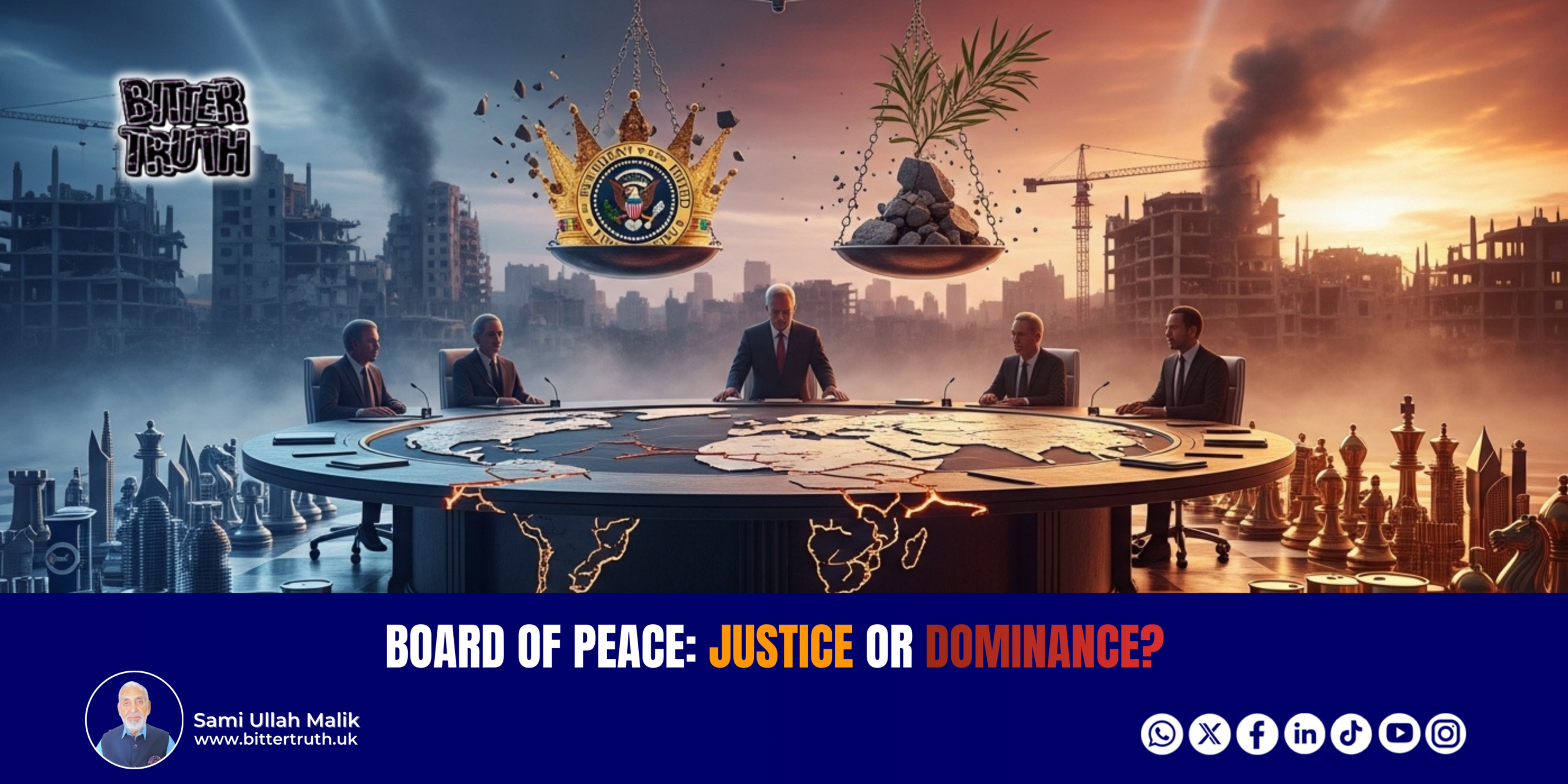
The Board of Peace: Justice or Dominion?
A New Trial for the International Order

Mr President of the Session,
Distinguished Delegates, Esteemed Scholars, and Honoured Representatives of the International Community,
I rise before this international forum to address a subject that stands at the crossroads of peace, power, morality, and history—a subject that tests all four simultaneously. What I submit today is not an argument confined to one nation, one region, or one institution; it is, rather, a meditation on the very soul of the global order itself. I shall present my observations with clarity, coherence, and a sense of historical continuity, enumerated not to inflame emotion, but to advance understanding—so that this discussion may proceed on the firm ground of reason rather than the shifting sands of sentiment.
Throughout the long chronicle of human history, peace has remained a sacred aspiration, a dream cherished by civilisation. Yet the realisation of that dream has too often been distorted by the hand of power. From the Roman Empire to the modern United Nations, every age has witnessed the creation of institutions established in the name of peace—institutions that arrived professing to salve the wounds of humanity, but which, in time, transformed into symbols of dominance, control, and vested interest.
Ladies and gentlemen of discernment,
There are moments in the life of nations that do not merely belong to the present, but decisively shape the future. These are the hours when history arrests its ordinary flow and poses its most searching question: Did you choose power, or did you choose justice? Today, we stand before such a delicate and consequential moment. Under the banner of “peace,” a new global institution—the Board of Peace—has come into being, entrusted with overseeing a ceasefire in Gaza, guiding reconstruction, and supervising an interim administration. Yet from its very inception, its contours have been shrouded in questions.
This is not merely the creation of an administrative body; it is an attempt to recalibrate the direction of global politics itself. It is an experiment in which peace is weighed upon the scales of power. And the world now stands at a junction of hesitation, hope, and apprehension.
The institution announced by President Donald Trump—ostensibly to render permanent the ceasefire between Israel and Hamas and to oversee the reconstruction of Gaza—presents itself as a herald of peace, yet in substance reveals a new narrative of power. In the President’s own words, the Board of Peace is tasked with guaranteeing the ceasefire and supervising an interim governance structure in Gaza. Its birth, however, coincides with an era in which moral principle has receded into the background, while strategic interest occupies the foreground of global politics.
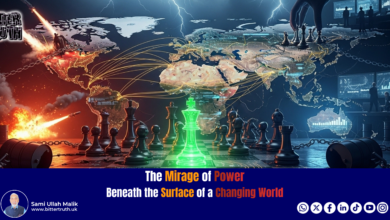
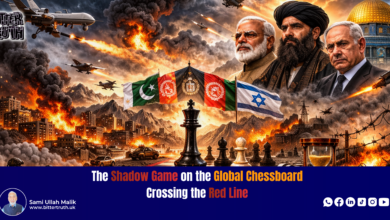
The invitation extended to India to join this Board is not a mere diplomatic courtesy; it is a calculated move in the grand chessboard of international power, where each piece is compelled to bear a burden heavier than its own weight.
According to President Trump, the Board’s mandate extends beyond monitoring a ceasefire to
sponsoring an interim administration in Gaza. Yet the fundamental question remains: Can peace truly emerge from the barrel of a gun? And can a peace that rests upon the discretion of a powerful leader ever prove enduring? Students of history know well that whenever a dominant power has proclaimed an “interim order” in a weaker land, authority has lurked behind the façade of order, and control behind the rhetoric of supervision. Global history teaches us, with relentless consistency, that not every proclamation of peace culminates in peace.
It is precisely this claim—to oversee not only a ceasefire but also an interim government in Palestinian territory—that elevates the Board of Peace from a technical arrangement to a profoundly political and historical question.
Gaza, already reduced to a symbol of siege, bombardment, and human tragedy, now stands on the brink of becoming the site of yet another global experiment. The question is not whether reconstruction is necessary—of that there can be no doubt. The question is: under whose supervision, upon what terms, and in whose ultimate interest?
Mr President,
The Board announced by President Donald Trump—framed as an instrument to stabilise Gaza and solidify the ceasefire between Israel and Hamas—appears, on the surface, as a messenger of humanity. Yet beneath this veneer flows the same ancient thirst for authority that has marked every imperial age in history. It is therefore not an idle question to ask: Is peace something that the powerful bestow? Or is it a trust that cannot survive without justice?
Prime Minister Narendra Modi was among the leaders invited to join this Board, and this invitation was no ceremonial gesture. It was an attempt to place upon India—one of the world’s most populous nations—a share of responsibility in a moment of global consequence. To invite India to the Board of Peace was not merely an act of diplomatic etiquette; it was the imposition of a significant political test.
Yet when the Board of Peace was formally inaugurated in Davos, India’s absence spoke louder than attendance ever could. Was this silence a calculated diplomatic strategy, or an expression of intellectual hesitation? That absence has itself assumed the character of a diplomatic statement. India, which presents itself as an emerging global power, appeared reluctant at this decisive juncture to commit itself. Perhaps, within the corridors of New Delhi, a single question continues to echo: Is this Board a candle of peace—or merely a lantern illuminating American interests?
When India’s absence at Davos became a statement in its own right, that silence contained many voices: one speaking of principles, another of interests, and a third of the fear that even the decision not to decide might prove costly. Such symbolic hesitation betrays a deeper uncertainty of national conscience. Prime Minister Modi’s name was on the invitation, yet India’s absence at the Board’s inauguration spoke volumes without uttering a word. It may well reflect the recognition that not every invitation is an honour, and not every platform is neutral.
Gaza—already reduced to an emblem of one of the longest sieges in modern history, of devastation without precedent, and of human suffering etched into the conscience of our age—is now being transformed into a laboratory for yet another global experiment. Much is said of reconstruction, yet it remains unclear whether what is proposed is the rebuilding of brick and mortar, or the reconstruction of authority itself. And should an interim government come into being, will it be a true expression of popular will, or merely an administrative shadow operating under the watchful gaze of global powers?
The participation of countries such as Pakistan, Turkey, Saudi Arabia, and the United Arab Emirates in the Board of Peace may, on the one hand, be read as a sign of hope—that perhaps this platform might mitigate, however modestly, the scale of human tragedy. Yet on the other hand, it exposes a harsher truth of international politics: that participation is often less a matter of choice than of survival. Their inclusion also underscores a deeper reality—that in global affairs, principles frequently yield to geography and economics. According to President Trump, fifty-nine countries affixed their signatures; yet only nineteen appeared at the ceremony itself. This disparity lays bare an uncomfortable fact: many signatures were penned under fear, pressure, or political expediency. It is testimony to the truth that many nations joined on paper, but not in conviction. In international politics, written consent and genuine participation are rarely synonymous.
When President Trump declared on this occasion, “You are the most powerful people in the world,” he was, in effect, articulating a new global philosophy. This was no casual compliment; it was a creed. A new lexicon of power—one in which morality, law, and justice are relegated to the margins, and influence alone becomes the measure of worth. A form of power unmoored from ethics and untethered from law, rooted instead in proximity and loyalty. Such power weakens institutions while aggrandising individuals. This statement was not praise; it was a redefinition—power born not of legitimacy, but of leverage; power vested not in structures, but in personalities.
To place Azerbaijan, Paraguay, and Hungary in a single breath among “the world’s most powerful people” is to reveal a profound transformation: power is no longer the reward of principle, but the consequence of alignment. Even smaller states now seek shelter beneath the shadows of greater powers, mistaking proximity for security.
In India today, a serious debate is underway as to whether the country should join the Board of Peace. Several former diplomats oppose participation on the grounds that the Board stands in contradiction to United Nations Security Council Resolution 2803, which already provides a clear, time-bound, and accountable framework for an interim administration in Gaza. The resolution’s fixed duration, reporting obligations, and provisional character are designed precisely to prevent such arrangements from hardening into permanent global models. The Board of Peace, by contrast, offers no defined term, no transparent mechanism of accountability.
Unlike the UN framework, the Board of Peace is of indefinite duration. It is not directly answerable to the Security Council, and its authority is concentrated around a single individual. This distinction is not merely administrative; it is philosophical. It marks the difference between the supremacy of law and the ascendancy of personal power.
India’s silence, therefore, is neither a full rejection nor an unequivocal acceptance. It reflects a deeper struggle—one in which a Hindutva-influenced power elite weighs whether participation would mean the sacrifice of principle, or abstention the loss of influence. This is the perennial dilemma that history sets before nations, and by which their stature is ultimately measured. Yet the language of India’s silence is unmistakably one of hesitation.
The participation of Pakistan, Turkey, Saudi Arabia, and the United Arab Emirates further illustrates that decisions in global politics are rarely driven by principle alone. Some states perceived the Board as a source of hope; others accepted it under duress; still others complied to satisfy the demands of political expediency.
Under the Security Council resolution, the interim arrangement is mandated to expire on 31 December 2027 and is required to submit reports every six months. The Board of Peace, by contrast, is bound by no temporal limits, nor does its mandate appear confined to Gaza alone. It is here that concern takes root. History bears solemn witness that institutions founded without an expiry date tend, sooner or later, to become fortresses of power. The Board’s open-ended nature transforms it into an experiment whose outcome defies prediction.
In its structure, the Board resembles less an organ of the United Nations than a private club—one in which membership, finances, and influence all emanate from a single centre. A body without a defined lifespan conveys not partnership, but proprietorship. Salaries, expenditures, and permanent membership are all tethered to President Trump’s discretion. This arrangement confers extraordinary leverage upon the American presidency and has become a source of deep unease across the world.
Supporters among Indian diplomats argue that India’s participation would amplify the concerns of the Global South. Critics, however, pose a sharper question: if the locus of decision-making lies in Washington, how far will Delhi’s voice truly carry? There is a palpable fear that India’s presence may amount to little more than a softened endorsement of the Israeli position.
The extraordinary powers vested in President Trump under the Board’s charter—veto, appointment, dismissal, dissolution, and succession—are incompatible with any democratic or genuinely multilateral conception of governance. These powers strengthen not the institution, but the individual. The Chairman appears not as a steward, but as a sovereign—an embodiment of authority unchecked and unaccountable.
Certain officials within the United Nations have already intimated that the model embodied by the Board of Peace could be extended to other conflicts. It is for this reason that many observers now regard it not merely as an auxiliary mechanism, but as a potential alternative to the United Nations itself—a notion that poses a grave and unsettling question for the international order.
The suggestion that this model might be replicated elsewhere strengthens the fear that the Board of Peace is laying the foundations of a parallel global system. President Trump’s own pronouncements have only deepened these suspicions, casting a longer shadow over the Board’s true purpose.
The composition of its executive board is itself revealing: personal friends of President Trump, a former British Prime Minister, his son-in-law, and representatives of the American corporate world. This roster speaks less of impartiality than of proximity. It delineates a widening circle of loyalty orbiting around a single individual, rather than an institution anchored in neutrality.
For all its shortcomings, the United Nations remains a custodian of a fundamental principle: that the world ought to be governed not by power alone, but by law. Security Council Resolution 2803—establishing a clearly defined, time-bound, and accountable framework for interim governance in Gaza—stands as an expression of that principle. Supporters of the Board among Indian diplomats argue that it does not challenge the United Nations, citing its limited representation. They liken it to a forum parallel to the G20. Yet history warns us that today’s limited forums often evolve into tomorrow’s decisive centres of authority.
Pakistan’s stated position appears straightforward: ceasefire, humanitarian assistance, and reconstruction. Yet the ambiguity embedded in the Board’s charter—particularly regarding the duration of membership and the scope of financial authority—raises a more troubling question: is this participation temporary, or does it entail a long-term entanglement? For India, the implications are even more acute. Should the Board of Peace one day turn its gaze towards disputes such as Kashmir, Delhi may find it far more difficult to remain outside this forum.
The Board of Peace is neither bound by the Security Council resolution nor accountable to any clearly defined global authority. It is precisely for this reason that it is increasingly perceived as either an alternative to the United Nations or, at the very least, a challenge to its mandate. Proponents contend that India’s participation would amplify the concerns of the Global South.
Critics counter that when the axis of decision-making rests with a dominant power, the presence of others risks becoming merely ornamental—a fear that looms particularly large in India’s case.
The emergence of the Board must also be understood against a broader backdrop: an America that has declared NATO ineffective, withdrawn from dozens of United Nations bodies, and reshaped its foreign policy around power, pressure, and transactional bargaining. Taken together, these developments point towards an imperial vision in which peace is subordinated to authority.
Ladies and gentlemen,
History teaches us with unforgiving clarity that institutions founded without limits and without accountability sooner or later harden into citadels of power. The Board of Peace, by virtue of its indefinite mandate, risks becoming an instrument not of peace, but of enduring influence. As one former diplomat has observed, given that the Board’s Chairman is President Trump himself, it is difficult to expect impartial justice from a political style rooted in transaction and deal-making. It remains equally unclear whether all member states will enjoy equal standing within this framework. To expect justice from a system shaped by such transactional instincts, another senior diplomat remarked, is an exercise in naïveté. Membership in a body whose powers are ill-defined and whose future is uncertain could prove perilous for India.
It is argued that India’s presence would strengthen the voice of the Global South. Yet the question persists: will that voice truly be heard? Critics warn that India may, in practice, become a tacit advocate of the Israeli position—thereby casting doubt on its neutrality. This concern is not merely political, but moral, for the Palestinian question is not solely a matter of geography; it is a question of justice. Even if India chooses not to join the Board, it will not be insulated from its consequences. Stability in West Asia is indispensable to India’s energy security, its expatriate workforce, and its trade routes.
The Board of Peace has come into being at a moment when the United States is distancing itself from the United Nations and withdrawing from multiple UN institutions. This body has the potential to reinforce a unipolar global order—at odds with India’s professed advocacy of multipolarity, even as, behind closed doors, it continues to align its policies with American interests.
Indian media has raised a fundamental question: will member states be able to challenge the decisions of the Board’s Chairman, or will this institution operate as a model driven by invitation, capital, and personal influence? If not, the Board risks becoming nothing more than a reflection of one individual’s will. The powers granted to President Trump under the Board’s charter—veto, appointment, dismissal, dissolution, and succession—are incompatible with any democratic conception of governance. These powers centralise authority not in the institution, but in the individual.
They place Chairman Trump in a position of near-absolute authority, capable of enforcing his will without meaningful restraint.
The individuals comprising the Board’s executive leadership—the US Secretary of State, the President’s special envoy, a former British Prime Minister, the President’s son-in-law, and representatives of American corporate interests—are either American citizens or figures closely associated with President Trump. Their collective background attests to an institution built more on proximity than on merit. It is a circle in which decisions are made not for the public good, but for the perpetuation of power. Such an arrangement raises profound questions about impartiality.
Pakistan has linked its participation in the Board of Peace to the objectives of ceasefire, humanitarian relief, and the reconstruction of Gaza. This intention is understandable. Yet the ambiguity surrounding the duration of membership and the financial terms has generated serious concern. The charter’s vagueness invites a fundamental question: can good faith survive within an opaque system? Many states appear to have accepted membership either as recognition of their relevance or under American pressure. According to foreign policy experts, the Board’s charter fails to clarify the obligations of member states, who will interpret those obligations, and what recourse exists in the event of disagreement.
The participation of the United Arab Emirates, Saudi Arabia, Israel, and Turkey may well intensify pressure upon India; yet history teaches us that decisions extracted under duress rarely endure. India’s gravest concern lies in the possibility that, should the Board of Peace one day extend its remit to disputes such as Kashmir, its long-standing doctrine of rejecting third-party intervention would be imperilled.
This Board has emerged at a moment when the United States is openly questioning NATO, withdrawing from United Nations institutions, and recasting foreign policy as a matter of transaction rather than principle—hallmarks of an unmistakably imperial temperament. As The Hindu, one of India’s most respected newspapers, has observed, neither principle nor prudence permits a decision of such magnitude to be taken in haste. India, it argues, must not decide out of fear, nor out of the anxiety of displeasing a powerful ally.
Meanwhile, according to leaked versions of the charter, subsequent amendments have gone so far as to remove any explicit reference to Gaza, while proposing the Board’s extension to other conflicts—a development that further entrenches the perception of this body as a substitute for the United Nations.
Pakistan’s participation in the Board sends a clear signal to India, particularly if disputes such as Kashmir are ever brought within its purview—more so in light of President Trump’s previously expressed desire to mediate on Kashmir. Here, the question is no longer one of peace, but of compliance. A peace that strips away the freedom to question is not peace at all; it is silence.
Ladies and gentlemen,
President Trump’s withdrawal from NATO and multiple UN institutions has introduced a new volatility into the global system. He has already declared NATO and numerous UN bodies ineffective, and the United States has withdrawn from more than sixty international organisations. Nations are judged by the choices they make, and institutions by the ends they serve. The Board of Peace, too, will one day stand before the tribunal of history, where it will be asked a single, unforgiving question: Did you strengthen peace—or did you entrench power?
This broader context renders the very nature of the Board acutely sensitive. President Trump offered no public explanation for the withdrawal of Canada’s invitation, yet it is a matter of record that Mark Carney had, only days earlier, criticised the US-led global order. That criticism, it appears, was unwelcome. The cancellation of Carney’s invitation may well have been a response to his remarks in Davos. It is precisely such moments that future generations will scrutinise when they ask us: When peace was being subordinated to power, where did you stand?
The exclusion of Mark Carney is emblematic of a deeper disposition within the Board of Peace: an apparent intolerance of dissent. It reveals the institution’s temperament—participation without obedience is not an option. This is a body that demands unanimity of voice, not diversity of thought. The world is thus confronted with a choice: the politics of principle, or the politics of expediency. The two cannot travel the same road.
Under the charter, President Trump is vested with powers to veto decisions, appoint and dismiss members, dissolve the Board, and even designate his successor—authorities extraordinary in any multinational setting and perilous in a democratic context. Where justice is absent, peace is merely an interlude. Unless the Board of Peace places justice at its core, it will offer nothing more than a pause between conflicts, not a durable settlement.
This Board is being established under an imperial vision in which power, domination, and control of resources have become the primary instruments of foreign policy. It is not merely a matter for India or Pakistan; it is a test of the global conscience itself. Will the world subordinate institutions to individuals—or individuals to the rule of law?
Once again, President Trump has offered no clear rationale for rescinding Canada’s invitation, yet the sequence of events speaks for itself. Mark Carney’s critique of the American-led order appears to have been the price of exclusion. It is this very question that posterity will put to us: When peace was made subservient to power, where did you stand?
The Board of Peace may present itself as a symbol of concord, but beneath its surface breathes the same old politics of power that have wounded the world time and again. History teaches us that only that peace endures which is founded upon justice, not one cast in the shadow of force. The question now is not whether history will judge—but whom it will vindicate.
India or Pakistan, the Global South or the Western world—each must decide whether it seeks peace grounded in principle or peace policed by power.
In conclusion, I submit this: peace is not a gift, not a contract, not a board. Peace is a moral covenant. And until that covenant is forged upon justice, transparency, and accountability, history will refuse to ratify it.
Distinguished Delegates,
Peace is not an institution, not a board, not a resolution. Peace is a moral commitment—one that cannot endure without justice, transparency, and accountability. If the Board of Peace becomes a guardian of these principles, history will welcome it. If it becomes an instrument for the perpetuation of power, history will summon it to its dock.
The verdict will not be delivered today—but it will be delivered. And it is history that will pronounce it.
Thank you.