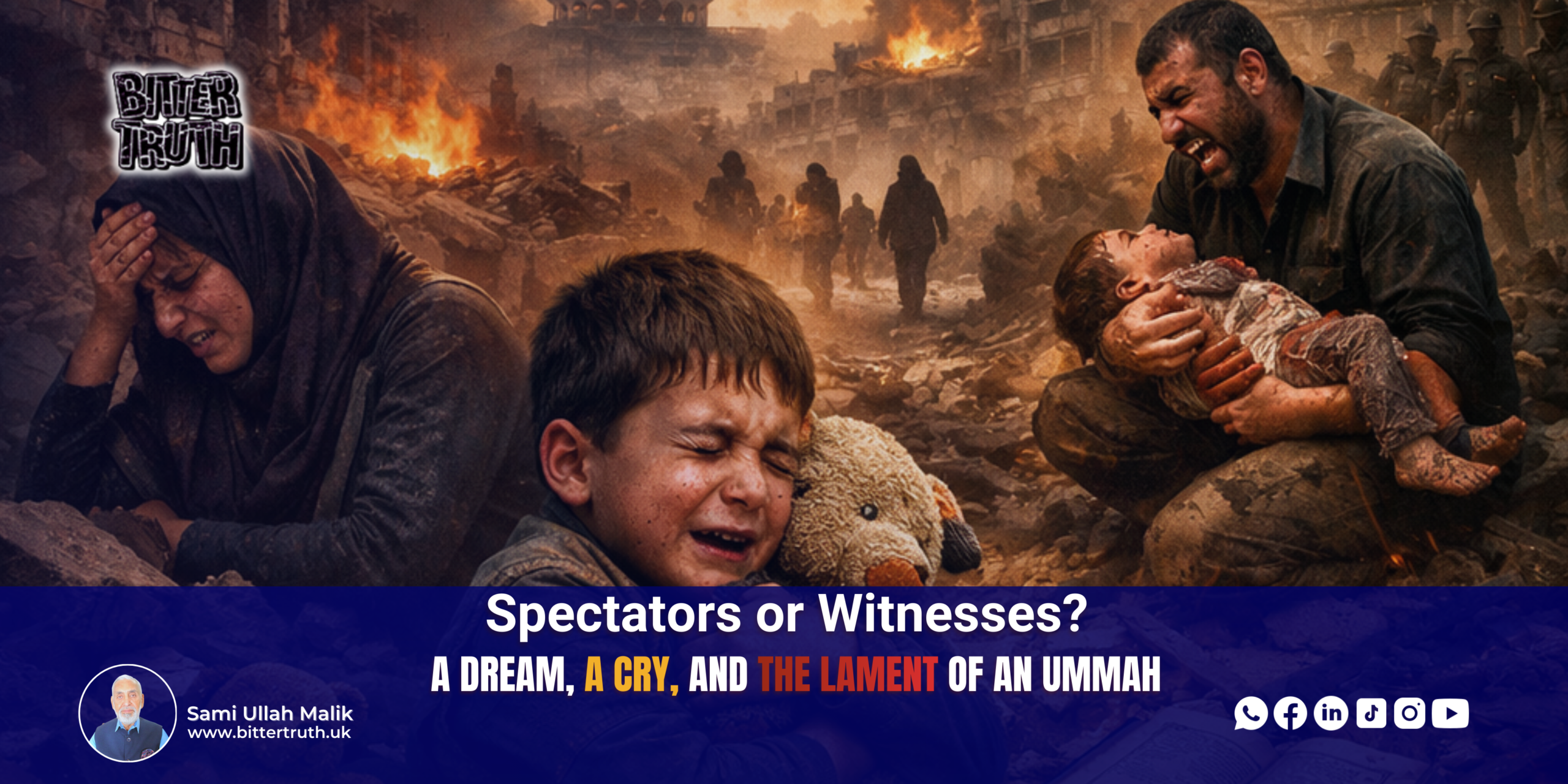
Spectators or Witnesses?
The Silence on Trial

A Dream, A Cry, and the Lament of an Ummah
(An Address to the Muslim World in the Contemporary Global Political Landscape)
بِسْمِ اللَّهِ الرَّحْمٰنِ الرَّحِيمِ
In the Name of God, the Most Compassionate, the Most Merciful
الْحَمْدُ لِلَّهِ الَّذِي جَعَلَنَا مِنْ أُمَّةِ مُحَمَّدٍ ﷺ وَالصَّلَاةُ وَالسَّلَامُ عَلَىٰ سَيِّدِ الْأَنْبِيَاءِ وَالْمُرْسَلِينَ، وَعَلَىٰ آلِهِ وَأَصْحَابِهِ أَجْمَعِينَ
All praise belongs to God, who has made us part of the community of Muhammad ﷺ; and peace and blessings be upon the Seal of the Prophets and Messengers, and upon his family and all his companions.
«مَثَلُ الْمُؤْمِنِينَ فِي تَوَادِّهِمْ وَتَرَاحُمِهِمْ وَتَعَاطُفِهِمْ كَمَثَلِ الْجَسَدِ الْوَاحِدِ»
“The likeness of the believers, in their mutual affection, compassion, and mercy, is that of a single body.”
Esteemed scholars, honoured teachers, venerable elders, courageous young men and women, and all those living souls
in whose chests not only hearts beat, but consciences still breathe;
whose eyes retain the strength to behold the truth,
and whose hearts have not yet surrendered to moral death—
اَلسَّلاَ مُ عَلَيْكُمْ وَرَحْمَةُ اللهِ وَبَرَكَا تُهُ
Peace be upon you, and the mercy and blessings of Allah.
This gathering is no ceremonial assembly.
It is no exercise in rhetoric, no indulgence in verbal ornamentation, no fleeting spark of emotional fervour.
It is, rather, a humble yet urgent knocking upon the doors of the heart.
I have not come today to speak of matters that are merely heard.
I have come to speak of truths that must be felt—
truths that do not merely engage the intellect but shake the soul;
truths that do not rest upon the ear but descend into the depths of the heart and leave the conscience restless.
I bring you no news bulletin, no policy analysis, no slogan fashioned for applause.
What I place before you today is a dream.
And yet—make no mistake—
this is not a comforting dream.
It is not an easy question I raise, nor a question that permits peaceful sleep.
It is the kind of question that robs one of rest,
for today I do not offer a speech—
I place before you a mirror.
And should we dare to see ourselves clearly within it, we may find sleep a stranger thereafte
My young friends,
if you imagine this gathering to be an ordinary programme, you are gravely mistaken.
This is a court of moral reckoning—
and in this court, the accused are none other than ourselves.
I will not recount fables.
I will not weave imaginary tales.
I will speak of a dream whose consequences are laid bare—
a dream that, for millions of Muslims across the world, is not a nightmare from which one awakens,
but a daily reality.
It is, in truth, our collective reality:
a cry suppressed for centuries,
a lament dissolved into the very breath of the Ummah.
Pause, then, and consider:
If tonight the roof above your home were torn away;
if missiles rained upon the beds of your children;
if your mother’s scream never reached a television screen—
would you still say, “This is not our concern”?
Therefore, I ask you—no, I implore you—
for a few moments, silence the noise of the world.
Set aside your devices.
Make your hearts حاضر—present.
Awaken your conscience.
For what is said today is not meant to be heard alone, but felt.
And it is a testimony that shall summon every one of us before the tribunal of history.
This address is spoken on behalf of the children of Gaza.
It is spoken on behalf of the mothers of Kashmir.
It is spoken on behalf of those orphans who have known not the warmth of a father, but only the coldness of a shroud.
And today, with unrelenting force, one question strikes at the very door of your conscience:
Are we, truly, an Ummah?
I have not come to deliver a political speech.
I have not come to chant an emotional slogan.
I have not come to ignite momentary excitement.
I have come to place before you a dream—
a dream that is, in reality, our shared condition.
So, for one moment—just one—
I ask all those in whose chests the heart still beats:
close your eyes.
Yes—close them.
And come with me to that moment when not one individual, not one family, but an entire Ummah was forced awake.
Imagine:
It is the final watch of the night.
The exhaustion of the day has settled.
Silence envelops the house.
A dim light lingers—
the kind that deepens sleep rather than dispels it.
The stillness is such that time itself appears to have paused.
Children lie in deep slumber.
A silence so profound that even a sharpened breath would be heard.
Innocent smiles rest upon peaceful faces.
The gentle rhythm of breathing moves like a quiet testimony to life itself—
those smiles which are the greatest treasure of a father, a mother, a grandfather;
those moments of unspeakable joy when one beholds one’s children as living dreams,
as the answered prayers of a lifetime.
And then—suddenly—the eyes open.
They search instinctively for the faces of the children.
But what appears is no dream.
It is a vision of the Day of Judgement.
Faces covered in dust.
Innocent forms drenched in blood.
Bodies torn by wounds.
Collapsed rubble.
Falling walls.
A trembling body in the cold air.
The heart longs to scream—
yet the scream dies in the throat.
Hands tremble.
Fingers reach out, desperate to touch the children,
to believe—if only for a moment—that they still live.
Yet the heart recoils in terror, fearing that this touch may be the last.
Pain courses through the body.
Bones feel shattered.
Breath grows heavy.
But above all else, one thought consumes the soul:
My children.
Where are my children?
Then—abruptly—the eyes open fully.
The room is intact.
The walls stand.
The roof remains.
The children are safe, sleeping soundly in their beds.
Their faces are clean.
Peaceful.
Secure.
And in that very moment, the human spirit collapses.
One wishes to cry aloud—not because the dream was dreadful alone,
but because the body trembles violently.
Tears stream unbidden.
The heart quakes.
Hands rise instinctively in supplication.
And the tongue whispers:
O God, it was only a dream.
Yet the heart responds:
But O God—was it not someone else’s reality?
This was not the dream of a single individual.
It was not a cinematic scene.
It was not a fictional plot.
It was the waking dream of a father in Gaza.
It was Gaza’s living lament.
It was the sobbing night of a mother in Kashmir.
It was the story of Syria, Yemen, Libya, Sudan—
a story that descends each night into the dreams of one Muslim or another.
It is the daily reality of the children of Syria, Yemen, and Palestine.
And yet, when we awaken, all is well.
Our children sleep safely.
Our rooms remain secure.
And tears fall—
because we realise it was only a dream.
But for those for whom this is not a dream—
do we truly know their reality?
Who Lives This Dream?
Esteemed listeners,
Whose reality is this dream?
It is the reality of the father in Gaza, who each night presses his children to his chest amidst the thunder of bombardment.
It is the reality of the Palestinian mother who, as she lulls her child to sleep, does not know whether he will awaken alive at dawn.
It is the reality of the Kashmiri child who closes his eyes at night uncertain whether they will ever open again.
This is the dream of children who have not known toys, but rifles;
the reality of children in Syria, Yemen, and Sudan who have not seen playthings, but missiles.
It is the truth of every corner of the world where being Muslim has become a crime.
We shudder at a dream and lose sleep for a single night—
they live this reality every day.
Every night they sleep without knowing whether morning will come.
We tremble at imagination;
they endure truth.
Esteemed audience,
Pause and consider a question that rends the heart:
what must pass through the souls of those parents for whom this is not a dream, but a daily routine—
who run from place to place carrying the torn bodies of their children,
neither granted the strength to bury them, nor even the permission to hold them close?
If you wish to see calamity walking on its feet, watch the footage from Gaza.
If you wish to feel pain breathing, the images from Palestine are sufficient.
This is not merely war.
This is the assassination of humanity’s conscience.
The blood that flows silently in Kashmir still cries out—
those who called “We are Pakistanis, Pakistan is ours” were buried beneath the soil wrapped in the Pakistani flag.
And where, then, do we stand?
There is an immutable law of nature:
so long as the oppressed still breathe, the oppressor remains an oppressor;
but when the oppressed fall silent, tyranny becomes unrestrained.
For years we have watched death dance,
while life gasps for breath.
The question is not: Who is the oppressor?
The question is: Where are we?
Esteemed listeners,
We comfort ourselves with the illusion that the danger has passed,
that these horrors are occurring “somewhere far away.”
But the truth is far more unsettling.
We are not passing through a difficult phase;
we are entering a perilous age.
To claim that the danger has receded is to deceive ourselves.
That moment can knock on any door, on any morning.
Which border is secure?
Which city is safe?
Which home is protected?
Today bombs fall on Gaza.
Tomorrow, on Kashmir.
And the day after?
History bears witness:
oppression does not halt quietly—it expands.
From Muhammad bin Qasim to Karbala, what does the mirror of history reveal?
When the cry of a daughter of Sindh was heard, Muhammad bin Qasim crossed the seas—
no passport, no visa, no waiting for the United Nations, no reliance on resolutions.
One truth alone propelled him: the Ummah was one.
And Karbala?
When brutality and savagery were being inscribed upon the family of the Prophet ﷺ himself, history asks:
where were the rest of the Muslims?
Today, the answer to that question stands exposed.
It is written plainly in our conduct.
We are Muslims—
but only within our borders.
Sometimes only within our homes.
And often only within the confines of our interests.
In the modern world, the very concept of the Ummah is being murdered before our eyes.
We are taught that the nation matters, not the Ummah;
that borders are sacred, not human beings;
that interest is supreme, not ethics.
Thus, the idea of the Ummah has been buried—
quietly, skilfully, almost beautifully.
“You mind your borders; we will mind ours.”
Let Gaza burn.
Let Kashmir groan.
We shed a few tears on our screens and then return to our routines.
The naked face of global hypocrisy now stands fully revealed.
The world knows who is the oppressor and who is the oppressed—
yet the oppressor is recast as the victim.
The United States stands shoulder to shoulder with Israel, fleets deployed in support.
Its Secretary of State invokes identity to sanctify injustice.
Joe Biden arrives bearing threats.
Donald Trump surpassed all limits in his infatuation with Israel.
Britain, France—partners in this crime.
And we?
We are engrossed in cricket.
Entangled in struggles for power.
When electricity fails in Ukraine, human rights awaken.
When Gaza is erased, silence prevails.
Perhaps because Muslims are no longer considered human.
Esteemed audience,
The greatest shame here is not the strength of the enemy.
The true tragedy—already etched into history—is our apathy, our cowardice.
We are busy with games.
We cheer before giant screens, dancing at boundaries and sixes.
We applaud in decadent gatherings.
Or we remain trapped in power struggles.
On social media, lies, vulgarity, and deceit mislead our youth, advancing the enemy’s agenda.
Falsehoods are spread without verification, fuelling division.
This silence.
This cowardice.
This indifference.
All of it has already been recorded by history.
And future generations will ask us:
When the Ummah was burning, what were you doing?
When Gaza, Kashmir, and others were butchered mercilessly, where were you?
On the Day of Judgement, no excuse will be accepted—
not that borders were distant,
not that responsibilities were heavy,
not that we were weak.
Esteemed listeners,
The injustices and suffering I have spoken of are not unknown to you.
You encounter them daily in the media.
You are aware of your helplessness.
But must we leave our children and future generations an inheritance of despair and subjugation?
That decision now rests with us.
We must seek the solution ourselves.
No outsider will come to wipe our tears.
Remember well:
The solution lies neither in NATO,
nor in the United Nations,
nor in the promises of global powers.
Its only solution lies in the Divine command:
وَاعْتَصِمُوا بِحَبْلِ اللَّهِ جَمِيعًا وَلَا تَفَرَّقُوا
“Hold fast, all of you together, to the Rope of God, and do not be divided.”
The Qur’an teaches us unity.
The Sunnah teaches us sacrifice.
And the Seerah teaches us courage.
When the Ummah is united, Badr is born.
When it fragments, Karbala is left to stand alone.
A Final Call to the Ummah
It feels as though this may be the Ummah’s final call—
a call that declares clearly:
this is not the time to be spectators,
this is not the time for speeches,
this is the time for self-accountability.
Awaken your faith.
Revive your conscience.
Rise above sects, nationalities, and narrow interests—
because if we do not awaken today,
tomorrow this nightmare will become our own reality.
Esteemed listeners,
What you have just heard was not merely a speech.
It was history’s lament, speaking to you in the language of today.
This question is no longer only about Gaza.
It is no longer only about Kashmir.
It is not confined to Palestine, Syria, Yemen, or Sudan.
This question is about all of us.
History’s pen does not pause—it continues to write.
And future generations will ask us:
When the Ummah was drowning in blood, where were you?
When children’s shrouds were too small, which screen held your attention?
When the first Qiblah was burning, which interest were you protecting?
When oppressed Kashmiris in Srinagar, Shopian, Jammu, and Rajouri were riddled with bullets for chanting “We are Pakistanis and Pakistan is ours,” why did you forget us?
Remember well:
on the Day of Judgement, no passport will avail you,
no nationality,
no flag,
no alliance membership.
Only one question will be asked:
What did you do for the oppressed?
Even now, there is still time—
but very little of it.
This is not the hour for spectatorship.
This is the hour of accountability.
This is the hour of return—
of holding fast to the Rope of Allah.
The Qur’an remains unchanged.
The Sunnah remains unchanged.
The Qiblah remains one.
The only difference is that we have fragmented.
Come—let us pledge today
that we will stand not with headlines, but with truth;
that we will decide not by interest, but by faith;
that we will not inherit silence, but responsibility.
My youth,
my brothers,
my sisters—
Today, history is watching us.
And in history’s hand is not a blank page,
but a pen of judgement.
Remember this:
history will not record what you said—
history will record what you did.
If today we choose silence,
tomorrow our children will question us from our graves:
When the Ummah was being slaughtered, where were you?
Once again, time is calling.
Either we shoulder the burden of our faith,
or history will remember us as a cowardly nation.
If today we do not awaken our hearts,
tomorrow this nightmare will invade our homes.
This is not the time for tweets.
This is not the time for mere status updates.
This is not the time for tears alone.
This is the time to stand.
This is the time to set aside nation, race, language, and party—
and adopt one identity only:
I am a Muslim.
My youth, my brothers, my sisters—
The speech may be ending,
but the decision begins now.
This gathering will disperse.
The chairs will empty.
The stage will fall silent.
Yet the question will remain:
Did we merely listen, or are we leaving with the resolve to change?
The Ummah does not need another speech.
The Ummah needs awakened consciences.
The Ummah does not need applause.
The Ummah needs youth who are willing to stand.
Remember this truth:
nations die the day their youth fall silent in the face of oppression,
and nations are reborn the day their youth stand up for truth.
My youth—
If even today you excuse yourselves by saying “We are helpless,”
remember this:
tomorrow your children will stand at your graves and accuse you.
This is the time to bury fear.
This is the time to shatter silence.
This is the time to move beyond being warriors of social media
and become soldiers of action.
This is the time to rise above sects,
to step beyond nationalities,
to abandon parties, interests, and positions—
and embrace one truth:
We are Muslims,
therefore we cannot be indifferent.
We cannot abandon the oppressed.
We cannot accept a life without truth.
If today we fail to awaken our conscience,
remember this fire burning in Gaza today—
whose flames are reducing the human settlements beneath Kashmir’s beautiful chinar trees to ashes—
will knock on our own doors tomorrow.
This blood flowing in Palestine today
will course through our streets tomorrow.
And the extremist Hindu who repeatedly dreams of staining his impure symbols with the pure blood of Muslims and Pakistanis—
on that day, neither the United Nations will remain,
nor any superpower,
nor any treaty.
Even now, there is time.
Even now, there is opportunity.
Even now, our Lord is present.
And the Qur’an still proclaims:
وَاعْتَصِمُوا بِحَبْلِ اللَّهِ جَمِيعًا وَلَا تَفَرَّقُوا
“Hold firmly, all together, to the Rope of Allah, and do not be divided.”
Come—
in this moment,
in this gathering,
before this stage—
let us make a covenant with Allah:
O Allah, do not make us spectators.
Do not make us cowards.
Do not make us a silent nation.
O Allah, make us the youth who stand for truth,
who do not bow before oppression,
who do not fear carrying the burden of the Ummah.
Transform our apathy into awakening.
Our weakness into unity.
Our silence into courage.
Make us once again an Ummah—
not a nation of spectators,
but a nation that bears witness to truth.
O Allah, do not make us onlookers—
make us warriors for truth.
Do not make us a scattered crowd—
make us one Ummah.
Do not make us silent—
make us voices of truth.
O Allah, when history calls our names,
let us not hang our heads in shame,
but stand tall and say:
O Allah, we did not sleep—
we were standing.
وَاعْتَصِمُوا بِحَبْلِ اللَّهِ جَمِيعًا وَلَا تَفَرَّقُوا
Hold fast to the rope of Allah, all of you, and do not be divided.
Allahumma ish’had. Allahumma ish’had. Allahumma ish’had.
O Allah, be a witness. O Allah, be a witness. O Allah, be a witness
(Lecture Maulana Zafar Ali Khan Trust Lahore 24 January 2026)