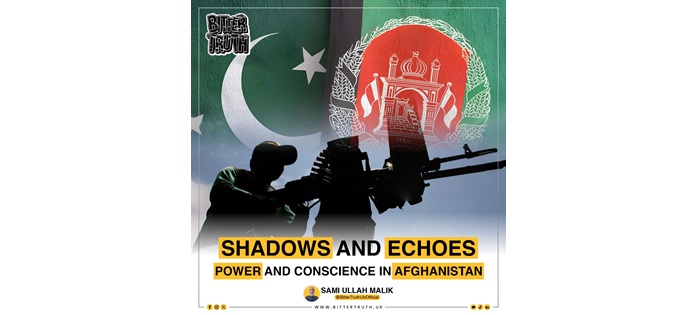
Shadows and Echoes: Power and Conscience in Afghanistan
The Trial of Faith and Interest in the Corridors of Politics

The Veil of History: Delhi, Kabul, and the Diplomacy of Contradictions
The history of South Asia is like a vast and ancient curtain — woven with the mingling threads of power, expediency, and faith. Upon that tapestry, the colours of ambition and belief have long merged and scattered, leaving patterns both luminous and obscure. Whenever a new chapter begins under its shadow, the echoes of bygone ages resound again — rising like a sudden gust of wind across a desolate plain, tearing through silence and lifting clouds of dust into the air.
So it is today. The growing intimacy between New Delhi and Kabul is not merely a sequence of diplomatic gestures or ceremonial accords; it is the unveiling of a new tableau in a story centuries in the making — a story in which ideals have bent beneath the weight of pragmatism, interests have replaced identities, and nations have been left to wrestle with the question of their own existence.
The Afghans, in their own unvarnished candour, have long observed:
“You cannot buy an Afghan, but you may hire him for your purpose.”
A remark both bitter and piercingly true — for it captures the entire philosophy of diplomacy in this volatile region. The price of Afghan independence is not small, and yet when necessity courts expediency, transient alliances are born. Within that uneasy truth lies the secret of the recent accord between Kabul and New Delhi — a dance between the pragmatism of power and the unspoken tragedies of history.
This document emerges from this changing backdrop — where political eloquence and moral purity are reflected. The issue at hand transcends borders and conventions. It is, in essence, a cultural, ideological, and moral test. Can the interests of survival ever be weighed against the moral appeal of faith and justice? Or will the voice of conscience be forever drowned out by the clamour of power? The Qur’an reminds mankind of caution and discernment:
“يَا أَيُّهَا الَّذِينَ آمَنُوا خُذُوا حِذْرَكُمْ”
“O you who believe, take your precautions.”
It is this very vigilance that must guide the nations of the region out of peril — for fleeting convergences of interest too often slip into paths of blood and betrayal.
Politics, as the weary historian knows, seldom moves upon the axis of principle; it revolves instead upon the cold geometry of interest. The very India that once decried the Taliban as the emblem of extremism now finds itself seeking pragmatic engagement with them. It is a paradox — darkness under the lamp — yet this contradiction reveals a deeper truth: that in the current of time, ideology is often melted down in the furnace of expedience.
“In politics there are neither perpetual enemies nor eternal friends; only interests endure.”
Thus, when the Hindu nationalist government of Mr Modi — defined by its hostility towards Islam — draws near to the Taliban’s Islamic Emirate, this communion is not born of creed but of convenience. The Qur’an again reminds us:
“وَتِلْكَ الْأَيَّامُ نُدَاوِلُهَا بَيْنَ النَّاسِ”
“And such are the days We alternate among mankind.”
It is the turning of these very days that now brings Delhi and Kabul into one another’s embrace — former adversaries, present companions in expediency.
In this game of diplomacy, smiles often dance upon the edge of daggers. The soft tones echoing in recent Indian and Taliban statements conceal a calculus as sharp as steel — the arithmetic of power, where the strong exact their due from the weak.
India seeks to use the Taliban as a lever against Pakistan; the Taliban, in turn, employ Delhi as a
pawn upon the chessboard of regional advantage. This relationship is not a fellowship of faith or conviction — it is, in essence, the commerce of interests.
As Allama Iqbal once lamented:
“In the theatre of politics, nothing is eternal — neither friendship nor enmity; only interest gives meaning to the game.”
Thus, the sly smiles of the Indian press and the supple diplomacy of the Taliban are both enslaved by their respective aims. Here, reality triumphs over ideology, as it so often does in the realm of statecraft.
The days between the 9th and 14th of October 2025, have already etched themselves as a brief but telling chapter in the chronicle of South Asia. The visit of Taliban Foreign Minister Mawlawi Amir Khan Muttaqi to Delhi was no mere diplomatic courtesy; it marked the quiet defeat of an old narrative — the very narrative that had once cast Delhi as the citadel of “infidelity” and Kabul as the banner-bearer of “jihad”. Today, that tale sits subdued upon the carpet of convenience.
India’s warm reception of the Taliban delegation is not so much a change of policy as it is a change of mask. It is the same Delhi that once denounced the Taliban as “terrorists”, now opening its doors in the name of “cooperation”.
The scene is a slap from history itself, reminding us that:
“At the gates of power, ideology is forever chained.”
For Islamabad, the growing intimacy between Kabul and Delhi has become a cause of palpable unease. The Taliban Foreign Minister’s visit to Delhi came a mere ten days after the Regional Dialogue in Islamabad, where anti-Taliban Afghan figures had gathered.
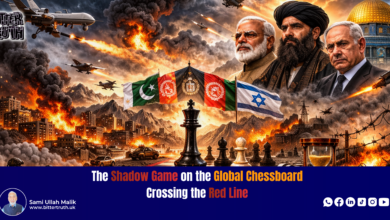
Thus, the chessboard of regional politics was reset — each player poised to sacrifice its pieces in the hope of a greater checkmate. Islamabad’s conference was a gesture of diplomatic defence, while Delhi’s welcome was a move of strategic counter-offence.
All this unfolded while border skirmishes between Pakistan and the Taliban raged, and aerial clashes between Pakistan and India had barely fallen silent. The moment itself seemed to whisper a timeless truth:
“Peace is not born in the halls of power, but in the balance of power.”
The Taliban Foreign Minister’s visit to Delhi has indeed ushered in a new chapter in diplomacy — and in doing so, it has sent a quiet but unmistakable message to its former patrons:
when necessity calls, even the hunted may clasp the hand of their erstwhile hunters.
Delhi’s Calculus, Kabul’s Bargain: The Politics of Convenience in South Asia
For New Delhi, the moment is one of opportunity — the chance to revive its strategic interests, even if that revival demands the sacrifice of ideological consistency.
For the Taliban, the connection is not born of affection but of survival. India seeks to reassert its influence in Afghanistan, to counterbalance the expanding reach of Pakistan and China; the Taliban, by contrast, aim to escape their economic and diplomatic isolation.
The Qur’an had long cautioned mankind in words that echo through centuries:
“إِنَّمَا الْمُؤْمِنُونَ إِخْوَةٌ فَأَصْلِحُوا بَيْنَ أَخَوَيْكُمْ”
“Indeed, the believers are but brothers; so reconcile between your brothers.”
Yet here, reconciliation is no longer the offspring of faith, but the by-product of expedience.
Delhi’s New Friendship — A Bitter Message for Islamabad
Only a few years ago, such a spectacle would have seemed inconceivable.
Today, it stands before us in bold relief: the growing warmth between the Taliban and India — a stinging slap delivered by time upon the face of ideological steadfastness.
Pakistan, which had once hailed the Taliban’s conquest of Kabul as an “Islamic victory,” now gazes in disbelief at their growing intimacy with Delhi.
The tableau reveals how dramatically the balance of power in the region has shifted —
“Those whom you once deemed the light of your tent, now march as companions of the storm.”
The Taliban–India rapprochement is not merely the handshake of two governments; it is the collapse of two decades of hostility, distrust, and ideological distance. For Pakistan, this is not a political jolt; it is a diplomatic earthquake.
Since the founding of the Taliban movement in 1994, India has viewed it as a proxy of Pakistan. Upon that premise, Delhi aligned itself with Iran and Russia to sustain the Northern Alliance — hoping to keep the Taliban’s shadow from falling over Kabul. When America invaded Afghanistan in 2001, India became the staunch ally of the Ghani administration, investing heavily against the Taliban cause.
For twenty years, the enmity between the two remained an accepted truth. But Time, that most ruthless of teachers, delivers lessons none can evade. The same India whose media once recoiled at the mere mention of “the Taliban” now proclaims them its regional partners.
This is the moment which once described as “Taghayyur-e-Ahwal” — the alteration of circumstance: “When truth itself is not defeated, but the bearers of truth become entangled in expedience, falsehood finds a way to sell enmity beneath the veil of friendship.”
When, in February 2020, the United States and the Taliban signed the Doha Accord, India received the news like a tremor underfoot. The pact paved the path for the withdrawal of foreign troops, yet it opened a chasm in Delhi’s foreign policy.
Then came 15 August 2021, the day Kabul fell. Indian embassies were shuttered, consulates emptied, and Delhi turned its eyes away from the Afghan people. The Taliban called it betrayal; Delhi named it a security necessity. Trust, that fragile tree, was uprooted — but politics, the patient gardener, soon planted new seeds in the same soil. Within a few short years, India re-established contact with the very Taliban it had once denounced as barbaric and blood-thirsty.
In politics, yesterday’s enemy is so often tomorrow’s ally; for this is the theatre where ends, not ethics, determine alliances.
The Taliban, in turn, sought to assure India that their foreign policy was subject to no third power. That unspoken “third power” was, of course, Pakistan. These were the same Taliban who had once spoken of “Islamic brotherhood” with Islamabad; yet now, under the banner of political autonomy, they proclaim a new independence.
This is, in truth, an effort to break the chains of Afghanistan’s past — chains that have bound it for centuries to the orbit of greater powers.
And in that very moment of self-assertion, India found its opening. It approached Kabul’s gates clothed in the robe of respect, but bearing the letter of interest.
The Qur’an enjoins again:
“يَا أَيُّهَا الَّذِينَ آمَنُوا خُذُوا حِذْرَكُمْ”
“O you who believe, take your precautions.”
That very prudence has now become the axis upon which both India’s and the Taliban’s diplomacy turns.
It is worth recalling that in June 2012, the Taliban issued an unexpected statement praising India for rejecting the American military role in Afghanistan. That compliment was not mere courtesy; it was a discreet knock upon Delhi’s door.
At that time, the United States was planning its withdrawal and urging India to assume a larger role in Afghan security. The Taliban, shrewdly recognising opportunity, lauded India as a “neutral power,” declaring that to appease America by joining the war’s ruin would be folly.
That was the first seed of diplomacy — the same seed that now blossoms in Delhi’s gardens.
The writer recalls having cautioned his own institutions and the Foreign Office the very next day, under the title “Palat, tera dhyan kidhar hai?” — “Turn back, where is thy focus?” Alas, the counsel went unheeded.
Politics, however, is a discipline where silence speaks louder than speech, and silence, in turn, is the master of all languages. This silence has become the foundation of this new chapter between India and the Taliban.
With the Taliban’s return to power on August 15, 2021, a subtle warmth began to permeate their relationship with India. At first, there were mere statements, then messages and, over time, meetings. This gradual progression-built trust brick by brick. India understood that if it retreated from the Kabul stage, both Pakistan and China would fill the void.
Thus, Delhi turned to the instruments of soft power, seeking to regain influence through patience and presence rather than confrontation.
This was the method I once called “the art of politics”: “What cannot be won with the sword can be won with a smile.” The Taliban smiled – and Delhi opened its doors. In June 2022, an Indian External Affairs Ministry delegation led by JP Singh paid an official visit to Kabul. It was the dawn of a new beginning — a new Sharia, as they call it — for the Taliban. In that moment, the stalemate of diplomacy cracked.
Kabul declared, “We are free — masters of our own decisions. “Delhi replied, with its characteristic civility, “So are we — masters of our interests.” That encounter became the first brick of trust.
The edifice that rose thereafter was built from the bricks of interest, trade, and regional calculus.
“Henna finds its hue only when mingled with blood;
So too friendship earns its faith only after sacrifice.”
The Winds of Diplomacy: Delhi, Kabul, and the Eclipse of Ideology
The winds that swept across the Gulf in January 2025 carried with them the scent of a quiet upheaval. In the opulent corridors of Dubai, Amir Khan Muttaqi, the Taliban’s Foreign Minister, sat face to face with Vikram Misri, India’s Deputy Foreign Minister.
It was that moment — subtle yet seismic — when politics once more triumphed over creed. This encounter was not a mere formality; it was the first brick of trust, carefully placed in the fragile bridge now being built between Delhi and Kabul.
The world learnt of it belatedly, but within diplomatic circles the tremors had long been felt. Irony, that faithful chronicler of history, could not have scripted it better: the very Dubai which once echoed with the Taliban’s fiery denunciations of the world, now served as the ground where the first seeds of conciliation with Delhi were sown. It is, indeed, the eternal jest of history — that where walls of hatred once stood, doors of expedience now open.
Four months later, in May 2025, another chapter unfolded. A telephone call — brief in form, profound in implication — linked Amir Khan Muttaqi in Kabul with Subrahmanyam Jaishankar in New Delhi. What the world dismissed as a “routine call” was, in truth, the second rung of trust’s uncertain ladder.
Between Delhi and Kabul, the distance began to dissolve — not in words, but in tone. This is that delicate moment in politics when conversation becomes the prelude to tacit understandings.“The most enduring peace is that which occurs in hearts before it appears on tongues.”
This was precisely that peace of hearts — still unannounced, yet quietly in motion. Over time, warmth began to return to the cold ashes of past relations. India started granting visas to Taliban officials, their families, and associates, ostensibly for “official meetings, training, and medical treatment.”
This gesture, draped in the language of humanitarian concern, was in fact a masterstroke of soft diplomacy — Delhi’s attempt to recast its image in hues of friendship and benevolence.
It was the hour when interest donned the robe of compassion, and policy walked under the veil of sympathy.
The Taliban, shrewd yet silent, accepted the gesture — and thus the circle of mutual confidence began to widen.
It was, one might say, an echo of the Divine reminder:
“وَمَكَرُوا وَمَكَرَ اللّٰهُ وَاللّٰهُ خَيْرُ الْمَاكِرِينَ”
They plot, and Allah plots in return; and Allah is the best of all planners.
Delhi planned, Kabul planned — but time alone would decide the outcome. Then came November 2024: the month when India quietly handed control of the Afghan Consulate in Mumbai to representatives appointed by the Taliban — a gesture soon mirrored in Hyderabad.
Though India had yet to formally recognise the Taliban regime, by accepting their diplomats within its mission in Delhi, it offered a silent yet decisive acknowledgment. This was the same Delhi that had once denounced the Taliban as illegitimate usurpers and now extended its hand in diplomatic courtesy.
One cannot but recall Iqbal’s verse, shimmering through the corridors of history:
“Beyond the stars there are yet other worlds —
and for the spirit of striving, there remain still more trials.” Not love, perhaps — but the tests of politics truly are without end, especially when every nation stands ready to sacrifice principle upon the cross of interest.
Pakistan’s border disputes and trade restrictions have effectively landlocked Afghanistan, depriving it of crucial sea access.
For years, Afghan officials have lamented that Pakistan often weaponised the Karachi port and Wagah border as tools of political coercion.
After decades of economic ruin — much of it self-inflicted — the Taliban now seeks to turn trade with India into both an escape route and a pressure tactic against Islamabad. India, in turn, saw in this an opportunity: to reopen an economic door that could lead to a political window — one overlooking Pakistan’s vulnerabilities.
Thus began a new phase: diplomacy through trade, and trade through political calculation.
Here, interest defeated ideology, and economics triumphed over creed.
As the Qur’an reminds us:
“وَفِي الْأَرْضِ آيَاتٌ لِّلْمُوقِنِينَ”
And upon the earth are signs for those who possess conviction.
Indeed, in the dust of Kabul today lie not the signs of faith, but the imprints of expedience.
Afghanistan has ever been the arena of great rivalries, the chessboard upon which empires and ambitions collide.
Both India and Pakistan have long sought to cast their shadows across its uncertain plains. During the Taliban’s first reign (1994–2001), Pakistan leaned decisively toward Kabul; but in the movement’s second coming, the script has reversed — relations are frayed, and the old fraternity lies in disrepair.
Border skirmishes have only deepened this estrangement. For Pakistan, the realisation now dawns — painfully — that the very force once hailed as its strategic depth has turned into a strategic threat, a power increasingly beholden not to faith, but to political convenience.
Kabul’s growing intimacy with Delhi tolls a new bell of diplomatic isolation for Islamabad — one that demands immediate attention before the echoes grow louder. When the sea of politics begins to churn with the whirlpools of interest, the tides of accusation are never far behind.
Today, Pakistan accuses the Taliban government of harbouring the Tehreek-e-Taliban Pakistan (TTP) —a group that has claimed countless lives in Pakistani territory.
Islamabad insists that Kabul’s silence on the matter is not neutrality but the result of Indian influence, and that Delhi, through Afghanistan, sustains Baloch separatists and anti-Pakistan networks. These are not mere rhetorical charges; evidence has been tabled.
Such is the sombre truth of this region:
“A nation that cannot trust its neighbour soon finds itself imprisoned within its own walls of suspicion.”
For Pakistan, this is no longer a question of defence but of existence. For Kabul, it is the delicate trial of how far it can court Delhi without provoking Islamabad’s wrath.
The Gathering Tempest of Silence
The silence of the Taliban has already sown the wind—and the whirlwind is now rising. Time and again, Pakistan has urged the Afghan authorities, with evidence in hand, to restrain the cross-border assaults; yet the answers have been promises, equivocations, and pious rhetoric. It seems as though the bond of Islamic fraternity has been lost in the shifting sands of politics.
Certain factions within the Taliban have given free rein to those Indian “agents of discord,” forcing Pakistan, in bitter necessity, to retaliate. Thus stand two Muslim neighbours—arrayed against each other—while the common enemy looks on and laughs.
Once again, the Qur’anic warning echoes across the mountains:
“وَلَا تَنَازَعُوا فَتَفْشَلُوا وَتَذْهَبَ رِيحُكُمْ”
“And do not dispute among yourselves, lest you lose courage and your strength depart from you.”
Alas! this verse is now recited merely in ritual, not lived in spirit.
As swiftly as the Taliban’s relations with Pakistan deteriorated, so too did their ties with India strengthen. This transformation was so unforeseen that neither Islamabad could anticipate it, nor Delhi fully believe its fortune. The labour of forty years—Pakistan’s hospitality, patronage, and political support—appears to have been cast to the wind.
The Taliban now court Delhi on political, commercial, and diplomatic fronts; and thus, the dream of strategic depth has turned to the reality of strategic isolation.
It all unveils an old truth:
“Nations are bound not by affection but by interest—and interest is loyal to no single master.”
The Taliban, once champions of Islamic solidarity, now move by the compass of regional equilibrium. And that, indeed, is the most perilous sorcery of politics—it can make an enemy a friend, and a friend a stranger.
For the Modi government, this newfound intimacy is no mere matter of foreign policy; it is an escape route from internal decay.
Kashmir’s unyielding resistance, the rumblings of separatism in over thirty Indian states, and the flames of sectarian bigotry—all gnaw at the edifice of New Delhi’s power. And so, Delhi unsheathes an old weapon once more—hostility towards Pakistan.
When popular anger surges, the easiest diversion is to conjure an external foe.
The outreach to the Taliban thus forms part of a larger stratagem: to pressurise Islamabad and conceal domestic failures behind the smoke of foreign defiance.
It is here that Iqbal’s prophetic voice returns to us:
“Thy civilisation shall slay itself with its own dagger;
He who builds his nest upon a slender branch shall never find it lasting.”
Modi’s India perches upon that same slender branch—imperilling the very peace of the region. Though Kabul and Delhi’s exchanges grow warmer, their courtesies remain veiled in mutual mistrust. The Taliban know that overt partnership will inflame Pakistan; Delhi knows that full faith in the Taliban is premature.
With China, Russia, and Iran in the vicinity, Afghanistan has once again become a grand chessboard of rivalries. India, unwilling to lag behind, tests the hardness of the ground before advancing further. These relations remain on trial—each side studying the other’s silhouette in wary silence.
At every step, the lamps of expediency burn bright; The night is still upon the road—the dawn is yet to come.
In the end, it would not be amiss to say that Modi burns in the twin flames of fear and vengeance. Setbacks in Kashmir, failures in diplomacy, and unrest within have shaken the throne of Delhi. Now, under the guise of friendship with the Taliban, he seeks to tighten the noose around Pakistan— yet his political psyche is fuelled not by peace, but by retribution. This, indeed, is the precipice upon which the region stands: one step closer to another war. For Pakistan, the hour demands not merely a defensive posture, but an intellectual and diplomatic counter-strategy.
For history bears witness:
“A nation that delays its policy becomes the instrument of another’s.”
Modi may well sacrifice the peace of South Asia at the altar of his own continuance in power;
but peace, in the end, remains the prayer of those who stand upon justice.
And the Qur’an has declared:
“إِنَّ اللّٰهَ يُدَافِعُ عَنِ الَّذِينَ آمَنُوا”
“Verily, Allah Himself defends those who have faith.”
Now, as we reach the end of this written journey, the panorama before us is stark:
on one side, towering regional dilemmas—border disputes, mistrust, economic need, and domestic disquiet; on the other, the new diplomacy of convenience that grants transient prestige, but never enduring peace.
The growing warmth between Kabul and Delhi is not a bilateral curiosity; it is a mirror reflecting the fragility of South Asia’s equilibrium.
The Afghan analysts’ bitter aphorism rings once more—
“You cannot buy the Afghans, but you can hire them for your interests.”
It teaches a hard lesson: the price of history, the cost of conscience, the measure of a nation’s dignity.
When power trades the people’s hope for fleeting gain, the harvest is nothing but ruin.
And if these interest-bound alliances pave the way for greater conflict, the fire will not confine itself to two or three states—it will engulf the region entire. What is needed today is wisdom of policy: a domestic and foreign doctrine that proves peace is not a profit of expedience, but a covenant of justice. For the Qur’an and the Sunnah remind us again and again that without justice, peace is but ink upon paper.
Iqbal’s echo resounds still— that only the nation steadfast in principle and fortitude ascends the heights of destiny.
If Delhi and Kabul truly wish to steer the region toward peace, they must forsake the marketplace of expediency and enter the bazaar of moral and human welfare. Else Afghanistan will remain a rented coin of politics,
its value flicked aside by time’s indifferent hand, and South Asia will once more blaze with the fire whose script history already knows. Thus does this narrative reveal the changing reality of our age:ideals no longer govern nations—pragmatism does.
Kabul’s intimacy with Delhi is a warning to Islamabad that politics is not the realm of passion alone, but of prudence and perception. For the Taliban, too, there lies a lesson: the weight of an Islamic claim endures only when sincerity shapes conduct and honesty anchors relations.
“I have slipped a thousand snares with but a single motion—He who is proud, let him test his fortune!” At this delicate turn of history, the chessboard of South Asia gleams with new colours. Whether these hues will illumine the path of peace,
or carve yet another tragedy with the dagger of interest— only time shall tell.
May God grant this region the wisdom of justice, the patience of restraint, and the courage to exchange the sword of blood for the bread, the book, and the light of learning— so that the generations to come may inherit not ruins, but renewal.