Rising from the Rubble: Iran and Pakistan’s Unified Future
Beyond the Flames: Iran and Pakistan's Shared Destiny

The Tragedy at Shaheed Ra’jae Port: A Civilisational, Political, and Economic Catastrophe
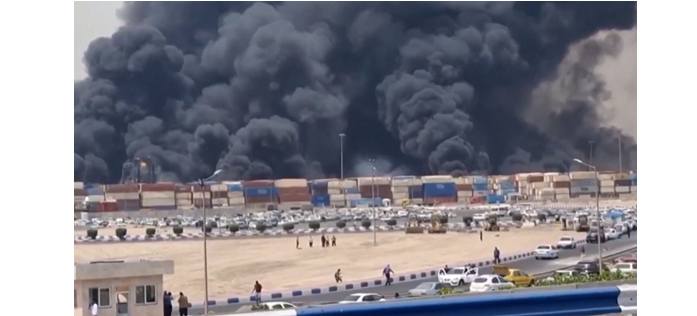
Sometimes, history sighs. And in that sigh—drawn long and deep across the shores of time—resides a sorrow so vast, so all-consuming, that even the most eloquent of tongues fall silent. Such was the sigh that rose from Iran’s southern coast, where Shaheed Ra’jae Port, once a proud sentinel of commerce and nationhood, crumbled beneath a pillar of flame and smoke.
It began not with sirens, but with the quiet hum of negligence—a spark, unseen, unfeared, nestled in the heart of stored fire. Sodium perchlorate, a name known perhaps only to those who trade in war, sat waiting. When it awakened, it did not whisper. It roared.
The heavens darkened. The ground, once kissed by the sea breeze, spat fire. And amid this fury, a nation stood still—its breath caught between grief and disbelief, its soul scorched by the folly of its own hand. Over forty lives were claimed in an instant—men who worked not to die, but to feed their families; women who watched the skies in dread; children whose dreams turned to smoke.
Yet, the true devastation lies not in numbers, but in the quiet absence that follows. In the empty chair of a father. In the blackened sky above a grieving port. In the knowledge that this pain was avoidable—that wisdom was shelved, that duty was deferred.
From time to time, the firmament of history is rent by events so searing that they transcend the immediate toll of human life, piercing the very soul of civilisation and casting tremors across the global conscience. Such is the tragedy that unfolded at Iran’s Shaheed Ra’jae Port—an episode not merely of industrial misfortune, but of profound symbolic magnitude, exposing the fissures in governance, the peril of misplaced ambition, and the fragility of modern civilisation beneath the façade of steel and science.
The skies were darkened with smoke, the earth scorched by raining embers, and an ancient nation stood paralysed—bewildered, wounded, suspended between disbelief and despair. This was no ordinary accident. It was a dirge in iron and flame, announcing the cost of forsaken prudence. The Shaheed Ra’jae Port, the arterial gateway of Iran’s maritime commerce, became the theatre of inferno where over forty souls perished, and more than a thousand were maimed. The lament of their blood now echoes in the hollows of global conscience.
Initial investigations suggest that the explosion stemmed from the negligent storage of ballistic-grade solid propellants—specifically, sodium perchlorate. That such volatile material was housed within a public infrastructure zone is not merely an oversight; it is a strategic and moral failing. In the heart of Bandar Abbas, a gateway responsible for 80% of Iran’s trade—oil, food, industrial goods—civilisation met calamity. The explosion was not simply of chemicals, but of credibility, of confidence, of the dream that Shahid Rajaee once symbolised.
Let us not forget the historical pedigree of this port. Once known as Bandar Siraf, a confluence of ancient trade and maritime legacy, this region stood firm during the Iran-Iraq War of the 1980s, when it alone bore the brunt of sustaining the nation’s economy. In the decades since, the Islamic Republic invested in its transformation—a beacon of progress amid sanctions and strife. Yet the blast of March 2025 reduced that dream to smoke and ruin, shaking the very foundations of Iran’s economic lifeline.
The dead include port workers, firefighters, and innocent civilians residing nearby—people who rose that day to labour, not to die. The wounded overwhelm hospitals, the air still thick with toxins, and the national psyche bruised beyond balm. Global powers extended condolences, fire-fighting ships were dispatched, but platitudes do not extinguish flames born of folly. For what worth are condolences when reason itself is in retreat?
Indeed, the tragedy lays bare a timeless truth: that nations are not great merely by the heft of their arsenals or the gleam of their GDPs, but by the wisdom with which they wield power and the humility with which they administer progress. The detonation at Shahid Rajaee is a cautionary parable, whispered from the charred walls of the port: when hubris reigns where foresight ought to sit, even the grandest of edifices may be reduced to cinders in the blink of fate.
Intelligence reports, particularly from Embry Analytics, cast further shadows upon the official narrative. Their revelations point toward a consignment of missile-grade fuel, imported under the Iranian flag from Chinese sources—stored recklessly, igniting not merely chemicals, but suspicions. If true, this was not merely a lapse in logistics, but a consequence of geopolitical brinkmanship. The hands that stoke the furnaces of war may find their own homes consumed.
The public has rightly raised its voice. Why was such perilous material housed so close to human habitation? Why was a facility of such strategic value not governed by sterner oversight? These are not rhetorical questions; they are indictments. The Iranian people, already beset by sanctions and inflation, now face disrupted supply chains for food and medicine—the consequences of incompetence cascading into the daily lives of millions.
Yet amid the ashes, let us salvage one ember of insight: that the might of a civilisation lies not in the roar of rockets but in the calm counsel of wisdom. The ruins of Shahid Rajaee cry out to history—not for vengeance, but for vigilance. For it is not enough to dream of greatness; one must govern it with care.
To paraphrase an ancient adage, oft repeated in times such as these:
“He who sets fire to his own house shall find no shelter in the ashes.”
And thus, the winds of time whisper again:
“Those whom fate would humble, it first permits to forget the virtue of restraint.”
The Tragedy at Shaheed Ra’jae Port: A Parable of Neglect, Power, and Peril
Along the sun-scorched coasts of southern Iran lies the port city of Bandar Abbas — long revered as the pulsing artery of Iran’s economic lifeblood. Yet, in a moment of violent disarray, this vital organ was engulfed in flames and fury. Official reports speak of over forty lives lost and more than a thousand souls wounded — figures that, for all their precision, fail to convey the anguish writ large on a nation’s heart.
Preliminary inquiries suggest that the inferno broke out in a sector where hazardous chemical materials were stored — a storage that, by all accounts, lacked the elementary precautions demanded by any nation that lays claim to scientific advancement or administrative prudence.
One must ask, with an air heavy with disquiet: was the port being repurposed for military ends? If so, it constitutes not merely an internal lapse but a transgression of international legal norms. Why were global safety protocols ignored with such staggering nonchalance? Who shall answer for this calamitous breach — a breach not only of safety, but of trust?
Indeed, as the poet once wrote: “Such are the ways of Caesars — ever unchanged through the ages.”
Shahid Rajaee is not merely Iran’s principal commercial port — it is the custodial threshold for over 80% of the nation’s imports. Its sudden closure portends not only logistical disruption but the ominous shadow of food shortages and economic instability. An economy already staggering beneath the yoke of international sanctions now finds itself bleeding from within.
This disaster occurred even as Iranian and American delegates engaged in delicate nuclear deliberations in Muscat — a coincidence not lost on the wary gaze of the global community. Though Iran has shown a measure of pliancy, even hinting at a willingness to accept certain curbs, it has adamantly refused to yield its sovereign claim to uranium enrichment — a stance that keeps the region perpetually poised on the edge of tension.
Iran’s insistence that its nuclear ambitions are “purely civilian” must now weather the fiercest scrutiny. For what nation, genuinely committed to peace and transparency, can permit such an unforgivable lapse in the guardianship of lethal materials? When the world watches with bated breath, can any state afford to be so criminally careless?
This tragedy may very well cast a long and menacing shadow over the already fragile negotiations. Should it be confirmed that the country is simultaneously advancing ballistic technologies, it will undoubtedly deepen Western suspicion and harden diplomatic lines. Iran insists on its peaceful intentions; the West suspects latent belligerence.
The foundations of any great nation are laid not in brute strength alone, but in caution, wisdom, and the sobriety of foresight. When the dust of complacency settles upon the throne of power, even the most venerable pillars of state begin to tremble. The explosion at Shahid Rajaee is not merely a mishap; it is an allegory of neglect and a monument to institutional torpor.
As the ancient warning resounds anew: “He who cannot govern his own household — how shall he aspire to steward the world?”
The decision to store ballistic missile fuel at a public trading port is not simply an error of logistics, but a declaration of intellectual bankruptcy. The resultant economic shock has dealt a staggering blow to Iran’s already fragile economy. The port’s paralysis implies a rupture in food supply chains and a descent into a deeper cycle of inflation and despair.
The Iranian public, anguished and incredulous, burns with a single question: Why was such a volatile cache housed so perilously close to civilian life? Was this, perchance, the result of tragic incompetence — or does it conceal a darker strategy?
One hears the lament echoing from the hearts of a wounded populace: “We believed you
would not neglect us — but by the time you awaken, we shall be dust.”
This incident is no mere industrial mishap; it is a cultural omen — a sign of a nation so entangled in its nuclear ambitions and military dreams that it has forsaken the essential demands of human stewardship.
To the wider world, too, it serves as a stern reminder: hubris cloaked in science and cloistered in power may reduce a civilisation to ashes — not in centuries, but in seconds. And so the question hangs heavy in the air: Is this catastrophe the herald of civilisational decay — or merely a cynical turn in a high-stakes political theatre?
As the poet-visionary mused: “The aims of Nature are kept by the lone shepherd — or the man of the mountain.”
In the final analysis, the tragedy at Shahid Rajaee forces upon Iran an existential reckoning: will it cling to dreams of grandeur while ignoring the rot within? Or shall it rise, with humility and introspection, to reforge its state upon principles of responsibility and reason?
If not, the future may hold not just the loss of economic standing — but the erosion of the very ideals upon which a nation must stand.
Ashes of Pride: The Lament of Shaheed Ra’jae Port
A Churchillian Meditation on Calamity, Sovereignty and the Shadows of Power
In a gesture as swift as it was symbolic, President Vladimir Putin of Russia dispatched specialised aerial firefighting aircraft and emergency systems to the Islamic Republic of Iran—an act that, beneath its veil of humanitarian concern, unmistakably signalled the strategic sinews binding Moscow and Tehran. In contrast, China, ever a master of studied ambiguity, acknowledged injuries to its nationals yet dismissed the incident as a “domestic matter,” choosing silence over sentiment. From Riyadh to Islamabad, from Ankara to Abu Dhabi, condolences flowed—a testament to the enduring primacy of human empathy, even in the theatre of geopolitical rivalry.
Yet as these courtesies fluttered like diplomatic pennants in a storm, the truth lay scorched beneath the sands of Bandar Abbas. The Shaheed Ra’jae Port—once the beating heart of Iran’s maritime commerce and the proud heir to centuries of seaborne trade—lay crippled, a titan brought low by the breath of sodium perchlorate and the collapse of prudent judgment. Here, where once the sails of ancient caravans brushed against Persian winds, and merchants from the edges of the earth unburdened their wares, now rose the stench of ash and the whisper of an old truth: that civilisations are not secured by weapons, but by wisdom.
We are reminded, as we so often must be, of Baghdad’s bloody gutters and Granada’s fallen banners. Their fall was not merely military—it was moral, intellectual, and strategic. And so it is with Iran today, as the ruins of Shahid Rajaee cry out not only in grief, but in rebuke.
The catastrophic mishandling of such volatile compounds as rocket propellant—stored with all the heedlessness of an empire drunk on its own illusions—raises questions not merely of safety, but of sovereignty itself. What are we to make of a nation seeking parity in the nuclear brotherhood, whilst fumbling the most basic tenets of statecraft? Can a state which cannot shield its own people be trusted to wield the atom with wisdom?
As the smoke curls over the Strait of Hormuz, the spectre of suspicion rises over the negotiations in Oman. While Iran pleads the peaceful purpose of its atomic ambitions, the ruins of its own recklessness serve as a damning counterargument. The irony is as sharp as a Damascene blade: the very fire that scorched Shahid Rajaee now casts a shadow over the conference table.
Yet perhaps the most searing indictment comes not from abroad, but from within—from the embers of a people’s wounded pride. For what was truly lost that day was not merely life, but legacy; not merely infrastructure, but identity. The port was not only a gateway of trade—it was a symbol of endurance, of revival, of sovereignty reclaimed after revolution. To see it so brought low is to feel, deeply and viscerally, the crumbling of confidence in the guardians of the republic.
O sons of Iran! Heirs to Persepolis and the poets of Shiraz! Do you not see that you have harvested fire where you should have sown foresight? You stockpiled fuel for rockets yet let the lamp of reason gutter out. You dreamt of piercing the heavens, while letting the ground beneath your feet rot with negligence. You built arsenals but forgot the armour of caution.
Power without prudence is a palace built on sand; might without mind is a mausoleum of empires.
When sodium perchlorate—deadly and volatile—was stored like grain at a public harbour, it was not merely an error of logistics. It was an abdication of reason, a betrayal of stewardship. And now, the ruins speak. They speak of a government enthralled by the myth of strength, yet unmoored from the discipline it demands.
As the diplomatic breeze rustles over Muscat’s corridors, it carries with it the ashes of Shahid Rajaee. It is a cold reminder: that history forgets those who forget themselves, and remembers only those who, rising from the cinders, rebuild not just structures but standards.
Let this be the lesson etched in fire:
“When pride ascends the throne and prudence is made prisoner, the pillars of power crumble from within.”
And yet—hope is the final duty of despair. Let not these ashes mark the end, but the reckoning. Let Iran not merely repair a port but reconstruct a paradigm—of governance rooted not in spectacle but in substance. The world watches, and so does time.
Arise, then, O Iran—
Not with the clangour of missiles,
But with the calm clarity of minds awakened.
Let the port that burned become a lighthouse once more.
From Ashes to Awakening: A Call for Fraternity and Foresight
In the barren windswept plains of Shahid Rajaee, amidst the smouldering ruins and choking smoke, history has once again whispered its age-old admonition: nations do not perish by arms alone—they fall when wisdom is exiled, when foresight is silenced, and when hubris replaces humility.
Today, I call upon you—not merely to mourn the ashes—but to rise from them. To forge a new covenant, not of blood and steel, but of intellect and principle. Let us pledge ourselves to an arsenal of ideas rather than missiles; to the stockpiling of insight, not combustible fuels. The time has come for a new awakening: where ports are safeguarded not just by firewalls, but by far-sightedness.
As the tides of geopolitics grow turbulent and tempests of uncertainty loom large, Iran and Pakistan stand once more at a historical crossroads. Bound by the silk threads of faith, culture, and shared sacrifice, these two nations must now shape their brotherhood into a bulwark—a moral alliance against the encroaching tide of hostility and hegemonic ambition.
Across our borders, the waters run dry—not by drought, but by design. Pakistan faces an insidious war, where rivers are transformed into weapons, and treaties into bargaining chips. Narendra Modi’s threats to abrogate the Indus Waters Treaty are no mere diplomatic posturing; they are a clarion call of environmental aggression—designed to suffocate the land and spirit of a nation. Meanwhile, Israel, India’s strategic bedfellow, exports its belligerence from the razed streets of Gaza to the silent conspiracy of regional manipulation.
Let us not be deceived—this is no fragmented front. The architect of division is singular, and its ambition manifold: to isolate Tehran, to destabilise Islamabad, to fracture unity where solidarity once stood. But have they forgotten? Have they not studied the chronicles of Karbala, where resistance was etched not in victory, but in valour? Do they not know that when Gaza weeps, Lahore listens? And when Kashmir bleeds, Qom prays?
Now is the hour to rise—not in lamentation, but in luminance. Let us forge unity not of convenience, but of conviction. A union that will not merely resist but radiate—a flame kindled in the ashes of Shahid Rajaee, spreading light from Gwadar to Chabahar, from the valleys of Kashmir to the deserts of Khuzestan.
Let not this tragedy become another footnote in the catalogue of forgetfulness. Let it be the furnace in which a new fraternity is forged. For history is a stern tutor: those who fail to read its warnings are condemned to relive its wounds.
To the people of Iran, to the sons of Persepolis and the guardians of the Caspian: your wounds are not yours alone. To the people of Pakistan, heirs of Indus and keepers of Iqbal’s dream: your struggle is our own. Together, let us transcend semantics and symbolism, and embrace the architecture of enduring alliance.
Let us tear down the walls of fear, unshackle the chains of old suspicions, and build instead a vessel that sails not on tides of trepidation, but upon winds of wisdom. Let it be a vessel steered by conscience, powered by collective courage, and destined for shores of shared prosperity.
Let us tell the world: Gaza is not alone. Kashmir is not forgotten. And the waters of the Indus shall not be stolen in silence.
O nations of kindred faith and soul, let us rise as one body, one voice, one unyielding resolve.
“From the ashes of the past shall rise a dawn anew;
Where wounds birth wisdom, and smoke reveals the stars.”
May the Almighty grant us discernment in despair, resolve amidst ruin, and unity in the face of division.
For beneath the wreckage lie the seeds of renewal.
And from dust, we have always known how to fashion crowns.