Reviving SAARC for Peace in South Asia: Ending India’s Intervention
Pakistan-Bangladesh Military Ties: A New Challenge for India

Pakistan-Bangladesh Military Cooperation: A Cause for India’s Concern
Recent developments in military cooperation between Pakistan and Bangladesh have not only altered the balance of power in South Asia but have also become a significant concern for India. Rooted in historical, political, and geographical realities, the growing collaboration between Pakistan and Bangladesh, 54 years after their separation, has raised alarms for India. This growing unease is evident in Indian media’s consistent coverage, with headlines like the one on the Indian news website First Post: “A Cause for Concern for India: Pakistan’s Military Returns to Bangladesh for the First Time Since 1971.”
The Indian media has been abuzz with reports and analyses on this topic for several days. Responding to claims circulating in the press, the Chief Advisor to India’s BSS stated via “Press Wing Facts” that the Ministry of Home Affairs’ spokesperson clarified: “The ISI Chief has not visited Bangladesh. The news circulating on press and social media is false.”
This wave of concern in Indian media intensified when earlier this month, a Bangladeshi military delegation led by Principal Staff Officer Lieutenant General S.M. Qamar ul Hassan visited Pakistan and held discussions with Pakistan’s military leadership. During this visit, the Bangladeshi delegation met with Pakistan’s Chief of Army Staff General Asim Munir, Chairman of the Joint Chiefs of Staff Committee General Sahir Shamshad Mirza, and Pakistan Air Force Chief Air Marshal Zaheer Ahmad Babar Sidhu.
On Friday, when asked about the Pakistan-Bangladesh military cooperation, Indian Ministry of External Affairs spokesperson Randhir Jaiswal remarked, “We always monitor activities in our neighbourhood, the region, or near India, particularly those affecting our national security. We will take the necessary measures as required.”
Historical Context of Pakistan-Bangladesh Relations
Relations between Pakistan and Bangladesh have historically been fraught, primarily due to the military operations conducted by Pakistan in 1971 and the subsequent separation of Bangladesh. The history of both nations is intrinsically linked to the Partition of 1947. The political, economic, and cultural differences between East Pakistan (now Bangladesh) and West Pakistan (now Pakistan) culminated in the creation of Bangladesh in 1971. India played a pivotal role in supporting Bangladesh during this period, with its military intervention instrumental in splitting Pakistan and establishing Bangladesh as an independent state.
Post-1971, India sought to expand its political and economic influence over Bangladesh. However, in recent years, Bangladesh has attempted to reduce its dependence on India and pursue an independent foreign policy. Since the 1990s, relations between Pakistan and Bangladesh have gradually improved, particularly through economic cooperation and people-to-people exchanges. However, the notable progress in military relations in recent years has become a matter of concern for India.
Sheikh Hasina’s Era and Its Aftermath
Last August, amidst violent protests, Sheikh Hasina resigned as Prime Minister and relocated to India. Following her resignation, an interim government led by Dr. Muhammad Yunus was established in Bangladesh. Sheikh Hasina was perceived as pro-India and anti-Pakistan. During her tenure, she oversaw the controversial trials and executions of numerous leaders of Bangladesh Jamaat-e-Islami, many of whom were accused of war crimes, and cracked down on her political opposition. Under her authoritarian rule, relations between Pakistan and Bangladesh remained strained. However, following her ousting from power, relations between the two nations have witnessed a significant improvement.
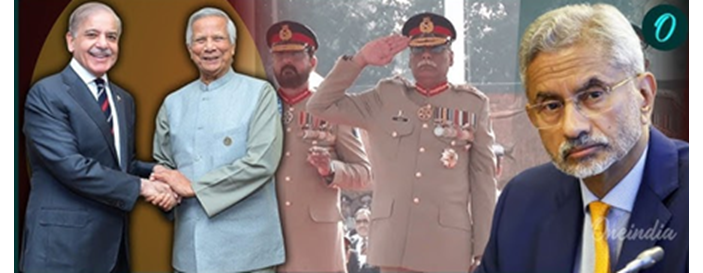
Last month, during the D-8 Summit in Cairo, Pakistani Prime Minister Shehbaz Sharif met with Bangladesh’s Chief Advisor Dr. Muhammad Yunus. According to Pakistan’s Prime Minister’s Office, both leaders expressed satisfaction over the recent positive developments in bilateral relations and agreed to work jointly toward shared developmental goals. This high-level meeting laid the groundwork for the first-ever visit of a Bangladeshi military delegation to Pakistan.
Defence Cooperation Between Pakistan and Bangladesh
Under a new defence agreement, Pakistan and Bangladesh are collaborating on joint military training, intelligence sharing, and the exchange of defence equipment. The Pakistani military has been providing training to Bangladeshi officers, strengthening defence ties between the two nations. Furthermore, both countries have conducted joint military exercises and are planning additional programmes to enhance their regional defence capabilities. Pakistan is also considering supplying Bangladesh with advanced weaponry, including modern military technology.
The growing Pakistan-Bangladesh collaboration has drawn criticism from the Modi administration, which views this relationship as a strategic encirclement. Indian media, aligned with Modi’s government, continues to propagate baseless narratives to express its discontent over the strengthening ties between its eastern and western neighbours.
Key Aspects of Pakistan-Bangladesh Military Cooperation and India’s Concerns
Another significant aspect is that military cooperation between Pakistan and Bangladesh could diminish India’s influence in the region. India, with support from Israel and the United States, aspires to maintain its dominance and act as the regional authority. However, this vision may crumble as a result of the growing partnership between Pakistan and Bangladesh.
A third critical element is the role of China, which is a key geopolitical rival of India. China is perceived as a behind-the-scenes force in strengthening relations between Pakistan and Bangladesh. It is already supplying military equipment to both nations, creating a sense of unease for India.
The fourth point of concern is that Pakistan-Bangladesh military cooperation poses a direct challenge to India’s dominance in South Asia. India fears that this alliance could significantly undermine its economic and strategic superiority in the region.
Fifthly, existing tensions between India and Bangladesh over border disputes and disagreements on the sharing of river water further strain their relations.
The sixth aspect relates to Indian apprehensions that intelligence sharing between Pakistan and Bangladesh might pose security risks, particularly in regions with active separatist movements. India played a pivotal role in the creation of Bangladesh and has always been vigilant about maintaining its dominance in the region. Bangladesh’s alignment with Pakistan is both an emotional and strategic setback for India.
It is worth noting that over the past seven decades, Pakistan and India have fought three major wars, with the Kashmir dispute being a core issue. This history of conflict makes India perpetually wary of any potential alliances involving Pakistan.
India is currently part of the QUAD alliance, which includes the United States, Japan, and Australia, aimed at countering China’s influence. However, increasing ties between Pakistan, Bangladesh, and China present new challenges for this alliance. The United States seeks to contain China’s economic dominance through QUAD, with trade tariffs and other measures hinted at during former President Trump’s administration.
The U.S. also wishes to derail the China-Pakistan Economic Corridor (CPEC) project by using India to destabilise Pakistan through proxies, particularly in Baluchistan and other regions. This contributes to rising unrest in South Asia, exacerbating tensions between India and its neighbours. The growing military cooperation between Pakistan and Bangladesh could further heighten friction between India and Bangladesh. As a major trading partner of Bangladesh, India may reconsider its economic ties in response to this evolving alliance.
India is particularly concerned that collaboration between Pakistan and Bangladesh could support efforts to curb separatist movements, some of which operate within its borders. This potential shift could extend such issues onto Indian soil, amplifying New Delhi’s concerns.
India seems intent on leveraging the growing Pakistan-Bangladesh relations to pressurise global powers, such as China and the U.S., to engage more actively in South Asian affairs through platforms like QUAD. By doing so, India aims to complicate regional politics to secure its interests.
It is worth mentioning that relations between Pakistan and Bangladesh have improved following the departure of Sheikh Hasina from power. Last year, in November, maritime trade between the two countries resumed after nearly two decades when a cargo ship departed from Pakistan and arrived at Chittagong.
Although political and trade ties between the two nations began improving last year, the first months of this year have also seen increased contact between the armed forces of Pakistan and Bangladesh.
On 14 January, Pakistan’s military issued a statement noting that Army Chief General Asim Munir and Bangladesh’s Principal Staff Officer Lieutenant General S.M. Quamrul Hassan reaffirmed their commitment to fostering “strong defence cooperation.” They also emphasised maintaining their bilateral partnership free from external pressures. During his visit, Lieutenant General Hassan met with Pakistan’s Air Chief Marshal Zaheer Ahmad Babar Sidhu and expressed interest in JF-17 Thunder fighter jets and other locally manufactured military equipment.
Some Indian media outlets have speculated that Pakistan might provide military training to Bangladeshi forces. However, official Pakistani statements have not confirmed such claims. It is evident that the removal of Sheikh Hasina’s government has paved the way for improved Pakistan-Bangladesh relations. Over the past two decades, numerous issues arose during Sheikh Hasina’s tenure, including the 2016 boycott of the SAARC summit by India, followed by Bangladesh’s withdrawal.
A positive development for Pakistan is that under Dr. Muhammad Yunus’ leadership, the new Bangladeshi administration is keen on reviving SAARC, which could further strengthen regional cooperation and harmony.
India’s Alleged Interference in Dhaka and Improved Pakistan-Bangladesh Relations
There has been growing resentment in Bangladesh over India’s alleged interference in Dhaka’s affairs. The new administration in Bangladesh is now moving away from Sheikh Hasina’s policies and is working to improve relations with Pakistan to address public dissatisfaction.
From an economic perspective, discussions are currently underway about the sale of JF-17 Thunder aircraft to Bangladesh. As security cooperation deepens, Pakistan’s strategic influence over Bangladesh is also expected to grow.
The improvement in Pakistan-Bangladesh relations presents a strategic opportunity for Pakistan, enhancing its importance in the region. For India, these strengthening ties between Pakistan and Bangladesh are indeed a cause for strategic concern, as New Delhi’s influence over another regional country is waning.
Tensions in India-Bangladesh relations are further fuelled by Sheikh Hasina’s presence in India. The new Bangladeshi administration has already demanded her extradition. Moreover, the long border shared by India and Bangladesh, coupled with recurring floods in Bangladesh, has led to ongoing disputes over water management. A growing sentiment in Bangladesh suggests that if India adopts an aggressive stance on this critical issue, Bangladesh might seek to strengthen its defence by forming a trilateral forum with Pakistan and China.
However, for the sake of regional peace, this is an ideal opportunity to revitalise the SAARC platform. By addressing their issues independently, without external pressure, the region can ensure the well-being of its large population, much of which lives below the poverty line. Instead of allocating vast resources to defence budgets, these funds could be used for public welfare. The nations in this region possess the potential to focus on mutual trade and realise the dream of development, a promise often made by politicians during elections.
For India, it is essential to approach this situation with wisdom and diplomacy, rather than emotions. Sustainable peace and stability in the region require all countries to work collectively, fostering cooperation rather than conflict. This can only be achieved if the Modi government stops fearing the growing ties between Pakistan and Bangladesh and refrains from interfering in their internal affairs. India must avoid becoming a pawn in the interests of distant powers, mistakenly believing that aligning with such forces will elevate it to the status of a regional superpower.