Power, Prudence, and Fate
Dust at Dusk

There are junctures in history when time itself appears to pause, as though the age were drawing breath before pronouncing its next decree, and the fate of nations is weighed in the narrow scales of a handful of decisions. The Middle East now stands upon such a threshold—where the language of power, the fire of ideology, the pulse of the global economy, and the fragile respiration of diplomacy have become entangled in a knot of uncommon complexity.
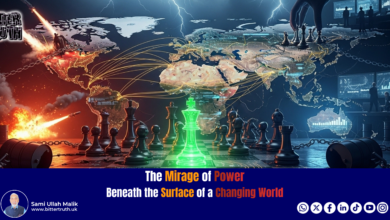
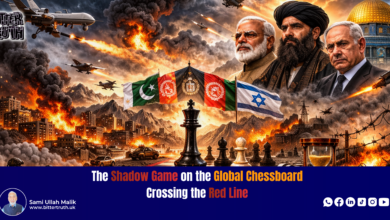
The admonitory pronouncements of Ali Khamenei, the avowedly combative instincts of Donald Trump, the meticulous war-gaming of the United States Department of Defense, and the acute sensitivities surrounding the Strait of Hormuz and the Bab el-Mandeb together compose a tableau in which it is not merely bullets that are in motion, but the very chessboard of international politics that is being reset. This is no ordinary exchange of fire; it is the rearrangement of the strategic grammar of a region whose tremors are seldom confined to its own frontiers.
To characterise the moment as a simple confrontation between Iran, the United States, and Israel would be to mistake the shadow for the substance. What is unfolding is a contest between ideological persistence and global interest; between the continuity of revolution and the assertion of primacy; between the rhetoric of resistance and the doctrine—so often rehearsed in Washington—of “regime change”. The question is not which side commands the greater arsenal. The more searching inquiry is which possesses the deeper reservoir of patience, the steadier faculty of judgement, and the longer horizon of statecraft.
Beneath the visible architecture of military manoeuvre lies a substratum of domestic calculation, the volatility of global energy markets, the unease of the Gulf monarchies, and the cautious alignment of the world’s major powers. Should the waters of the Strait of Hormuz grow turbulent, the echo will be heard not merely in the Gulf but in Tokyo, Beijing, Berlin, and New Delhi. Should the gate of Bab el-Mandeb shudder, European markets will feel the tremor in their very ledgers. In an age of interdependence, a regional spark may yet illuminate the farthest reaches of the globe.
This essay seeks to gather these strands into a single, intelligible whole—not merely to recount events in their chronology, but to discern the meanings that lie beneath their surface. Here, words are not employed simply to report occurrences; they are summoned to register the heartbeat of an era. Analysis is not confined to the enumeration of assets and losses; it aspires to hold the present up to the mirror of history. Let us therefore read this unfolding drama not with a cursory glance, but with the attentive eye of reflection—for what is being inscribed today may well furnish the chapter headings of tomorrow’s history.
Weeks ago, when Ali Khamenei issued his warning, it was not the casual flourish of a routine communiqué. It bore the cadence of ideological proclamation and the weight of strategic intent. Since the upheaval of 1979, the leadership born of the Iranian Revolution has declined to regard itself as merely the custodian of a nation-state; it has conceived of itself as the nucleus of a revolutionary axis. Thus, when Khamenei declared—on the anniversary of that revolution—that should America ignite war it would spread across the entire region, the statement was less a threat than a thesis: a proposition about the geometry of conflict in a connected theatre.
The meaning was plain to those prepared to listen. Iran signalled that its influence did not terminate at its borders; that political networks, allied movements, and asymmetrical capabilities extended its reach beyond its own territory. It would not consent to encirclement. The doctrine implied was one of retaliatory diffusion: if the centre were struck, the reverberation would travel outward to the circumference. And when Tehran has since sought to give operational form to those earlier words, one is compelled to observe how rhetoric, under certain pressures, may transmute into ordnance.
The reverberations of Iranian missiles across the airspace of Saudi Arabia, Kuwait, Bahrain, Qatar, and the United Arab Emirates were not merely acts of reprisal; they were cartographic messages. According to the United States Department of Defense, approximately forty thousand American personnel remain stationed across the Middle East. The vast Al Udeid Air Base in Qatar functions as a central nervous system for aerial command and control; the Fifth Fleet in Bahrain anchors maritime power; installations in Kuwait, Jordan, and Saudi Arabia form a lattice of readiness that, from Tehran’s vantage, resembles not a shield alone but a tightening cordon.
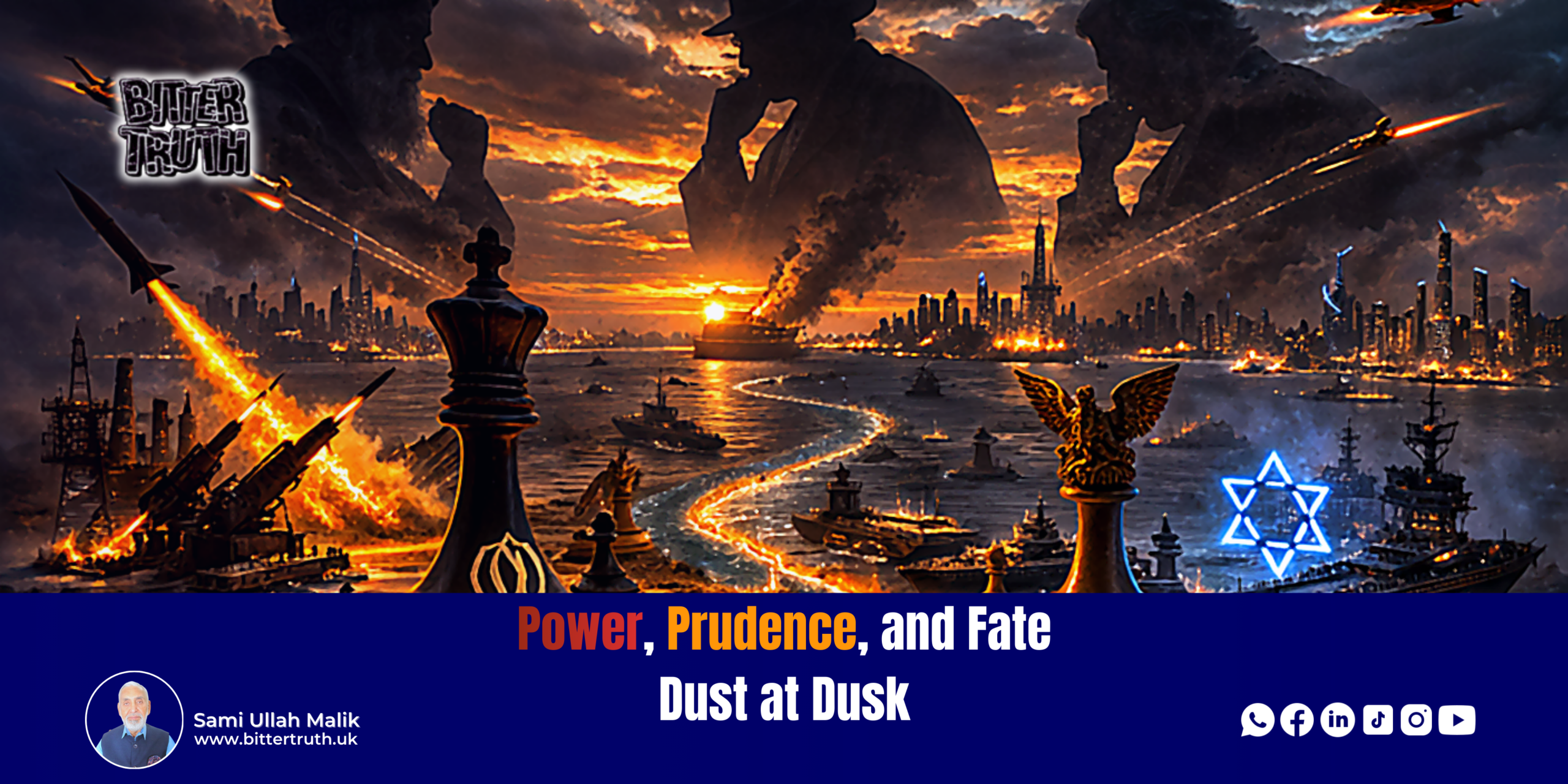
In Washington’s lexicon, this posture is defensive and stabilising. In Tehran’s, it is the politics of encirclement—a sustained military pressure whose permanence alters the regional equilibrium. The Gulf has thus become a chessboard upon which every square is freighted with consequence, and every piece is implicated in a larger design.
Why, then, should Iran direct its response toward Gulf states rather than exclusively toward the United States itself? The answer lies in the perennial question of escalation: who shall delimit the theatre of war? Tehran appears intent upon demonstrating that if a front is opened against it, the heat will not be contained within Iranian territory. Its conduct may be read through the lens of deterrence—the Cold War logic whereby the prospect of intolerable cost restrains an adversary’s hand. If Iran is encircled, it implies, the walls of the encirclement cannot presume immunity.
Striking at facilities within host states is not, in this view, solely a message to Washington but an address to the hosts themselves. It is a form of indirect resonance: pressure applied in Riyadh, Abu Dhabi, Doha, or Amman is intended to echo in the corridors of Washington. Military partnership, the message suggests, may exact its price in local vulnerability.
For Saudi Arabia, the United Arab Emirates, Kuwait, Bahrain, and Qatar, economic stability is not an accessory but the cornerstone of national policy. Energy infrastructure, ports, and urban development projects are ill-suited to protracted turmoil. Their predicament is that of a double-edged sword. They rely upon the American security umbrella; yet they harbour no appetite for open war with Iran. If hostilities remain confined to American assets and spare oil installations, it is conceivable that these states will strive to avoid direct confrontation, coupling formal denunciations with practical restraint. Behind the scenes, one may expect heightened defensive preparations and discreet diplomatic efforts to lower the temperature.
In politics, silence can be a strategy, and caution itself a declaration. The Gulf monarchies, poised between protection and peril, must calculate not only the cost of action but the consequence of association. In such an hour, prudence may prove the most eloquent of policies.
The immediate reverberation of Iranian action is registered not only in the theatre of war but upon the trading floors of the world. In an energy market so finely balanced, even the suspicion of disrupted supply is sufficient to quicken prices. It is therefore unsurprising that the first discernible tremor of Tehran’s moves has appeared in the upward flicker of oil benchmarks. Markets, like nervous systems, respond to the faintest hint of pain.
Should Shi‘a militias in Iraq expand their operational tempo, American installations may find themselves exposed to fresh hazards, while Israeli targets confront a new and volatile calculus. Investor confidence—never an inexhaustible resource—would inevitably suffer. Thus the circumference of conflict has extended beyond borders and battlefields; it now presses upon the very pulse of the global economy.
The international energy market already exhibits visible signs of agitation. In such a climate, the mere prospect of constraint in oil or gas supply suffices to propel prices skyward. Asia’s industrial economies—above all China, Japan, and South Korea—remain materially dependent upon Gulf hydrocarbons. Europe, having only recently weathered successive energy shocks, can ill afford another season of instability. This confrontation, therefore, is not regional in its consequences but intercontinental in its reach.
According to assessments circulated by the Stimson Center, Iran has adhered to a phased and pre-announced pattern of retaliation. In other words, Tehran appears intent upon aligning deed with declaration, thereby preserving the credibility of its narrative. The strategy, while likely to strain relations with Gulf capitals, was foreshadowed by explicit warnings: if regional states proved unable—or unwilling—to restrain American operations, they must be prepared for the consequences. Some analysts discern in this posture a politics of calibrated pressure—an attempt to induce Gulf governments to advocate de-escalation and impress upon Washington the mounting costs of adventurism.
Indeed, Iran seems determined not to confine the quarrel solely to the United States and Israel, but to broaden its ambit so that the burdens of war are more widely shared. If the price of escalation is borne collectively, then the calls for its cessation may arise organically from the very capitals that now practise guarded silence. The implicit logic is plain: widen the circle of impact, and you multiply the number of stakeholders in restraint. Such is the arithmetic of strategic diffusion.
Although Iranian strikes have thus far inflicted limited infrastructural damage in the Gulf, the impression has nevertheless taken root that Tehran operates under acute pressure. When a state concludes that it has little left to lose, its conduct may become bolder—at times even desperate. Reports of damage to residential structures in the United Arab Emirates and of attacks near Kuwait’s airport have sharpened that perception of fragility. Yet it is plausible that Gulf governments, rather than resorting to direct retaliation, will privilege defensive readiness and strategic patience. In the clamour of war, restraint can prove the most formidable of weapons.
Domestically, Iran contends with the cumulative weight of sanctions, inflation, and social unease. External confrontation can, for a time, serve as a solvent of internal division, forging unity in the crucible of perceived siege. But should material losses mount, that same instrument may recoil upon its wielder. For Tehran, the maintenance of equilibrium between outward defiance and inward stability is therefore not merely desirable but imperative.
For his part, Donald Trump has been unambiguous in declaring regime change in Iran as an objective. Such rhetoric amounts not merely to policy preference but to a direct challenge to the architecture of the Iranian state. It exerts psychological pressure even as it proclaims political resolve. The suggestion that the Iranian populace might be stirred to the streets betrays a hope for internal rupture. Yet history offers sobering counsel: transformations induced by external coercion often inaugurate prolonged disorder and yield consequences no strategist fully anticipates. The experiences of Iraq and Libya remain cautionary. In a polity as institutionally entrenched as Iran, sudden collapse appears improbable; protracted uncertainty, however, is far from inconceivable.
Scholars at the Stimson Center, including Barbara Slavin, have warned that even senior Iranian officials—conceivably the Supreme Leader himself—could become targets. The removal of high command rarely produces a vacuum for long; it may instead summon forth a harder line or engender extended instability. Iran’s institutional lattice—the armed forces, the Islamic Revolutionary Guard Corps, the judiciary—constitutes a resilient network capable of absorbing abrupt shocks. Leadership change does not invariably entail systemic transformation.
It is conceivable that the United States and Israel will concentrate their efforts upon constraining Iran’s missile and nuclear capacities rather than pursuing comprehensive regime overthrow. A gradualist approach—degrading military assets, applying pressure to civilian leadership, and encouraging domestic protest—presents itself as a conceivable path. Yet it is a path both narrow and perilous. The planning of the United States Department of Defense appears oriented towards diminishing Iran’s missile, drone, and nuclear infrastructure: a strategy of capability reduction rather than explicit systemic replacement. Between the two, however, the boundary is slender, and miscalculation ever a lurking hazard.
Gulf leaders perceive with increasing clarity that the war has approached their own thresholds, even as their principal ambition has been economic diversification and regional development. The crisis is an unwelcome encumbrance. Though embedded within the American security framework, these states are acutely aware that the costs of escalation are frequently borne upon their own soil. Across the Middle East there is discernible frustration—not solely with the war itself, but with the strategic tenor of the Trump administration. Prospects for swift rapprochement appear dim, yet this does not imply uncritical alignment with every decision emanating from Washington. Hence the pursuit of balanced foreign policies, and the cultivation of ties with Beijing and Moscow, must be understood within this broader calculus.
Recent strikes have, for the moment, swept the negotiating table clear. The candle of diplomacy burns low, and the region seems once more enveloped by flame. Formal channels may be obstructed, yet intermediaries such as Oman and Qatar, alongside certain European governments, may still labour quietly in the interstices of conflict. History reminds us that, on occasion, it is only after the fiercest exchanges that the aperture for compromise reopens. When the guns speak, diplomats are compelled to silence—such has too often been the tragedy of our common past.
The aspiration for transformation in Iran is, for Washington, a wager of uncommon magnitude—one that may stir tempests not only abroad but within the precincts of American politics itself. Public opinion in the United States has long been divided over foreign wars; enthusiasm wanes swiftly when campaigns lengthen and outcomes fall short of promise. Should this conflict prove protracted, or its results equivocal, presidential credibility may suffer, and the tremors could be felt in the theatre of electoral politics. Economic pressures—budget deficits, inflationary strain, and the quotidian anxieties of voters—will weigh heavily upon the national mood.
Donald Trump has, in effect, placed a formidable stake upon the table. His strategy—reshaping the Middle East through the application of military power—revives an enduring ambition, one glimpsed in earlier administrations yet never fully realised. The notion of “re-engineering” the region by force is hardly novel; but the experiences of Iraq and Afghanistan counsel sobriety. Military supremacy does not inexorably beget political stability. Iran’s state architecture is, by most measures, more cohesive than that of post-Saddam Iraq; the consequences, therefore, may differ in form and duration.
Even were air power to cripple Iran’s nuclear capabilities, even were its atomic progress temporarily arrested, and even were authority in Tehran to change hands—however indistinct the subsequent map—one question would remain obstinately unanswered: what then? Is there a coherent political design to follow the clash of arms, or is military success deemed sufficient in itself? Would such an outcome prove durable? And if leadership were altered, would a successor align more closely with the international community, or chart a more fiercely autonomous course?
The United States Department of Defense has reportedly designated its campaign “Operation Epic Fury”—a title as emphatic as it is portentous. Should the flames spread, the political ramifications could extend to the midterm elections in November, with consequences for the Republican Party’s prospects. American opinion remains divided on overseas ventures; when the President acknowledges that “American heroes’ lives may be lost,” he concedes, however obliquely, the risk that this contest may prove both long and costly. In interviews, he has spoken of casualties while simultaneously expressing readiness to speak with Iran’s leadership—a juxtaposition that suggests the tension between martial resolve and diplomatic necessity.
The slogan “Make America Great Again” is rooted in a promise of domestic renewal. If foreign entanglement appears to contradict that pledge, persuading core supporters may become an onerous task. Will advocates of inward consolidation embrace a fresh expedition abroad? Amid inflationary pressures and unresolved domestic concerns, this question may yet confront the President with a stern political reckoning.
Reports indicate that certain senior officials within the Trump administration harboured reservations about a major operation against Iran. Between the rhetoric of escalation and the prudence of restraint, policy divergences appear to have surfaced—an indication that unanimity in decision-making was, at best, imperfect. Such fissures, though seldom publicised, are seldom inconsequential.
The geographical and economic centrality of the Strait of Hormuz may prove decisive in this unfolding drama. This narrow artery, linking the Persian Gulf to the Gulf of Oman, spans roughly twenty-one miles at its tightest point and carries a vast proportion of the world’s seaborne crude. By many estimates, between a fifth and a third of global oil trade traverses this corridor; for Saudi Arabia, Kuwait, the United Arab Emirates, Oman, and Qatar, it is the principal conduit for energy exports, including liquefied natural gas. Should it be closed, even temporarily, the shock to global energy markets would be profound. Asian economies would feel the impact with immediacy; Europe would be compelled to seek alternative routes and suppliers at considerable cost.
Recent reports suggest that Iran has moved to impede passage through the Strait—an act whose repercussions would extend far beyond the region. Prices could surge; shipping insurance premiums would rise; freight costs would mount; and energy distribution chains would strain under sudden constraint. Japan, India, and China would be driven to secure substitutes with urgency. The global economy, already susceptible to disruption, might confront a crisis of severe magnitude.
The peril is compounded when one considers the Bab el-Mandeb, gateway to the Suez Canal on one flank and the southern entrance to the Red Sea on the other. The Houthi movement has previously demonstrated its capacity to target maritime traffic. Were this non-state actor to render the passage effectively insecure, it would represent a striking instance of asymmetric power shaping global commerce. Disruption here would divert shipping between Europe and Asia around the Cape of Good Hope, lengthening voyages, inflating costs, and delaying delivery. The price of consumer goods would rise accordingly; time itself would become more expensive.
In contemplating the road ahead, three broad scenarios present themselves. First, a limited military engagement accompanied by gradual diplomatic re-engagement. Second, a wider regional conflagration in which maritime routes and energy supplies are gravely impaired. Third, internal political upheaval—either in Iran or in the United States—precipitating a shift in policy. Each path carries its own hazards; none offers assurance.
States such as Turkey, Egypt, and Pakistan are not direct belligerents, yet neither are they insulated from consequence. Their diplomacy may incline towards balance and mediation. Meanwhile, China and Russia may seek to convert crisis into strategic or economic advantage. Following the reported killing of senior Iranian figures, prospects for immediate settlement appear diminished. Both Moscow and Beijing have condemned what they characterise as an American violation of Iranian sovereignty, warning that such actions imperil international peace.
Thus the conflict stands at a perilous intersection of force and fortune. The decisions taken in Washington and Tehran will not merely determine the fate of a bilateral quarrel; they may recalibrate the strategic architecture of an entire region—and, by extension, the equilibrium of the wider world.
This crisis is not the quarrel of two or three states alone; it is a reckoning with the destiny of an entire region. Iran’s strategic calculus, America’s military enterprise, the guarded diplomacy of the Gulf monarchies, and the trembling pulse of the global economy are inextricably intertwined. What confronts us is not merely an exchange of gunfire and communiqués, but a contest of narratives and markets, of ideological constancy and entangled global interests. Should prudence fail to prevail, the region may descend into a prolonged season of uncertainty. Yet if reason asserts itself, this very crisis might furnish the prologue to a new diplomatic dispensation. At such a hinge of history, each decision may cast a long shadow across the politics and economies of decades to come.
This struggle is not confined to missiles and pronouncements; it is a collision of doctrines and designs. Iran pursues the fulfilment of its declared commitments; the United States tests the outer limits of its power; and the Gulf states tread the narrow path of equilibrium. At moments such as these, a single spark may set an entire harvest aflame. The question is not whether the fire has been lit, but who possesses the resolve to extinguish it.
When nations surrender to the tide of passion and allow emotion to supplant judgement, history subjects them to stern examination. In the confrontation between Iran and the United States, it is not merely two governments that stand opposed, but two conceptions of power, two political philosophies, and two historical narratives locked in contention. If force is treated as the final and sufficient argument, the conclusion is often one already familiar: regional instability, economic dislocation, and the forging of new alignments born of disorder. Yet should wisdom prevail, this moment of peril may yet become the seedbed of a more balanced order.
The Gulf states continue their delicate traversal of this contest; the global economy quivers; energy markets remain unsettled; and citizens across continents ask whether the price demanded was ever truly inevitable. History instructs us that external interventions frequently yield consequences unforeseen, and that ideological wars are waged not only upon battlefields but within minds and societies. If diplomacy’s doors are sealed shut, future generations will inherit the cost; if, however, a glimmer of accommodation emerges from the present darkness, this hour may serve as the preface to a different chapter.
Reader, regard this essay not as a mere catalogue of events, but as a portrait of an age—an age that reminds us that power is transient, yet its repercussions endure. When will the dust rising over the Middle East finally settle? That verdict will be delivered not by missiles alone, but by discernment. And history, in its austere patience, seems once again to pose the question: has America learnt from its past, or does it stand yet again upon the precipice from which it has fallen before?
One cannot ignore the broader pattern of American intervention and its aftermath. Critics contend that the arteries of the American defence industry have too often pulsed with the lifeblood of perpetual conflict. From 1955 to 1975, the long war in Vietnam became one of the most conspicuous and controversial interventions in modern American history. The declared aim was to contain communism; the outcome, after two decades of sacrifice, was a withdrawal whose imagery—helicopters lifting the last personnel from Saigon—remains etched upon the historical conscience.
Following the attacks of 11 September 2001, intervention in Afghanistan was undertaken under the banner of counter-terrorism. The Taliban government was displaced, yet two decades later, upon the withdrawal of American forces, the Taliban returned to power. It was a protracted and intricate campaign whose political conclusion proved deeply challenging for Washington.
In 2003, the invasion of Iraq was justified on assertions of weapons of mass destruction that were never substantiated. Saddam Hussein’s regime fell; yet the country endured years of instability and sectarian strife from which it has struggled fully to recover. In 2011, NATO intervention in Libya hastened the end of Muammar Gaddafi’s rule, but the aftermath was marked by fragmentation and enduring turbulence.
Elsewhere, interventions such as the 1983 operation in Grenada and the 1989 removal of General Noriega in Panama were declared successes by Washington, yet each formed part of a longer chronicle of contentious engagement. The list is extensive, and the political debates surrounding these ventures have seldom abated. Frequently, the regions concerned have borne prolonged instability as their inheritance.
Is history repeating itself? The question is not rhetorical but urgent. Vietnam taught that local resistance cannot be dismissed as marginal. Iraq demonstrated that dismantling a state apparatus is far easier than constructing a stable alternative. Afghanistan revealed that extended military presence does not guarantee political success. Should the present tensions widen into general war, those same lessons may reassert themselves with renewed force.
The essential inquiry, then, concerns the future of the Middle East and the settling of its storm-raised dust. Dust subsides when diplomacy prevails over militarism; when regional powers choose balance over confrontation; when global actors, having pursued limited objectives, reopen the door to negotiation. History has shown repeatedly that power is transient, though its consequences may endure for generations. If foresight triumphs, the crisis may remain contained. If passion governs, it may inaugurate decades of instability.
The dust that now swirls above the Middle East will not be settled by rockets, but by negotiation; not by martial triumph, but by political sagacity. And so history, with quiet persistence, poses its enduring question: has humanity truly learnt from its past, or does it once more approach the same precipice from which it has fallen time and again?