Power as Trust: SMASH and the Islamic Conception of Responsible Deterrence
Power as Trust: SMASH and the Islamic Philosophy of Defence

In the present age, national defence can no longer be confined to the mere guarding of frontiers. It has assumed a far graver and more comprehensive significance: it is now the visible measure of a state’s dignity, the guarantor of its political sovereignty, and the sentinel of its intellectual independence. Among the community of nations, esteem is reserved not for those who brandish force with impetuosity, nor for those who plead incapacity as virtue, but for those who, being self-reliant in their means of defence, exercise power with moral restraint and intellectual poise. Defence technology has thus become one of the cardinal pillars of sovereignty, geopolitical equilibrium, and the architecture of global politics.
Islam, in its enduring wisdom, neither consecrated power as an instrument of aggression nor sanctified weakness as an excuse for inertia. Rather, it elevated strength to the service of justice, protection, and the preservation of peace. The Qur’anic injunction—“And prepare against them whatever force you can muster” (8:60)—has, across the centuries, formed the cornerstone of the Islamic conception of defence. Yet this verse is not a mere summons to arms; it is a comprehensive intellectual charter. Within its compass lie knowledge and prudence, discipline and self-reliance, and above all a profound sense of moral responsibility. Islamic history bears eloquent witness to this truth: when power was subordinated to knowledge and ethics, the polity was at once just and ascendant; when severed from them, it degenerated into tumult and tribulation.
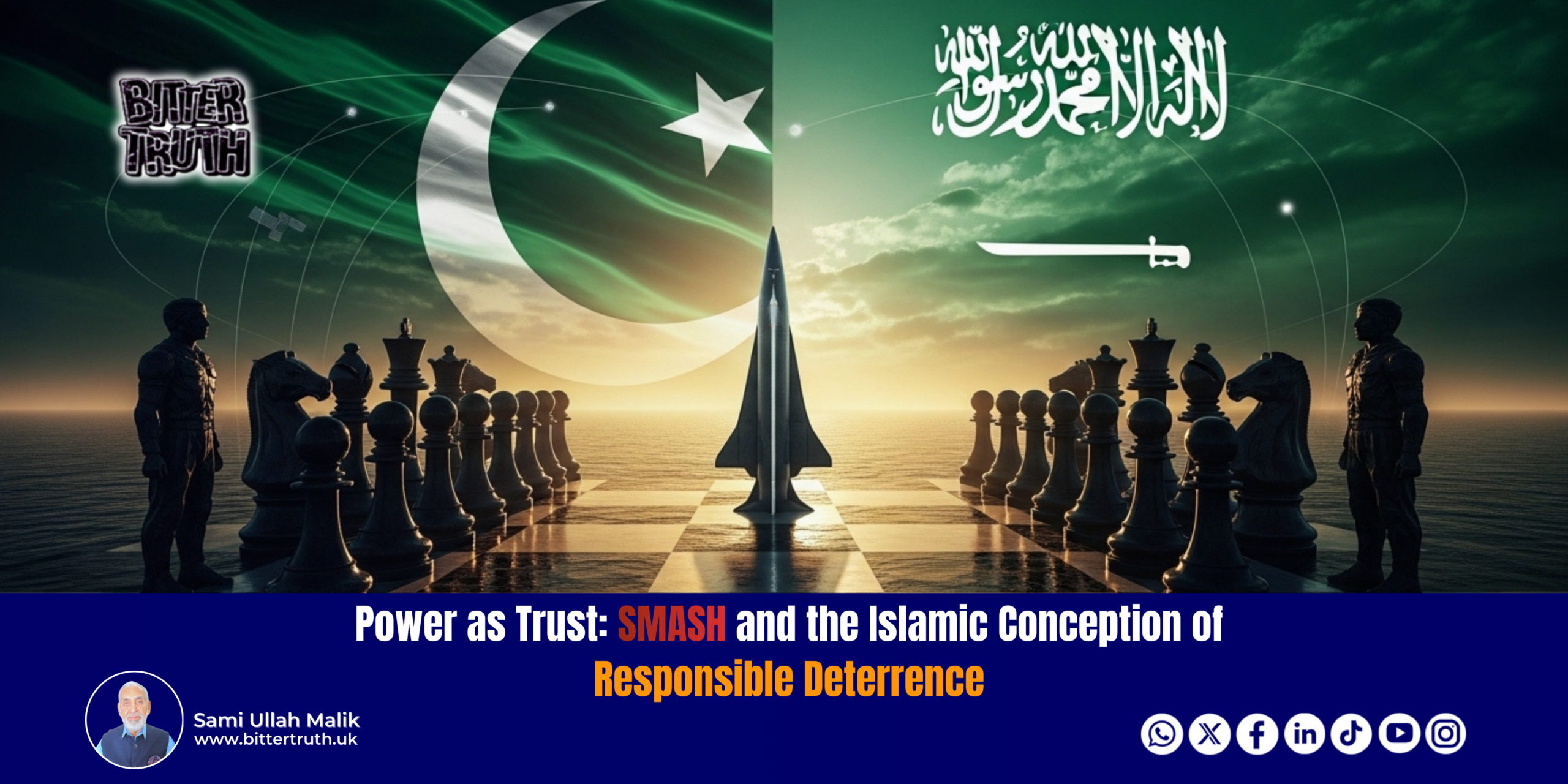
It is against this intellectual horizon that Pakistan’s unveiling of the SMASH hypersonic missile at the World Defence Show 2026 in Riyadh must be understood. This was not simply the announcement of a new weapons system; it was a civilisational declaration, a considered knock upon the door of history. It signalled that Pakistan regards defence not as a theatre for ostentation, but as a solemn trust. The development of the SMASH hypersonic anti-ship and land-attack ballistic missile by Pakistan’s defence industry represents a contemporary articulation of that Qur’anic principle—where technology, prudence, and responsibility converge.
The presentation of SMASH at the World Defence Show was therefore not merely a technical milestone but an intellectual, cultural, and strategic statement. The missile’s dual-role capability—engaging both maritime and terrestrial targets—places it squarely within the demands of modern warfare, where versatility and precision are prized above brute mass. The paper under consideration seeks to examine the missile’s technical features and dual function within the broader global defence landscape, while also subjecting this development to critical reflection in light of the Islamic philosophy of power, responsibility, and the ethics of defence.
When Global Industrial & Defence Solutions (GIDS) appeared upon the international stage in Riyadh, it did so not as a purveyor of imported hardware, but as the herald of an indigenous capacity. The introduction of SMASH made plain that Pakistan has begun to move beyond the posture of consumer and into the more exacting rank of creator and architect. In an era where strategic credibility rests upon domestic capability, such a transition marks no trivial advance. It is the point at which a state anchors its survival not in borrowed doctrines, but in its own scientific ingenuity and civilisational capital. This, too, accords with the deeper Islamic conception of defence: preparedness as an expression of self-respect, and capability as the guardian of autonomy.
For decades, Pakistan relied substantially upon external sources to meet its defence requirements. The gradual emergence of a robust indigenous defence industry signals an evolutionary shift of consequence. SMASH stands as a conspicuous milestone in that progression—an emblem of strategic self-reliance in an increasingly contested regional environment stretching from the Middle East to South Asia and the Indian Ocean.
The missile’s reported hypersonic velocity, its high-precision guidance, and its near-vertical terminal attack profile together reflect the changing philosophy of warfare in the twenty-first century. War is no longer waged solely upon visible battlefields; it is conducted within systems—of detection, interception, and rapid response. Hypersonic technology, travelling at multiples of the speed of sound, compresses reaction times to a narrow and unforgiving margin. In such a theatre, speed is not merely an advantage; it is a determinant of deterrence.
According to its developers, SMASH has been engineered to combine extraordinary velocity with acute guidance accuracy and a steep attack angle, thereby posing a formidable challenge to contemporary air and missile defence systems. By penetrating layered defensive shields and striking with what strategists term “strategic surprise,” it embodies a doctrine that views defence not as passive reaction but as calibrated deterrence. Herein lies the essence of prudence: the maintenance of credible capability so that conflict may be forestalled rather than invited.
Thus, the unveiling of SMASH must be read not as a flourish of martial exuberance, but as a measured affirmation of responsibility. It suggests a state mindful of its obligations—to its sovereignty, to regional stability, and to the moral discipline that must govern the use of force. In that equilibrium between power and principle resides the true dignity of nations.
The wars of the twenty-first century are waged less upon open fields than within the invisible theatres of cognition, velocity, and systems. It is no longer mass alone that determines ascendancy, but the mastery of tempo, the compression of response time, and the capacity to outmanoeuvre the adversary’s architecture of defence. In the contemporary global order, hypersonic technology has altered the military equilibrium in a manner both subtle and profound: it diminishes the enemy’s window of reaction, renders elaborate missile defence systems precarious, and affords the possibility of limited yet decisive action.
Across the Middle East, the Indian Ocean basin, and South Asia—regions where geography and geopolitics are locked in uneasy embrace—the appetite for such capabilities has grown markedly. Strategic friction along sea lanes and contested frontiers has elevated the defence industry from a supporting enterprise to a central actor in global politics. In this charged environment, technological innovation is no longer ancillary to diplomacy; it is diplomacy conducted by other means.
It is within this altered landscape that GIDS has introduced the SMASH missile as a modern hypersonic ballistic platform capable of engaging both maritime and terrestrial targets. In its anti-ship configuration, the missile possesses a range of 290 kilometres and carries a 384-kilogram warhead. Its guidance architecture integrates an HDGNS-assisted inertial navigation system with an active radar seeker, ensuring both resilience and terminal precision. Propulsion is provided by a single-stage, dual-thrust solid rocket motor—an engineering choice that confers sustained acceleration and stable flight dynamics.
In its maritime role, the combination of a substantial warhead and an active radar seeker opens a new chapter in the grammar of naval warfare. The sea—now the arterial conduit of global trade, energy flows, and strategic influence—has become a domain where defensive superiority is no longer optional but imperative. With a reported circular error probable (CEP) of ten metres or less, and a terminal velocity exceedingly twice the speed of sound, SMASH emerges as a formidable instrument in littoral and blue-water contexts alike. Such characteristics render it particularly consequential in environments shielded by advanced missile defence systems, where speed and precision must converge to achieve effect.
Islamic history offers no stranger to maritime power. From the fleets of Andalusia to the naval reach of the Ottoman Caliphate, the sea was never regarded as a vulnerability but as a theatre of stewardship and strength. In this sense, SMASH may be seen as a modern expression of an older tradition: the transformation of maritime space from a source of exposure into a bastion of security.
The missile’s near-vertical attack profile in its anti-ship configuration poses a serious challenge to contemporary naval defence architectures, designed primarily to counter more conventional trajectories. Yet SMASH is not confined to the maritime domain. In its land-attack variant, the range remains 290 kilometres, while the warhead weight is increased to 444 kilograms, thereby enhancing its striking power without sacrificing reach. In this configuration, navigation relies fully upon the HDGNS-assisted inertial system, optimised for terrestrial targets and strategic installations.
The augmentation of payload without compromise in range signals that SMASH is distinguished not solely by speed, but by the force and finality of its blow. It is configured for limited yet decisive engagement—a capability aligned with the higher discipline of modern deterrence. Here, one glimpses the Islamic conception of warfare in its classical restraint: no needless prolongation, no indiscriminate devastation, but action defined, proportionate, and purposeful.
Notably, the same single-stage, dual-thrust solid rocket motor is employed in the land-attack variant. This is more than a technical convenience; it is an expression of intellectual economy. The development of a distinct configuration for terrestrial missions, while retaining core propulsion architecture, reflects a design philosophy in which simplicity and performance are harmonised. With a reported accuracy of fifteen metres or less and sustained supersonic velocity in terminal phase, the missile exemplifies structural coherence—an attribute central to contemporary defence thought.
Perhaps the most striking feature of SMASH is its dual-role character. A single platform adaptable to both maritime and land missions simplifies logistics, reduces training and maintenance burdens, and enhances operational flexibility. Islamic civilisation has long favoured wisdom-infused simplicity over ostentatious complexity—whether in jurisprudence, governance, or military organisation. Such simplicity strengthens reliability, curtails expenditure, and renders systems more resilient.
In practical terms, this configuration makes SMASH well suited to sensitive installations, military nodes, and strategic objectives. In conceptual terms, it resonates with the Islamic principles of order and economy: the avoidance of extravagance, the disciplined use of resources, and the cultivation of self-reliance. GIDS has articulated the missile’s dual-role design precisely in this spirit—so that a single system may serve distinct operational theatres without duplication or waste.
Frugality, discipline, and autonomy—these are not merely fiscal virtues but strategic imperatives. The employment of one missile across two domains demonstrates that defensive power is being exercised with deliberation and structure, not for spectacle but for substance. By streamlining logistics and lowering costs, the system stands as a synthesis of military economy and operational prudence.
In Islam, the concept of strength is anchored not in aggression but in protection and balance. The exercise of force is circumscribed by moral limits; it is legitimate only within the bounds of necessity and justice. The development of a weapon such as SMASH can therefore be reconciled with Islamic thought only insofar as its purpose remains defensive, its use regulated, and unnecessary destruction scrupulously avoided. Under such conditions, it becomes not merely a military asset but a symbol of responsible deterrence.
The single-stage, dual-thrust solid rocket motor at the heart of SMASH enhances its speed, altitude control, and terminal maneuverability. By providing a refresher after initial acceleration, it helps the missile evade layered defenses and maintain momentum toward its target. This combination of engineering precision and principles of strategic restraint reveals the emerging forms of a defense philosophy that seeks security anchored in responsibility, not dominance for its own sake.
Defence analysts observe that in the Middle East and other volatile theatres, the demand for long-range, high-precision strike capabilities continues its steady ascent. In regions where strategic mistrust is layered upon fragile political equilibria, the appetite for hypersonic and precision-guided systems has grown markedly. The SMASH missile is presented as a response to precisely such contested and hazardous environments. It stands as evidence that Pakistan not only comprehends its own defence imperatives but is also acutely attuned to the temper and trajectory of the global defence market.
For Pakistan, this moment carries significance both economic and strategic. Yet the central question is not one of demand alone; it is one of responsibility. As an Islamic state, Pakistan bears an ethical charge no less weighty than its strategic ambition. In Islamic thought, power is a trust (amanah), not a mere commodity for trade. Should Pakistan step more decisively into this domain, it must do so accompanied by moral accountability, regulatory clarity, and principled restraint. It is this dimension which elevates SMASH beyond the status of an armament and renders it an intellectual emblem.
An Islamic polity is bound by the obligation that weapons are not to be instruments for inflaming conflict or perpetuating injustice. Transparency in defence cooperation, a preference for the protection of human life, and adherence to declared norms must guide policy. Yet the Qur’anic injunction to prepare strength remains binding: to remain equipped with modern means of defence, capable of repelling aggression and preserving sovereignty, is itself a religious and civic duty. The balance is delicate but essential—preparedness without provocation, capability without recklessness.
The dual-role conception of SMASH reflects a conspicuous trend in modern military planning. Its advantages are neither trivial nor merely technical: logistical simplicity, reduced training expenditures, a unified maintenance regime, and enhanced operational flexibility. In a world where complexity often breeds fragility, such integration embodies prudence. Islamic intellectual tradition has long accorded high value to economy and order; the avoidance of extravagance and the cultivation of disciplined organisation are regarded not simply as fiscal virtues but as moral ones. The architecture of SMASH gives practical expression to that principle.
From this study several conclusions emerge. First, SMASH symbolises Pakistan’s growing defence
self-reliance. Secondly, its dual-role capability aligns with contemporary military requirements, where adaptability is as prized as power. Thirdly, its hypersonic speed and precision reinforce deterrence within a region marked by strategic volatility. Finally—and most critically—the employment of such technology under the Islamic conception of defence demands ethical governance. In Islamic jurisprudence and political thought, the purpose of strength is the prevention of oppression, the safeguarding of peace, and the discouragement of aggression. Force is justified not as an assertion of dominion but as a shield against injustice.
Weapons such as SMASH can therefore be considered consonant with Islamic thought only insofar as their deployment remains within a defensive doctrine. Properly framed, they strengthen deterrence, reduce the likelihood of unnecessary war, and preserve equilibrium in the balance of power. The dual-role strategy itself signals an efficient stewardship of resources—an embodiment of order and restraint. Within the moral boundaries prescribed by Islamic defence ethics, such technology is not only permissible but potentially prudent.
The unveiling of SMASH is thus more than a routine military announcement. It marks a stage in Pakistan’s intellectual journey towards the integration of self-reliance, scientific proficiency, and strategic dignity. SMASH is not merely an assemblage of alloy and propellant; it is a declaration of intent—that Pakistan views defence not through the lens of fear but of prudence, not through aggression but through balance, not through ostentation but through responsibility.
It reminds us that the ultimate source of strength is not steel or firepower alone, but the animating thought that directs them. When knowledge is joined to wisdom, and capability to conscience, power may serve as a guarantor of peace rather than a harbinger of turmoil. In this sense, the SMASH hypersonic missile represents in Pakistan’s defence history not simply the addition of a new system, but a strategic and intellectual pronouncement. True to its name, it resounds as a firm knock upon the door of the defence world—one that may well shape the trajectory of Pakistan’s strategic identity in the years to come.
Above all, it demonstrates that modern technology and Islamic thought are not adversaries but potential allies. Properly harmonised, they produce a model in which strength and morality, speed and restraint, modernity and tradition coexist in disciplined balance. That balance constitutes the very spirit of the Islamic conception of defence. If a nation can yoke knowledge to faith, and power to ethical purpose, then defence ceases to be a source of discord and becomes instead a guardian of peace.
In that light, SMASH may be regarded as a contemporary metaphor for the Islamic state’s vision of defence—quiet yet formidable, firm yet measured, resolute yet responsible. It stands as a milestone in Pakistan’s strategic evolution: a testament that when advanced technology is aligned with intellectual clarity and moral accountability, it not only secures the state but also confers upon it a dignified station within the international order.