

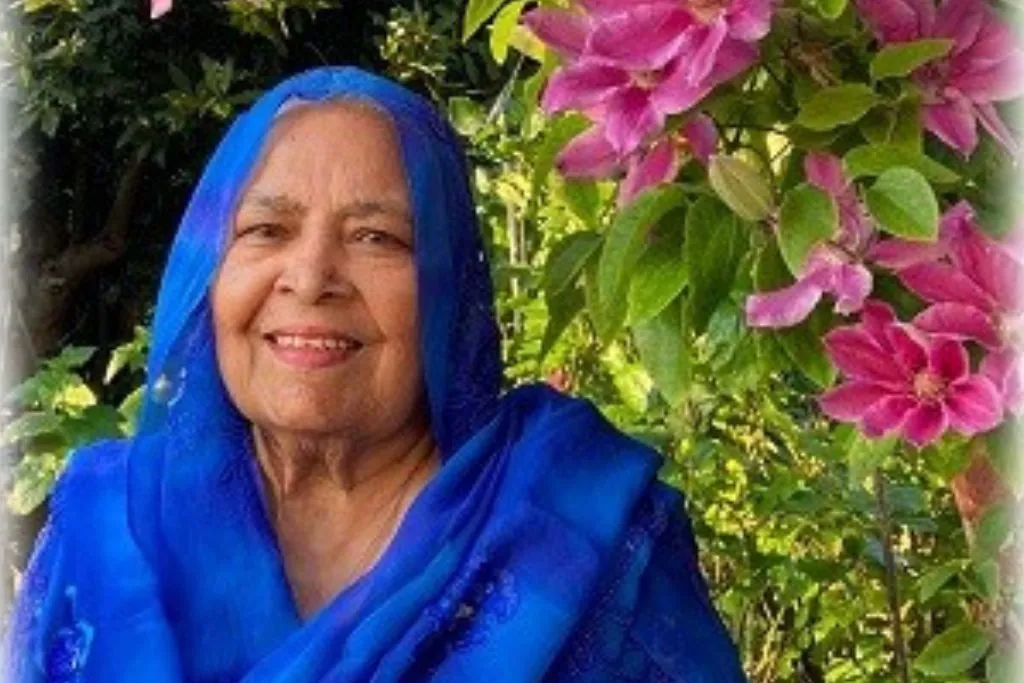
Whenever October arrives, the memory of Ma’a Ji’s birthday begins to intensely resurface. At such times, I find myself prostrating in gratitude before the benevolent Allah SWT, thanking Him for the coincidence of our birthdays falling on the same day. Winter has already started a few days ago, and today, for the first time, I saw the heater lit at home. It reminded me that perhaps Mom is also busy preparing for the arrival of the cold season.
Numerous dreams and interpretations have been appearing lately, and I extend my hand towards the phone, wanting to note down many wishes upon hearing her voice. However, my heart does not permit it.
Let me take you to a Village of Sumandari close to Faisalabad city, where Ma’a Ji opened her eyes. It was definitely a cold day, typical of winter. Ma’a Ji’s room was made of mud, plastered with white clay from the inside. In the center of the room, there was a wooden table with a beautiful, embroidered tablecloth draped over it, adorned with flowers at its edges. A wood-fired stove was burning in the room, casting its warm glow. Oil lamps made of clay were also lit. The room had an unusual blend of the scent of wood and oil.
There was a peculiar cabinet in the room, filled with Ma’a Ji’s veils, as well as the cow dung cakes (Pathian) she used for fuel. The sun had already set, and the melancholy of a cold evening had settled in the room. In this melancholy, a mother and her child were silently shedding tears. I don’t remember what had made them cry, but I do recall that Ma’a Ji was holding Javed, her elder son, in her lap, and in front of them, Javed’s grandfather looked at them with deep concern. It must have been about three years since then.
On that day, for the first time, I witnessed that Ma’a Ji, too, could control her tears. Perhaps “crying” isn’t the right word. In Ma’a Ji’s eyes, there were just a few large tears that silently trickled down Javed’s cheeks. In those times, we didn’t have the science of tears, knowing that they are not just saltwater but a combination of elements like lipids, lactoferrin, glucose, urea, sodium, potassium, and many more. But on that day, I did realize that tears are not only salty for oneself; they can be salty for others as well.
In a rural society, a child learns at a very young age that men don’t cry; crying is a woman’s role. Perhaps that child had not fully absorbed the praise of his society yet. Now I wonder, what pride is there in being more possessive than Ma’a Ji?
The house in which Mother was born was an ordinary one. Three small rooms and a courtyard, and even today, they eagerly await the touch of her hands. Perhaps no one ever hung swings on those trees outside. In those days, perhaps even hanging swings wasn’t favoured by her father, who was a respected landlord in the village. However, he would occasionally put young Javed, his grandson, on his bicycle and take him for a ride.
Mother never got the chance to go to school. She never saw a market. But today, looking at her wisdom, one can be sure that if she had been able to study in a school for a few years, she would have undoubtedly excelled far beyond an educated person today. Yet, her understanding and intelligence tell her that the person in front of her is not aware of this knowledge. It never crosses their mind that this rural mother could have never gone to school. Her father himself used to say that the mistake was ours for not sending our daughter to school. If she had gone to school, she would surely have been a lawyer or a judge today.
Mother never had the chance to go to a park because such a system didn’t exist in the village. Instead, she would go to her father’s agricultural fields, where she would gather her share of fruits from the fruit-bearing trees. Mother’s greatest joy in life was her friend’s engagement. The ground served as her wedding dress, and in her imagination, I can see Mother holding young Javed’s hand, heading towards someone’s house. However, the thought of returning home before evening would have worried her, even before going to her friend’s house.
In the rural environment, milking buffaloes, fetching water in a tub for her father’s bath, ensuring the availability of soap and a towel, were all part of her faith. Preparing for the preparation of bread and vegetables, hearing her mother’s objections to the shape of the flatbreads, and smiling at her father’s heartwarming words, all these were the essence of Mother’s being.
Taking care of her parents and siblings’ beds, cleaning her father’s bicycle like a coach, she considered it her responsibility. If it was a new day, she would start all these tasks again, considering them her duty. Most of the time, I hear these events repeatedly, as if she is reliving all her childhood memories. Many times, while narrating them, a slight smile appears on her face, and I understand that my ledger of good deeds has increased with yet another act of kindness.
Mother often advises not to befriend three types of people: first, those who are arrogant about their wealth and possessions; second, those who try to impress people with their fashionable attire; and third, those who lie and commit wrongdoing.
She narrates her childhood stories with utmost simplicity, where wearing clothes, respecting elders, and thanking SWT were common practices. Even today, her trust is in the belief that whenever you pray, you should say, “My Allah, do what pleases You, and do not do what pleases us.” This is the wisdom of Mother’s life.
Today, on Ma’a Ji’s birthday, I won’t recount her sorrows and emotions, but that doesn’t mean I am not familiar with her struggles and feelings. Today is her birthday, a day to thank our Allah SWT for blessing us with such a precious and invaluable gift named “Ma’a Ji,” whose lips are always adorned with prayers for our well-being and prosperity, day and night.
There is no specific day for a mother’s birthday. If you ever visit a village, you may see a simple house, the smell of raw earth, and there you will feel the presence of Ma’a Ji’s room, and you will realize that today is Mother’s birthday. Even if you find a small mud mosque in a countryside of Sumandari village, and you see burning lanterns in the night, you will sense the presence of Ma’a Ji. It’s her birthday today.
If, for some reason, your heart is heavy and melancholic, and you lie in bed at night trying to fall asleep, suddenly the touch of someone’s hand on your back makes you feel the warmth, and you instantly recognize that it’s Mother’s touch. It’s her birthday today.
I am still amazed at how simple my mother is, and how she continues to live in the past. She always thinks that her children are the most innocent and naive in the world. She constantly fears that her child will always remain a child and will be unaware of the world’s complexities. She believes that prayers can solve every problem in the world, and her heartfelt prayers are truly miraculous.
She doesn’t know how to use a mobile phone for the most part, struggles to operate a TV remote control, doesn’t understand big talk, can’t have conversations with reasoning, knows nothing about Facebook, is unfamiliar with Twitter, lives a simple life, takes everything at face value, gets anxious quickly, is worried about small things, and loves the least capable child in the house the most. She prays relentlessly for their progress so that they can excel like other children. She prays extensively for her grandchildren who are excessively pampered, and she constantly worries about them.
Most of us probably don’t even know what our mother enjoys eating with great enthusiasm. We don’t know her favourite suit colour or her preferred sweet dish. Have you ever seen her haggling over something? She eats whatever is given to her with patience and gratitude. Even when seriously ill, she thinks about the children’s well-being. She goes to the doctor without complaints and gets better on her own. She is so simple that she puts away her dowry items, thinking they will be useful for her daughter’s marriage.
We often feel like our mother has always been this way, but no. She was once young too, had desires, and had aspirations. However, as soon as she became a mother, she buried all her emotions, all her interests, and all her passions, and became solely about her children.
That’s why it’s essential that we always pray for our mother’s happiness, so that
her shadow remains over our heads, and we stay protected from life’s hardships, sorrows, and accidents under the umbrella of her sincere prayers.
My dear Ma’a Ji, happy birthday. I love you, I will never forget you, and I will always pray for you.
May Allah keep all mothers healthy and safe and grant those whose mothers have passed away a high place in paradise. Ameen.