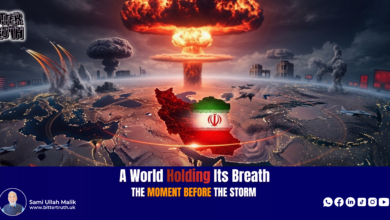
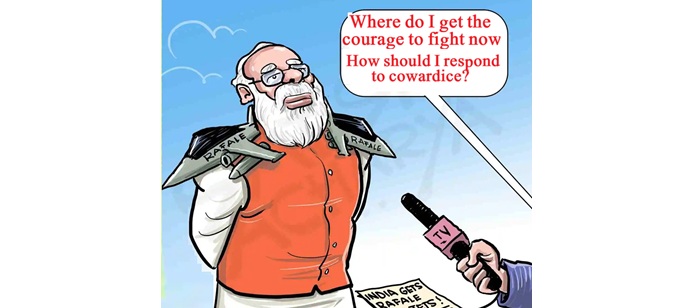
Peace is our priority, but honor is our nature
We are messengers of peace, but the sword of defense is our legacy

Cowardice at Midnight: Unprovoked Aggression and the Dignified Response of a Sovereign Nation
In the still of the night on May 6, 2025, while the civilised world slumbered in peace, the Indian state launched a surreptitious and ignoble assault upon Pakistan’s sovereign territory. The targets of this unannounced belligerence were not military installations nor strategic outposts, but mosques, sanctuaries of faith, civilian homes, and critical infrastructure. These were not the acts of a nation defending itself — they were the deeds of a power unshackled from the constraints of international law, bereft of moral compass, and blind to the devastating echoes of its own aggression.
Let it be recorded in the annals of history, without fear or favour, that this attack violated not only the sacred tenets of the Geneva Conventions but transgressed the broader covenant of humanity. The deliberate targeting of places of worship and unarmed civilians — including women and children — is not merely an infraction; it is, in every sense, a war crime. The Indian missiles, rained upon the sleeping towns of Muzaffarabad, Kotli, Bahawalpur and Rawalakot, took with them twenty-six innocent lives and wounded dozens more.
India has attempted to veil its transgression behind the shroud of a so-called “Operation Sandur,” claiming to target “terrorist hideouts.” Yet no verifiable evidence has emerged to support such assertions. Like the rustle of autumn leaves disguising the rot beneath, such claims crumble under the weight of truth. The international community, independent media, and conscientious observers have questioned both the timing and intent of this false narrative — a narrative often employed to fan the flames of jingoism ahead of elections or diplomatic summits.
The response of Pakistan, though forceful, was measured and just. In the face of provocation, the armed forces of Pakistan acted with commendable restraint and professionalism. Five Indian fighter aircraft — including their much-vaunted Rafales — were brought down with precision, and multiple reconnaissance drones were neutralised. In a display of strategic clarity and defensive acumen, Pakistan also incapacitated Indian forward operating bases that had facilitated the initial strikes. These actions were not borne of vengeance, but of solemn duty — a duty to protect the lives and dignity of our people.
More grievous still is the revelation that one of India’s targets included the Neelum–Jhelum Hydropower Project — a vital civilian infrastructure and lifeline for the region. This attempt to damage water reserves amounts to what may rightly be termed hydro-terrorism, a reckless gamble that imperils not only regional stability but the shared natural heritage of South Asia. It compels us to ask: does international law permit the weaponisation of water? Can the conscience of the world remain mute in the face of such ecological vandalism?
In a tone steeped in duplicity, India’s Foreign Secretary, Vikram Misri, described the strike as a “measured action” to “avoid escalation.” One might ask: what moral calculus permits the bombing of mosques at midnight while calling it de-escalation? What measure of reason justifies the slaughter of innocents in the name of security? It is an irony too great to ignore, a hypocrisy too grotesque to dismiss.
Let us be clear — the burden of restraint lies not with the aggrieved but with the aggressor. And Pakistan, though grievously wronged, has demonstrated a rare nobility of conduct by acting within the bounds of international law and proportionate self-defence.
The global response has not been muted. China, in a voice of sorrow and reason, called the strikes “regrettable,” urging restraint and dialogue. The United States, through President Trump, condemned the actions as “shameful,” warning that nuclear powers bear a special responsibility to peace. The United Nations Security Council is considering an emergency session, while international human rights organisations demand independent investigations.
This is no ordinary episode of military brinkmanship. It is a test — a test of the world’s resolve to uphold law over lawlessness, truth over propaganda, and justice over brute power.
Pakistan, with its moral spine intact and diplomatic posture dignified, now turns to the international community — to the United Nations, the Organisation of Islamic Cooperation, the European Union, and all free peoples of the world — and urges them to hold India to account. Let there be sanctions, resolutions, and above all, justice.
To let this pass unanswered is to invite chaos; to ignore this affront is to bury the very foundations of modern civilisation beneath the rubble of aggression. History will judge not only the perpetrators of this crime, but those who chose silence when action was demanded.
A Deliberate Assault on Humanity and Law: The Grave Consequences of India’s Reckless Escalation
In the shadowed theatre of geopolitics, when the sacred sanctuaries of civilians and the vital lifelines of nations are subjected to calculated aggression, the matter no longer remains one of mere territorial contest. It evolves into a harrowing indictment of conscience, justice, and the very scaffolding upon which the edifice of international law rests.
The recent missile strikes by Indian forces—unprovoked and incendiary—against Pakistan’s Neelum-Jhelum Hydropower Project and the strategically critical Noseri Dam constitute not only an egregious violation of sovereign integrity, but a frontal assault on the humanitarian spirit, environmental sanctity, and legal architecture that governs civilised conflict. These installations, nestled within the serene landscape of Azad Kashmir, are neither military bastions nor instruments of war. They are instruments of life, conduits of light, and lifeblood for millions.
This blatant attack upon essential hydro-infrastructure is not merely an act of militaristic folly—it is, in effect, a crime cloaked in impunity. The damage inflicted upon these sites endangers electricity provision to vast populations, destabilizes water security, and invites the spectre of catastrophic flooding in downstream regions. The implications are not speculative; they are perilously real and immediate.
Let it be underscored, with the weight of jurisprudence and the clarity of moral vision, that Article 56 of the 1977 Additional Protocols to the Geneva Conventions explicitly prohibits assaults upon “installations containing dangerous forces, namely dams, dykes and nuclear electrical generating stations.” The wording is not ambiguous. These attacks are not legitimate acts of war. They are war crimes.
And what shall the world call this if not environmental terrorism? For when the flow of rivers is weaponised, when sacred watercourses become targets, and when civilian infrastructure is used to provoke retaliation, it is not just the natural order that is violated—but the moral order as well.
Pakistan, in its restraint and in fidelity to the principles of international law, has responded with responsibility, not vengeance. It has issued a solemn warning to the international community: that such belligerence must not go unchallenged, and that silence in the face of aggression is complicity.
The spokesperson of Pakistan’s armed forces, General Ahmed Sharif Chaudhry, has rightly posed a question that ought to haunt every chancery in the civilised world: “Does India comprehend the magnitude of the catastrophe it courts by targeting water infrastructure?” The consequences are not limited to one nation. They threaten regional stability, environmental balance, and the shared future of South Asia.
The call now is not only for justice—but for urgent and principled mediation. The United Nations, the International Court of Justice, and global humanitarian institutions must not merely issue statements; they must act. For when water becomes a theatre of war, famine follows. When dams fall, societies collapse.
Pakistan, a nation built on constitutional fidelity and international cooperation, does not seek conflict, but it shall not shrink from the duty to defend its people. Under Article 51 of the United Nations Charter, the right of self-defence is not a favour granted—it is an inalienable sovereign prerogative. No nation is required to remain passive in the face of existential peril.
The doctrine of Responsibility to Protect (R2P) holds that if a state is unwilling or unable to shield its citizens from war crimes or crimes against humanity, the international community must intervene. But before all else, that sacred responsibility first rests with the state under siege.
Let it be declared, then, in no uncertain terms:
Pakistan shall defend its dams, its mosques, its people, and its peace. It shall strike, not in anger, but in defence. It shall warn, not out of fear, but out of wisdom. And if India persists in its path of lawlessness, Pakistan reserves the right to retaliate with precision, proportionality, and purpose. Not for retribution—but for deterrence.
In closing, Pakistan entreats the world not merely to listen—but to awaken. For this is no longer a border dispute—it is a moral inflection point for the future of humanitarian law, ecological stewardship, and the peace of an entire region.
A Sovereign’s Appeal to the Conscience of the World: Pakistan’s Diplomatic Response to Indian Belligerence
Let it be known, with solemnity and with purpose, that the Islamic Republic of Pakistan, a nation forged in the crucible of justice, peace, and lawful restraint, now finds itself the unwilling recipient of unprovoked hostility. A grievous assault has been launched upon our sacred mosques, our civilian infrastructure, and the very lifeblood of our economy—our hydropower systems—by a neighbour whose actions flout not only international statutes but the basic tenets of human decency.
In response to this belligerence, Pakistan must, without hesitation, commence a vigorous and coordinated international diplomatic offensive. We must rise—not in vengeance, but in vigilance—to awaken the slumbering conscience of the world.
Let the halls of the United Nations Security Council resound with our cry for justice. Let the permanent members—America, China, Russia, the United Kingdom, and France—be summoned to consider not abstract theory, but tangible proof: the charred remains of missiles, the harrowing images of wounded civilians, the medical reports of the martyred innocents.
Let international journalists, with their own eyes, witness the destruction that silence has permitted and that justice must now restrain.
We must petition for an emergency session of the United Nations General Assembly. We must invoke the voices of the Organisation of Islamic Cooperation, of the European Union, and of all nations that still cherish peace, to condemn India’s actions not as isolated incidents, but as war crimes of global consequence.
Let the attacks on the Neelum–Jhelum Hydropower Project and the mosques of Azad Kashmir be declared not merely criminal, but violations of the Geneva Conventions—and thus be pursued through the full weight of the International Court of Justice and, where appropriate, the International Criminal Court.
In legal terms, India stands culpable of environmental terrorism, of the deliberate targeting of civilians, and of assaults upon sites of religious sanctity. These transgressions demand a response not of rhetoric, but of law.
To this end:
Let foreign correspondents be granted full access to the affected areas.
Let Pakistan file an immediate case before the ICJ, with supporting evidence drawn from forensics, satellite imaging, and international treaty law.
Let a demand be issued for a UN investigative commission to ascertain the extent of civilian, environmental, and infrastructural harm.
Moreover, let us declare unequivocally that Pakistan is a state of peace, not war, of deterrence, not aggression. We renounce the first use of nuclear weapons, even as we affirm our absolute right to self-defence under Article 51 of the UN Charter.
Simultaneously, we must initiate a campaign for global sanctions against India:
A call for a universal arms embargo;
A trade boycott of Indian products, especially in Western consumer markets;
Travel bans upon Indian military officials and policymakers complicit in the violations;
A demand that India’s GSP+ status be revoked in light of its human rights abuses.
We must appeal to our allies—China, Turkey, Saudi Arabia, and the Gulf States—to issue joint condemnations and coordinated actions. Let China wield its veto power, not in favour of rivalry, but in defence of rule-based international order.
And if the world still falters, still hesitates, then let history bear witness: Pakistan will defend its sovereignty, its people, and its honour—utterly, resolutely, and lawfully. For though we seek peace, we shall not submit to tyranny. Though we advocate for dialogue, we shall not be silent when the innocent bleed.
Let this be our message to the world:
We do not covet war. But if war is forced upon us, we shall meet it not with fear, but with fidelity. Not with vengeance, but with valour. Not as aggressors, but as guardians of law, of justice, and of our rightful inheritance.