
Pakistan: Beacon of Hope and Ideals
Unity, Sacrifice, and Leadership

The river of history never stands still; its current bears along the chronicles of centuries and the rise and fall of peoples. In that sweep, the narratives of ages and the fortunes of nations flow together — now elevating one people to the summit of glory, now driving another down into the abyss of decline. A nation that once illumined the world with spires of learning and monuments of art may, in an instant, find itself imprisoned by darkness. Yet one truth remains immutable through every age: the powerful, intoxicated by their own might, have always ridden roughshod over the weak and contrived ever newer rationales for their oppression — now under the banner of civilisation, now under the aegis of democracy, now behind the pretext of a war against terrorism.
History is, indeed, a great book written in the ink of blood and tears. Each page tells us that when oppression reaches its apogee, the prayer rising from a victim’s heart can perturb the moral economy of the cosmos. Civilisations, empires and mighty sovereigns lie buried in the dust, yet the tale of their injustices still serves the vigilant as a lesson. In this world of hue and scent, the strong have always sought to overwhelm the weak, and to gild their aggression with some high-sounding name — the flag of civilisation, the torch of democracy, the crusade against terror. The game continues, unchanged in its essentials. Prime Minister Netanyahu’s recent address is but a new chapter in that ancient tale — a chapter inked in blood, carrying a warning to the Muslim world as a whole.
As Iqbal counselled:
؎ افراد کے ہاتھوں میں ہے اقوام کی تقدیر
ہر فرد ہے ملت کے مقدر کا ستارہ
“Study again the lesson of truth, of justice, of valour;
Thy charge it shall be to shoulder the world’s leadership.”
In the current situation, Iqbal is calling out:
“Rise, for the assembly of the world now demands a new manner;
East and West ring with the proclamation of thy era.”
Yet one maxim persists through time: might intoxicates the mighty, and in that intoxication they trample the weak and labour to clothe their cruelty in rhetoric. The present moment is no exception to this historical recurrence.
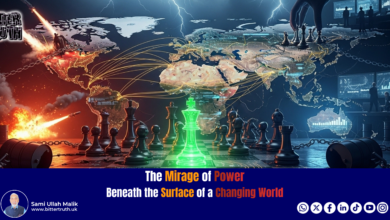
For several days now a short video address by Prime Minister Benjamin Netanyahu has been the subject of intense global scrutiny. In that message he invoked the memory of 9/11 to justify Israel’s strike on Qatar. This utterance is not merely a piece of political rhetoric; it is a glimpse of a new arrangement of pieces on the chessboard of world affairs.
In his two-minute statement, Mr Netanyahu asserted that Israel acted as the United States had after 9/11 — that America struck into Afghanistan to uproot Al-Qaeda and subsequently entered Pakistan to kill Osama bin Laden. On the face of it this is a comparison; in truth, it is a warning and a portent. To single out Qatar today and name Pakistan in the same breath is to open the door upon schemes that might follow tomorrow — Qatar may be the target today; Pakistan, perhaps, the prospect of tomorrow.
This is not an unfamiliar stratagem; it is the time-honoured artifice of powerful states. In the mirror that is history, every imperial hand has sought a pretext for its violence. They seize upon some event to rationalise aggression and then iterate that rationale until the weak begin to internalise guilt. In the age of the Crusades, religion furnished the pretext; in the colonial era, a civilising mission provided the excuse; and now, under the rubric of counter-terrorism, the Muslim world is not merely being targeted — it is being systematically crushed.
Qatar replied promptly and with due gravity. It made plain that the hosting of Hamas’s office had not been a voluntary act of sanctuary but a function of mediation at the behest of the United States and Israel themselves. Thus, those very powers that once implored Doha to act as intermediary now brand it as a nest of treachery and terrorism. Such duplicity corrodes the foundations of diplomacy. It is this very breach of covenant that undermines the edifice of international trust.
One question, stark and unavoidable, remains: with the American air base Al-Udeid sited in Qatar, could such an attack have been mounted without the knowledge — if not the tacit consent — of the United States administration? History tells us that minor powers seldom venture so bold a stroke without a nod from the great. The silence of dominant powers is frequently the shadowy synonym of assent; that silence often constitutes a concealed confession of complicity.
Mr Netanyahu’s pronouncement — “hand over the terrorists to us, or we shall act” — is not a threat directed only at Qatar but a menace to the entire region. Is it fanciful to suppose that such rhetoric might tomorrow be deployed against Pakistan? Is it beyond imagination that an axis of the United States, India and Israel might turn upon Pakistan as it has upon Iraq, Syria and Libya?
We must not be blind to a crucial reality: Pakistan is not Qatar, nor is Israel the United States.
Pakistan is a nuclear power, a state founded upon an idea, and a nation steeped in religious valour and civilisational pride. Its very soil resounds with the echo of a revolutionary voice. Yet these facts are not guarantees against designs hatched elsewhere. Enemies do not always respect such realities; they may attempt to ensnare Pakistan in a web of plots. The reality of Pakistan’s strength is not, in itself, a promise that adversaries will remain idle.
This is all the more perilous at a time when, reeling from the defeats of May 2025, Mr Narendra Modi speaks openly of vengeance. The humiliation India suffered then — a wound scored deeply upon national pride — remains fresh. If Mr Modi were to lean upon the shoulders of Israel and the United States to redress that shame, would not the region be set alight anew?
The river of history does not pause; its current carries with it the chronicles of centuries and the ebb and flow of nations. In that stream, the narratives of ages and the destinies of peoples move together — raising one nation to the summit of glory, plunging another into the abysses of decline. A people that once lit the world with pinnacles of learning and beams of art may, in a single turn of the page, find itself shut within the dungeon of night. Yet one axiom endures across all epochs: the powerful — drunk on their own might — have always ridden roughshod over the weak, weaving ever-new rationales to justify their oppression. Sometimes the premise is civilisation, sometimes the banner reads democracy, and at other moments the mask bears the claim of a war on terror.
History is not a mere ledger of events; it is a looking-glass in which nations read their errors and successes and, by that reading, shape their future. The annals of the Muslim ummah attest the same truth: when we built our polity upon the twin pillars of unity and faith, no power could stand before us; when we succumbed to division, the adversary triumphed, and we were driven into the darkness of subjugation.
Iqbal put the matter with his accustomed moral urgency:
رَبط و ضَبْطِ مِلتِ بَیضاء ہے مَشرِق کی نَجات
ایشیا والے ہیں اس نُکتۂ سے اب تک بے خَبر
— the discipline and cohesion of the white nation is the salvation of the East; yet Asia remains, to this day, unaware of this truth.
Consider the Ottoman Caliphate. For six centuries it stood as the embodiment of Muslim dignity and unity, its sway stretching across three continents. It was not merely a political formation but a living symbol which compelled the great powers of Europe to revise their calculations for generations. Yet when internecine strife, Western machinations and the baleful germs of nationalism began to gnaw at its foundations, that edifice weakened. After the First World War the caliphate collapsed, and the Muslim world was parcelled into fragments. The lesson of that decline is stark: once a community sacrifices its unity, its grandeur is buried in the dust.
The era of the Crusades is no less instructive. When the Crusader host seized Jerusalem, the Muslim world seemed plunged into eclipse. It was the leadership of Ṣalāḥ al-Dīn al-Ayyūbī — a figure of piety and purpose — that restored the city and, more significantly, demonstrated that courage born of conviction and the common will of a people can render the impossible achievable. If that spirit were to be rekindled today, no earthly force could bar our path.
Turning to the subcontinent, the Revolt of 1857 marked a turning point of profound consequence. It was not merely an insurrection of arms but an eruption of collective honour; Hindus and Muslims alike rose against imperial domination. Though the rebellion did not end in immediate victory and cost countless lives, it kindled the lamp of liberty. The lesson is plain: liberty is not bequeathed without sacrifice and resolve. The creation of Pakistan is the long, eventual fruit of such sustained endeavours.
The sack of Baghdad in 1258 stands as one of history’s bleakest hours. With the Mongol onslaught the Abbasid Caliphate was extinguished, and the Muslim world’s intellectual heart was shattered; millions perished, and centres of learning lay in ruin. Yet from that devastation came renewal — new dynasties, new academies, a rebirth that testifies to the resilience of a civilisation that makes knowledge and faith its weapons. The moral is clear: from ruin, a people committed to learning and belief can arise anew.
In 1919, the Khilafat movement in the subcontinent testified to a different but related truth. Faced with the fate of the Ottoman caliphate, the Muslims of India rallied in its defence, giving public expression to devotion and dignity. Though the movement failed to save the caliphate politically, it awakened a consciousness that would, in time, help to shape the demand for a separate homeland. The message is that collective sentiment and a shared purpose can galvanise a people toward transformational effort.
All these episodes converge on a single, unambiguous point:
without unity, principled leadership and the readiness to sacrifice, a community’s survival is precarious. Whether it is the fall of the Ottomans, the victories of Ṣalāḥ al-Dīn, or the 1857 uprising, each teaches the same lesson — when Muslims stand firm upon their faith and ideals, the world yields before them; when they are rent by faction and selfishness, ignominy becomes their portion.
Today, Pakistan and the wider Muslim world must draw that lesson without delay. If we fail to learn, posterity will consign us to the role of a cautionary tale. Look closely over the pages of history and you will find that whenever the Muslim ummah united under steady leadership, the great powers bowed. The Ottoman caliphate, for all its complexities, once embodied that unifying power. When the community fractured, the same structure that governed three continents disintegrated into pieces.
The example of Ṣalāḥ al-Dīn is no mere antiquarian romance. His triumph was not the product of superior arms alone but of a leadership that fused moral purpose with unyielding strategy. Were that spirit to animate our policies today, no geopolitical obstacle could long obstruct our way.
Our own subcontinental experience offers no softer counsel. The Revolt of 1857 was more than a clash of muskets; it was the cry of a people determined to break the chains of servitude. It teaches that bonds of subjection are broken only by the willingness to set the lamp of sacrifice alight. The question for Pakistan remains blunt and unadorned: will we heed history, or shall we consign ourselves to, yet another defeat written into our destiny?
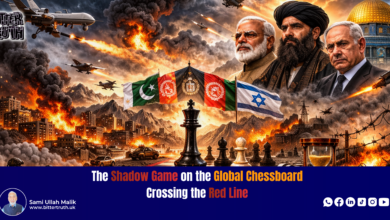
Against this historical tableau stands the contemporary configuration of power: the trilateral alignment of the United States, India and Israel is not a transient convenience but — so it would appear — the instrument of a considered strategy. In Washington’s view the expanding Chinese presence constitutes the principal strategic problem; in New Delhi the sting of recent reverses seeks salve in revanche; in Tel Aviv a broader regional assertion continues apace. These strands meet at a single aim: to fracture Pakistan’s rapport with China and to perpetuate divisions within the Muslim world.
This is the old playbook, practised with variations by leaders of the present day. The technique — summon a state to the negotiating table, distract the language of discourse, then marshal allied force to strike — is a recurring feature of modern interventionism. Afghanistan, Iraq, Syria and Libya remain living case studies. If Qatar is being subjected to this device today, why should Pakistan, tomorrow, be exempt?
Faced with this predicament, Pakistan confronts two paths: to conceal itself in the mantle of expedience and let time erode its options, or to marshal friends and partners and adopt a vigorous, proactive strategy. History instructs us that nations survive not by dreaming but by deliberate action.
The question stands stark before Pakistan: what course shall it pursue? Shall it be content with words, or will it enact deeds? History instructs with unerring clarity that nations who dwell in dreams while shirking the terrain of reality are invariably those who remain weak. For Pakistan, the foremost obligation is to marshal its own ranks, to bring internal coherence and discipline to its polity.
The second, and no less vital, imperative is to forge political, economic, and military ties with China into a strategic depth commensurate with the times. Reactivating the China–Pakistan Economic Corridor, inviting new investment, and expanding its scope are not mere suggestions but urgent necessities. In tandem, new alliances must be cultivated — alliances that embrace fellow Islamic nations and emerging global powers alike. SAARC may yet be revived, whether India participates or not; should China join, the framework could be strengthened manifold. Similarly, Pakistan must pursue earnest accession to BRICS to carve for itself a position of influence in the global economy and international politics.
A glance at history leaves no doubt: when Muslims were united, the world bowed to their influence. In Andalusia, the light of learning and culture shone; Baghdad served as a beacon of knowledge and artistry; Constantinople was the pivot of political authority. But when unity dissolved into fragmentation, tyranny surged forth unchallenged. Even now, the moment remains to correct our ranks. Should we forfeit this opportunity, our narrative will survive only in the pages of books. But if we draw upon the grandeur of our past, Pakistan can emerge as a beacon of hope and a lamp of courage for the ummah.
Iqbal captured this truth in words of unerring precision:
افراد کے ہاتھوں میں ہے اقوام کی تقدیر
ہر فرد ہے ملت کے مقدر کا ستارہ
— “The destinies of nations rest in the hands of individuals; each person is a star in the fate of the ummah.”
Hali, with characteristic urgency, admonished:
یونہی رہو گے تم تماشائی بن کے لوگو
کبھی نہ کچھ بھی کرو گے، بس سوچتے ہی رہو گے
— “You shall remain mere spectators, O people; never acting, only contemplating.”
This underscores an immutable reality: the challenges of the Muslim ummah are not to be met by protest or resolutions alone. If we are to evade the intricate web of the United States–India–Israel alignment, we must close ranks and forge a robust bloc. Islamic teaching furnishes us with guidance: the greatest strength of a community is unity. The Quran commands:
وَاعْتَصِمُوا بِحَبْلِ اللَّهِ جَمِيعًا وَلَا تَفَرَّقُوا
“And hold firmly to the rope of Allah all together and do not become divided.” (3:103)
Were we to implement this injunction in politics and economy alike, no earthly power could overcome us.
Remember my words: once cautioned that nations which forget the lessons of their past render the present inconsequential and the future dark. Today, we must heed his words: Pakistan is not merely a state, it is an idea — an idea capable of uniting and inspiring. Netanyahu’s statement is not a mere political utterance; it heralds a storm of danger across the region. The assault on Qatar signals that tomorrow, another may similarly be targeted. Pakistan must not confine its response to observation; strategy must be crafted with this threat in mind.
The hour calls not for reaction alone but for deliberate, proactive strategy. Pakistan must remember that it is a nuclear power, an ideological state, and a beacon capable of illuminating the path for the Muslim world. Were it to consolidate its ranks, strengthen alliances, stabilize its economy, and infuse politics with foresight, no tyrannical power could prevail.
Pakistan must demonstrate that it is not merely guardian of its soil but also protector of its ideology and civilisation. Now is the moment to show the world that Pakistan is not Qatar, and Israel is not the United States. Pakistan is the lamp that casts light amid darkness; it is the fortress that safeguards the aspirations of the ummah.
The present moment stands at the threshold of decision. Shall we wrap ourselves in the shroud of silence and fade into the shadows of history, or shall we illuminate the present with the light of our past, brightening the path of the future? Netanyahu’s declaration is not merely a justification of a strike on Qatar but a declaration of hostility to the entire region. Pakistan must refuse the role of spectator and instead assume the mantle of history-maker.
This is a moment of trial. The time has come to show that Pakistan is not merely a tract of land but a vision, a hope, and a lamp that brings illumination to the Muslim world. The world must see that Pakistan is not Qatar, Israel is not the United States; Pakistan is the fortress safeguarding the aspirations of the ummah, and the flame casting light across seas of darkness.
Pakistan’s existence is not merely that of a state but the fulfilment of a dream — the very dream envisioned by Iqbal and realised by Quaid-e-Azam. The onus now rests upon us to preserve that dream and make it a fulcrum of hope for the ummah. The present moment confronts us with a choice: to vanish into history’s obscurity or to let the light of our past illuminate the present and brighten the future. Netanyahu’s statement does not justify a strike on Qatar; it constitutes a declaration of war upon the region. Pakistan must refuse the role of spectator and act to steer the current of history itself.
As Iqbal once said:
؎ جو تو سمجھے تو آزادی ہے پوشیدہ محبت میں
غلامی ہے اسیرِ امتیازِ ماوتو رہنا
— “If you comprehend, freedom lies in concealed love; enslavement is to remain captive to distinctions of death.”