Pakistan and the Rewriting of the Strategic Map
Arms Do Not Save Nations—Order Does

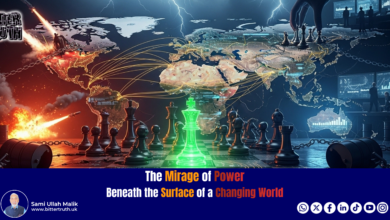
The international order of our age stands once more at that familiar, disquieting bend in the road where power speaks with the full weight of coin, and principle is quietly relegated to the shelves of forgotten volumes. Those imperial manuals of conduct which history had pronounced defunct appear now to have been dusted down, revised, and re-issued under new titles and fresh jargon. The recent American action in Venezuela is not a mere local episode; it is a rising cloud on the horizon of world politics, behind which are concealed many questions yet unasked, and answers yet unoffered.
The unbridled use of force, the re-reading of the Monroe Doctrine, new precedents of military intervention, the eloquent silence of international bodies, and the pitiable helplessness of smaller states—these together compose the grim tableau of our time, wherein peace assumes the frailty of a dream and justice the rarity of a precious relic. History has proved, again and again, that when great powers begin to regard themselves as standing above law, the destinies of weaker nations are inscribed not in parliaments but upon battlefields.
It is in this sombre context that the present essay seeks to examine the Venezuelan events, to understand the American deployment of power, to assess the global reaction thereto, and in particular to ask: what tremors shall travel through the besieged and subjugated corners of the globe, and towards which compass-point does the world order now appear to be moving?
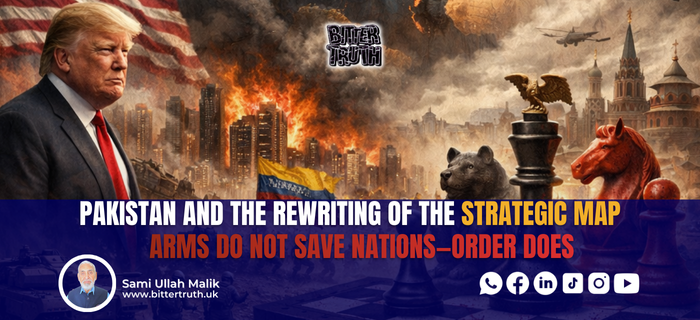
President Donald Trump’s tone, following military action in Venezuela, breathed fresh life into the two-century-old Monroe Doctrine, clothing it in modern garments yet preserving its ancient spirit. The American President’s direct resort to force against Venezuela may, on the surface, be construed as an action against a single state; in truth, it is a declaration to the world at large. It is a tacit message to China, Russia and other formidable yet authoritarian regimes that the lexicon of power has not, after all, been revised. The pages of history record that whenever imperial powers proclaimed themselves arbiters of the world’s conscience, a fresh imbalance in the order of nations duly ensued. The question, therefore, presses hard upon us: has Mr Trump merely struck at Venezuela, or has he traced new lines upon the political map of the world?
Is this operation a confined incident, or the first footprint upon a path meant equally for powers such as China and Russia? History observes that when ideas speak under the shadow of power, they cease to be mere sentences; they become signposts of destiny.
The arrest of President Nicolás Maduro and his confinement in an American prison stands as the very embodiment of a sombre proposition: that when power becomes the law, justice is escorted to the rear. Mr Trump’s pronouncements—“we shall run Venezuela”—sent tremors through the world of diplomacy; they intimated not merely bravado but the dawn of a new age of audacity. His indication that ground troops might, if needed, be deployed heralds the return of an era in which power proves itself not by rhetoric but by the cold demonstration of action. The ready compliance of smaller states, the hesitant acquiescence of their leaders, testify to a diminishing capacity to refuse, and to an enlarging shadow of compulsion.
Here the central question rises in stern simplicity: may a distant power rule a nation by remote control? This is not merely an analytical query; it is an examination set by history itself. Can objectives be attained by military pressure alone, without understanding the temperament of local societies? The historic reply has been voiced repeatedly in the negative. Governments may indeed be overthrown by force; hearts may not. Indigenous resistance, subterranean psychology, the quickened consciousness of nationhood—these are the imponderables that cast any “government at a distance” into chronic instability. American thinking may answer “yes”, yet the realities on the ground answer otherwise: nations are governed not by control but by consent—and consent remains the rarest jewel in the treasury of time.
Think tanks had warned us in advance: abrupt deposal may turn the avenues of the state into colliding alleyways of faction and feud. When power outgrows institutions, authority ceases to be politics and becomes a tug-of-war for dominance. Power vacuums are never left vacant; where governments fall, weapons speak, and groups contend for supremacy. If the chroniclers of the state fall silent, the story is seized by the gun.
The removal of Maduro was publicly paraded as the effective demonstration of American military might. Not a single American soldier fell, and the declared aim was achieved—or so the narrative runs. But history interjects: is this victory? Is the mere absence of casualties the measure of moral triumph? Does the sovereignty of nations weigh for nothing in the scales of judgement? Within Venezuela, some circles perhaps displayed jubilation; beyond its borders, unease broadened like a widening gyre. The ultimate consequences stand veiled for the moment behind the long curtains of time.
At Mr Trump’s press conference, the tone was unmistakably that of the victor. Yet the annals of history inscribe repeatedly that while governments may be changed by force, societies rarely are. Iraq and Afghanistan remain living testaments to the sombre truth that nation-building does not spring ready-made from the loins of military conquest; the battle that follows victory is often the harder war. From Baghdad to Kabul the examples knock loudly at the door of conscience: arms may win the field, but they seldom win the peace.
The experience of the past three decades cries aloud that the gun may clear a path, but it does not confer a destination. Nations refuse to accept decrees imposed from without; they pronounce their verdicts in the court of time—and time is captive to no master. Iraq of 2003 still bleeds as an unhealed wound. The ignominious withdrawal of American forces from Afghanistan after two decades reminds the world that when the palaces of power are built on sand, the first wind is sufficient to bring them low. History is not mute; it surveys the present in the mirror of the past.
At such moments one is reminded of the Qur’anic proclamation concerning the true seat of power and its transience in human hands:
﴿ قُلِ ٱللَّهُمَّ مَٰلِكَ ٱلْمُلْكِ تُؤۡتِي ٱلۡمُلۡكَ مَن تَشَآءُ وَتَنزِعُ ٱلۡمُلۡكَ مِمَّن تَشَآءُ وَتُعِزُّ مَن تَشَآءُ وَتُذِلُّ مَن تَشَآءُۖ بِيَدِكَ ٱلۡخَيۡرُۖ إِنَّكَ عَلَىٰ كُلِّ شَيۡءِۢ قَدِيرٞ ﴾
“Say, O Allah, Lord of Sovereignty: You bestow dominion on whom You will and You remove dominion from whom You will; You exalt whom You will and abase whom You will. In Your hand is all good; surely You are powerful over all things.”
And again, that another majestic reminder:
﴿ وَقُلۡ جَآءَ ٱلۡحَقُّ وَزَهَقَ ٱلۡبَٰطِلُۚ إِنَّ ٱلۡبَٰطِلَ كَانَ زَهُوقٗا ﴾
“And say: Truth has come, and falsehood has vanished away; verily falsehood is ever bound to vanish.”
These verses stand, not as mere adornments, but as moral milestones: power is lent, not owned; history judges, and truth outlives the thunder of arms.
In 1823, the sentence uttered by President Monroe was given a new cadence by Donald Trump. His assertion that “we have gone far beyond the Monroe Doctrine” was not a casual remark; it was a fresh line carved upon the political map of the Western Hemisphere. “We have left it behind” — the phrase itself intimates that the age of mere non-interference has yielded to an unabashed proclamation of supremacy. To declare the Western world as “our sphere” is not merely a slogan; it is a new ordinance in global politics. The message admits of no ambiguity: the United States will brook no challenge to its geographical pre-eminence.
A threat to the President of Colombia, a pointed remark regarding Mexico, a warning to Haiti — these are not words; they are the moving shadows of policy. When power refuses to converse, the lamp of diplomacy grows dim, anxieties deepen, and the final act of the drama — as history so often records — is nothing less than the ruin of nations. In Haiti, change of government occurred beneath the shadow of the gun. Few bullets were fired, but many tears were shed. Thirty years have passed, yet prosperity remains in debt. The example stands as a silent admonition to Venezuela.
Cuba has long been a thorn embedded in the American psyche. Its socialist heritage and the geographical importance of the Caribbean have made it a permanent target; Mr Rubio’s familial associations render the question all the more sensitive.
In Mr Trump’s tone there was warning, there was boastfulness, and there was resolve. Past interventions have turned entire regions into laboratories of experiment, yet the results stagger still like wounded soldiers upon a broken field. Haiti illustrates a truth writ large across history’s pages: governments may be changed — nations may not.
Mr Trump studiously avoided the word “democracy”. He expressed confidence neither in María Corina Machado nor in González; as though the verdict were not to be rendered by the people, but by power itself. Hence arises the question: has democracy been reduced to a mere rallying cry? Venezuela’s leadership, the very question of democracy, the transfer of power or the survival of the system — these are questions whose answers have been crushed beneath the mountains of might.
No foreign power triumphs without fissures within. It was domestic hands that smoothed the path against Maduro. Yet that very fact is a source of humiliation for honourable generals who could not offer resistance — and history has left the question hanging in the air. The financial stakes of regime supporters, armed militias, Colombian guerrillas, networks of corruption and the raw strength of paramilitary forces — all form the tinder that may burst into flame at any moment. When the struggle for power seizes weapons, the future of the state becomes a question mark.
Maduro is confined, yet Chávez’s system endures, roots and all. The entangled interests of military and political elites, militias and armed groups proclaim openly: the game is not over; the game has, in truth, just begun.
Whether we speak of Venezuela’s oil and mineral wealth or the treasure sleeping beneath Greenland’s ice, great powers are seldom tied merely to land — they are bound to that which lies beneath it. The signals of world politics indicate that both North and South stand now within the same arc of attention. Fear is no longer confined to the Global South. Arctic ice melts swiftly, and beneath it dormant riches stir restlessly. American attentions fixed upon Greenland betray this unspoken covetousness.
International law was once the world’s hope; today the danger grows of a reversion to the law of the jungle. When great powers weigh law upon the scales of preference and aversion, the court stands silent before history, and international statutes shatter like a broken mirror — whose fragments, even if gathered, will not form a whole.
The Maduro operation has rendered urgent the question: is international law a mere textbook expression, or does it indeed possess enforceable authority? When the strong begin to reinterpret law to suit their will, justice becomes a dream for weaker nations. European powers know full well that the act is a flagrant violation of the Charter of the United Nations, and yet they remain silent; whether out of interest or fear — history faithfully records their silence too.
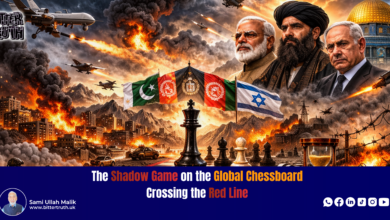
After Maduro’s meeting with Chinese diplomats, Beijing’s strong condemnation signalled the formation of new alignments. The cinders of the Cold War glow anew. Mr Trump’s action has delivered an open message and a fresh precedent: if America may, then may not China in Taiwan? May not Russia in Ukraine? Though China has voiced disapproval, the world asks: if this path is now trodden, what remains to prevent Taiwan, Ukraine and other regions from being devoured by the same logic? A line has been crossed; every power will now claim the right of its own interpretation. Senator Mark Warner has articulated this fear: that each nation will advance its own reading, and the world will slide from order to disorder.
These are not mere news items; they are the preface to the coming years. It is being inscribed upon the brow of history that the axis of power is shifting, and the world trembles. Radars were silenced, commanders mute, flight leaders recalled, defence systems disabled, anti-aircraft guns stilled — this was not merely technology at work; it was the footprint of treachery within. The lamps were extinguished from inside. History reminds us: whether Abbottabad or Tehran — where the door is opened from within, the visitor without need not knock for long. Power seldom collapses from the outside; more often it crumbles from within. Where command fractures, states are shown to be walls of sand.
External conspiracies abound, yet the largest breach is always inward. History bears witness: Rome, the Ottoman Caliphate, the Soviet Union — all fell more through internal weakness than external attack. Modern American power faltered in Somalia before popular resistance, in Afghanistan before the betrayal of local allies, in Iran before discipline and counter-measures. The lesson is stark: the strength of institutions and unity of the nation outweigh the brute force of arms.
It is this fundamental truth that stands before Pakistan with the weight of commandment: the protection of the chain of command is the first and greatest defence.
What, then, is the “chain of command”? Where is the decision made? To whom is the order conveyed? Who carries it into execution? To mislead the leadership, to distort information, to delay decisions, to fracture command — and to suppress, with iron hand, all elements engaged in such sabotage — this is the foremost duty of the state, for here lies its most vulnerable point. In modern warfare the primary target is not missiles, nor tanks, nor airbases, but the brain that makes decisions — the nervous system of the state, the command-and-control centres. Thus, the lesson for Pakistan is imperative: harmony among intelligence agencies, cohesion between civil and military authority, resilience against disinformation warfare across media and social platforms, trust within the military leadership, and firm prevention of internal traitors, leakers and facilitators.
If the chain of command stands secure, the enemy cannot prevail, no matter how dazzling his technology.
At such a point one recalls the Qur’anic warning against inner decay:
﴿ إِنَّ ٱللَّهَ لَا يُغَيِّرُ مَا بِقَوۡمٍ حَتَّىٰ يُغَيِّرُوا۟ مَا بِأَنفُسِهِمۡ ﴾
“Surely God does not change the condition of a people until they change what is within themselves.”
And likewise:
﴿ وَلِلَّهِ عَٰقِبَةُ ٱلۡأُمُورِ ﴾
“And unto God belongs the final outcome of all matters.”
These are not merely verses but verdicts: nations fall not merely by the blows of others, but by the frailty of their own spirit.
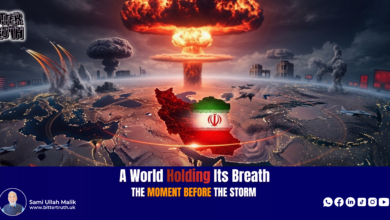
It has now become painfully evident to the nations of the so-called Third World that wars are no longer fought merely upon cartographic frontiers. The battlelines today run through currencies under siege, through the fevered jungles of social media disinformation, through the proxy wars of political polarisation. Treaties have grown frail; the United Nations stands enfeebled; and the great powers, with practised indifference, consult little save their own advantage. Hence it is inevitable that the states of the developing world will look onward—indeed must look onward—towards nuclear deterrence, strategic technologies, ballistic shields, and defensive alliances commensurate with the perils of their age.
Against this gathering backdrop, China, Russia and Pakistan are emerging as potential poles of a new constellation—possible centres of alignment for those nations that seek to secure the sinews of their defence in an unforgiving world. Pakistan, already a nuclear power, seasoned by war and endowed with a strategic geography of consequence, occupies a pivotal station in this evolving theatre. It is for this reason that, following the defence accord with Saudi Arabia, the Gulf states increasingly seek security partnership with Islamabad. The causes are manifest: the unresolved tension betwixt Israel and Iran; waning confidence in American constancy; and the growing conviction that sovereign defence is no longer a luxury but a necessity writ large.
The central lesson for Pakistan is stern yet simple: weapons alone do not suffice. What is needed in the last resort is secure and vigilant leadership, a resilient and unbroken chain of command, national cohesion and inner stability of the most rigorous kind. If treachery finds no purchase within, then no leviathan of power—however dazzling its armoury—can bring a people to their knees. States are not shattered by cannon fire; they disintegrate when the links of discipline corrode. When the chain of command snaps, military strength turns to a house of sand. The ultimate truth is unambiguous: it is not merely arms but order that sustains the State. Break the command, and armies—though mighty—are undone; preserve the order, and even the seemingly weak prevail with honour.
Pakistan, Turkey, Iran—these examples stand before us in unblinking clarity. The secret of dignity and survival lies hidden within that discipline of command and trust between institutions and the people they serve.
Venezuela has taught the same chastening lesson—and it speaks to Pakistan and to the wider world alike: the security of nations is not measured in gun barrels alone, but in loyalty, cohesion, and an unbroken chain of command. Put in the plainest English: a State is more often broken from within than conquered from without; therefore, Pakistan’s foremost duty is to safeguard the strength and integrity of its command structure.
The world now stands at a turning of the road. Claims of power, the entanglements of ideology, and the lure of mineral wealth have once again set history in motion. Politics is no longer the sport of rhetoric alone; it has become a contest of nerves, of economies, of technologies, and of domestic unity. History is not forever silent; it records its judgments and, in its own sovereign hour, it speaks them aloud. Those who today appear mighty may tomorrow find themselves arraigned at the bar of time. True power is that alone which endures the balance of justice.
The annals of history attest that the success of external aggression has not always depended upon explosives, bombardment, or the wizardry of technology; more often there has lurked the dagger thrust from within. Whether one surveys the recent pages of Venezuela or leafs back through older volumes, the verdict is constant: where internal ranks did not rupture, even a military colossus such as the United States—despite all its technological grandeur—could not secure triumph, and its chronicles remain strewn with episodes of humiliation.
Be it the American forces mired in Somalia, the weary withdrawal from Afghanistan’s broken valleys, or the failed venture in Tehran—each episode inscribes the same conclusion: no external power is irresistible so long as the inner wall of a nation stands firm. Where the chain of command holds, where national resolve lies awake, and where the bond between institutions and the people is rooted in trust, even mountains of technology are rendered as shifting sand.
At this juncture another sobering reflection arises. When smaller nations observe that international law has grown pliant to the will of the powerful, there germinates within them a compelling resolve—that survival demands self-reliance and strategic autonomy in defence. It is therefore no fancy to foresee that many states of the developing world may yoke their conception of security to nuclear and strategic capability, looking towards China, Russia, or Pakistan—countries seasoned already in the disciplines of defence—for guidance and partnership. Pakistan’s defence cooperation with Saudi Arabia, and the mounting interest of other Arab states, mirrors this changing global temper.
Yet this chapter of history teaches a deeper truth still: the ultimate strength of nations resides not in armaments but in honest leadership, national unity and the durable trust between their institutions. A people fractured within require only a push from without; a people inwardly steadfast are bowed by no tempest, however fierce. Time keeps its verdicts under seal—but history even now proclaims that the foundations of security are laid less in arsenals than in unity; that the first rampart of defence is the internal discipline of the State itself.
Here the eternal words of the Qur’ān stand as both admonition and solace:
﴿إِنَّ اللَّهَ لَا يُغَيِّرُ مَا بِقَوْمٍ حَتّىٰ يُغَيِّرُوا مَا بِأَنفُسِهِمْ﴾
“Indeed, God does not change the condition of a people until they change what is within themselves.”
And again:
﴿وَأَعِدُّوا لَهُم مَا اسْتَطَعْتُم مِّن قُوَّةٍ﴾
“And prepare against them whatever force you are able to muster.”
In these twin beacons resides the balance of moral fibre and material preparedness—the marriage of inner reform with outward strength. It is this union of discipline, unity, and just purpose that fashions nations capable not merely of surviving history, but of shaping it.