
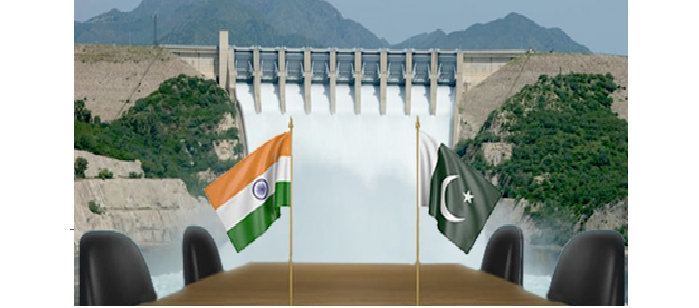
Pakistan and India: The Growing Water Dispute
The Water Dispute: Diplomatic Solution or Conflict

The water dispute between Pakistan and India has spanned several decades, with experts predicting that future water scarcity could further escalate tensions in the region. The complexity of the river systems in South Asia, rapid population growth, climate change, and political differences have all contributed to intensifying this dispute.
The origins of the water dispute between Pakistan and India date back to the partition of the subcontinent. In 1960, the Indus Waters Treaty (IWT) was signed, dividing the waters of the Indus River and its tributaries (Jhelum, Chenab, Indus, Ravi, Beas, and Sutlej) between the two nations. According to the treaty, control over the eastern rivers (Ravi, Beas, and Sutlej) was given to India, while Pakistan was granted rights over the western rivers (Indus, Jhelum, and Chenab). However, India was permitted limited use of the western rivers for “non-consumptive” purposes, such as hydroelectric projects.
The treaty is widely regarded as a successful international agreement, as it provided a framework for dialogue on water disputes even during the wars of 1965 and 1971. The Indus Waters Treaty was brokered by the World Bank and signed on 19 September 1960 to resolve conflicts over water distribution between the two nations. The agreement allocated full control of the eastern rivers to India and of the western rivers to Pakistan, thus forming the foundation of the treaty.
Under the treaty, India was granted full control over the eastern rivers, allowing it to construct dams, store water, and use it for agricultural purposes. India was permitted limited use of the western rivers for irrigation, hydroelectric power, and domestic needs, provided that such usage did not affect Pakistan’s allocated share of water. For example, India could develop “run-of-the-river” hydroelectric projects but was not allowed to store water or obstruct its flow. A Permanent Indus Commission was established to resolve disputes, and if unresolved, the matter could be taken to the International Court of Justice or an arbitration tribunal.
Pakistan has accused India of diverting water from Pakistani rivers, arguing that India’s construction of numerous dams and canal systems on the eastern rivers (Ravi, Beas, and Sutlej) has reduced water flow to Pakistan. India, however, maintains that its actions are permissible under the Indus Waters Treaty. In recent years, India has constructed multiple dams and barrages on the western rivers, including the Kishanganga and Ratle hydroelectric projects, which Pakistan believes violate the treaty and threaten its water rights.
India asserts that it has full control over the eastern rivers, allowing it to build dams, store water, and use it for agriculture. For the western rivers, India is allowed limited usage, such as “run-of-the-river” hydroelectric projects, without obstructing water flow. The Permanent Indus Commission was established to resolve disputes, and unresolved issues can be referred to international arbitration.
The primary cause of recent disputes is India’s hydroelectric projects on the Chenab and Jhelum rivers, which Pakistan argues are violations of the treaty. Notable examples include the Baglihar Dam on the Chenab River, where Pakistan objected that India’s construction allowed it to control water flow. In 2007, an arbitration court ruled that India could build the dam but must reduce its height to ensure uninterrupted water flow to Pakistan. Similarly, India constructed the Kishanganga Hydroelectric Project on the Jhelum River’s tributary, the Neelum River (called Kishanganga in India), which Pakistan claims disrupts its agricultural water supply. Pakistan argued that this project could reduce the Neelum River’s flow, affecting regions in Azad Kashmir and Punjab. The matter was taken to the World Bank, and in 2013, the arbitration court ruled that India could continue the project but must ensure a minimum water flow to Pakistan. Despite this ruling, Pakistan has experienced reduced water flow due to the project.
Pakistan has also filed a case against India’s Ratle Hydroelectric Project, which is under construction on the Chenab River. Pakistan fears this project will reduce its water supply, while India insists that it complies with the Indus Waters Treaty.
Additionally, India has diverted the waters of the Ravi and Beas rivers towards Rajasthan through the Indira Gandhi Canal and stored water in the Bhakra Dam on the Sutlej River. Pakistan sees these actions as treaty violations. Several other Indian projects on the western rivers remain contentious, heightening Pakistan’s concerns.
India maintains that it has legally redirected the eastern rivers for its own use and that its projects on the western rivers do not violate the treaty. However, Pakistan continues to object, arguing that India’s dam construction affects the “quantity and timing” of water flow, contradicting the treaty’s spirit. India believes it has lawfully utilised the eastern rivers, while Pakistan views India’s projects on the western rivers as a threat to its water security under the Indus Waters Treaty.
Experts warn that tensions over water resources may escalate in the future due to several key factors.
The Himalayan glaciers are melting at an alarming rate, leading to water shortages. The impact of climate change, including unpredictable rainfall and intense heatwaves, has made river flows inconsistent. For instance, 80% of the Indus River’s water originates from Himalayan glaciers, which are rapidly shrinking due to climate change. This uncertainty in water availability affects both India and Pakistan.
India’s strategy of constructing additional dams on rivers could trigger a severe water crisis in Pakistan. Since Pakistan heavily depends on the western rivers, any policy by India to restrict water flow could have a detrimental impact on Pakistan’s agricultural output, posing a threat to the economy and food security.
The rising populations of both India and Pakistan are increasing water demand. Due to demographic pressure and agricultural expansion, Pakistan is now the fourth most water-stressed country in the world, with per capita water availability dropping below 1,000 cubic metres annually. In India, 600 million people are already facing water shortages. The constant demand for water in agriculture (which contributes 20-25% to both economies) exacerbates tensions.
Geopolitical tensions, particularly over Kashmir, further complicate the issue. Pakistan frequently accuses India of violating the Indus Waters Treaty. Additionally, strained relations over cross-border conflicts and security issues have made negotiations on water disputes increasingly difficult. Some analysts argue that India is using water as a strategic tool to pressure Pakistan by controlling the flow of rivers.
The key question remains: has the Indus Waters Treaty, once considered one of the longest-standing and most successful agreements of the 21st century, become ineffective in addressing modern challenges?
The lack of data sharing between the two nations results in a lack of transparency regarding river flow statistics. Furthermore, the treaty does not account for climate change factors such as global warming and glacial melt. India prefers bilateral negotiations over third-party arbitration by the World Bank, leading to delays in resolving disputes, for which India bears full responsibility.
Resolving the water conflict requires immediate action:
٭Both nations must conduct a modern review of the Indus Waters Treaty and update it to reflect changing climatic and geopolitical conditions.
٭Pakistan needs to construct additional dams and water reservoirs to enhance its water storage capacity.
٭Water disputes should be addressed diplomatically through international forums to ensure fair resolution.
٭Both countries must adopt efficient water management policies, including advanced irrigation techniques and conservation strategies.
٭Climate change impacts, data sharing mechanisms, and emerging technologies must be incorporated into the treaty.
٭Advanced technologies such as drip irrigation, smart water grids, and water recycling plants can significantly improve water efficiency.
If India and Pakistan fail to separate water management from geopolitics, tensions could escalate into serious conflicts. According to the World Bank, Pakistan’s water availability could decline by 50% by 2050, further aggravating the crisis. Additionally, India has recently issued a notice proposing amendments to the Indus Waters Treaty, suggesting a review in light of current circumstances. While Pakistan has not formally responded, this move adds further complexity to the ongoing water dispute.
Will water become a cause of war? The growing scarcity of water and disputes over its control could increase tensions between India and Pakistan. While a direct war seems unlikely, increasing water shortages and struggles for control could intensify conflicts in the future. The treaty remains in effect under international pressure, and arbitration mechanisms exist to resolve disputes. However, diplomatic and technical solutions are crucial to ensuring the fair and sustainable use of water resources.
As nuclear-armed nations, any direct confrontation between India and Pakistan could have catastrophic consequences, making war an undesirable option. However, if water scarcity continues to worsen and no diplomatic solutions are pursued, water-related disputes may escalate significantly, potentially leading to a conflict that could not only destabilise the region but also have global repercussions.
The risk of a water war is real but not inevitable. The only way to avoid such a catastrophe is for both nations to recognise the Indus River system as a shared resource that must be managed responsibly rather than exploited. As Mahatma Gandhi once said, “Winning a war over water is far less important than learning to share it.” The question remains: is India willing to heed the advice of its founding father?