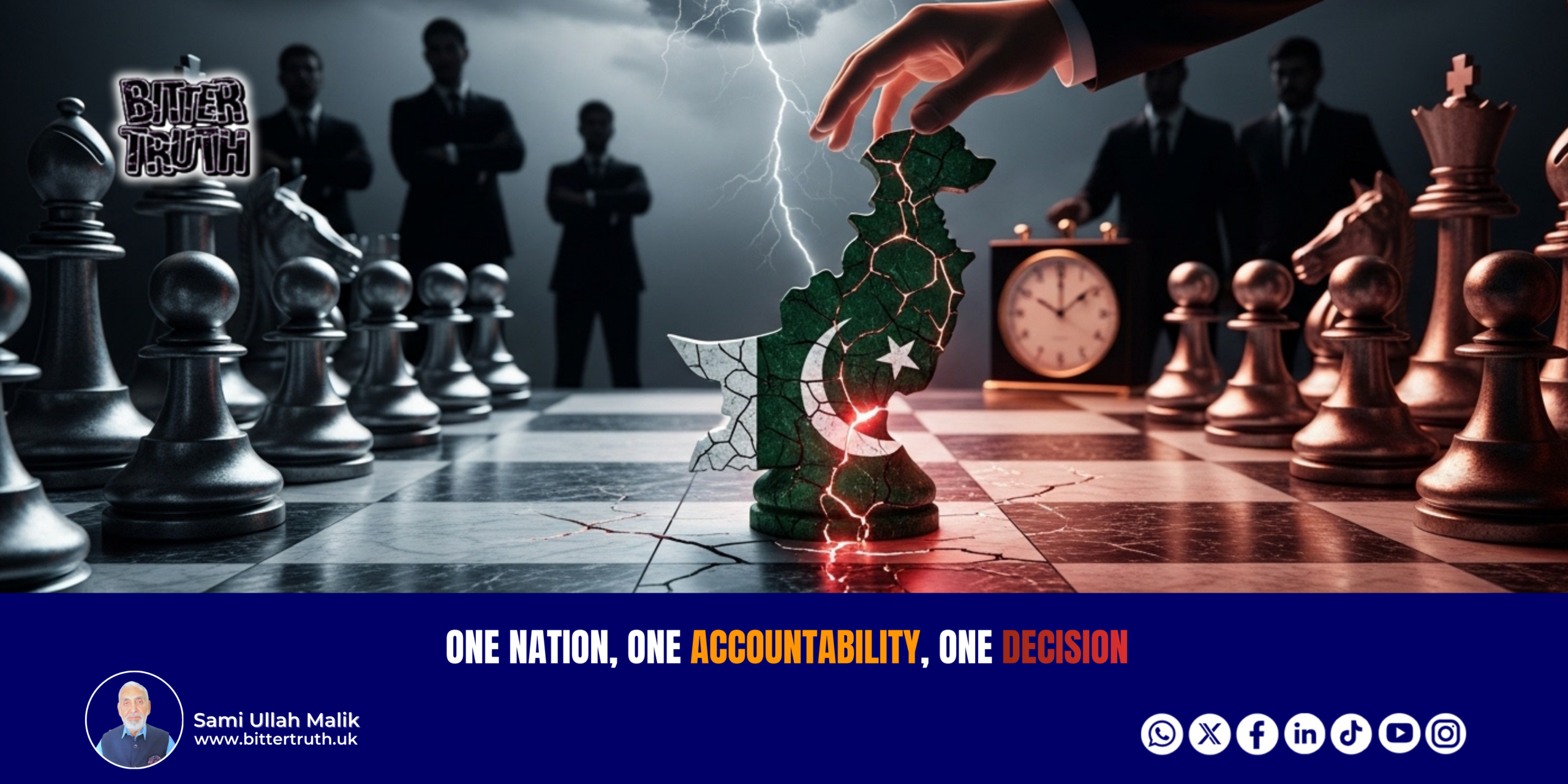
One Nation, One Reckoning, One Decision
A Breathing State, a Whining Conscience

O people of this land—listen well.
This is not an hour for whispers; it is an hour for a clarion call.
This is not a season of comfort; it is a season of questioning.
This is that solemn moment in the life of nations when they are compelled to stand before the mirror of history and speak truth to themselves. It is a juncture at which peoples either seize their destiny with conscious resolve or are thrust—silently yet irreversibly—into the long night of subjugation. When the courage to speak truth is lost, history records silence not as neutrality, but as a confession of guilt.
Today, this land—whose every grain of soil bears the trust of martyrs’ blood, a mother’s prayer, and a child’s unfulfilled dream—lies before us like a gravely ailing patient. Its breath falters; its pulse weakens. Its eyes search desperately for hope, even as they fix upon us with questioning accusation. Its lips tremble, yet no sound emerges.
And let it be said without ambiguity: this patient is neither an individual nor a faction. It is Pakistan.
This condition is no coincidence, no accident, no blind trick of history. It is a consequence—the harvest of misrule, injustice, fear, and the silence we chose in the face of oppression. When justice descends from the throne and conscience is banished from the court, states do not merely weaken; they become living corpses. Today, it is that corpse which rests upon our shoulders, while we turn to one another and ask, with growing dread: What now?
O people! The testimony of centuries is unambiguous: when states fall ill, their wounds are not confined to the economy; they strike at the soul. When nations cease to ask questions, their answers are buried beneath the dust of oblivion. This is the very question that has echoed at every perilous turn of history—before Baghdad was reduced to ashes, before Granada slipped from Muslim hands, before Dhaka was severed from our body. Each time, the same refrain was heard: “Nothing will happen.” Each time, darkness was mistaken for a passing shadow. And when night fully descended, there remained no one left to light a lamp.
Today, Pakistan stands at that same threshold: one step towards renewal, and survival; one step towards ruin, and collapse. Yet questions alone do not save nations—answers do. And answers are given only by peoples in whom courage, character, and faith are alive. Pakistan now stands at the physician’s door where mere ointment will no longer suffice. What is required is surgery; not consolation, but decision; not transient politics, but enduring justice.
When justice grows feeble, truth is smothered, and power is treated as plunder rather than trust, nations hollow from within. That hollowing is now visible across our collective existence. Markets resound with the din of inflation; homes echo with the silence of hunger. In the halls of power, grand declarations are made; in the streets, shattered hopes lie scattered like debris. People meet one another, and before a word is spoken, a sigh escapes—as though every meeting were a rehearsal for a funeral. Every eye asks the same question: What now?
This patient cannot speak, yet its wounds cry out. They cry out through delayed justice, through deserted classrooms and ruined schools, through the groans echoing in hospital corridors; through the farmer’s empty palm and the labourer’s bent back and vacant pocket. These cries are not directed at a single individual; they are an indictment of an entire system—a system that has elevated power above law and wealth above destiny, granting indulgence to the strong while crushing the weak. Remember this well: when injustice becomes routine, resistance becomes a moral obligation.
O custodians of power! History delivers a stern warning: when nations cease to feel pain, their death draws near; and when they feel pain yet remain silent, their death becomes inevitable. Pause—listen carefully. Those breaths you hear are suspended upon your decisions. Attend to the breathing of this patient, for its life depends upon your judgment. These tears are not marginal notes on bureaucratic files; they are pages of history itself, crying aloud that power is not a crown—it is a trust. Betrayal of trust does not merely erase nations from existence; it drags them before the tribunal of history.
Let there be no misunderstanding: this is not a manifesto of despair. It is a revolt of conscience. For when conscience awakens, chains begin to fall of their own accord. This opening is not an announcement of hopelessness; it is a call to awakening. For as long as pain is felt, a nation remains alive.
O sons and daughters of this soil, and you in whose hands rest authority, power, and decision-making:
Today, every person endowed with even the slightest measure of insight stands stunned and restless. Faces have turned into questions; eyes search desperately for answers; and on every tongue the same anxious refrain circulates: What is about to happen? Where do we stand? Towards what darkness is our future being led?
People meet, and before conversation begins, a sigh escapes. Every heart thirsts for good news; every eye seeks a glimmer of hope. They look into one another’s eyes as relatives of a dying patient look towards a miracle—clinging to the hope that some remedy, some master physician, or some earnest prayer might yet restore a flicker of life.
Today, this critically wounded patient has dragged itself, barely alive, to the physician’s door—yet it lacks even the strength to name its illness. The truth is stark: the disease has reached a stage where balm alone is futile; where reassurance is meaningless; where courageous decisions, bitter medicine, and uncompromising accountability have become unavoidable. We have reached the point where prayer must walk hand in hand with surgery. And the longer the delay, the more prolonged, painful, and fatal the operation will become.
This Patient Is Not an Individual — It Is Pakistan
This patient is no single person.
This patient is no party or faction.
This patient is Pakistan.
Wounded, weakened, and writhing in pain, it lies before you like one hovering between life and death—having dragged itself, with its last reserves of strength, to the physician’s door. Yet it is now so depleted that it cannot even name its illness, let alone articulate its suffering. It cannot speak when questioned; but its wounds cry out. It utters no words—only tears. And those tears, those groans, those open wounds are unmistakable.
Each battered limb gestures silently toward its affliction. At times it clutches its head, as though the very faculty of reason has been stripped away. At times it presses a hand to its heart, as though justice itself has expired. At times it covers its eyes with both hands and weeps uncontrollably. And when the physician offers even the slightest reassurance, it begins—through its eyes alone—to beg for mercy, for hope, for the mere continuation of life.
Years of deprivation, injustice, and shattered dreams are etched upon its face, yet its tongue remains mute—as though it no longer possesses the courage to look towards the future. These tears are not merely tears; they are appeals, supplications, and questions—questions now being directed towards its own people and the corridors of power. This is the restlessness of those who feel the pain. Indeed, it is the condition of the relatives of a dying patient—clinging desperately to the hope of a miracle, a healer’s prescription, a master physician’s remedy, or the prayer of a righteous soul that might yet restore a breath of life.
This anguish is not confined to those who merely understand the circumstances; it is borne most heavily by those in whose hearts Pakistan’s pain has hardened into a festering wound. Their sleep has deserted them; their hearts are denied peace. In the stillness of night, when they prostrate themselves before their Lord, sobs overtake their prayers. As they beseech God for the safety of Pakistan, they invoke the memory of the millions of martyrs of this land—those who sacrificed everything for its sake. And then a question, terrifying in its clarity, tears through the heart: What answer shall we give on the Day of Judgement for those pure sacrifices?
O holders of authority, O people of this nation—imagine this:
On the Day of Reckoning, the martyrs of this land will stand before you. They will ask: We gave our lives—what did you give?
Allah the Exalted declares:
﴿وَلَا تَحْسَبَنَّ اللَّهَ غَافِلًا عَمَّا يَعْمَلُ الظَّالِمُونَ﴾
“Do not think that Allah is unaware of what the wrongdoers do.” (Sūrah Ibrāhīm 14:42)
لکھتے رہے جنوں کی حکایات خونچکاں
ہر چند اس میں ہاتھ ہمارے قلم ہوئے
We kept on writing blood-soaked chronicles of madness,
Though the pen, in every age, was held by our own hands.
This condition is not exclusive to those who suffer in silence. History bears witness: those who glimpse an approaching storm before others do not remain quiet. For those who see the tempest in advance, silence becomes a sin. They raise the alarm; they warn; they devote their nights and days, their wealth, their words, their very breath, to averting catastrophe.
My purpose is neither to spread despair nor to cultivate fear. But consider this: if one of your own loved ones were afflicted with a fatal illness, would you sit calmly at ease? Would you not scour the world in search of the finest physicians, the most skilled surgeons? Would you not spend beyond your means? And having done all this, would you not finally fall into prostration and say: O Lord, healing lies only in Your hands?
Then consider this homeland. It is our collective existence—our identity, our recognition, our present and our children’s future. A political mirage and an ever-thickening darkness surround us. With the fall of every government, the people breathe a sigh of relief, hoping that perhaps now conditions will change, perhaps now the darkness will lift. Yet, tragically, the darkness does not recede; it deepens. Inflation has already rendered life unbearable, and on top of it crushing electricity and gas bills have broken the people’s backs. Those who once proclaimed development now avert their gaze in shame.
Allah the Exalted warns:
﴿ وَ اِذَاۤ اَرَدۡنَاۤ اَنۡ نُّہۡلِکَ قَرۡیَۃً اَمَرۡنَا مُتۡرَفِیۡہَا فَفَسَقُوۡا فِیۡہَا فَحَقَّ عَلَیۡہَا الۡقَوۡلُ فَدَمَّرۡنٰہَا تَدۡمِیۡرًا ﴾
“And when We intend to destroy a city, We command its affluent but they defiantly disobey therein; so the word comes into effect upon it, and We destroy it with [complete] destruction.”
(Sūrah Banī Isrā’īl 17:16)
Have you ever reflected whether this apparent indulgence is itself a test? Power is a trust—not spoils of war.
The Messenger of Allah ﷺ said:
“Each of you is a shepherd, and each of you will be questioned about his flock.” (Bukhārī, Muslim)
When nations are deprived of justice, when they abandon raising their voices against oppression, when they grow indifferent to one another’s suffering and confine their prayers solely to personal safety—then even the hands raised for reform lose their effect, and divine assistance is withheld. If the responsibility of justice, governance, and equity is neglected, an answer will be demanded on the Day of Judgement.O decision-makers! This nation is your flock. Its tears will cling to your collars. Remember well: states do not survive without justice.
Allah declares:
﴿إِنَّ اللَّهَ يَأْمُرُ بِالْعَدْلِ وَالْإِحْسَانِ﴾
“Indeed, Allah commands justice and excellence.” (Sūrah al-Naḥl 16:90)
And the Messenger ﷺ warned:
“Beware of oppression, for oppression will be darkness upon darkness on the Day of Resurrection.”
(Muslim)Despair draws perilously close to disbelief—and today this nation is being deliberately driven into despair. Beware: this is the most dangerous weapon of all.
Allah says:
﴿لَا تَقْنَطُوا مِن رَّحْمَةِ اللَّهِ﴾
“Do not despair of the mercy of Allah.” (Sūrah al-Zumar 39:53)
Today, through a calculated design, the Pakistani nation is being pushed into the thickets of despair—so that, once weakened, it may be set upon by ravenous beasts. Remember this well: despair is more lethal than nuclear fallout. History has shown that nations can rise again even after nuclear devastation if hope endures; but despair has claimed lives that wars themselves could not.
The Lamp of Hope
To extinguish the lamp of hope is, in truth, to concede defeat in the battle of life—to abandon the journey before the destination is reached. Pain itself is a sign of life. When blood flows, a person seeks treatment; he looks for means of protection and survival. Only the patient who desires to live survives. Despair is a satanic weapon. Desperation is the very signature of Iblīs. Iblīs is not merely the name of Satan; in the Arabic lexicon, a soul consumed by hopelessness is itself called iblīs.
The Messenger of Mercy ﷺ said:
“Take charge of life, or life will take charge of you.”
And he ﷺ also said:
“The strong believer is better and more beloved to Allah than the weak believer.” (Muslim)
Strength is not confined to muscles alone; it resides equally in resolve, conviction, and character.
Under the weight of conscience, with sincerity and pain, I have raised this call. Now this call must reach those halls where it belongs.
A final call to those in power:
There is still time. Revive justice and fairness. Uproot despair. Treat authority as a trust, not a prize. Return what belongs to its rightful owners. Give the nation hope and direction—and bow before Allah. O holders of authority, remember well: power is a trust, and oppression is a summons to punishment. Authority is not a bounty; it is an amānah. Pause for a moment. Turn your gaze away from your offices, your privileges, your power and your plans—and look instead towards your end.
The Qur’an proclaims:
﴿وَقِفُوهُمْ ۖ إِنَّهُم مَّسْـُٔولُونَ﴾
“Stop them; indeed, they are to be questioned.” (Sūrah al-Ṣāffāt 37:24)
A day is coming when protocol will avail nothing—neither documents, nor narratives, nor institutions. Only deeds will speak. On that Day the question will thunder forth: Are we not answerable before Allah? Was authority not a trust? Do the tears of this nation not shake the Throne? Power is not indulgence; it is a trust. These tears, these sighs, these sobs ascend rapidly to the Throne itself.Even now, if fear of the Hereafter awakens, if justice is revived, if mercy and integrity are proclaimed, this patient can still breathe. And once more, the fragrance of faith of an Islamic society can return to this land.
A Call to the People
And now, O people of this land: keep hope alive. This sermon is not meant for palaces alone—it is for you as well. Have you accepted oppression merely because it does not yet strike you directly? Have you fallen silent out of fear that your turn may come next? Silence and despair are themselves enemies.O people, do not abandon speaking the truth. Reject despair and choose the path of reform. Remember: silent spectators are partners in the crime.
The Qur’an warns:
﴿وَلَا تَرْكَنُوا إِلَى الَّذِينَ ظَلَمُوا فَتَمَسَّكُمُ النَّارُ﴾
“Do not incline towards those who do wrong, lest the Fire should touch you.” (Sūrah Hūd 11:113)
Praying only for one’s personal safety is not enough. Nations are saved through collective prayer and collective reform.
The Messenger ﷺ said:
“When people see an oppressor and do not restrain his hand, it is near that Allah will punish them all.” (Tirmidhī)
If fear of the Hereafter awakens, this very patient—Pakistan—can stand again. But if this moment too is squandered, history will not forgive—and the Lord of the worlds never does.
The Final Reckoning
O people of this land! If these words have pierced your heart, if they have descended upon your chest like fire, then know this: the heart is still alive. Dead nations feel no pain. This is not the time for lamentation; it is the time to rise. If your eyes have moistened, know that hope has not yet died. Nations are revived by this very moisture. This is not the hour for trading accusations—it is the hour for correcting direction. It is time to decide whether we shall remain spectators of history, or become its architects.
Remember well: darkness does not fear a single lamp—it flees from a caravan of lamps.
O those seated in the corridors of power—beware! History does not wait, nor does it forgive delay. It is written in moments of decision. A day comes when neither uniform nor pen, neither seal nor statement will avail. Thrones and crowns are temporary; justice is eternal. A day comes when no protocol, no narrative, no justification will stand—only deeds will speak.
The Qur’anic call still resounds:
“Stop them; indeed, they are to be questioned.”
Prepare for that question, for the tears of this patient rise swiftly to the Throne and shake it to its core. If mercy, integrity, and justice are revived today, this patient will breathe again. If justice is restored today, the state will survive. But if oppression is allowed to endure, the verdict will be delivered in Allah’s court—and if delay persists, the surgery of history will be ruthless. There, no one escapes.
And O people—listen well! This address is not only for the halls of power. Silence and despair are the most dangerous weapons of all. Silence is complicity; despair stands at the threshold of disbelief. If you abandon truth, falsehood will grow stronger. Do not accept oppression merely because it has not yet reached your doorstep—when fire breaks out, it does not ask which street it burns.
Speaking the truth is your duty. Bowing before falsehood is your defeat. Keep hope alive, for without hope, reform is impossible. Collective prayer and collective action alone save nations.
This patient—Pakistan—can still live, can still be saved—if fear of the Hereafter awakens; if justice is adopted as principle and shield; if authority is recognised as a trust; and if the people emerge from the shell of despair and embrace hope.
This is not an ending. This is not the conclusion of a tale. It is the knock of a beginning. It is a declaration. Either we respond to this call and open the door—or history will break it down and make an example of us.
The choice is now in our hands.
May Allah grant us the ability to hear, to understand, and to act.
Āmīn, O Lord of the worlds.