Nuclear Thresholds and the Fragility of Peace in South Asia
Beyond Missiles: The Fragile State of Indo-Pak Relations

Operation Sindoor: A New Theatre in an Old Rivalry
In the dim and uncertain hours between Tuesday and Wednesday, India, invoking what it termed “Operation Sindoor,” launched a series of targeted strikes across the border in Pakistan and the territories administered by it in Kashmir. The stated objective of these actions was to dismantle what New Delhi described as “terrorist encampments” allegedly involved in the recent killing of twenty-six Hindu tourists in Pahalgam. The Indian campaign, spanning from 1:05 to approximately 1:30 a.m., has been portrayed by Islamabad not as a surgical operation but as a blatant act of aggression, wherein mosques and civilian dwellings were reportedly struck with impunity.
This episode, unfolding on the heels of the tragic attack on April 22, 2025, marks yet another perilous crescendo in the long, tumultuous history of Indo-Pakistani relations. In response to the Pahalgam massacre, India accused Pakistan of culpability and, on the 7th of May, unleashed a volley of missile strikes targeting nine sites across Azad Kashmir. According to Indian sources, these were militant hideouts associated with proscribed groups such as Jaish-e-Mohammed and Lashkar-e-Taiba. Yet, Pakistani officials contend that the brunt of these attacks was borne not by militants, but by civilians — thirty-one souls lost, among them women and children, and several mosques and schools reportedly reduced to rubble.
In an emphatic riposte, Pakistan claims to have downed five Indian aircraft, including three Rafale jets — the pride of the Indian Air Force — and intercepted seventy-four drones. Both nations have since engaged in a flurry of accusations, each charging the other with violations of sovereign airspace and provocations through unmanned aerial assaults. India, for its part, purportedly struck installations within Pakistan’s heartland, including a Chinese-manufactured HQ-9BE air defence system stationed near Lahore — a claim, notably, uncorroborated by independent observers.
While Delhi has remained characteristically reticent regarding the exact munitions deployed, Pakistan’s military spokesman, Lieutenant General Ahmed Sharif Chaudhry, alleged that India utilised a varied arsenal across six targets on the operation’s first night alone, executing a total of twenty-four strikes. In swift retaliation, Islamabad asserts that five Indian aircraft and one drone were neutralised in Pakistani airspace — a scenario reminiscent of past skirmishes.
This is not uncharted territory. In March 2022, a BrahMos missile from India strayed into Pakistani Punjab, near Mian Channu. Though it caused no casualties, the incident had nonetheless cast a long and dangerous shadow over strategic stability in the region. India later claimed that the missile had been fired accidentally — a technical error, they said. But Pakistan’s Inter-Services Public Relations (ISPR), represented then by Major General Babar Iftikhar, contended otherwise: the projectile was a supersonic, ground-launched cruise missile — one that penetrated 124 kilometres deep into Pakistani territory and lingered in its airspace for nearly four minutes.
The reverberations of the 2019 Balakot incident, wherein an Indian jet was downed, and the spectre of full-scale conflict loomed, still echo in both military doctrines. Since then, both nations have augmented their arsenals. The Indian Air Force now boasts a fleet of 36 French-made Rafale fighters, while Pakistan has procured at least 20 J-10 multirole aircraft from China, reportedly equipped with PL-15 missiles.
On the subject of aerial defence, India has acquired Russia’s formidable S-400 anti-aircraft system. Pakistan, in turn, has developed a defence apparatus that includes the Chinese HQ-9 series — capable, in theory, of engaging targets up to 260 kilometres away. Yet it was precisely these defences, notably the HQ-9BE unit stationed in Lahore, that Indian strikes reportedly sought to neutralise — though such assertions remain without confirmation from impartial sources.
Notably, the efficacy of Pakistan’s air defences — however advanced in nomenclature — is now under scrutiny. How, critics ask, did such a barrage of missiles evade early detection and interception? Why did automated systems not emulate the performance of systems like Israel’s Iron Dome or David’s Sling, which have become bywords for modern missile interception?
Modern aerial defence is a symphony of precision: radar arrays, missile shields, command-and-control systems, and artificial intelligence must work in seamless concert. Pakistan, for its part, claims to possess a sophisticated network of aerial platforms, medium-altitude defence systems, unmanned combat vehicles, and cyber-electronic warfare capabilities. Yet, in war, as in history, claims alone do not secure the skies.
India, on its side, maintains that it employed its S-400 batteries to thwart incoming Pakistani drones and missiles. Among the intercepted were allegedly several Harop drones — Israeli in origin and once thought nearly invincible — now, Islamabad asserts, humbled in flames over its soil.
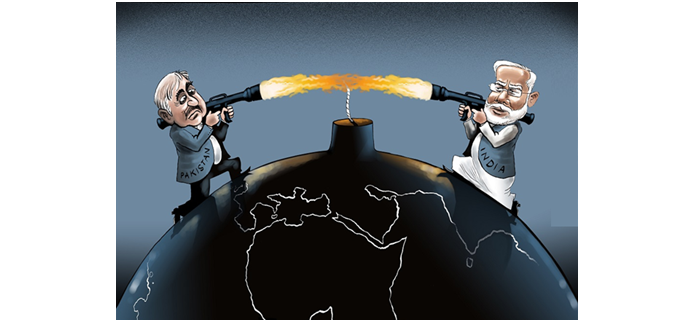
As the fog of war thickens, the line between offensive strike and defensive necessity blurs. What remains irrefutable is this: in the shadow of nuclear parity, even a minor miscalculation can cascade into catastrophe. One must hope — as Palmerston once warned — that the “great game” played by empires and nations does not forget the cost paid by ordinary souls beneath the skies they cannot command.
The Thunder Before the Storm: Pakistan’s Calculated Response and the Prelude to Escalation
In the tempestuous theatre of South Asian geopolitics, where history seldom slumbers and grievances ferment like wine in ancient casks, recent developments have brought the region perilously close to the abyss of open conflict. Following India’s alleged airstrikes deep into Pakistani-administered Kashmir under the banner of “Operation Sandur”, Islamabad’s response—both rhetorical and military—has assumed a tone of grim determination.
Pakistan has claimed the downing of several Indian fighter jets, including three of advanced make, in what it termed a retaliatory act of necessity. While these claims remain beyond the remit of independent verification, the silence from New Delhi—neither confirmation nor denial—speaks volumes, perhaps echoing the axiom that in matters of war, ambiguity may serve as strategy.
At the heart of Pakistan’s aerial rebuttal lies the PL-15E missile, a modern Chinese air-to-air weapon guided by AESA radar, boasting a lethal range exceeding 145 kilometres. Mounted upon the JF-17 Block III and the more sophisticated J-10C, this missile is a potent counter to India’s vaunted Rafale jets. With its “Beyond Visual Range” capabilities, the PL-15E does not merely target an enemy; it asserts air dominance in contested skies, projecting power with cold precision beyond the reach of the naked eye.
Indeed, in a theatre where perception often rivals firepower, the PL-15E has emerged as a symbolic “game-changer”—a phrase oft-bandied, but here meriting its full weight—particularly when the adversary chooses to engage from beyond sovereign airspace.
In a striking tone redolent of Churchillian defiance, Pakistan’s civil and military leadership denounced the Indian strikes as cowardly provocations, vowing a response “at a time and place of its choosing.” Prime Minister Shehbaz Sharif went further, characterising the Indian action as casus belli—a direct act of war—thus raising the spectre of escalation in a region long haunted by nuclear shadowplay.
As the drums of war beat louder, the international community now watches with bated breath. The question looms like Damocles’ sword: Is South Asia poised upon the brink of full-scale war?
Both nations—armed with nuclear arsenals and decades of enmity—have placed their militaries on high alert. Pakistan, in the lexicon of military resolve, has invoked the solemnity of national duty. India, for its part, has fortified its Northern Command. As sabres rattle on either side of the Radcliffe Line, the echoes reverberate through chancelleries in Washington, Moscow, Beijing, and beyond.
While Indian officials have warned of a “massive retaliation” should Pakistan’s countermeasures escalate, Islamabad has taken great pains to distinguish between civilian and military targets. Precision, rather than passion, appears to govern its calculus—striking not at cities but at military depots, not at innocents but at infrastructure.
Thus was born Operation Banyan al-Marsous—a name steeped in both scriptural symbolism and strategic resolve. At precisely 01:50 AM on 10 May, Pakistan executed calibrated strikes against 25 military installations across India, purportedly in direct response to Indian ballistic missiles launched hours earlier from Adampur, all of which failed to cross the frontier.
Using JF-17 Thunder aircraft armed with hypersonic missiles, Pakistan reportedly obliterated India’s S-400 air defence systems at Adampur, and dealt decisive blows to bases in Udhampur, Bathinda, Suratgarh, and beyond. The strikes were, according to Pakistani military sources, not acts of vengeance but of proportionate deterrence.
In an act resonant of Thucydidean symmetry, the point of origin became the point of return. Where missiles had emerged, there missiles were returned. Footage released by Pakistan’s military purportedly shows the very aircraft and systems involved, a gesture both evidentiary and emblematic.
Perhaps most symbolically, Pakistan’s drones reportedly conducted deep reconnaissance over Gujarat and New Delhi—an overt gesture of capability aimed not merely at the enemy’s machinery, but at its very seat of power. The message was unmistakable: We can see you, even when you think we cannot.
Among those struck down was Raj Kumar Thapa, an Indian official accused by Pakistan of abetting repression in Kashmir—a move likely as political as it was tactical.
Now, the hour is grave, and the stakes monumental.
Diplomatic backchannels, though strained, remain ajar. Former Indian High Commissioner Ajay Bisaria has opined that Pakistan’s response was inevitable but cautioned that “the true test will be in how both sides manage the escalation thereafter.” This is the moment, he insists, for diplomacy not as artifice but as salvation.
Strategists across the globe—from think tanks in Washington to seminar halls in London—echo this sentiment. Professor Christopher Clary of the University at Albany warns: “Inaction by Pakistan would be tantamount to inviting further incursions. But action risks entrenching a cycle of retaliation from which neither side can easily withdraw.”
Thus, we stand—once more—on the precipice.
History may yet look upon these weeks as a hinge moment, a grim turning of the page. Whether that page leads to diplomacy or devastation may well rest on decisions taken in midnight war rooms, by men and women who understand that in the great game of nations, there are no true victors in war—only those who survive it.
The Echoes of a Digital Tempest and the Theatre of Modern Deterrence.
In the wake of precision missile salvos that rattled the very marrow of the subcontinental status quo, another theatre of confrontation unfurled—this time in the spectral realm of cyberspace. It was not the thunder of steel nor the wail of sirens, but rather the silent, incandescent blink of terminals that marked the advent of a new front in this perilous rivalry. One by one, the digital bastions of India fell under a cascading tide of calculated intrusion. From the official website of the ruling Bharatiya Janata Party to strategic nodes such as the Indian Air Force and the UIDAI—the very backbone of citizen authentication—the electronic ramparts were not merely breached but rendered into ether. In a dramatic culmination, nearly 70% of India’s power grid was plunged into darkness, as if night itself had risen prematurely upon a land gripped by uncertainty.
What greater testament to Pakistan’s evolving cyber prowess could be conceived than this unbloodied, yet devastating retaliation?
As the dust settled over firewalls and fibre-optic arteries, a different set of questions emerged from within Pakistan’s own intellectual and strategic circles. Chief among them: Does Pakistan possess the capacity to intercept enemy missiles launched from air to ground? This, indeed, is the crucible wherein the mettle of modern deterrence is tested—not in rhetorical bravado, but in technological resilience.
Pakistan’s air defence matrix, fortified with advanced Chinese-origin systems such as the HQ-16FE, has long since evolved from its erstwhile reactive posture. It is now capable of neutralising short-, medium-, and long-range ballistic and cruise threats—launched from terrestrial platforms. Yet, when it comes to the interception of air-launched projectiles—especially those travelling at hypersonic velocities—the truth must be faced with Churchillian candour: No nation, not even the titans of technology—the United States, China, or Russia—can claim full-spectrum invulnerability.
In regions such as South Asia, where geography conspires against time, and borders are drawn closer than a soldier’s breath, the margin for reaction shrinks to the blink of an eye. Missiles fired from airborne platforms, particularly those exceeding Mach 3 or even Mach 9, allow but a fleeting window—barely seconds—for interception. And in such crucibles, perfect defence is not merely improbable; it is an illusion.
Pakistan, to its credit, has responded to recent provocations with composure cloaked in capability. The eastward frontier, stretching over 2,500 kilometres, cannot be hermetically sealed with iron domes. Such a fantasy would bankrupt a nation thrice over. And India, for all its sabre-rattling and theatrical posturing, possesses no greater capacity to halt retaliation than does its rival.
When India allegedly unleashed its wrath on the night of the 6th of May—70 aircraft thundering across the ether, a maelstrom of ordnance trailing in their wake—Pakistan was confronted with a truth familiar to every military historian since Thucydides: in the theatre of war, not every blow may be parried, and not every flame extinguished. That a handful of missiles found their mark does not betray a flaw in doctrine but reveals the cruel arithmetic of war.
Pakistan’s response, by contrast, was swift, surgical, and symbolic. Five Indian aircraft and one unmanned combat drone were brought down—a rebuttal not only in fire but in finesse. This was not the retaliatory tantrum of the aggrieved but the calculated assertion of a sovereign will, steeped in strategic prudence.
Indian media, ever prone to narrative inflation, reported countermeasures such as flares—useful perhaps against infrared-guided threats at modest distances, but utterly impotent against radar-guided missiles like the PL-15. The tragedy, perhaps, lies not in India’s preparedness but in its presumption—that Pakistan would remain tethered to past restraint, that it would not strike within India’s own airspace. They were wrong.
Indeed, the theatre of aerial combat is governed by a law older than any doctrine: once the eagle takes flight, it does not hover in hesitation—it strikes, or it falls. The dogfights that ensue are not confined to radar arcs and pre-plotted intercepts; they are choreographies of chaos, dictated by instinct and honed by the harsh tutelage of necessity.
Thus, what unfolds before us is not merely a clash of arms, but a contest of paradigms—of technologies, of tempers, and of truths. Pakistan, with a mixture of grit and grace, has signalled its capacity not only to endure but to respond with precision, discretion, and dignity.
But let there be no mistake: every skirmish, every salvo, draws us closer to that fateful brink where diplomacy, delayed too long, finds itself drowned by the drums of war. Let it be the wisdom of statesmen—not the wrath of steel—that writes the next chapter of this troubled region.
A Crisis Poised on the Razor’s Edge: Between Escalation and Restraint
If left unchecked, the current chain of events may well become the unwitting prologue to a full-scale war. For the moment, the hostilities, grave as they are, have not surpassed the tremors of 2019. And yet, the incremental rise in tension bears the unmistakable scent of peril. The spectre of hypersonic missiles or sustained cyber warfare looms ominously, threatening to plunge two nuclear-armed states into the chasm of mutual devastation.
One need not summon the ghost of Cassandra to warn us of what lies ahead should the present path be pursued without pause. History, that somber tutor of nations, reminds us how in 1971, and again in the snows of Kargil, it was not martial restraint but timely intervention — from the United States, China, and the United Nations — which stayed the hand of annihilation. Now, with Saudi Arabia entering the fray of diplomacy, the stage is once again set for the prudent voices of the world to step between the horns of this gathering storm.
At the heart of Indo-Pakistani discord lies the festering wound of Kashmir, a dispute more than seven decades old, ossified by blood and obfuscation. India’s unilateral abrogation of Article 370 on the 5th of August 2019 was not merely a legislative manoeuvre but, by any diplomatic measure, a direct repudiation of United Nations resolutions — a decision that, in the eyes of the world, demands scrutiny, not silence. Since then, the line of control has bristled anew, erupting intermittently with the crackle of shells and the thunder of retaliation.
Amidst this cauldron of tension, cyber hostilities — the invisible daggers of the digital age — have emerged as the new frontier of conflict. Incursions, data thefts, and attacks on critical infrastructure signal a troubling evolution of warfare — one that transcends borders and operates in the shadowed margins of legality and sovereignty.
The international community, sensing the peril, has not remained mute. Once again, there are murmurs of mediation, calls for dialogue, and tentative gestures towards détente. And yet, despite all the sound and fury, formal negotiations remain conspicuously absent. It is in this diplomatic vacuum that Track II diplomacy, that discreet handmaiden of statecraft, must rise to prominence.
The ever-looming presence of nuclear arms imposes a strange and sobering equilibrium — a Damoclean deterrent which, by its very threat, curtails the full theatre of war. Both India and Pakistan possess the capacity to retaliate and absorb limited strikes, but neither can afford the suicidal hubris of unrestrained aggression. The price of miscalculation, in this context, is not conquest but cataclysm.
In this fragile balance, the economic question plays an increasingly vital role. The ravages of COVID-19 have already exacted a heavy toll on both nations. A protracted conflict would not merely scorch the soil; it would set aflame the very foundations of the region’s economic stability, driving millions further into poverty, and rendering hollow any talk of national pride.
The hour is late, but not yet lost. In 2019, amid the rumbles of Pulwama and Balakot, it was diplomacy — quiet, persistent, often hidden from view — that shepherded both countries back from the brink. Today, similar efforts stir once again: from Beijing to Riyadh, from Washington to Turtle Bay. It remains to be seen whether these voices will be heard over the roar of jet engines and the hiss of falling bombs.
If either side is willing to take a step back, tensions could ease. The biggest factor preventing both countries from a major war is nuclear weapons, which leaves room for negotiations between the two countries. But at present, there is a lack of formal negotiations between the two countries, but informal channels such as Track Two Diplomacy need to be activated. Both countries, especially the recent effects of Covid-19, have put significant pressure on their economies, and the biggest challenge for the people of both countries is still poverty and inflation. On top of this, the economic effects of further war will push them back decades.
For peace to prevail, someone must step back — not in cowardice, but in wisdom. And should that step be taken, it may be remembered not as a retreat, but as the first stride towards sanity.