New Wars, New Allies, New Equations
The Eastern Alliance and Western Anxiety

Pakistan-China Defence Partnership:
A Strategic Renaissance in the Asian Theatre
In the ever-shifting contours of international relations, Pakistan has emerged once again as a pivotal fulcrum in the balance of global power. Of particular consequence is its deepening defence collaboration with China, which, in light of recent regional tensions, has assumed strategic proportions that transcend the narrow confines of bilateral transactions. What we are witnessing today is not merely an exchange of military wares but the unfolding of a new strategic axis with implications far beyond the subcontinent.
Amid the throes of escalating hostilities between India and Pakistan, the crescendo of which peaked on the 8th of May, the world observed a striking military demonstration: Pakistan’s Air Force reportedly downed six Indian aircraft—three of them Rafales, the much-vaunted crown jewels of India’s aerial fleet. What lent this moment its defining gravity was not just the victory itself, but the very instruments that enabled it: Chinese-built J-10C fighters, PL-15 air-to-air missiles, and the now-celebrated JF-17 Thunder, co-produced by Pakistan and China.
This encounter unfolded as a veritable ‘live-fire defence expo’, a term not coined lightly. Within forty-eight hours, Chinese defence firms such as AVIC Chengdu Aircraft Corporation and NORINCO saw their stock valuations surge by a remarkable 36%. Global investors, military strategists, and policymakers alike took note: Chinese military technology had proven itself not in sterile laboratory conditions but in the crucible of actual combat.
Pakistan’s pivot towards China is neither novel nor impulsive; it is the culmination of two decades of gradual strategic realignment. Once a staunch ally and recipient of Western military hardware, Pakistan, post-2000, found in Beijing not only a willing arms supplier but a political ally, an economic partner, and a co-architect of regional deterrence. Chinese weapons, renowned for their cost-efficiency, technological sophistication, and diplomatic pliability, have proved uniquely suited to Pakistan’s geostrategic and budgetary realities.
The Sino-Pakistani defence nexus now encompasses advanced aircraft like the J-10C, a 4.5-generation fighter rivalling the French Rafale; the PL-15, a beyond-visual-range missile with a striking range exceeding 200 km; and the Wing Loong series of drones used for surveillance and precision strikes. More significantly, the JF-17, a symbol of indigenous innovation fortified by Chinese collaboration, continues to evolve through its Block III iteration, positioning itself as the backbone of Pakistan’s air defence architecture.
This relationship is not unidirectional. NORINCO’s ongoing cooperation with Pakistan’s domestic arms producers reflects a broader ambition: the indigenisation of military technology through joint research and co-production. In doing so, Pakistan is not merely purchasing security; it is cultivating self-reliance and regional ascendancy.
What transpired in May was more than a skirmish; it was a symbolic contest between two global defence paradigms. On one end stood India, flanked by Israeli Harop drones and French Rafales; on the other, Pakistan, fortified by the emergent might of Chinese technology. The latter prevailed, and with that, a tremor reverberated through the halls of Western defence contractors. The message was unmistakable: the monopoly of Western arms in defining modern warfare had been irrevocably challenged.
It is therefore unsurprising that, following the conflict, a remarkable diplomatic ballet unfolded behind closed doors. While President Trump publicly cited the spectre of nuclear conflict to justify his call for an immediate ceasefire, it is now evident that a more intricate calculus was at play. Behind the veil of de-escalation, China and the United States quietly concluded a major trade accord in Geneva—a dramatic lowering of tariffs and a pause in the economic hostilities that had long gripped the two giants.
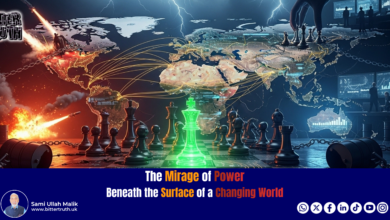
Analysts contend that Pakistan’s military prowess, showcased in tandem with Chinese ingenuity, served as the trigger. The battlefield had, in essence, become a diplomatic chessboard. Through a singular military engagement, Pakistan reminded the world—and particularly the West—that it remains a central node in the calculus of peace, war, and power. In Churchillian terms, “Never has so much been said by so many about so few”; for a few minutes of aerial dominance reshaped global narratives, altered investment flows, and redefined strategic partnerships.
China, a nation that has not engaged in large-scale warfare for over four decades, has not been idle. With the patience of a Confucian sage and the precision of a Sun Tzu strategist, it has quietly amassed a military-industrial complex now ready to rival the West. Pakistan, in this unfolding tableau, is both beneficiary and exemplar—the stage upon which China’s martial resurgence is being dramatized.
This is not merely a tale of weapons and warplanes; it is the story of a new global equilibrium in the making—a parable of preparation, partnership, and purpose. The fall of a Rafale was not the end of an aircraft; it was the eclipse of an era.
And so, the world watches anew.
A Theatre of Alliances, Shadows of Steel, and the Ghosts of Empire
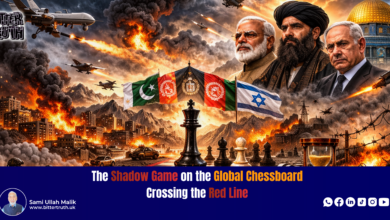
In the shifting sands of geopolitics, where alliances form not in parlours of diplomacy but in the smoky calculus of strategy, India’s burgeoning military intimacy with Israel has emerged as a chapter both troubling and instructive. Far from symbolic, this partnership has become a steel-bound reality, evidenced by the deployment of Israeli-origin Harop “kamikaze” drones against Pakistani targets—machines of silent death that carry within them not only explosive payloads, but the heavy weight of geopolitical provocation.
The introduction of Israeli weaponry into an already volatile theatre has inflamed passions beyond conventional military logic. In Pakistan, the public’s outrage—already kindled by the brutal suffering of innocents in Gaza—flared into a storm of indignation. The use of Israeli drones was not seen as a mere tactical decision but rather as a deliberate alignment: a Hindutva-Zionist axis, perceived by many as an affront to the collective Muslim conscience. What ensued was not merely a battle of arms, but of ideas, identity, and historical memory.
In the bazaars of Lahore, the madrassas of Karachi, and the drawing rooms of Islamabad, a singular question echoed with increasing fervour: “Is this not the resurrection of a modern-day colonial pact aimed at subjugating the Islamic world?” The sentiment found resonance far beyond Pakistan’s borders, as the spectre of Israeli-Indian military cooperation reverberated across the wider Muslim ummah.
Faced with such provocation, Pakistan did not merely issue rhetorical warnings. It articulated a bold and deeply consequential posture: that any attack upon its sovereignty, aided by Israeli technology or expertise, would grant it the moral and strategic prerogative to respond directly. This declaration was not a bluff—it was a calibrated pronouncement from a nuclear state, and therein lay the rub.
For Washington and its Western cohorts, this marked the edge of the abyss—the proverbial “red line” beyond which the risks of escalation grew exponentially. A nuclear Pakistan, provoked into a retaliatory doctrine that includes Israel, was a scenario no Western planner wished to imagine, let alone confront.
Amid this storm of steel and semantics, another question loomed large: Would Pakistan, emboldened by its strategic efficacy, now lean ever more heavily upon Chinese military technology? The answer, it seems, is writ not in ink, but in iron.
The future lies in deepening symbiosis. Pakistan is no longer content with being a customer at China’s military bazaar; it now seeks to become a co-architect. The JF-17 Thunder—a symbol of this bilateral engineering renaissance—is set to evolve into its next generation, perhaps under the banner of “Block-IV” or even “JF-20”. Furthermore, eyes are now turned toward the J-31, a fifth-generation stealth fighter, poised to redefine air superiority in South Asia.
But hardware alone does not define hegemony. Pakistan’s defence ecosystem—comprising PAC Kamra, HIT Taxila, and NRTC Haripur—is being restructured into a self-sustaining fortress, nourished by Chinese technical wisdom. Joint exercises like the Shaheen series and growing cyber-warfare collaborations suggest that this partnership is fast evolving from transactional to transformational.
Yet to understand China’s ascent, one must look not only at the tip of the sword but also at the mind that wields it.
China’s Grand Doctrine: The Sword in the Scabbard
Unlike the West, which often confuses motion for progress and aggression for strength, China has mastered the art of stillness that contains latent thunder. It has followed, unwaveringly, the principles of its ancient strategist Sun Tzu: “To subdue the enemy without fighting is the acme of skill.” For over four decades, China has waged no major war; yet its military has not slept—it has meditated, modernised, and metamorphosed.
Its strategy is not of spectacle but of inevitability. The People’s Liberation Army has not needed to fire to dominate; it has needed only to exist convincingly. Its advancements in drone warfare, cyber capabilities, space militarisation, and hypersonic missile systems—especially the DF-17—are not mere upgrades; they are warnings, spoken in the austere language of deterrence.
In the South China Sea, where imperial maps once floated above gunboats, China now commands one of the world’s largest navies. Its (A2/AD (Anti-Access/Area Denial) doctrine ensures that no adversary may enter its maritime sphere without grave peril. Its radar systems, electronic jamming technologies, and stealth aircraft form an invisible wall—silent, unseen, but impenetrable.
China’s war doctrine, if war must come, is swift and surgical: strike first, strike hard, and strike across all domains—land, sea, air, cyber, and space. The goal is not victory through attrition but supremacy through shock.
As Pakistan increasingly aligns itself with this doctrine, it signals a regional order in which the old certainties of Western dominance are increasingly vulnerable to erosion. China and Pakistan, through their synchronised doctrines, offer a new model—one that blends Confucian patience with Islamic resilience, technological edge with strategic subtlety.
This is not merely a military evolution. It is a civilisational reawakening—a tectonic shift wherein the heirs of empires long deemed dormant now stir, speak, and, if needed, strike.
The Shadow War of Giants — And the Dawn of a New Strategic Order
The Chinese leadership, seasoned in the art of statecraft and well-versed in the follies of rash belligerence, has long understood that a direct military confrontation — especially with the United States — would exact an unacceptable economic and political toll. In its stead, Beijing has adopted the quieter but no less formidable instruments of cyber warfare and proxy conflict, where influence is exerted not by the clash of steel but by the silent hum of servers and the calculated extension of economic tendrils.
It is within this grand strategic design that China’s alliance with Pakistan must be interpreted. By arming its southern ally with advanced weaponry, China has, in effect, acquired a strategic proxy in South Asia — one capable of absorbing the tremors of conventional war while Beijing itself remains poised in the background, its interests guarded not merely by its arms, but by its allies. This policy, subtle yet astute, is emblematic of a doctrine that believes not in constant combat, but in cultivating such potent strategic leverage that war becomes redundant — and victory, cerebral.
China’s model is not one of domination through fire and fury, but of intimidation through competence. True strength, as the old adage goes, lies not in the ability to strike but in commanding such formidable presence that the adversary surrenders in apprehension alone. Pakistan, if wise, would do well to imbibe this doctrine, nurturing in its own military, economic, and technological spheres the same depth, resolve, and sophistication.
Were one to distil four decades of Chinese strategic doctrine into a single maxim, it would be this:
“Do not go to war, but if war must come, do not let the enemy recover.”
This is no mere rallying cry — it is a philosophical scaffold, supporting the weight of China’s military posture, foreign policy orientation, and defence readiness.
Since the 1979 war with Vietnam, Beijing has eschewed direct confrontation, choosing instead the path of quiet readiness. But let no man mistake this restraint for passivity. In truth, China has been rearming with relentless precision, preparing not for yesterday’s wars, but for tomorrow’s domains — cyber, space, and beyond.
In this latest Indo-Pakistani flare-up, Turkey — as ever, a brother in spirit and policy — stood firmly by Pakistan, not merely with declarations but with joint naval drills that preceded the conflict. These manoeuvres, symbolic yet potent, conveyed a message to New Delhi and its allies: any miscalculation at sea would be met with irreparable reprisal. The mere mobilisation of India’s naval fleet was tempered by this prospect, for they well understood that Pakistan’s naval missile systems possess the precision and swiftness to pursue and dismantle entire carrier groups before they could pose a credible threat.
Turkey’s emergent defence industry, notably through its Bayraktar TB2 drones, missile systems, and submarine technology, has matured beyond national confines. No longer serving Turkish interests alone, it now stands as a pillar of trust for allies such as Qatar, Azerbaijan, and other Muslim nations — a testament to Ankara’s ascent in the global defence arena.
The depth of Sino-Pakistani military collaboration today is not merely a bilateral affair; it is a model for others. It provides strategic equilibrium vis-à-vis India, but more importantly, it offers a replicable framework for nations such as Saudi Arabia, Egypt, and Nigeria, who increasingly view this partnership as a viable alternative to Western dependency.
Parallel to this, Iran — despite being encircled by sanctions and subjected to geopolitical isolation — has pursued a determined course of military self-reliance. Its progress in missile technology, drone warfare, and naval defence has not only fortified its own deterrence but has also empowered its allies in Yemen and Hezbollah, extending the arc of influence in spite of sectarian fissures.
Indeed, amid the fragmentation of the Muslim world, a quiet constellation of military alliances is beginning to emerge. Turkish-Pakistani defence agreements, the Qatar-Turkey military axis, joint Iranian-Iraqi security forums, and Saudi training collaborations with Pakistan and Jordan are threads weaving a tapestry of a new Islamic defence bloc. This is not mere coincidence, but rather a structural response to the growing entente between Israel and India.
As Tel Aviv supplies New Delhi with advanced military systems, the reaction within the Muslim world has been neither impotent nor disorganised. Instead, it manifests in an awakening — a quest for indigenous capability, collective security, and shared strategic purpose.
What is taking shape is a new architecture of power within the Islamic world — no longer reliant on the arsenals of the West or the umbrella of Moscow. The future lies in a sovereign, Eastern, interdependent defence complex, reshaping not just regional dynamics but altering the strategic calculus of global powers.
Gone are the days when the Muslim world was merely a consumer of Western weaponry, reliant on the caprice of foreign manufacturers. The emergence of China, Turkey, Iran, and Pakistan as self-reliant defence innovators has disrupted this asymmetry. Their rising capabilities portend a new equilibrium, a recalibration of hard power within the Muslim world.
Pakistan, through its recent military campaign, has not merely asserted its defence capability but has also served as a catalyst for China’s quiet ascendancy. The message, however muted, has been received in the corridors of Washington and Brussels alike: this alliance is not to be trifled with.
And so, despite political turbulence, economic headwinds, and media bias, Pakistan remains relevant — and shall remain so. For it occupies not only a geographical fulcrum but a strategic soul in the great Asian theatre.
Let it be said, and understood clearly:
1. Pakistan must deepen its strategic partnership with China, not merely as a recipient, but as a co-architect of regional defence.
2. Alternatives to Israeli military alignments must be explored, lest the imbalance grow fatal.
3. Joint military training and production institutions with China must be established, integrating knowledge, design, and deployment under one roof.
4. And to the West, a clear signal must be sent:
Pakistan is no mere pawn in the game of empires — it is a pillar of regional security and a sentinel of peace.