
Merchants of Interest and Wayfarers of Power
The Vessel of Politics upon the Waves of Time

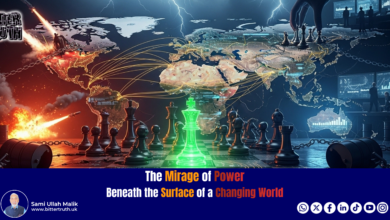
The politics of the world is in truth an ocean whose waves never rest in stillness. It is here that the tempests of power, the whirlpools of interest, and the insatiable hunger of nations carve fresh landscapes at every hour. This is the great chessboard of humanity, where the pawn of yesterday is enthroned as the sovereign of today, and today’s monarch may tomorrow be reduced to a feeble foot-soldier. A glance across the pages of history reveals but one lesson, recited century after century: in the realm of international politics there is no friendship eternal, nor enmity ordained forever. The Qur’an had long disclosed this inexorable truth:
وَتِلْكَ ٱلۡأَيَّامُ نُدَاوِلُهَا بَيۡنَ ٱلنَّاسِ (آل عمران: 140)
“Such days We deal out in turns among mankind.” (Āl ʿImrān, 3:140)
This single verse lays bare the timeless logic of history. Power and weakness, rise and fall — all are but the changing turns of passing days. Once Rome and Persia held the sceptres of the world, yet their ruins now stand as mournful relics for the wayfarers of time. Once the lamps of Granada illuminated the breadth of Europe, yet its arches now weep only with the tears of blood.
World politics is thus nothing but the perpetual game of shifting balances and revolving interests. Alliances are fleeting, hostilities transient; the abiding reality is interest alone. The friend of yesterday may prove the adversary of today, and today’s foe may tomorrow walk beside one as a companion in destiny. The subcontinent’s present condition offers a living theatre of this eternal axiom.
India, self-anointed as a rising global power, now finds itself poised at so delicate a juncture that every path thrusts it into a river of trial. The United States — long Delhi’s most significant commercial and military partner — has begun to let a coldness course through its veins. China, once the very nemesis of India’s soul, now extends the handshake of amity with a smile. And Russia, the comrade of decades past, knocks again at Delhi’s door, sometimes remembered, sometimes forgotten.
For India, this is no ordinary circumstance. On one hand, she has long relied upon America to prop her faltering economy, only to find her breath constricted by tariffs and trade barriers that have imperilled millions of livelihoods and pierced the bubble of the capitalist miracle. On the other, her borders with China are yet raw with fresh scars, and yet she is compelled to speak words of friendship to the very neighbour who drew blood in the valley of Galwan. Meanwhile, Russia — once slighted, then rediscovered — re-enters the Indian discourse as if to cover up an earlier neglect.
Iran too, erstwhile supplier of cheap oil, was cast aside at the merest nod from Washington. Should similar pressures be applied upon Russian oil, Delhi’s economy may well be brought to its knees.
At this hour, India has begun to realise that to lean upon a single mighty pillar in the global edifice is to embrace political suicide. What statesmen call “diversification of alliances” has become not merely prudent, but indispensable.
And yet the question endures: is such a path within Delhi’s grasp? Can China and Russia truly fill the void left by America’s retreat? Can Washington ever rekindle its lost warmth? Can Delhi repose its trust in a neighbour that has so recently shed its soldiers’ blood? Can the frost of neglect in Russo-Indian ties be thawed to its former vigour? And can Washington, ever mercantile in its calculus, once again be the friend it seemed in the days of Trump?
Under Donald Trump’s presidency, India approached America with uncommon ardour. The camaraderie was trumpeted across continents, and in grand public gatherings Prime Minister Modi — in a note of unseemly flattery — proclaimed “My best friend Trump”, as though offering to the nations a certificate of his triumphant diplomacy. Yet now, a chill has settled over that romance. America has made it plain: our friendship is no unqualified passion, but a transaction, a bargain struck in the marketplace of interests.
By suspending trade negotiations indefinitely, Washington has delivered its verdict: “On the chessboard of global powers, no partnership is eternal.” Thus Delhi, chastened, casts its gaze once more toward its ancient adversary — China.
The recent rigours of America were unforeseen in India’s corridors of power. Delhi was ill-prepared for the realisation that Washington speaks not only in the accents of friendship, but also in the piercing tones of a tradesman who prizes profit above sentiment. The White House has shown a different face: behind the smile of the ally, the cold eyes of the merchant. And this is the bitter irony — that India, who believed the gates of Washington would forever remain open, now stands disillusioned before the stern doors of reality.
On the great bazaar of commerce, America stands as India’s foremost partner. In the $133 billion annual trade, Delhi counts the very breaths of its economy. Diamonds, pearls, pharmaceuticals, textiles, and electronic goods — all lean heavily upon the American market. Yet that very market now holds its gates half-closed, forcing Delhi to ponder: was it ever wisdom to place all eggs in one basket? For when tariffs and barriers dammed the once-flowing river of trade, millions of livelihoods found themselves imperilled.
As the sharp blade of tariffs fell upon these exports, the wheels of industry began to slow. Orders were cancelled, contracts suspended, and over the heads of countless workers dangled the sword of unemployment. Once Delhi prided itself on an economic miracle; now that miracle appears to shatter at a mere stroke of Washington’s pen. Cancelled orders, suspended exports, idle factories — these are the footsteps of decline echoing at India’s door.
The blood shed upon the stony heights of Galwan in 2020 still poisons the relationship between India and China; it has congealed upon the icy rocks, a frozen reminder of distrust. That clash was not merely an incident; it was a wound upon the artery of confidence. Yet the logic of politics admits of no permanence: Delhi now stretches forth its hand to those very fingers that once laid its soldiers in the dust. The shifting tempests of world affairs compel Delhi to knock at the gates of Beijing — the same Beijing it had once declared the gravest peril to its security.
These are the ironies, the inexorable reciprocities of fate, wherein Delhi casts its gaze upon the same China that yesterday spilt its blood upon the frontier but today sings the melodies of reconciliation.
The Modi government too has known moments when the old comrade, Russia, was cast aside and left in neglect. But today Delhi feels afresh that without Moscow its diplomatic chamber remains incomplete. The journeys of Ajit Doval and later S. Jaishankar to Moscow stand as tacit confessions of regret. Now Delhi seeks once more to knock at Russia’s door — belated though the attempt may be. Jaishankar’s most recent visit to Moscow is but one chapter in this endeavour.
Nor was the visit of the Chinese Foreign Minister, Wang Yi, to Delhi a matter of mere formality. It was a message writ plain: “Though we be adversaries, we are neighbours still, and we must discover the paths to coexistence.” Both nations sought to salve old wounds by agreeing upon the resumption of trade, the supply of minerals and fertilisers, the re-opening of direct flights, and the easing of visas. It was, as it were, the first gentle ripple upon the frozen waters of a cold estrangement.
In 2019, under American pressure, India ceased to buy oil from Iran. It was a decision akin to economic suicide: Tehran was near, its oil was cheap, yet Delhi sacrificed this lifeline at Washington’s signal. Should similar coercion fall upon Russian oil, Delhi’s economy would in effect strike an axe against its own foot, scattering like a fragile house of cards.
The frontier between China and India remains among the most intractable in the world. The most formidable obstacle to genuine reconciliation lies here: the border disputes unresolved. Until this knot is untied, the river of trust cannot flow. Though the two nations have met time and again at the conference table, no decisive progress has ensued. Hence the tree of confidence has yet to strike its roots. Let it be remembered: this is the very dispute that once drove them to war, and its shadow still hangs over every overture of peace.
Another element must not be forgotten in America itself there resides a sizeable following of the RSS. These voices will, in one form or another, continue to exert pressure for the preservation of Indo-American ties. Yet the pressing question remains: can such pressure restore the solidity of old? Political reality suggests otherwise — that the harmony of the past is unlikely to return for many years to come.
The United States is the world’s mightiest power, the largest economy upon the globe. India cannot abandon it. But it is equally true that Delhi has invested in Washington’s system more than in any other; and that investment now weighs as a burden. Delhi’s hands are tied; it is compelled to endure Washington’s cold indifference. Yet the trust and stability that once bound them have already dissolved.
At this point, a question of profound consequence arises: amidst this shifting diplomatic theatre, where does Pakistan stand? If Delhi inclines toward Beijing and Moscow, is Islamabad seizing the moment to transmute opportunity into diplomatic capital? This, then, is the challenge to the powers-that-be: how shall Islamabad play its cards? In this great game, where indeed does Pakistan stand?
The Qur’an reminds us with solemn clarity:
وَتِلْكَ ٱلۡأَيَّامُ نُدَاوِلُهَا بَيۡنَ ٱلنَّاسِ (آل عمران: 140)
“Such days We deal out in turns among mankind.” (Āl ʿImrān, 3:140)
The lesson is manifest: the days of power alternate, sometimes in the hands of one, sometimes of another. Pakistan must prepare for the coming days, that the turn of fortune may be turned to its advantage. And again, the Qur’an enjoins:
وَأَعِدُّوا لَهُم مَّا ٱسۡتَطَعۡتُم مِّن قُوَّةٖ وَمِن رِّبَاطِ ٱلۡخَيۡلِ تُرۡهِبُونَ بِهِۦ عَدُوَّ ٱللَّهِ وَعَدُوَّكُمۡ (الأنفال: 60)
“Prepare against them whatever force you can, and steeds of war, whereby you may strike fear into the enemies of God and your enemies.” (Al-Anfāl, 8:60)
Thus does Revelation remind the nations: vigilance, strength, and preparedness are the prerequisites of survival in a world where no alliance is eternal, and no foe forever vanquished.
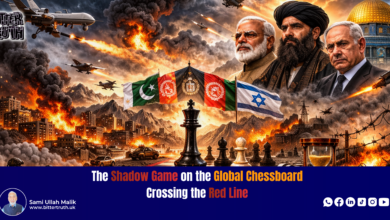
Pakistan must anchor its diplomatic and defensive bearings upon that eternal principle revealed by Heaven itself, so that upon the shifting chessboard of the region it appears not as a pawn to be manoeuvred, but as a player of dignity and resolve.
These questions are not India’s alone; they concern the entire subcontinent. For every move in Delhi creates for Islamabad both opportunities and dangers. This is the moment for Pakistan to marshal its cards in foreign policy with precision. Should Delhi incline towards Beijing, Islamabad must discern to whom the balance tilts. Should Delhi knock upon the gates of Moscow, Pakistan must decide how to secure its own place in Russian relations. And should Delhi seek once more the warmth of Washington, Islamabad will have to recalibrate its strategy anew.
This is also a moment of solemn instruction for the Muslim Ummah. The Qur’an declares:
وَأَعِدُّوا لَهُم مَا ٱسۡتَطَعۡتُم مِّن قُوَّةٖ (الأنفال: 60)
“And prepare against them whatever force you are able.” (Al-Anfāl, 8:60)
This verse reminds us that the theatre of world politics is not merely a play of words, but a trial of strength and preparedness. Only that nation which arms itself with readiness plays upon the board with honour; the unprepared are relegated to the footnotes of others’ decrees.
India today stands at a crossroads: on one side the unreliable hand of America, on the other the overtures of China and Russia. The choice must be Delhi’s, but the rest of the region — above all Pakistan — must seize the occasion to broaden and deepen its foreign policy. History’s verdict is plain: the nations that endure are those who can alter their step with the turn of time.
India’s present foreign policy is like a traveller lost in the wilderness of diplomacy. Three paths lie before him — America, China, Russia — yet each path is strewn with thorns and haunted by mirages. The American road seems paved with wealth yet veiled by the mists of mistrust. The Chinese road promises hope, yet its stones are still stained with blood. The Russian road is old and familiar, yet covered with the dust of neglect, awaiting the broom of renewal.
Delhi must at last comprehend the axiom: in the game of power there are no perpetual friends, only perpetual interests. This is no mere aphorism of Western sages; it is the very essence of Islamic thought. The Qur’an proclaims:
﴿لَن يَضُرُّوكُمۡ إِلَّآ أَذٗىۖ وَإِن يُقَٰتِلُوكُمۡ يُوَلُّوكُمُ ٱلۡأَدۡبَٰرَ ثُمَّ لَا يُنصَرُونَ﴾ (آل عمران: 111)
“They will not harm you except for a little annoyance; and if they fight you, they will turn their backs and they will not be helped.” (Āl ʿImrān, 3:111)
This is a declaration against all who deem themselves invincible: on the board of God’s dominion, no power is everlasting.
For Pakistan, the moment demands that diplomacy not be confined to the politics of reaction, but elevated to the politics of initiative and foresight. Islamabad must ask itself: in the changing balance of power, where does it stand? If Delhi draws nearer to Moscow and Beijing, Pakistan must consolidate its own position lest it be consigned to the margins. If Washington embraces Delhi anew, Pakistan must hold its balance with wisdom.
This is the hour when nations do not survive by dreams but by discerning realities. Pakistan must recognise the truth: that to live upon the chessboard of world politics demands trust in one’s own resources, confidence in one’s unity, and absolute reliance upon one’s faith.
India stands at a fateful junction: three roads, each perilous.
America: the richest power yet wrapped in the fog of unreliability.
China: the nearest neighbour yet shadowed by the stains of blood.
Russia: the oldest friend, yet its friendship rusted and in need of renewal.
This is Delhi’s trial. In the game of power there are no permanent friends, only permanent interests. But for Pakistan, this is the opportunity. The question is whether Islamabad shall seize it, or once more be condemned to the margins as a spectator of others’ designs.
Remember: only those nations live in history who triumph in the examinations of their age. India is caught in such a trial today. For Pakistan, the question is whether it can transform that trial into an opportunity. Should it shape its policy with wisdom and resolve, this moment may herald a new chapter in its history. Should it squander the occasion, it will remain but a footnote in the pages of others.
The Qur’an concludes with the sovereign truth:
إِن يَنصُرۡكُمُ ٱللَّهُ فَلَا غَالِبَ لَكُمۡۖ وَإِن يَخۡذُلۡكُمۡ فَمَن ذَا ٱلَّذِي يَنصُرُكُم مِّنۢ بَعۡدِهِۗ (آل عمران: 160)
“If Allah helps you, none can overcome you; but if He forsakes you, who is there that can help you after Him?” (Āl ʿImrān, 3:160)
Here lies the ultimate lesson: the salvation of nations rests not in diplomacy alone, but in faith, in unity, and in unwavering resolve. For India, this is a crisis; for Pakistan, it may yet be an opportunity.