Libya’s Shadow and Pakistan’s Choice: Arms, Law, and Geopolitics
Power, Arms, and Libya: Pakistan at the Crossroads

Libya: A Tragedy, an Accord, and the Trembling Chessboard of Global Politics
The military history of Libya has once more been inscribed upon the sombre margins of tragedy, as though fate itself had dipped its quill in ink darker than night. The nation’s Chief of General Staff, General Muhammad Ali Ahmad al-Haddad, together with several senior commanders, perished in an air disaster that has shaken the already fragile edifice of the Libyan state. For nearly a decade and a half, Libya has been ensnared in a labyrinth of political disarray, military fragmentation, and persistent international intervention. Since the fall of Muammar Gaddafi’s regime in 2011, power has ceased to repose in a single sovereign centre, and parallel structures of authority have emerged in the east and west, like twin shadows cast by a broken sun. Against this unstable backdrop, the recent air crash — together with the defence pact with Pakistan — assumes an extraordinary significance.
According to initial reports, General Muhammad Ali Ahmad al-Haddad was travelling aboard a Falcon-50 jet. Barely sixteen minutes after take-off, a request for an emergency landing was transmitted; moments later, the aircraft vanished from the radar, as if history itself had closed the page upon it. This was not merely the death of an individual; it marked the obliteration of an entire circle of Libya’s military command. On that ill-fated flight journeyed not just one general, but an entire chapter of Libyan military leadership. Among those accompanying him were the Commander of the Land Forces, Lieutenant General Futuri Garibel; the head of the Military Manufacturing Corporation, Brigadier General Mahmoud al-Qattawi; the Adviser to the Chief of General Staff, Muhammad al-Aswi Diab; and the General Staff’s photographer, Muhammad Umar Ahmad Mahqib. These were not names alone; they were vertebrae in the backbone of Libya’s military structure. A loss of this magnitude inevitably carves an immediate vacuum in any state’s martial order and governance.
General al-Haddad had served as Libya’s Chief of General Staff for more than five years. His persona symbolised discipline, institutional loyalty, and the dignity of the uniform; he was widely regarded as a comparatively non-political soldier. Although his early life remains veiled behind the curtain of obscurity, it is well-acknowledged that he served in various capacities within the Libyan armed forces prior to the 2011 rebellion. He played a conspicuous role in nurturing military and strategic relations with Türkiye — ties that were gradually shaping the trajectory of Libya’s new defence orientation.
His most prominent contribution lay in widening the arc of military and technical cooperation with Türkiye, which became a principal pillar of Western Libya’s security strategy. Thus, this calamity was not merely the result of a technical malfunction; it was, in a deeper sense, a symbolic moment within the long procession of history. The Libya once ruled, with iron centrality, by Muammar Gaddafi since 1969 was swept away in the winds of the Arab Spring in 2011. NATO-backed interventions shattered the bricks of Tripoli and splintered the nation into rival centres of authority — a division that has etched itself upon Libya’s destiny to this day.
Gaddafi’s forty-two-year rule (1969–2011) fashioned Libya into a powerful yet highly centralised state. The Arab Spring, assisted by external intervention, broke that central pillar; yet no stable national structure arose in its stead. Consequently, the country has remained vulnerable to civil strife, armed factions, and the unrelenting tug-of-war of foreign influence.
The Falcon-50 in question, produced in 1988, was not Libyan state property; it had been leased
from an Africa-based company registered in Malta. This fact lays bare Libya’s growing reliance on private contracting within sensitive military logistics — a trend that inevitably provokes questions of transparency, accountability, and national security.
Turkish authorities reported that the wreckage was discovered in a rural area nearly 105 kilometres from Ankara, scattered across a span of two kilometres — a grim testament to the ferocity of the crash and suggestive of catastrophic technical failure. It was as though the pride of power had been cast down and shattered upon the earth.
The Prime Minister of Libya’s internationally recognised Government of National Unity, Abdul Hamid Dbeibah, described the tragedy as a “great loss to the nation”. In his words, Libya had lost those who had served the state with loyalty and integrity — a statement resonant not merely with condolence, but with the sombre echo of national continuity and unity. At a juncture when Libya is already beset by institutional fragility, this message carried the weight of both lament and resolve.
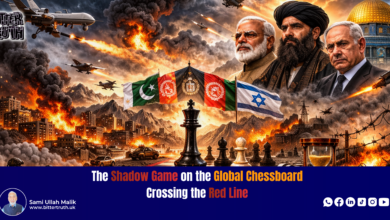
This disaster unfolded just as another development was circling the horizon of international politics: the defence agreement between Pakistan and Libya, valued at over four billion US dollars. This was no ordinary commercial transaction; it represented a fresh angle in the geometry of global power.
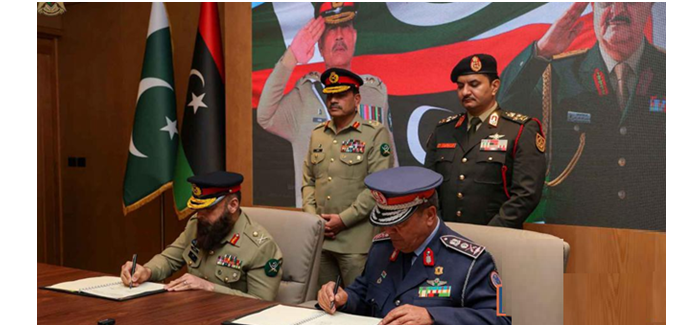
Only two days prior to the accident, news emerged of the defence accord between the two countries — among the largest defence export arrangements in Pakistan’s history, and a potential gateway to enhanced Pakistani military presence in North Africa. Under the agreement, reported to span two and a half years, Pakistan is to supply Libya with land, naval, and air defence equipment — including multi-role JF-17 fighter aircraft and Super Mushshak trainer planes. These very aircraft, produced through Pak-China collaboration, have become emblematic of low-cost yet versatile combat capability. The final number of JF-17 units, however, remains shrouded in ambiguity.
According to four Pakistani officials, the accord ranks among the most substantial defence export deals in Pakistan’s history, finalised in Benghazi between Pakistan’s Chief of the Army Staff, Field Marshal Asim Munir, and the Libyan National Army’s Deputy Commander-in-Chief, Saddam Khalifa Haftar. The venue itself — Benghazi, in eastern Libya — serves as a signal that Pakistan has, in practical terms, forged direct military channels with Eastern Libya.
Owing to the sensitivity of the matter, Pakistani officials declined to reveal their identities, while both the Ministry of Foreign Affairs and the Ministry of Defence opted for a strategic silence. That silence was not without reason, for since 2011 Libya has been subject to a United Nations arms embargo. Although in December 2024 UN experts described this embargo as “ineffective”, legal and ethical questions remain suspended in the air like unanswered echoes. This posture signifies that the matter is not merely commercial; it is profoundly strategic.
At this juncture, the Qur’anic warning seems poignantly apposite:
﴿وَتِلْكَ الْأَيَّامُ نُدَاوِلُهَا بَيْنَ النَّاسِ﴾
“And such are the days We alternate among mankind.”(Surah Āl-ʿImrān 3:140)
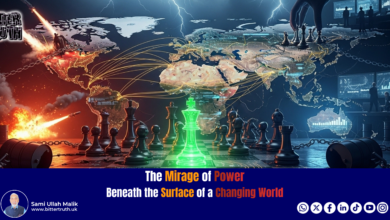
History, it appears, continues its solemn rotation — exalting some, humbling others — while nations stand upon a trembling chessboard, their pieces vulnerable to both fortune and folly.
Since 2011, Libya has been subject to a United Nations arms embargo, under which any transfer of military equipment requires prior UN authorisation. In December 2024, UN experts described this embargo as “ineffective”; nevertheless, its legal validity still formally endures. The official media of the Libyan National Army (LNA) has confirmed defence cooperation with Pakistan, encompassing the sale of weapons, joint training programmes, and military preparedness. Haftar termed it the inception of “a new phase of strategic military cooperation” with Pakistan.
According to a UN panel, several foreign states — despite the embargo — continue to provide training and assistance to both eastern and western Libya. In this context, Pakistan maintains that it has violated no restrictions. On the other hand, the government of Abdul Hamid Dbeibah in western Libya enjoys United Nations recognition, while Haftar’s LNA controls the east and south of the country, including the major oil fields. This division raises searching questions about the legal and moral standing of defence agreements — a tale of two powers, one nation, and an unending crisis.
The LNA’s media channels reiterated confirmation of defence cooperation with Pakistan, while Haftar once again declared that a “new strategic phase” had commenced, involving arms sales, joint training, and military preparedness.
Pakistani officials argue that the agreement does not infringe the UN embargo, and that Pakistan is by no means the only state engaged in defence cooperation with Libya. In their view, increasing oil exports have brought Benghazi closer to the Western world, altering the diplomatic geometry of the region.
For several years, Pakistan has pursued a deliberate strategy of expanding defence exports and consolidating its footing in global arms markets. Its defence industry now spans aircraft manufacturing, armoured vehicles, weapons systems, and naval construction. Decades of counter-insurgency experience, growing self-reliance in defence production, and the Air Force’s performance during clashes with India in May have all become assets in Pakistan’s defence diplomacy and marketing. According to Field Marshal Asim Munir, Pakistan’s leadership cited the Air Force’s performance in those engagements as illustrative of its modern capabilities — a display that thrust Pakistan’s contemporary military competence onto the world stage. The confidence thus accrued is now translating into defence exports.
Pakistan is not only advancing strategic defence partnership with China; it is simultaneously widening security ties with the Gulf states — particularly Saudi Arabia and Qatar. The defence agreement concluded with Saudi Arabia in September 2025 represents another link in this growing chain, positioning Pakistan as a regional security partner of consequence.
Pakistan presents the JF-17 as a cost-effective, multi-role fighter — a strategic product that offers training, maintenance, and operational autonomy outside the Western supply chain. This very feature renders it especially attractive to developing nations. The agreement with Libya may significantly expand Pakistan’s influence in North Africa, where global powers are arrayed in competition over oil, security, and political leverage.
Defence ties with the Gulf are deepening further; Pakistan is extending cooperation with both Saudi Arabia and Qatar. The September 2025 agreement with Saudi Arabia stands as a telling example of this trend, portraying Pakistan as an emerging pillar of regional security architecture.
Yet an unavoidable question arises: will the global arms cartels regard this deal as a challenge to
their long-entrenched dominance? History bears austere witness that whenever the balance of power is disturbed, the shadows of intrigue lengthen. The aircraft that vanished from the radar may, therefore, not have represented merely an accident; it may have traced upon the horizon of world politics a line revealing the intricate nexus of power, interest, and history. In international affairs, it is far from inconceivable that major arms deals invite political pressure, legal entanglements, or indirect resistance. History is replete with such precedents, narratives of conspiracy, and illustrative analogies.
Pakistan’s emerging role in North Africa is thus unmistakable. The agreement with Libya signifies an attempt to establish firm footing in a region where global and regional powers vie for influence over oil, security, and geopolitics. This development may pose a potential challenge to the traditional arms manufacturers who have long dominated African markets.
The Libyan military tragedy and the Pakistan–Libya defence agreement have together raised new questions concerning regional security, the politics of global arms, and the practical relevance of UN sanctions. For Pakistan, the agreement constitutes both an economic and strategic opportunity; yet it simultaneously necessitates unwavering vigilance with regard to legal transparency, diplomatic equilibrium, and the long-term regional consequences.
Pakistan’s defence industry is, for the first time, emerging as a visible and direct strategic actor in North Africa. However, Libya’s internal divisions, the vested interests of international arms monopolies, and the continued — though weakened — UN embargo render this trajectory particularly delicate.
For decision-makers, the central challenge lies in maintaining a judicious balance between economic gain and international legal obligations; ensuring that defence exports do not become the harbinger of diplomatic isolation; and presenting Pakistan as a responsible, reliable, and principled security partner.
It is only prudent to assume that Pakistan’s defence institutions are diligently shaping their policies in the light of this evolving situation. Yet within these circumstances, attention must be devoted to certain aspects of legal clarity and documentary safeguards.
First, Pakistan must ensure that at every stage of defence agreements, legal opinions relating to UN arms restrictions are preserved in written form, so that its position is not weakened before any future international forum. Although the embargo has been declared “ineffective” by some experts, Pakistan should nevertheless maintain discreet channels of communication — backdoor diplomacy — with relevant UN bodies, in order to pre-empt potential disputes.
Second, to insulate agreements from political volatility, defence cooperation should be institution-based rather than personality-based. Linking arrangements to enduring institutions rather than transient factions will ensure that any internal political changes within Libya do not render the agreements void or inert.
At such a moment, one is reminded of the Qur’anic admonition:
﴿فَاعْتَبِرُوا يَا أُولِي الْأَبْصَارِ﴾
“So take heed, O people of insight.”(Surah al-Hashr 59:2)
For history does not merely narrate — it summons the discerning to reflection, prudence, and responsibility.
Thirdly, while Pakistan may, out of strategic necessity, cultivate avenues of cooperation with the Libyan National Army in the East, it must, in the same measured breath, preserve a diplomatic equipoise with the United Nations-recognised government in Western Libya, lest it be branded as the partisan ally of one belligerent against another. Prudence counsels balance; wisdom demands restraint.
Fourthly, defence exports ought not to be reduced to the mere vending of armaments. Rather, the architecture of engagement should encompass capacity-building in its fuller sense—training, maintenance, and technical assistance—thus transforming transactions into partnerships and contracts into long-term strategic relationships.
Fifthly, the JF-17 should not be showcased merely as an aircraft but projected as a strategic emblem of sovereign ingenuity. The recent skirmishes between Pakistan and India—wherein these very aircraft were employed with consummate professionalism—have left many in the international community struck with astonishment at the élan and discipline of Pakistan’s military aviators. It is therefore imperative that such platforms, along with other defence materiel, be presented to the world as symbols of affordable self-reliance and technological confidence.
Sixthly, Pakistan’s policy regarding Libya must remain attuned, through discreet consultation, to the diplomatic sensibilities of Saudi Arabia, Qatar, and the United Arab Emirates, in order to avoid becoming ensnared in the cross-currents of regional rivalries.
Seventhly, Pakistan must enunciate an explicit National Arms Export Policy Framework, wherein human rights, internal stability, and the dictates of international law are not mere rhetorical ornaments but formal criteria governing state policy.
Eighthly, a strategic communication plan should be devised so that the global media and influential think tanks may perceive and present Pakistan as a responsible actor—law-abiding, stability-seeking, and conscious of its obligations within the community of nations.
Ninthly, the likelihood of non-state pressure and the leverage of powerful international arms cartels must not be underestimated. A vigilant legal team, an agile diplomatic network, and reliable commercial partners should be kept pre-emptively engaged to forestall coercion and to navigate turbulent waters with steady hand and clear conscience.
These timely measures notwithstanding, our gaze must turn with equal earnestness toward a sober assessment of risks. We may have to confront not only the interpretive ambiguities of United Nations sanctions and the necessity of explicit legal cover, but also diplomatic headwinds—criticism from Western powers or human-rights constituencies. To meet these challenges, proactive narrative-building and carefully prepared diplomatic clarification are not optional luxuries; they are strategic necessities.
It is foreseeable that regime change within Libya will be invoked to brandish political anxieties and to sabotage any prospective agreements with Pakistan. There will be clamour that weaponry may fall into non-state hands; selective moral outrage will be paraded as universal principle. Yet it is known—indeed too well known—what provenance much of the weaponry in global conflicts has borne. We need not travel far for illustration: the modern arsenal discovered in the hands of extremists emerging from Afghanistan stands as stark testimony.
Financial architecture, too, is seldom neutral. International financial institutions—often subject to geopolitical pressures—may first seek suspension of agreements, and failing that, resort to delaying payments, thus inflicting extraordinary commercial injury. It is therefore incumbent upon Pakistan to adopt phased delivery schedules and robust financial guarantees to shield such agreements from deliberate attrition.
The lessons of history admonish us that adversaries will again endeavour to link Pakistan’s name with instability. Our institutions must, even now, craft and carry a compelling narrative of responsibility and state maturity, ready to meet proxy politics with principled neutrality and multidimensional diplomacy. Preparation must precede contest.
The Libyan tragedy and any prospective defence agreement are not mere episodes—no accidental footnotes to history. They are emblematic of twenty-first-century politics of armaments of contested sovereignty, and of shifting global power. For Pakistan, they constitute both an opportunity and a trial. Should we proceed with prudence, legal scruple, and diplomatic balance, this moment may anchor Pakistan as a responsible global defence partner; mishandled, it may prove a misstep upon the uneven terrain of world politics.
In such matters, the Qur’anic counsel resounds with particular resonance:
﴿وَكَذَٰلِكَ جَعَلْنَاكُمْ أُمَّةً وَسَطًا﴾
“And thus We have made you a community justly balanced.”(Al-Baqarah 2:143)
And again:
﴿وَلَا تَبْخَسُوا النَّاسَ أَشْيَاءَهُمْ وَلَا تَعْثَوْا فِي الْأَرْضِ مُفْسِدِينَ﴾
“Do not diminish what rightfully belongs to people, nor roam the earth sowing corruption.”
(ash-Shu‘arā’ 26:183)
Between power and principle, between opportunity and responsibility, lies the narrow bridge of balance—and upon that bridge nations are tested.