
Kashmir: A Testimony Written in Blood
O Nations of the World, When Will You Awaken?

“The Kashmir Dispute: A Bloodstained Chronicle of Struggle and Betrayal”
“O ye eyes of history, attend! This tale is not merely an addendum to the dusty annals of empire — it is a chronicle etched in blood, penned by the silent tears of a forsaken people. Each page laments in the language of pain, and every silence resounds with the cry of a nation undone.”
I. Historical Prologue: The Promise Betrayed
When the Indian subcontinent, long shackled beneath imperial chains, stirred at last to the tremors of liberation, the year 1947 arrived not merely as a calendar event but as a defining rupture in the political destiny of South Asia. The Partition of India was not conceived as a mere division of land but as the enactment of a solemn principle: that regions with a Muslim majority would rightfully accede to the newly created Dominion of Pakistan.
This principle — sanctified by demographics, demanded by history, and propelled by the ideological force of the Two-Nation Theory — was not a whimsical assertion, but the very bedrock of Pakistan’s raison d’être. Yet, in the idyllic valleys of Kashmir, where the muezzin’s call echoed over a 99% Muslim population, shadows of betrayal had already begun to descend.
II. The Shameful Sale: The Treaty of Amritsar (1846)
Let it not be forgotten — and may British posterity recall with disquiet — that the roots of Kashmir’s bondage lie not merely in communal discord, but in the sordid ledgers of imperial commerce. In the year 1846, under the cold gaze of colonial self-interest, the British Crown sold the princely state of Kashmir to Gulab Singh Dogra for a paltry sum of seventy-five lakh Nanak Shahi rupees. Thus, was signed the Treaty of Amritsar — not a treaty between nations, but a transaction of human souls as though they were chattel.
The act remains an indelible stain on the conscience of the Empire. As the Persian sage Saadi once lamented, “He who trades in men, trades away humanity itself.” In that grim barter, Kashmir became the ill-fated pawn in a game whose board was drawn in London, and whose consequences would be suffered for centuries.
III. The Myth of Accession: Fabrication Dressed as Fact
With the sun of independence rising on the 14th of August 1947, princely states were granted the right to accede either to India or to Pakistan. The Dogra ruler, Maharaja Hari Singh, initially hesitated — not out of a principled neutrality, but in the hope of preserving his own dominion amidst the looming disarray.
However, when the people of Kashmir, with voice and vigour, demanded accession to Pakistan, the Maharaja capitulated to Delhi’s overtures and, under duress, signed the so-called Instrument of Accession on 26 October 1947 — notably after Indian troops had already landed in Srinagar. This was not an act of sovereignty, but a retreat in panic, staged as legality.
IV. The Testimony of Alfred Schofield: Truth from an Englishman’s Pen
The celebrated British historian Alfred Schofield, in his seminal work “The Disputed Legacy,” casts grave doubt on the authenticity of the Accession. In language as restrained as it is revealing, he notes:
“No authenticated original instrument exists in the official records of the British Empire or the Indian dominions.”
Thus speaks the conscience of the very Empire that once held the quill of law in these matters — revealing that the claim of legal accession may be, at best, an apocryphal legend woven in New Delhi’s bureaucratic looms.
Epilogue to the Prologue
The tragedy of Kashmir did not commence with the crackle of gunfire or the march of troops — it began with a betrayal of principles, wrapped in the rhetoric of legality, sanctified by imperial indifference, and perpetuated by silence. What was promised as the birth of freedom soon revealed itself as the stillbirth of justice.
“Kashmir, thou art not a mere land between mountains. Thou art the echo of broken promises, the cradle of defiance, and the cemetery of peace. If the world remains silent, then history shall not.”
The Kashmir Conundrum: A Tragedy Betrayed by the Silence of Power –
And so it came to pass — no plebiscite, no justice, no reckoning. The great powers — the United States, Britain, France — who once stood beneath the noble banners of the United Nations and pledged to guarantee the right of self-determination to the Kashmiri people, have since allowed those solemn promises to wither into the brittle pages of history. In the grand chambers where once echoed the ideals of liberty and equity, now resounds only the hush of compromise. Kashmir remains, still, ensnared in the rusted chains of a subjugation cloaked in silence.
Why this delay? Why this diplomatic inertia in the face of moral catastrophe?
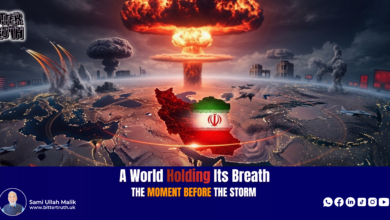
South Asia — that volatile crucible of ancient civilisations and modern ambitions — stands alone as the world’s most densely nuclearised region. Here, two rival atomic states — Pakistan and India — stare across a contested frontier, weapons poised, fingers trembling over triggers. China, the ascendant dragon, breathes ever closer, locked in a silent contest for dominance. Russia, the old bear of the north, prowls through Central Asia with its arsenals in tow. Iran, on the cusp of nuclear capability, watches from the periphery, its presence unnerving Western chancelleries and Tel Aviv alike.
Within such a perilous theatre, Kashmir is not a mere conflict — it is a live ember, one that, if stoked, could incinerate an entire continent in radioactive fire.
And yet, there are those among the powers who seem to prefer this ember to glow — not extinguished but contained — so that the crisis may continue to justify their interventions, their intelligence outposts, and their geopolitical gamesmanship. To solve Kashmir would be to lose a bargaining chip, a diplomatic lever, an excuse for armed presence.
The betrayal of Kashmir is not born of oversight; it is crafted by design.
The United States and its Western allies have embraced India as a strategic bulwark against a rising China. To press New Delhi too hard on Kashmir would risk driving it into Beijing’s open arms. Such is the cynical calculus of modern statecraft.
India, the world’s largest arms importer, is a golden goose in the war economy. The United States, France, and Russia feed greedily from this trough. To resolve Kashmir would be to quieten the cannons — and who, then, would purchase the weapons of peace?
The United Nations, that weary old institution of once-glorious intent, now shackled by the vetoes of its five sovereign titans, has no means to enforce its own resolutions — they are but parchment, solemn yet impotent.
And so the delay festers. But delay is no neutral act; it is complicity in disguise.
Each passing day of diplomatic dithering amplifies the peril of nuclear miscalculation. Each year of silence consigns more Kashmiri children to orphanhood, more families to grief, and the region to the edge of conflagration.
In 1965, when the Pakistani army unleashed a storm upon its adversary, the world shuddered. The Tashkent Declaration, signed upon Soviet soil, promised calm. But again, India reneged. Once more, pledges fell like leaves in autumn — crumpled and forgotten.
In 1971, in the tragic unravelling of East Pakistan, India’s covert hand, through the machinations of RAW, sowed the seeds of division. In 2015, Narendra Modi, standing in Dhaka, shamelessly proclaimed this perfidy: “We supported the Mukti Bahini; we split Pakistan.” It was a blatant breach of international law, met with the UN’s deafening silence and the world’s averted gaze.
Then came the dream of the China-Pakistan Economic Corridor — a silk road reborn, from Gwadar to Kashghar. This vision awakened imperial anxieties. The QUAD alliance — comprising the United States, Japan, Australia, and India — was conjured not for peace but as a siege. And Pakistan, for daring to partake in sunrise, is now punished by shadows.
February 2019: Indian jets dared cross into Pakistani airspace. In response, Pakistan’s eagles rose — swift and resolute. Within hours, an Indian MiG-21 lay shattered, its pilot captured, then returned — a gesture of magnanimity met with global admiration. Days later, Pakistan struck its own targets — precision, restraint, resolve. The message was clear: the balance had shifted.
Meanwhile, across the icy heights of Ladakh, China, sensing India’s ambitions to sever CPEC through covert means, cemented its hold. Defence Minister Rajnath Singh would later admit — 36,000 square kilometres of Indian-claimed territory now lay under Chinese control.
Russia, a merchant of arms and an old friend to India, continues its commerce with calculated indifference.
Iran looms, its nuclear breath held behind a curtain of sanctions, its posture shaking the Middle East like a slumbering colossus.
Amid this dangerous constellation, Kashmir is not a frozen dispute — it is a dormant volcano. And if it erupts, the ash will not stop at the Himalayas; it shall reach the halls of New York and London, of Brussels and Riyadh.
The world, it seems, is no longer a witness but a bystander — indifferent, if not complicit. The same powers who once signed their names beneath the UN resolutions now watch from the stands, their consciences dulled by convenience and coin.
In Europe, the sovereignty of Ukraine sparks outrage, embargoes, and arms deliveries. But in Kashmir, where an entire population remains garrisoned and gagged, the response is but a litany of statements — hollow, hesitant, and hopelessly late. This double standard has not gone unnoticed by the Muslim world, where anger and disillusionment fester like an untreated wound.
One is left to wonder: if the conscience of the world lies buried beneath realpolitik, then perhaps the blood of Kashmir shall one day stir it awake.
For more than seventy years, the people of Kashmir have borne the yoke of broken promises. Over 100,000 lives have been sacrificed at the altar of justice deferred. And still, the question echoes in the halls of history:
How long must this injustice endure?
And to the architects of this moral duplicity, history shall ask:
When your children read the chronicles of our age, will they be proud of the silence you inherited — or shamed by the cowardice you bequeathed?
Of Rafale Shadows and the Rising Tempest
Lo! The spectre of ambition once again stirred within the palatial corridors of New Delhi. Prime Minister Modi, stung by the humiliation of aerial defeat, cried aloud with characteristic anguish: “Had we possessed the Rafale fleet, we would have redrawn the map of this region!” And thus, with little delay, India hastened to dispatch an order for thirty-three of France’s finest warbirds, seeking to crown itself as the undisputed sovereign of South Asia. Yet fate — that ancient adversary of arrogance — had penned a different script.
As seventy of these airborne titans thundered into the skies, poised to unleash inferno upon the land of the pure, they forgot that for every design of the Devil, Providence dispatches a counterforce of the Divine. A voice echoed across the valleys and peaks:
“O History, take up thy pen once more —
for the sulphurous stench of gunpowder is in the air,
the scarlet sheen of blood stains the clouds,
and the mists of deceit once again seek to veil the sun of truth.”
From the crags of the Himalayas to the crescent shores of Gwadar, every heart in the subcontinent trembled, not merely with fear, but with foreboding. For two nuclear titans stood once more at the precipice — on one side, Pakistan, a bastion of resolve; on the other, the swaggering scion of Gujarat, Modi, the butcher cloaked in diplomacy.
May 2025 bore witness to yet another grim trial — a crescendo of Indo-Pakistani tension that rattled the very tectonics of global conscience. Besieged by domestic turmoil — agrarian protests, economic decay, and the steady advance of an emboldened opposition — the Modi regime defaulted to its oldest trick: war for the ballot. A manufactured outrage in Occupied Kashmir served as the pretext; the usual finger pointed, predictably, towards Pakistan.
India’s airspace incursion was met not with panic, but with precision. The Pakistan Air Force, rather than merely retaliating, demonstrated a calculus of superiority that confounded analysts and adversaries alike. India’s stealth technology crumbled beneath the gaze of Pakistani radars. Several aircraft were downed; high-value military sites in India came under surgical strike. Once again, as fate would mock repetition, an Indian pilot was taken captive — the second “Abhinandan” of his nation’s hubris.
With defeat setting in, India’s diplomatic lifeline arrived — not from New Delhi, but Tel Aviv. Israeli advisers swiftly pressed Washington into action. The United States, under pressure from its Zionist ally, leaned on Islamabad and New Delhi alike, choreographing a ceasefire under the guise of preserving peace. Let it be stated unequivocally: Pakistan agreed not out of weakness, but in honour of peace.
President Trump, initially aloof, dismissing the matter as a “bilateral issue,” was forced into motion only when India’s narrative collapsed. Thus, the ceasefire — not as triumph, but as a salvaging operation for a government unravelling before its people.
Meanwhile, within India, public pressure bore down on the Modi regime. Elections loomed, and across television screens and town halls echoed a single lament: “Pakistan has shattered our illusion of supremacy.” Desperation breeds recklessness. The Indian government, once again, appears to flirt with another assault, this time supported by drone acquisitions from Israel, satellite intelligence from the United States, and financial overtures to the Gulf — particularly the UAE and Saudi Arabia.
Reports now confirm that three colossal aircraft of the U.S. Air Force have landed at India’s Jaipur base — ostensibly under the guise of joint security, though astute minds interpret them as a deterrent to Pakistani retaliation. As a dear friend and strategic thinker mused, “Just as Diego Garcia holds bombers poised for Iran, so too does Jaipur now serve as a shield — not of defence, but of coercive equilibrium. An attack on these aircraft would be an attack on the American flag.”
Pakistan now finds itself at a decisive crossroads. With strategic options on the table — some of which may not leave the region unscathed — a sobering reality has dawned: Israel and India have been sent a message, clear and stern. This time, Pakistan may not sheathe the sword so easily.
Two emergency meetings have been called in Islamabad. Important decisions have been made. The hourglass bends, but the sand has enough power to suffocate the enemy
The Global Chorus: Between Silence and Strategy
Saudi Arabia and the UAE, long-standing partners in Pakistan’s economic and strategic fabric — particularly in the context of CPEC — are caught in a bind. Should Modi proceed with further aggression, these nations must choose diplomatic aloofness or silent affirmation. History, alas, leans towards the latter.
The United States continues its delicate dance. On one hand, it celebrates India as a bulwark against China; on the other, it reassures Pakistan of partnership. In the event of renewed hostilities, Washington’s likely play is to enforce a ceasefire before Pakistan can exact a military reckoning — a desperate attempt to salvage Modi’s waning credibility. But this time, perhaps, it is already too late.
The Modi Doctrine: Bluster, Betrayal, and the Shadow of the Bomb
The air in South Asia is once more dense with cordite and consequence. Modi’s every syllable teeters on the precipice of calamity. Let none mistake Pakistan’s forbearance as fragility. Ours is a yearning for peace — but peace with dignity.
Kashmir’s soil, soaked in the blood of martyrs, cries for justice. And now the hour draws near when the world must decide: Will it heed that call, or once again cloak itself in the hypocrisy of selective compassion?
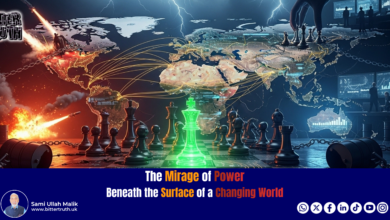
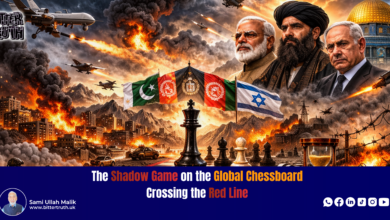
Four nuclear powers gaze at one another across the chessboard: Pakistan, India, China, and Russia — and Iran now stands at the nuclear threshold. This is the only region where a spark may ignite an apocalypse. To leave Kashmir unresolved is not merely a diplomatic failure — it is a moral catastrophe, a betrayal of the very idea of civilisation.
Do the powers that be truly seek peace? Or does war remain their most profitable enterprise?
In the Muslim world, alas, the voice of unity has long been hushed. But the Kashmiri people persist — their resistance a spiritual flame, undimmed by the silence of nations.
And so, let it be recorded in the annals of history:
“If the conscience of the world lies dormant,
then the blood of the Kashmiris shall stir it once more.”
📜 Conclusion — A Cry Echoing Through Conscience
The United Nations resolutions on Kashmir clearly support the inalienable right of self-determination for the Kashmiri people. Yet, due to the political expediencies of global powers and the chronic impotence of the UN itself, these promises to remain unfulfilled—words etched on cold paper, betrayed in practice.
It is no longer the time for silence or symbolism. The global community, and especially the United Nations, must now either honor their pledges or be recorded by history as deceivers, betrayers, and opportunists cloaked in the garb of diplomacy.
The Kashmiri people still await justice—yearning for a dawn promised to them decades ago. And the onus of action lies squarely with the world’s so-called defenders of human rights and justice. Let it be known ignoring Kashmir is not just a diplomatic failure, it is a moral collapse—a stain on the conscience of humanity.
If the world truly desires peace, then it must abandon its double standards and enforce the very resolutions it once championed. This is not merely a regional crisis; it is a test of the international system’s integrity.
Remember: If the valley of Kashmir is silent today, that silence could erupt into an irreversible storm tomorrow. A day will come when history itself will ask:
“Why did you not grant the Kashmiris their right? Why did you break your promises?”
O nations of the world!
If you still possess a living conscience, then hear the cry of the oppressed from Kashmir.
If not, prepare to answer to the tribunal of history, where no diplomacy, no alliance, and no wealth will shield you.
O nations of the world!
Will you awaken only when this land turns to ash?
The oppressed of Kashmir now stand at the threshold of time.
Will your halls of justice echo even a single note of their tears?
O Valley of Kashmir!
You are not alone.
This flame of dawn, lit with your blood, shall one day pierce the darkness—
and rise as the harbinger of freedom.
In shā’ Allāh.