Islam in the American Political Conscience: A Forgotten Legacy
Islam and Citizenship in the Making of the American Republic

Fate and Foresight – The Forgotten Islamic Roots of American Liberty
It may come as a revelation to many that Thomas Jefferson — the third President of the United States and principal author of the Declaration of Independence — not only possessed a copy of the Qur’an but also envisioned Islam as a legitimate and vibrant thread in the fabric of American civic life. Far from being a mere collector of the exotic, Jefferson regarded Muslims as prospective citizens of the nascent American republic and sought to enshrine their rights within its legal and moral order.
Indeed, eleven years before he would etch his name into history by penning America’s Declaration of Independence, Jefferson had already acquired his personal copy of the Qur’an — a two-volume English translation now housed with solemn reverence in the Library of Congress. That very copy stands today as both a historical artefact and a symbolic bridge between the intellectual forebears of America and the enduring presence of Islam. For American political philosophers of integrity and curiosity, this intersection remains of profound relevance.
Jefferson’s ownership of the Qur’an serves not merely as a token of intellectual engagement with Islamic teachings, but as part of a broader inquiry into universal rights and the moral structure of society. His earliest acquaintance with Islamic notions of liberty and justice did not emerge in isolation but was influenced by the writings of the 17th-century English philosopher, John Locke. It was Locke who first urged European societies to embrace the presence of Jews and Muslims, not as foreigners, but as equal members of the civic body — a notion rooted in the footsteps of even earlier moral pioneers.
Jefferson’s vision for Muslim inclusion, therefore, cannot be viewed in isolation but must be understood as a continuation of an intellectual current that flowed steadily across the Atlantic between the 16th and 19th centuries — a current which reshaped the philosophical contours of citizenship, conscience, and coexistence.
As Europe grappled with internecine strife between competing Christian sects, some thinkers turned to the figure of the Muslim as a kind of moral litmus test: Could a society, fractured by dogma, rise to the challenge of tolerance — even toward the theological ‘Other’? This very question soon travelled westward and began to animate political discourse in America, where the Muslim — long before arriving on its shores — became the focal point of an abstract but urgent debate: Where do the boundaries of citizenship lie, and who is deemed worthy of protection under its umbrella?
In 1784, at his Mount Vernon estate, General George Washington laid bare his convictions regarding Muslims with characteristic candour and civility. Responding to a letter from a friend in Virginia who sought a carpenter and mason for the construction of a home, Washington replied with a clarity that cut through the parochial prejudices of his time. The religious creed, sectarian affiliation, race, or origin of an artisan, he declared, ought to be of no consequence. A master craftsman might hail from Asia, Africa, or Europe. He might profess Christianity, Judaism, Islam — or adhere to no religion whatsoever. In these words, seemingly mundane yet profoundly significant, one perceives the broad contours of Washington’s moral and civic imagination — an imagination that did not exclude Muslims from his vision of America.
Though Washington may well have recognised that Muslims, in tangible numbers, would remain absent from American public life for many decades, his intellectual foresight ensured that they were not left out of its moral preamble.
We now know, through a patchwork of historical records, that Muslims were indeed present on American soil even in the eighteenth century. Yet Thomas Jefferson and his compatriots remained unaware of their silent presence. The references they made to Muslims were not predicated on demographic certainty, but on philosophical intent. When Jefferson spoke of Muslims as future citizens, he was articulating a principle — not reacting to an electoral constituency. The inclusion of Muslims in the writings and speeches of Jefferson and Washington was not casual, nor accidental; it was the outcome of a deliberate intellectual posture, informed by the competing legacies of Europe.
These legacies stood in stark opposition to one another. On the one hand, there lingered the suspicion — widespread among European Protestants — that the teachings of Islam were not merely antithetical but actively hostile to Protestant values. Islamic thought was portrayed as the ideological handmaiden of despotism, an accomplice to tyranny in its most elaborate and theological form. Thus, to admit Muslims into a Protestant-majority republic was to welcome a tradition long cast as foreign, false, and fearsome. Nor was this suspicion reserved solely for Muslims. Catholics too — particularly Roman Catholics — were subjected to similar censure, their allegiance to Rome viewed as a fundamental contradiction of American liberty.
Yet Jefferson and a coterie of fellow visionaries championed a rival tradition — one in which the civic architecture of the new republic would be built not upon religious exclusion but on the embrace of conscience. In advocating for Muslim rights, they simultaneously cleared a path for Catholic and Jewish inclusion. These principles were not born in a vacuum. They were forged in the crucible of European upheaval — in the minds of those sixteenth-century Protestants and Catholics who had died for the liberty to preach their faiths, and in the hearts of those seventeenth-century thinkers who had dared to imagine a polity open to all creeds, cultures, and colours.
Such heretics — if one may use that term for men ahead of their time — paid dearly. Many faced death, exile, or the slow torment of imprisonment. Wealth and title offered no protection. Even among the gentry, those who espoused the toleration of all religions often suffered vilification, denunciation, and loss. From English Baptists to dissident scholars, from Catholic peasants to early political theorists, the path to tolerance was paved with persecution. Yet even amidst these fractures, there were those — disorganised though they were — who raised their voices in defence of Muslims persecuted within Christian dominions, recognising in them not an enemy, but a fellow bearer of belief.
It was within this philosophical lineage that Thomas Jefferson, himself a product of the Anglican establishment and a prominent statesman of Virginia, dared to propose doctrines that had, in Europe, provoked only contempt and, too often, the scaffold. That Jefferson could be heard — and sometimes heeded — was owing less to the novelty of his thought than to his stature within a nascent American elite. Together with his allies, Jefferson breathed new life into ideas that Europe’s dominant traditions had long abandoned as eccentric, if not dangerous.
Let it not be imagined that Jefferson’s advocacy for religious liberty was met with universal acclaim. Far from it. His efforts attracted vigorous opposition. Yet there were also many — particularly among Presbyterians, Baptists, and other dissenting Protestant sects — who recognised in Jefferson’s stance a shield against their own marginalisation. Though few in the American mainstream were ready to embrace non-Protestants as full citizens, there existed, nonetheless, a nascent sympathy for the rights of Muslims.
To speak of Muslim rights in eighteenth-century America was to utter a foreign tongue. Citizenship, at that moment, was almost synonymous with being white, male, and Protestant. To separate civic identity from religious identity required not just legislative innovation but cultural courage. In Virginia, the passage of legislation was merely the opening salvo in a much longer campaign. Jefferson, Washington, and Madison set this process in motion, not with illusions of easy victory, but with an enduring sense of duty. Though they did not complete the work, they bequeathed it — with gravity and hope — to those who would come after them.
This book undertakes, for the first time, a sustained inquiry into how Jefferson and his colleagues, despite their incomplete and often conflicted understanding of Islam, advocated civic inclusion for all non-Protestants — Muslims among them.
There is, however, a tension that cannot be ignored. In 1784, when Washington wrote in favour of permitting Muslims to immigrate and work in America, he had, less than a decade earlier, documented the presence of two enslaved women on his estate — of African origin, and mother and daughter — named Fatima and Little Fatima. In principle, he endorsed the inclusion of Muslims in the civic order; in practice, he purchased and owned them as slaves, thereby denying them the very liberties he espoused. It must also be noted that enslaved Muslims were seldom permitted to practise their religion freely. A similar reality may well have existed on the plantations of Jefferson and Madison, though little evidence survives as to the faith of their slaves.
What we do know is that tens of thousands — perhaps hundreds of thousands — of enslaved Muslims were transported from West Africa to the Americas, outnumbering Catholic and Jewish settlers by a considerable margin. It is even plausible that some of these individuals served in the Continental Army. But there remains no firm evidence that they retained their faith, nor that the Founding Fathers recognised their presence as Muslims. The civic dream articulated in the letters of Jefferson and Washington was, at once, noble in intention and incomplete in execution — a promise made in the abstract but denied to those most in need of its fulfilment.
It is also worth noting that former Muslim slaves had no real influence on the discourse concerning Muslims’ civic or citizenship rights.
There is no doubt that Muslims—like Protestant Christians—were present in America since the 17th century. However, the forces of race and slavery were so powerful that matters related to their religion remained veiled in obscurity. When the Founding Fathers considered the rights of future American Muslims, it is likely that they envisioned white Muslims. This is because, by the 1790s, any white person—regardless of ethnic or religious background—could apply for American citizenship.
Jefferson had met only two Muslims in his lifetime, both of whom were North African ambassadors of Turkish origin. He neither commented on nor wrote about their complexion. Both were relatively fair-skinned. Jefferson held no particular fascination with either their race or religion. The only reason he gave them importance was because of their political and diplomatic influence.
Prior to that, in his roles as ambassador, Secretary of State, and Vice President, Jefferson never viewed America’s tensions with North African states through the lens of religion. American shipping was constantly threatened by pirates in the Mediterranean and eastern Atlantic. Jefferson made it clear to the rulers of Tripoli and Tunis that the United States held no anti-Islamic prejudice. At one point, he even told them: “We worship the same God you do.”
Jefferson was committed to separating religion from politics and governance. The views he promoted abroad were the same ones he advocated domestically. His ideas about Islam and Muslims were likely shaped primarily by his contact with North African states—contacts that also formed the basis of his foreign policy towards the region. It is also worth remembering that Jefferson, being a Unitarian, may have found some personal resonance with the Islamic world on account of monotheism.
By Jefferson’s time, many negative stereotypes and misconceptions about Islam were widespread. He was unlikely to be completely untouched or unaffected by these ideas. Indeed, it is possible that he drew upon some of the European assumptions about Islam and used them as a supporting argument in favour of separating church and state in Virginia.
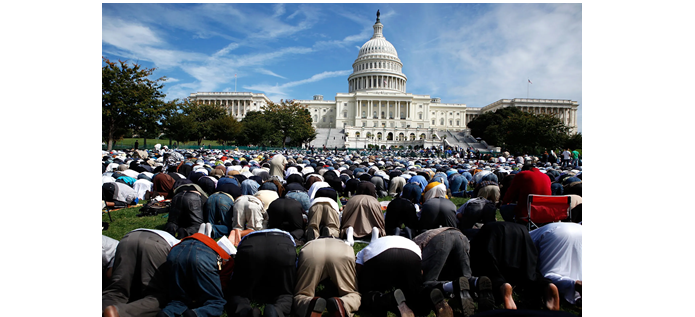
The victory that Jefferson won in the 18th and 19th centuries in the struggle between principle and prejudice still stands before Americans in the 21st century, now in the form of a crisis. Since the late 19th century, the number of Muslims in the United States has increased significantly, and today American Muslims are characterised by ethnic diversity and mobility. However, the sad reality remains that Muslims have never been fully embraced by American society.
In Jefferson’s day, an imagined Muslim population was subjected to prejudice. In today’s America, Muslims who are very much a part of society are now subject to political attacks. Since 9/11 and the so-called War on Terror, a hostile climate has been cultivated in which many seem to believe that Muslims should be denied their basic civic and human rights.
Now, debates have even intensified over whether a Muslim could be eligible to become President of the United States. The same question was raised about Barack Obama. Yet this debate is not new. Thomas Jefferson was the first political figure in American history to be accused of being a Muslim.
The question of whether a Muslim can or should become President of the United States helps us understand how deeply the image of the Muslim has entered the American public consciousness—and how, from the very beginning, the issue of Muslim rights was already tied to the nation’s ideals. Therefore, to comprehend the situation of Muslims in contemporary America, one must first understand the debate over Muslim rights that emerged in the late 18th century.
While the rights of American Muslims may have been recognised in principle early on, in practice they have faced severe trials. The truth is, American Muslims must contend with challenges to their rights on a daily basis. Today, even a prominent historian of Islam in the West like John Esposito has been compelled to ask: “American Muslims have been forced to ask themselves: What are the limits of Western pluralism and tolerance?”
A close reading of Thomas Jefferson’s Qur’an helps us understand when, where, and how the rights of Muslims came to be integrated into American ideals.
Until now, historians have largely focused their efforts on proving that Muslims are fundamentally at odds with American values. These same scholars argue that Protestant Americans have always instinctively rejected Islam and Muslims as inherently un-American. Some have even tried to demonstrate that America was founded as a reaction to Islam’s perceived despotism and its opposition to liberty. It is an undeniable fact that many of America’s early policy documents do contain such sentiments.
Yet, at the same time, one also finds notable instances of positive views about Islam and Muslims—for example, the debate around the rights of future American Muslim citizens. This shows that not all Protestants saw Islam as an entirely foreign or alien faith.
This book sheds light on the fact that Muslims were not only not un-American, but that their potential citizenship and anticipated rights were being debated at the very founding of the nation. That said, many of these ideals were not warmly embraced by the majority of Americans at the time. While covering Jefferson’s views on Islam and the Islamic world, the book also provides valuable insight into the thoughts of John Adams and James Madison.
The discussion surrounding Muslim rights was not confined to the Founding Fathers alone. The book also recounts the struggles of Baptists and Presbyterians in Virginia, particularly their confrontation with the religious establishment. It highlights how prominent lawyers affiliated with the Church of England—such as James Iredell and Samuel Johnston—also spoke out in favour of Muslim rights.
Evangelical Baptist John Leland, a close associate of Jefferson and Madison, raised his voice for Muslim rights in Connecticut and Massachusetts. He also protested against the deficiencies in the Constitution, the shortcomings of the First Amendment, and the role of religion at the state level.
The book mentions two Muslim slaves from West Africa: Ibrahim Abdul Rahman and Omar ibn Said. Omar ibn Said was literate in Arabic and even wrote his autobiography in the language. Their stories offer evidence that thousands of Muslims were present in America at the time, yet they were denied many rights, including the freedom to practise their religion. They were also deprived of the right to citizenship.
Catholic Christians and Jews continued their struggle for rights well into the 20th century. The rights they eventually attained were not always in full harmony with the Constitution. Yet the bitter reality remains that, even today, Muslims are the only community in the United States that has not been fully accepted—and efforts persist to confine their influence within limited boundaries.