In Chanakya’s Shadow: The Rise of New India’s Demagogue
Nationalism as a Veil, Tyranny as its Face

From Himalayan Valleys to Iron Brothers: A Chronicle of Shifting Allegiances
It is one of the rare ironies of history that where once the hills of the Himalayas echoed with the refrain of Hindi-Chini bhai bhai (Indian Chinese Brother) — “Indians and Chinese are brothers” — the same mountainous passes now bear testimony to a newer, sterner fraternity: that of “all-weather iron brothers.” This metamorphosis was not merely the child of political convenience, but rather the inevitable confluence of time’s ticking pendulum with the intricate latticework of global interests, regional flux, and the stratagems of great powers. Two nations, dissimilar in temperament and mould, were drawn side by side—not by affinity of origin, but by convergence of purpose.
Thus begins the saga—from the whispered sentiments of Indo-Chinese amity to the steely resolve of Sino-Pakistani alignment. It is a tale that spans heights loftier than the mountains that bore witness to its genesis, and depths more profound than the oceans that separate empires.
In the realm of international politics, some alliances are conceived in the crucible of necessity, only to be tempered by time into enduring pacts. The camaraderie between China and Pakistan, now spoken of as forged in iron, finds its roots not merely in shared interests but in a past scarred by imperial cartographies, colonial legacies, and the fog of Cold War diplomacy.
In the early 1950s, Beijing’s gaze was not cast westward toward the Indus, but eastward towards Delhi. Yet by the close of the decade, the ardour had cooled, and Pakistan—then a steadfast ally of the United States—emerged as an unexpected yet opportune companion.
Prelude: On What Stones Was This Friendship Founded?
In the post-colonial world, as newly born nations sought to etch their identities into the harsh granite of history, China emerged in 1949 as the People’s Republic—a leviathan reawakened by revolution. In the nascent days of its statecraft, New Delhi held pride of place in Beijing’s imagination. Upon the dawn of the 1950s, if China searched the mirror of reconciliation for a fraternal visage, it beheld the countenance of India. The two embraced the Panchsheel principles, vowing peace and mutual respect, while the world looked on with cautious optimism.
At that time, the Chinese communists, freshly enthroned in the Great Hall of the People, regarded India—champion of non-alignment and trusted by the Soviets—as a partner more promising than perilous. In 1954, the Sino-Indian Panchsheel Agreement was signed, and a chorus of harmony rang across Asia. Newspapers, rallies, and official communiqués sang with almost poetic fervour the slogan of “Hindi-Chini bhai bhai.” (Indian Chinese Brother) China, for the first time, articulated the vision of a “Shared Asian Destiny” — a dream in which India was not a rival, but a natural compatriot.
Yet while diplomacy danced in the daylight, history, ever the silent scribe, began penning a darker script. The legacy of British-drawn boundaries—those illusory lines in the snows of Aksai Chin and Arunachal Pradesh—became fault lines of future conflict. To China, these lands belonged, by ancient custom and geographic rationale, to Tibet and Xinjiang. To India, they were inseparable parts of its sovereign frontier.
At the time, Pakistan stood in the American camp, clasping the hands of SEATO and CENTO like a desert pilgrim chasing the mirage of Western security. None foresaw that the sands would soon shift. Friends would become foes, and adversaries—unlikely allies. The idealism of slogans would be exposed for what it was: a blade beneath a benediction, a dagger behind a smile.
It is said, and rightly so, that no friendship in geopolitics is eternal, and no enmity immutable. Only interests endure. And it was upon this maxim that the decade to come would etch its imprimatur. The first fracture upon the fragile fabric of Sino-Indian warmth appeared in 1959, when the Dalai Lama sought asylum in India. To China, this was no act of charity—it was a diplomatic wound, inflicted by a supposed brother.
The boundary disputes—over Aksai Chin, the McMahon Line, and China’s claim to Arunachal Pradesh—soon escalated from simmering tensions to open skirmishes. These culminated in the brief but bruising war of 1962, which not only laid to rest the illusion of Sino-Indian amity but also reoriented China’s strategic worldview.
It was at this pivotal juncture that China recognized India as not merely a territorial irritant, but a geopolitical adversary inching ever closer to Washington’s embrace. The compass of Beijing’s foreign policy now turned towards Islamabad. If India could not be trusted, then perhaps her perennial rival could be courted.
Was It China’s Courtship or Pakistan’s Calculus?
This question haunts the corridors of diplomatic retrospection: Was it China who came knocking, or Pakistan who foresaw the winds of change? The truth lies, as it often does, somewhere in the middle. The rapprochement was gradual, but resolute. In 1951, Pakistan became the first Muslim nation to recognize the People’s Republic of China, despite its then-robust alliance with the United States.
Under the leadership of President Ayub Khan, Pakistan began to craft what it called a “balanced foreign policy.” China was slowly, but surely, invited into the circle of strategic partnership. Trade, culture, diplomacy—each paved the way for a deeper military and geopolitical entente that echoes to this day.
Andrew Small, in his seminal work The China-Pakistan Axis: Asia’s New Geopolitics, aptly observed that in the 1950s, Beijing dreamt of Delhi—but it was the reality of disappointment that steered it toward Islamabad.
From Shaksgam to Silk Roads: The Iron Pact Reforged
In the annals of modern diplomacy, few events startled India more than the quiet, yet momentous agreement signed in 1963 between Pakistan and the People’s Republic of China. Through this pact, Pakistan ceded to China the Shaksgam Valley—an expanse of some 5,180 square kilometres nestled between Gilgit-Baltistan and Xinjiang. While to New Delhi this was a cartographic betrayal, to Islamabad and Beijing, it marked the laying of the first stone in a temple of enduring fraternity.
With that signature, China secured a strategic land route that would throb with geopolitical consequence for decades to come. Pakistan, in turn, found itself no longer alone in the cold shadows of the Himalayas, but embraced by a rising titan of the East. What India decried as an act of diplomatic aggression; Pakistan celebrated as an accession into a brotherhood beyond the reach of transient alignments. Thus, was born an alliance not of mere sentiment, but of shared purpose and calculated foresight.
In the years that followed, this relationship deepened with a quiet but resolute cadence. After the Indo-Pakistani war of 1971, Pakistan played a pivotal role in ushering China into the halls of the United Nations, recognising its rightful seat at the table of global legitimacy. Then, in 1974, when India detonated its first nuclear device, China did not mince words—it declared the act a harbinger of regional imbalance and deemed Pakistan’s apprehensions to be wholly justified. Thereafter began a discreet but discernible chapter in China’s indirect assistance to Pakistan’s own nuclear aspirations.
Kashmir: Where the Dreams of Three Empires Collide
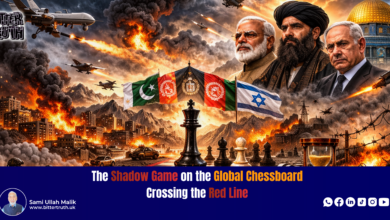
There exists upon the map of South Asia a wound that refuses to heal—Kashmir, the enchanted valley where, as some have mused, the dreams of three gods now clash. Though historically viewed as a bilateral Faultline between India and Pakistan, it has gradually evolved into a tripartite conundrum. China, once a distant observer, now sits firmly upon the chessboard. According to Rongxing Guo, Kashmir is today divided with 45.62% under Indian control, 35.15% administered by Pakistan, and 19.23% claimed and held by China.
In White as the Shroud, a haunting meditation on war and diplomacy, journalist Myra MacDonald argues that even during the British Raj, the cartography of Aksai Chin was fraught with ambiguity. Its hazy depiction on colonial maps remains a spectral presence in the contemporary contest among three nations. Thus, the dispute is no longer a simple tug-of-war—it is a tangled web of claims where China’s presence forms an inextricable third strand.
India considers China-held Aksai Chin to be part of Ladakh; Pakistan-administered Gilgit-Baltistan and Azad Kashmir are still claimed by India; and China regards Arunachal Pradesh as Zangnan—the Southern reaches of Tibet. In recent statements, Pakistan’s military leadership, including Lieutenant General Ahmed Sharif Chaudhry, has openly declared Kashmir an international dispute between three nations—India, Pakistan, and China—a crucible of global conscience not unlike the Palestinian question.
Where Boundaries Fade and Ghosts of Empire Linger
The ghosts of the nineteenth century continue to haunt the present. When the British Empire tightened its grip over the subcontinent, it regarded the barren valleys between Tibet, Xinjiang, and Ladakh as wastelands of little value. In consequence, border demarcations such as the Ardagh-Johnson Line and the Macartney-MacDonald Line were proposed, then shelved—never accorded the dignity of international recognition.
And yet, as history has proven time and again, what empires neglect in their grandeur, successors must resolve in toil. Today, those very borderlines—scribbled in imperial ink and left to the mercy of mountain winds—have become the fulcrum of geopolitical strife. When China’s communist regime assumed power in 1949, it made its position unequivocally clear: no Chinese official had ever signed any border accord with India; thus, the lines were but fiction to Beijing—a cartographer’s illusion on parchment, not the substance of statehood.
In such a vacuum, ideology is a luxury; necessity, the law. The Sino-Pak entente was not born of shared dogma, but of mutual exclusion. India’s assertive nationalism, America’s selective engagement, and the Soviet Union’s ambivalence created the perfect storm in which a new friendship could be anchored. What began as an alignment of convenience has matured into a nexus of trade, defence, diplomacy—and now, grand strategy.
CPEC: The New Silk Thread
Today, the China-Pakistan relationship has found its apotheosis in the form of the China-Pakistan Economic Corridor (CPEC). More than a 60-billion-dollar infrastructure endeavour, CPEC is the cornerstone of Beijing’s Belt and Road Initiative—an ambitious 2.5 trillion-dollar vision that seeks to stitch together 52 nations in a tapestry of trade and transcontinental connectivity. It is not merely a corridor, but a compass—a route through which China hopes to win the world not by conquest, but by commerce.
For Pakistan, CPEC is the promise of economic lifeblood, energy continuity, and regional mobility. For China, it is a terrestrial artery—from Gwadar to Khunjerab—offering access to the riches of the Middle East and the markets of Africa. Where once the Silk Road was trodden by caravans bearing porcelain and prayer scrolls, now steel-laden trucks chart a new path through the same timeless mountains.
When Necessity Knocked, History Answered
History does not wait, but it always leaves footprints. The Indo-Chinese friendship once founded upon the Panchsheel principles crumbled under the weight of unspoken ambitions. In its place rose an alliance forged not in the utopian fires of ideology, but tempered in the crucible of realpolitik.
Who made the first move—China or Pakistan? The answer, as always, is more nuanced than the question. History teaches us that it was necessity that knocked first, China that took the first step, and Pakistan that extended a welcoming hand. When one’s adversary embraces your rival, it is considered a manoeuvre; when that embrace endures decades, it becomes strategy—indeed, the wisdom of history.
What began as an exchange of maps has matured into a harmony of strategic vision. Today, China and Pakistan share more than just borders or battlegrounds—they share a worldview. Their alliance, born of calculated interests, now breathes with ideological resonance and geopolitical destiny. It is no longer just an iron brotherhood—it is an iron narrative.
And perhaps therein lies the unease of India and its allies. Not in the noise of tanks or treaties, but in the silent certainty that two once-disparate nations have learned to march to the same drumbeat—united not only by geography, but by resolve.
Of Empires, Illusions, and the Burden of Truth
The prime cause behind Prime Minister Modi’s insomnia, and that of his ideological kinsmen, lies in the twin mirages of Akhand Bharat and Greater Israel—two grand delusions painted not in ink but in ambition, which seek to redraw the map of the world in accordance with ancient myth and modern opportunism. Where the waves of the Indian Ocean kiss foreign shores, the RSS sees its rightful dominion; where Zionist cartographers dream, they etch the borders of an Israel stretched across the graves of a half-dozen Muslim nations.
And behind this ideological cartography looms the ghost of Henry Kissinger’s so-called “World Order”—a doctrine conceived in the cold corridors of realpolitik, yet bearing the stench of imperial cunning cloaked in the garb of diplomacy.
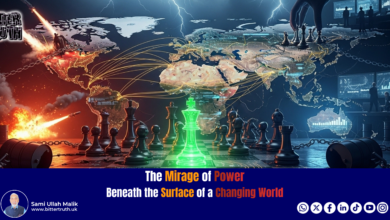
The world, ever since Cain struck Abel, has weighed justice not in the balance of morality, but in the scale of might. Yesterday, thrones were wrapped in silken canopies; today, they gleam with camera lights and hashtags. Monarchs once wooed their subjects by promising paradise; now, elected strongmen seduce them with nationalism. The pawns remain the same, only the board has changed.
Politics, now, is war without blood—and sometimes, blood without battlefield.
In this new age, it is not the sword but the screen that wounds.
The theatre of war no longer begins at the borders—it begins in the newsrooms.
Modi, the conjurer of “New India,” has mastered the arcane art of media manipulation, buying allegiance not with ideology, but with treasury. Thus, the Indian press—once a voice of conscience—has become an obedient choir, crooning tunes in praise of their sovereign, now globally ridiculed as the “Godi Media” — the lapdog press.
The game of war has changed its garb, yet not its soul.
The weapons are forged first; the enemies chosen later.
The Military-Industrial Complex, that faceless Leviathan with tentacles in every budget, every conscription, and every mother’s cradle, is the true emperor of our times. As one British scholar once quipped in weary wit: “It is not the generals who declare wars, but the arms dealers who demand them.”
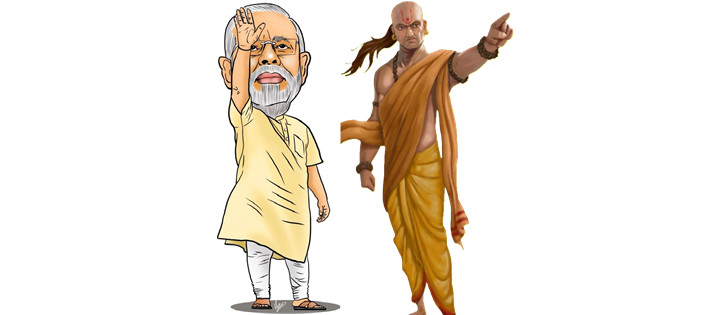
And so, under the garb of nationalism, a far more sinister enterprise flourishes. Modi’s brand of politics draws heavily from the ancient strategist Chanakya, who advised: “When the economy stumbles, raise the bugle of war.” The Prime Minister has taken this to heart. With unemployment mounting, education withering, and healthcare vanishing, he has learnt well the art of distraction: If the people begin to question, give them an enemy—be it Pakistan, China, or even Nepal.
Thus emerges his trinity of power: War. Media. Control.
Every question is met not with an answer, but with a counter-allegation.
“Where are the jobs?” asks the youth.
“Why are the hospitals empty?” cry the mothers.
“Why is bread a luxury?” laments the worker.
The answer? “The nation is under threat.”
Sacrifice now; salvation later.
This is not journalism. This is orchestration.
The newsroom has become the war room.
Dissenters are labelled traitors, thinkers dismissed as agents of “urban Naxalism,” and truth-tellers dragged through the mire of televised infamy. Words like “Tukde Tukde Gang” and “Desh Drohi” are no longer descriptors—they are verdicts.
When a nation’s hearth grows cold, its people are told to warm themselves with patriotic chants. “We shall starve but never surrender”—a slogan crafted not from courage, but from despair. Yet the people reply: “The country exists, yes—but we do not.” In this cruel paradox, Modi has demanded that his citizens carry the weight of sacrifice so his throne may stand firm. But every extinguished stove cries out for flame—not for fuel, but for reckoning.
Let us now cast our gaze from New Delhi’s chambers to the minarets of moral guidance—the Islamic perspective on governance, which rests not on conquest, but on justice, transparency, and accountability.
The Qur’anic wisdom resounds:
اَلَّذِیْ اَطْعَمَهُمْ مِّنْ جُوْعٍ وَّ اٰمَنَهُمْ مِّنْ خَوْفٍ
“It is He who has fed them against hunger and granted them security against fear.” — Surah Quraish (106:4)
A ruler who cannot provide sustenance, safety, or the sanctity of free speech is not a guardian of the people—but a usurper of their trust. Governance is a trust, not a trophy.
If politics is a form of service, it should not fear questions.
If truth is its foundation, it must not imprison truth-tellers.
Governments propped up by slogans are often felled by history’s pen. A media that sells its conscience becomes not the fourth estate, but the first accomplice. When silence becomes a national virtue, and dissent a punishable sin, then the storm of retribution is no longer a question of if, but when.
In Kashmir, where children orphaned, widows wailed, and graveyards expanded in silence, there brews a tempest history shall not ignore. This reckoning will not be televised—it will be remembered.
Let Mr Modi know this:
Truth does not reside in the echo chambers of purchased media.
It whispers in the hunger of a child,
the defiance of a grieving mother,
and the silence of a valley that bleeds in every season.