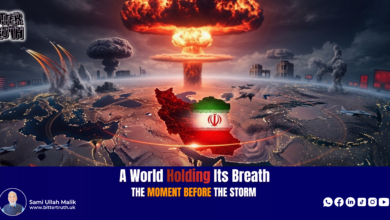

Honour, Ego, and Global Politics: India’s Trial
Trust, Betrayal, and the Burden of History

The New Global Chessboard: India’s Oil Gambit, America’s Sanctions, and the Quiet Smile of Moscow and Beijing
From age to age, the theatre of international politics is overcast with tempests whose clouds obscure the light and yet pour down storms unforeseen. Today we behold such a spectacle. On one side stands the United States, ever fond of brandishing the scourge of sanctions, as though nations could be chastised into submission. On another, India—parched for energy and growth—stoops to the Russian fountain of oil to quench its thirst. And beyond them both, Russia sits in silence, smiling at the irony of a game where another’s peril becomes its profit.
But the question must be asked: is this merely a tale of oil and commerce, or a contest of egos, a battle for dominion masked by trade?
History offers its stern witness. When chains of embargo have been fastened upon a people, they have either been shackled into servitude or compelled to hew new paths through the wilderness of adversity. “وَتِلْكَ ٱلۡأَيَّامُ نُدَاوِلُهَا بَيۡنَ ٱلنَّاسِ” — “And such are the days, We alternate them among mankind.” (Āl ʿImrān 3:140). Thus, the wheel turns; today’s captive may be tomorrow’s contender.
In diplomacy, a sanction is never mere arithmetic. It is a whip—an attempt by the strong to bend the will of the reluctant. Washington, by raising its tariffs upon Indian goods, has all but declared: Delhi shall not walk freely in its oil policy. Yet every yoke imposed breeds the search for another master, another door to knock upon. India’s eyes now glance, however reluctantly, towards Beijing, the adversary of yesteryear who may, in the irony of fate, become a temporary shelter.
And here stands Vladimir Putin, the iron man of Moscow. Shall he fashion Modi’s ordeal into a rung upon his ladder? In politics, weakness is ever a coin minted for another’s gain.
A few months ago, none would have imagined that the storm of Washington’s politics should break so fiercely over Delhi. The thunder of sanctions has cracked upon Indian soil with unyielding severity. Yet what was meant as fire may, paradoxically, become the light that guides India towards new thresholds. Yesterday’s enemy may by expedience turn ally, and Russia—guardian of its own interests since the age of Czars—knows well how to transmute another’s weakness into the foundation of its own edifice.
This is no new play. History’s curtain has risen before on such scenes: empires that sought dominion by lash and fetters, only to find their designs undone by rivals who seized the moment. “وَلَن يَجۡعَلَ ٱللَّهُ لِلۡكَـٰفِرِينَ عَلَى ٱلۡمُؤۡمِنِينَ سَبِيلٗا” — “And never shall Allah grant to the disbelievers a way over the believers.” (Al-Nisāʾ 4:141). So too now: America has tightened the collar of tariffs around India’s neck, yet the very burden may drive Delhi to bow at Beijing’s threshold.
Trump’s imposition of a 50 per cent tariff is no ordinary decree of commerce; it is a cudgel laid upon the very spine of India’s economy, with an added surcharge for Delhi’s dalliance with Russian oil. Its consequence is stark: Indian goods, stripped of their allure, risk vanishing from the American marketplace. Markets quiver, exporters despair, and Delhi’s bazaars echo with lament.
And yet, from the annals of history comes a softer refrain: wounds, when borne with patience, may become portals of renewal. “فَإِنَّ مَعَ ٱلۡعُسۡرِ يُسۡرٗا ١ فَإِنَّ مَعَ ٱلۡعُسۡرِ يُسۡرٗا” — “Indeed, with hardship comes ease. Indeed, with hardship comes ease.” (Al-Inshirāḥ 94:5-6). If India, chastened by affliction, finds resolve to temper its rivalry with China and deepen its embrace of Moscow, then this rod of iron may yet become a staff of relief.
The White House Press Secretary, Caroline Leavitt, proclaims that these measures are tied to the tragedy of the Russia–Ukraine war. Thus Washington has aimed its arrow at two targets: to bruise Moscow, and to admonish Delhi. Yet one question still hovers like a storm cloud: is India truly a silent accomplice to Russia’s designs, or merely the latest emblem in the grand theatre of Western power?
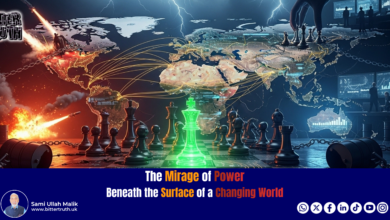
For now, the board is set, the pieces in motion. Whether Delhi shall prove pawn or herald of its own destiny, only the next turn of the wheel will tell.
The Double Standard of Sanctions: India as the Scapegoat of Western Politics
The words of America’s Treasury Secretary, Scott Bassant, have rung like a verdict across the capitals of the world: that India is profiteering by purchasing Russian oil. Curiously, when the subject turned to China, the same severity of tongue was absent. Instead, the mild observation was made that Beijing’s “inputs are diverse.” This duplicity of language reveals the truth of the matter: the principal target of Washington’s displeasure is not Beijing, but Delhi. Is this accusation merely economic, or is it political in its marrow? For in our time, oil has ceased to be only fuel; it has become the very jugular vein of world politics. Whosoever holds the tap of oil holds the key to power.
America claims that the chastisement of India is but a consequence of the Russia–Ukraine war. Yet can it be said that this conflict is fought only in the fields of Ukraine? No, it is a war of pride, of egos, of rivalries dressed in the garments of commerce and honour. It is that contest of spirit which the Qurʾān described:
﴿أَشِدَّاءُ عَلَى ٱلۡكُفَّارِ رُحَمَاءُ بَيۡنَهُمۡ﴾
“Fierce against the disbelievers, yet merciful among themselves.” (Al-Fatḥ 48:29)
—meaning that true strength lies in unity within, and firmness against falsehood. India lacks such strength; it has become a captive to the designs of others.
The charge has been levelled that Delhi buys Russian oil and resells it to world markets—supplying, in effect, the powder for Moscow’s cannons. Indian diplomacy’s silence is notable; yet it is not the silence of consent, but of calculation—a move upon the chessboard. At the same moment, Washington announced a 50 per cent tariff: a whip falling upon India’s economy. And still the question lingers: if President Trump sought sincerely to end Russian aggression, why did his tone soften after shaking hands with Mr Putin in the chill airs of Alaska? Perhaps because the contest is not over oil, but over credit. For Mr Modi could never permit his own people to believe that the laurels of peace would be hung upon the brow of the American President. Thus the quarrel, in truth, became one of egos.
The West accuses Delhi of being the merchant of Moscow’s oil, but the hypocrisy lies bare: when China stands at the same bar of accusation, indulgence is granted; when India does so, the lash is raised. Here is the true face of Western politics: favour to one, chastisement to another. This is not a question of oil, but of justice weighed in unbalanced scales. And yet, India itself is not innocent of such betrayals. Did it not, when the Soviet Union collapsed, forsake its long ally and seek new masters? The tears Delhi now sheds may be seen by history as crocodile tears.
Peter Navarro’s voice was harsher still. He declared that America buys Indian goods, and India, with those same dollars, fuels Russia’s war machine. In this accusation, India is painted not merely as a rival, but as a moral culprit, a facilitator of aggression. Navarro did not so much criticise as anathematise: Delhi, he implied, was guilty of feeding Russian guns with American coin. Here, accusation became execution, diplomacy transformed into denunciation. The spectacle was reminiscent of Pharaoh against the Israelites—where power, unable to persuade, resorts to public humiliation.
Think-tanks in Delhi speak their bitter truth: that India has become the West’s punching bag. Russia, for its part, will not dress India’s wounds, knowing well that quarrels between Delhi and Washington are transient, not permanent. For Moscow, India is a partner to be held when convenient, discarded when expedient—just as India once discarded Moscow.
After the Alaska meeting of Trump and Putin, hopes flickered in Delhi that the tariffs might be withdrawn. But the opposite transpired. Herein lies the perennial lesson promises in world politics are castles of sand. The tide rises, and they are washed away. India’s hopes, however just, were dashed upon the reefs of reality. For in this great game, the true reckoning is made in Washington and Moscow; Delhi remains but a piece upon the board.
And thus India now faces its retribution. Its exports, burdened by tariffs, shall grow costly and unappealing; its economy weighed down, its markets diminished. This 50 per cent tariff is no mere figure; it is a stone laid upon the back of Delhi’s economy. Shall Mr Modi bear it, or find new paths through the wilderness? Opposition parties whisper their fear—that this economic burden may one day transmute into political upheaval, dragging India towards a new subservience.
Recall that moment when Trump and Putin clasped hands in Alaska’s frozen air. A candle of hope flickered in Mr Modi’s heart, but that candle was swiftly extinguished. The promises were but sandcastles, and the wave came, sweeping them away. The lesson is written clear: nations that entrust their destiny to the pledges of others shall inherit only disappointment.
The Qurʾān warns:
﴿وَلَا تَرۡكَنُوٓاْ إِلَى ٱلَّذِينَ ظَلَمُواْ فَتَمَسَّكُمُ ٱلنَّارُ﴾
“And do not incline toward those who have done wrong, lest the Fire should touch you.” (Hūd 11:113)
Trusting in the promises of the powerful is to place one’s lamp in another’s hand. And when the wind blows, that lamp is the first to be extinguished.
When Egos Collide, and Empires Tremble
If one peers closely into the shifting chessboard of power, it becomes apparent that America’s grievance is not as sharp against Russia or even China, as it is against India. It is not fear of Beijing that gnaws at Washington but rather anger with Delhi. And why? The answer does not lie solely in the crude calculus of oil, but in the collapse of trust—the shattering of that fragile glass of confidence which the West had so long placed upon India’s shoulders.
India had been regarded as an ally, one tethered to the Western fold. Yet its foray into Russian oil has ruptured that bond, as though the perfume of Moscow’s petroleum lured Delhi into an embrace that the West did not anticipate. When an ally strays, the wound cuts deeper than when an adversary offends. Betrayal of trust is a wound that festers long after the first strike.
It must be remembered: the true clash is not of oil, but of egos. President Trump had desired the laurels of peace to be bound upon his brow; Prime Minister Modi denied him that glory. And when two sovereigns of pride collide, the tremor reverberates across history’s annals.
9 – The Real Conflict: The Clash of Egos
The question that now looms larger than all others is this: is the quarrel between Trump and Modi merely over oil—or is it, in truth, over honour? Let us lift the veil: the conflict is not petroleum but prestige; not barrels of oil, but crowns of vanity. Trump could not endure that Modi withheld from him the credit for a truce, particularly when his intervention had been sought by both Modi and Netanyahu. Yet Modi, buoyed by the sycophantic chorus of his “godi media”, could not humble himself before his people by declaring that the garland of peace belonged to Washington. Thus pride clashed with pride; and when egos collide, decisions become more perilous than artillery, and the fire of politics is kindled into a consuming blaze.
History whispers a stern lesson: nations live or die by their honour. Wars fought for self-respect are the most ferocious of all. Great disputes among nations often turn not upon resources but upon dignity. Here too, each leader strains to bend the other. For Trump, yielding would tarnish America’s claim to supremacy; for Modi, yielding would fracture the brittle shell of popular pride. The contest, therefore, is no longer arithmetic—it is psychological, it is political, it is existential. It is a duel where retreat for either side is poison.
And here arises the solemn reminder:
﴿لَا غَالِبَ إِلَّا ٱللَّهُ﴾
“There is no victor save Allah.”
Empires fracture, power dissipates, but honour and dominion belong only to the Almighty. Nations that surrender their dignity dissolve into dust; those that guard it, endure. This conflict, stripped of its pretences, is nothing less than a trial of America’s pride. To retreat now would be, for Trump, to dent the very majesty of his republic.
The think tank Ananta Centre spoke truly: India, in the Western imagination, is but a punching bag. Delhi is confronted with a reality it long denied. It should remember for five decades it leaned upon Moscow as a dependent child; but when the Soviet colossus faltered, India hastened—without a moment’s hesitation—to kiss the steps of Washington. Putin, therefore, spares no thought for India’s wounds; he pursues his own advantage. Trump, too, has little regard for India’s honour. The time has come for Delhi to ask: will it always remain a pawn upon another’s board, or will it at last take the mantle of its own destiny?
And yet, the Indian public trembles less at the ties between Moscow and Islamabad than at the prospect of intimacy between Pakistan and America. They know that relations with Russia wax and wane, but a bond between Washington and Islamabad would strike a more enduring fear. This psychology betrays India’s weakness: a nation that frames its policies in fear of another’s shadow can never be truly free. This is the essence of servitude—that men quake at the silhouette of power, and shiver beneath its imagined shade.
Meanwhile, Russia’s embrace of Pakistan and its quiet dialogues with the Taliban ring new alarms for Delhi. Once Moscow sold arms to Islamabad; now it courts Kabul’s rulers too. The time may not be far when the political cartography of South Asia is redrawn, and India finds its old equilibrium crumbling beneath its feet.
The regional chessboard has grown yet more intricate with the trilateral negotiations of Pakistan, China, and Afghanistan, culminating in the announcement of the expansion of the China-Pakistan Economic Corridor (CPEC). This is not merely an economic declaration, but a political thunderbolt—an arrow aimed squarely at India’s pretensions of centrality in the subcontinent. Once the pivot of South Asian politics, India now finds itself hemmed in by the shadows of its neighbours’ alliances.
Thus, while Delhi sought to stride the stage as a protagonist, it finds itself relegated to a pawn in the grand drama of nations. Russia cares not, China cares not, Trump cares not. The hour has struck for India to ask itself: how long will it play another’s piece? How long before it lights its own lamp of destiny?
Oil, Tariffs, and the Theatre of Honour
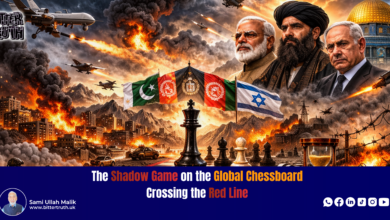
In the end, the present turmoil is not a mere ledger of trade figures nor a quarrel over oil consignments. It is part of that greater contest wherein honour, ego, and the symbols of power are so inextricably entwined that commerce becomes but the veil of deeper passions. If Mr Trump wields punishment upon India, Mr Putin smiles in tacit satisfaction; and if New Delhi ponders a fresh gambit upon the chessboard, Beijing, in its habitual inscrutability, gathers its cards in silence.
Time alone shall reveal whether America’s harshness proves a scourge or, paradoxically, a benediction for Delhi. For now, it is enough to observe that in this amphitheatre of global politics India stands as both the hope of its friends and the suspicion of its foes—a duality that constitutes at once its gravest weakness and its severest trial.
Consider, too, the shifting tides: once, Russian arms flowed freely into Pakistan. Today, Moscow does not merely court Islamabad but reaches even towards the Taliban. Such realignments ring alarm bells for Delhi; for in South Asia’s theatre, India grows ever more isolated, and Russia, rather than easing this solitude, deepens it. The evidence is stark: a new player has entered the regional stage, one intent on keeping India under perpetual pressure. This reconfiguration is not transient; it carries the portent that India may one day find itself pushed from the very board upon which it once presumed to be central.
The announcement, in the trilateral parleys of Pakistan, China, and Afghanistan, of the extension of CPEC has sounded like a death knell for Delhi. It is, for India, not merely an economic blow but the tolling of a political tocsin. For here lies the declaration that the region’s commerce and strategy shall no longer revolve about Delhi but upon the twin axes of Beijing and Islamabad. This is the hour in which India’s once-central stature recedes into the twilight of memory, and the cartography of power is redrawn. The blow is decisive, and its resonance unmistakable.
O men of discernment, this is not a contest of oil and tariffs alone—it is a trial of dignity, of pride, and of the very substance of sovereignty. Trump seeks to plant his banner by chastising Delhi; Modi strives to keep his frail lamp from guttering in the storm; Putin, with a statesman’s sardonic smile, converts adversity into opportunity; and Beijing, calm and calculating, unfolds its stratagems with unhurried precision. The page of history cries aloud: nations that permit themselves to be pawns upon another’s chessboard shall never wear the crown. The question therefore presses: how long shall India remain the plaything of other men’s designs, and when shall it dare to become the arbiter of its own destiny?
History has ever vindicated those peoples who dared to seize their fate by their own hands. And the Qur’ān declares with imperishable clarity:
إِنَّ ٱللَّهَ لَا يُغَيِّرُ مَا بِقَوْمٍ حَتَّىٰ يُغَيِّرُوا مَا بِأَنفُسِهِمْ
“Indeed, Allah does not change the condition of a people until they change what is in themselves.” (Qur’ān, 13:11)
The question, then, is this: when shall India free its destiny from the fetters of alien councils, and summon the courage to act for itself?
The panorama before us makes plain that this crisis is no mere tale of oil and tariffs. It is a grand struggle of pride, of national honour, of the relentless theatre of geopolitics. America would reassert its supremacy; India clings to its independence; Russia plucks advantage from the hour; and China, with the patience of empire, gathers its strength in silence. History’s scroll reminds us that when the great play their games, the lesser often serve as pieces upon the board. The challenge for India is stark: how long shall it endure this fate, and when shall it set its own board, kindle its own lamp of dignity, and shape its destiny by its own will?