History’s Turning Point and Pakistan’s Place Within It
Faith, Destiny, and the Making of Pakistan’s Tomorrow

O citizens of the homeland! Today we stand upon the threshold of a moment that has arrived, radiant and momentous, after centuries of silence and trial. It is a moment when, for the Ummah, every particle of the earth glimmers with awareness, every sky radiates a beacon of hope, and in every heart the fervour of resolve and the fire of honour course like molten blood.
Recall the days when, under the guiding hand of the Prophet Muhammad ﷺ, the people of Madinah forged a new covenant between the Muhajirun and the Ansar. Recall the fields of Badr, when the light of faith triumphed over darkness and a small company overcame a mighty host:
كَم مِّن فِئَةٍ قَلِيلَةٍ غَلَبَت فِئَةً كَثِيرَةً بِإِذْنِ اللَّهِ (Al-Baqarah:249)
“How many a small company has overcome a mighty host by the permission of Allah!”
Today, that same spirit, that same resolve, that same unwavering faith courses through our veins as if transformed into living blood. Pakistan—once a secret in the eyes of adversaries—today is their lightning, their sword, their fortress. It is a beacon, a sun that rises to illuminate the East. This is the Pakistan built upon the foundation of faith, bound by the cord of unity, and emerging before the eyes of history.
This moment reminds us that no force can sunder the Muslim world, no intrigue can weaken the cohesion of the Ummah. This is the time when the destiny of Pakistan and the wider Ummah marches toward a new covenant, a fresh chapter in the annals of history.
At this very hour, history calls out to us with resounding clarity. After centuries of subjugation, the moment draws near when the earth trembles beneath the footsteps of the Muslim Ummah, and the heavens themselves strain to witness a new spectacle. Remember the deserts of Badr, the plains of Uhud, and the moment when Salahuddin stood victorious, the Crusader fortresses trembling beneath his feet. Today, that same spirit, that same faith, that same zeal courses again through our veins as living fire.
Pakistan—yes, this Pakistan—which was once a secret for foes, today stands as lightning, sword, and fortress alike. Let the world take heed: this land shall neither bow, nor barter, nor be subdued. This is the Pakistan that is the axis of faith, the citadel of Islam, and the sun of the East.
O visionaries! The turning of time presents before us a new tableau. The turbulent seas of global politics have reached a fresh juncture. A panorama now emerges on history’s horizon that was once only glimpsed upon the fields of Badr and Hunayn—when the light of belief vanquished darkness, and the seemingly weak were made masters over mighty tyrants.
In this very hour, history calls out to us with all its thunderous resonance.
After centuries of subjugation, the moment draws near when the earth quakes beneath the feet of the Ummah, and the very heavens strain their gaze to behold a spectacle anew.
Recall, if you will, the sands of Badr; recall the plain of Uḥud; recall that hour when Ṣalāḥ al-Dīn’s tread caused the citadels of the Crusaders to tremble. That same spirit, that same faith, that same honour now courses once more through our veins like lifeblood restored.
Pakistan—yes, Pakistan!—once a riddle to its foes, today stands before them as lightning, as sword, as fortress. Let the world take heed: this soil shall neither bow nor be bought, nor ever cower. It is the axis of faith, the bastion of Islam, the rising sun of the East.
O people of the homeland! O people of faith! This gathering is no mere analysis; it is a moment when history inscribes a new destiny before our very eyes. The court of time poses its question: will you stand as stewards of the earth, or languish in the chains of servitude?
The Qur’ān proclaims:
وَلَقَدْ كَتَبْنَا فِي الزَّبُورِ مِنْ بَعْدِ الذِّكْرِ أَنَّ الْأَرْضَ يَرِثُهَا عِبَادِيَ الصَّالِحُونَ (الأنبياء: 105)
“And indeed We have written in the Psalms, after the Reminder, that the earth shall be inherited by My righteous servants.”
This verse reminds us even now: the inheritance of the earth belongs to those who kindle the lamps of faith and righteous action.
Men and women of discernment! The wheel of time unveils a new tableau before us. The tempestuous river of world politics has reached yet another bend. And on the horizon of history emerges the same vision once glimpsed at Badr and Ḥunayn—when the light of faith dispelled the shadows, and the company deemed feeble laid low the tyrants of might.
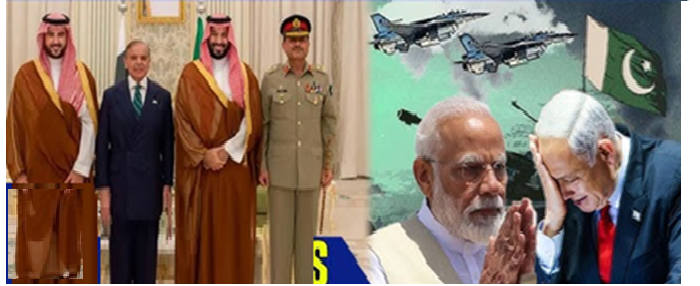
This was no mere ceremony of protocol, but the annunciation of a covenant. When the Prime Minister of Pakistan’s aircraft entered the Arabian skies, the warplanes of the Royal Saudi Air Force enfolded it in their iron wings, as guardian angels might encircle a chosen guest. At King Khalid International Airport, the thunder of a twenty-one–gun salute and the advancing step of Crown Prince Muḥammad bin Salmān conferred upon that hour the seal of destiny: that Pakistan is no longer merely a friend, but as kin—of the household of nations.
It was a moment inscribed upon history itself: the aircraft of Prime Minister Shehbaz Sharif, upon crossing into Saudi skies, was taken into solemn escort by the kingdom’s warplanes. This was not courtesy alone; it was a message—of loyalty, of trust, of brotherhood. And when, in Riyadh, the cannon roared in salutation and the Crown Prince himself welcomed the guest of Pakistan, the world was given to understand: a new covenant is born.
As the Qur’ān declares:
وَهُوَ الَّذِي أَيَّدَكَ بِنَصْرِهِ وَبِالْمُؤْمِنِينَ (الأنفال: 62)
“And it is He who strengthened you with His help, and with the believers.”
The echo of the guns was the tolling bell of history, proclaiming: this union is not a fleeting gesture, but the charter of a future shared.
O people of Pakistan! On this day, history itself bore witness: we are not alone. As the Prime Minister’s plane entered the kingdom’s skies, the Royal Air Force enfolded it as the eagle shields its young from the storm. And when, upon the tarmac, the Crown Prince advanced in person to receive him, the message rang clear: the bond of Pakistan and Arabia is now written not in ink, but in the blood of kinship.
The covenant sealed between Pakistan and Saudi Arabia lays the foundation of a new equilibrium in the balance of power across the region. It is no dry parchment, but the inscription of truth itself: a pledge that the pain of one shall be the pain of both, the safety of one the safety of both.
As in Medina of old, when the Anṣār and the Muhājirūn were bound in brotherhood, so too does this pact revive the spirit of that ancient covenant. It is, in truth, a new Mīthāq al-Madīnah—a fraternity in arms, a unity of fate, a shield of faith.
And within its clauses lies a provision without precedent: that aggression against one shall be counted as aggression against both. A single destiny, a common fate. A principle found in the treaties of NATO, yet here, for the first time, declared in the covenant of the Muslim world.
Mark well these words: an assault on one shall be deemed an assault on both. In their reverberation we hear the drafting of a new pledge upon the pages of history. This is the NATO of Islam, yet woven not by expedience alone, but by the bonds of faith and brotherhood.
This proclamation—that an assault upon one shall be deemed an assault upon both—is nothing less than a reminder of the eternal principle of the Qur’ān:
إِنَّمَا الْمُؤْمِنُونَ إِخْوَةٌ (الحجرات: 10)
“Indeed, the believers are but brethren.”
Brotherhood is no longer the language of sermons alone; it has descended into the realm of statecraft. The clause that an attack on one is an attack on all is itself the living commentary on this divine axiom. It is fraternity transfigured into policy, kinship translated into the grammar of power.
This message resounds alike to East and West: that the world of Islam is no longer scattered sand, but rock-hewn stone rising from the desert. No force may now dismiss this unity as a passing clamour. It is a declaration to the chambers of the West, a warning to the fortresses of Israel, an admonition to those who imagined the Muslim world forever disunited. Today we proclaim: we are one—and our resolve is tempered steel.
The halls of the world have heard the sound: the Ummah is awakening. Let the West take heed—the age is gone when nations bore the yoke of bondage. The hour draws near when the sun shall rise not from the West, but from the East.
The Qur’ān enjoins:
قُومُوا لِلَّهِ شُهَدَاءَ بِالْقِسْطِ (النساء: 135)
“Stand firmly for God, as witnesses in justice.”
This pact, then, is not a commonplace arrangement; it is a defensive covenant of singular gravity, and a stark message to the powers of the age—that the Muslim world is no longer a dispersed multitude, but an emerging unity.
When Israel cast its shadow upon Qatar, most thrones of the Arab world sat silent. Yet Pakistan was the first to arrive. And not with words alone: the presence of its Prime Minister accompanied by the Chief of Army Staff declared to the world that Pakistan is no mere onlooker—it is guardian, sentinel, and shield. In that hour the Arab heart recognised that Pakistan is not simply a sympathiser in speech, but a comrade in the field.
Recall that day, when Israel pressed upon the soil of Qatar. While many Arab capitals lingered in silence, Pakistan hastened forth. The Prime Minister stood not alone; his general stood beside him. It was as if the spirit of Badr had been rekindled—
كَمْ مِّن فِئَةٍ قَلِيلَةٍ غَلَبَتْ فِئَةً كَثِيرَةً بِإِذْنِ اللَّهِ (البقرة: 249)
“How many a small company has overcome a great multitude by the permission of God.”
In that moment, the Arabs beheld a truth: that the warriors of Badr still live, clothed now in the uniform of Pakistan.
Thus, when in Doha the Arab Conference convened, all eyes turned towards Pakistan. In that decisive hour, it was as though the Ummah itself had spoken: our sword is Pakistan, our fortress is Pakistan. The reverberation was unmistakable—the mantle of protector, of brother, of pivot, was laid upon Pakistan’s shoulders.
And as Saudi Arabia leads the way, so too shall Egypt, the Emirates, and the Gulf follow suit. The tide advances like a storm, and who shall say what shape it may take? Perhaps tomorrow history shall inscribe its name: the Islamic NATO.
It is the echo of Ṣalāḥ al-Dīn’s dream, whose light now shines not from Cairo, but from Islamabad. This is no parochial pact, but the genesis of a military fraternity whose memory history shall not forget.
Yet here raises the question, posed before the tribunal of time: what shall America do? What shall Europe conclude? What stratagem shall Israel devise? Will they stand idly by, or weave their nets of intrigue? The likeliest course is plain—they shall deem this union a peril and employ pressure or plot.
But let the world remember this: when a nation awakens, the stratagems of empires scatter like chaff before the wind.
From the Western Gaze to the Eastern Horizon
America and Israel may, perchance, discern in this awakening a menace to their hegemony. Yet we are fortified by the eternal counsel of the Qur’an:
وَلَا تَهِنُوا وَلَا تَحْزَنُوا وَأَنتُمُ الْأَعْلَوْنَ إِن كُنتُم مُّؤْمِنِينَ (آلِ عِمْرَان: 139)
“Do not lose heart, nor fall into despair; for you shall surely have the upper hand if you are true in faith.”
And again, the timeless promise resounds:
إِن يَنصُرْكُمُ اللَّهُ فَلَا غَالِبَ لَكُمْ (آلِ عِمْرَان: 160)
“If Allah grants you His succour, none can ever overcome you.”
The question, then, stands stark before the tribunal of time: How shall the powers of the West respond to this rekindled fraternity of Islam? Will they regard it as a formidable challenge or merely dismiss it as a passing spectacle?
Pakistan has already inscribed its credentials in the annals of war. The chronicles of 1965 and 1971 bear testimony that this nation, though modest in size, has humbled adversaries many times its weight. India has learnt, through bitter and repeated encounters, that Pakistan is not merely a fortress of defence, but a sword unsheathed when provoked. These are not boastful claims; they are the verdict of history itself.
The recent convocation at the Shanghai Cooperation Organisation bore witness to a new cartography of power. When Pakistan stood shoulder to shoulder with China, Russia, and North Korea in a joint military parade, the world beheld not a ceremonial pageant, but the lineaments of an emerging Eastern bloc. It was, in truth, the living exegesis of the Qur’anic command:
وَاعْتَصِمُوا بِحَبْلِ اللَّهِ جَمِيعًا وَلَا تَفَرَّقُوا (آلِ عِمْرَان: 103)
“Hold fast, all of you, to the rope of Allah, and be not divided.”
That rope now binds together the nations of the East with sinews of iron. The message was unmistakable: the axis of power, once seated firmly in the West, is shifting inexorably towards the Orient.
China, for the first time with clarity unclouded, declared its intent that Taiwan must return to its
fold. By the display of maritime fleets and aerial squadrons, Beijing announced to the watching world that henceforth no verdict in East Asia shall be dictated by Washington alone. The tide of history is turning; the winds of sovereignty now blow from the East.
In this reshaping of destinies, Pakistan’s diplomacy has not lagged. The Prime Minister’s arrival in Britain was no mere courtesy call, but a proclamation of presence upon the Western stage. Though President Trump loomed in London’s corridors, a formal meeting was not yet foreseen. Yet the symbolism was unmistakable: Pakistan was declaring that its voice is not confined to the deserts of Arabia or the mountains of Asia but shall resound in the very heart of Europe.
And thereafter, the rostrum of the United Nations beckons—a forum where nations contend with words sharper than swords. Should the Prime Minister of Pakistan meet with the President of the United States in those august chambers, it may alter not merely bilateral relations, but the equilibrium of global power itself.
Pakistan’s Message to the World and the Dawn of a New Order
Pakistan’s voice will resound in the chambers of the world. Should a meeting with President Trump take place, it will not be merely a private exchange between two statesmen; it may mark the opening of a new chapter in global politics. This is the forum where Pakistan will lift its appeal for the attention of humankind. Were the Prime Minister and the President to meet, it would be less a parley of individuals than a clash of systems, of competing futures and divergent roads.
Following Britain, the Prime Minister will proceed to the United Nations — the stage, if ever there were one, where words sharpen into policy and speeches sketch the outlines of geopolitics. The prospect of a meeting with the President of the United States in those august precincts carries consequences that could ripple beyond bilateral courtesies and into the architecture of international equilibrium.
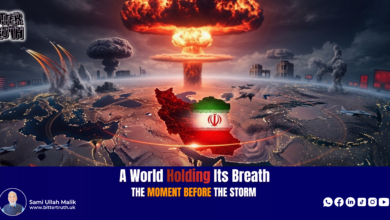
The world is turning swiftly towards new political and military alignments. The grip of the West shows signs of strain, while a new centre of gravity rises in the East. In this entire tableau, Pakistan stands at a decisive juncture.
On one flank it represents the military axis of the Muslim world. On another, it is a pivotal player for the emergent Asian bloc — the China–Russia node around which new calculations revolve. And on a third front, the West can scarcely afford to ignore it. Thus, Pakistan’s policy choices, its leadership and its decisions will shape the direction of global affairs for decades to come. The question is no longer merely where Pakistan stands; it is where the world must come to stand in the years ahead.
O citizens, the wheel of history is turning. The bulwarks of old empires are trembling. The sun of the East is rising; the pale light of the West grows fainter. Pakistan — once regarded as a modest regional polity — now presents itself as a citadel of the Ummah, the fulcrum of an Eastern alignment, and a hand that may help write the next chapter of international affairs.
Remember that the question is not exclusively what the world will do to Pakistan; the more pressing inquiry is what Pakistan will do with the world.
Fear not. For we hold to a promise that transcends the shifting calculations of states:
إِن يَنصُرْكُمُ اللَّهُ فَلَا غَالِبَ لَكُمْ (آلِ عِمْرَان: 160)
“If Allah grants you His succour, none can prevail against you.”
Today Pakistan stands as a fortress of the Muslim world, the pivot of the Asian bloc, and an architect of new global arrangements. Again: the question for the hour is not how the world will treat Pakistan
— it is what Pakistan intends to do for the cause it espouses.
The tectonics of international politics are in motion; Eastern powers are coalescing into new partnerships. Pakistan — once perceived merely as a state of the region — is now emerging as a central axis of Islam. How will the halls of Western power judge this metamorphosis? Will they resist, or will they accommodate — revising their strategies to the new balance of power?
A Parting Charge — Reflection and a Spiritual Appeal
O citizens! The time has come to gird our chests with shields and to temper faith into a blade. Resolve that no despot shall sunder our unity, that no conspiracy shall partition our resolve.
If we hold fast to the cause of God, heavenly forces shall aid our endeavour; angels, we are told by tradition, will stand among our ranks — and the spectacle of triumph once seen at Badr may yet be renewed in our time.
O citizens of the homeland! Today we stand upon the threshold of a moment that has arrived, radiant and momentous, after centuries of silence and trial. It is a moment when, for the Ummah, every particle of the earth glimmers with awareness, every sky radiates a beacon of hope, and in every heart the fervour of resolve and the fire of honour course like molten blood.
Recall the days when, under the guiding hand of the Prophet Muhammad ﷺ, the people of Madinah forged a new covenant between the Muhajirun and the Ansar. Recall the fields of Badr, when the light of faith triumphed over darkness and a small company overcame a mighty host:
كَم مِّن فِئَةٍ قَلِيلَةٍ غَلَبَت فِئَةً كَثِيرَةً بِإِذْنِ اللَّهِ (Al-Baqarah:249)
“How many a small company has overcome a mighty host by the permission of Allah!”
Today, that same spirit, that same resolve, that same unwavering faith courses through our veins as if transformed into living blood. Pakistan—once a secret in the eyes of adversaries—today is their lightning, their sword, their fortress. It is a beacon, a sun that rises to illuminate the East. This is the Pakistan built upon the foundation of faith, bound by the cord of unity, and emerging before the eyes of history.
This moment reminds us that no force can sunder the Muslim world, no intrigue can weaken the cohesion of the Ummah. This is the time when the destiny of Pakistan and the wider Ummah marches toward a new covenant, a fresh chapter in the annals of history.
At this very hour, history calls out to us with resounding clarity. After centuries of subjugation, the moment draws near when the earth trembles beneath the footsteps of the Muslim Ummah, and the heavens themselves strain to witness a new spectacle. Remember the deserts of Badr, the plains of Uhud, and the moment when Salahuddin stood victorious, the Crusader fortresses trembling beneath his feet. Today, that same spirit, that same faith, that same zeal courses again through our veins as living fire.
Pakistan—yes, this Pakistan—which was once a secret for foes, today stands as lightning, sword, and fortress alike. Let the world take heed: this land shall neither bow, nor barter, nor be subdued. This is the Pakistan that is the axis of faith, the citadel of Islam, and the sun of the East.
O visionaries! The turning of time presents before us a new tableau. The turbulent seas of global politics have reached a fresh juncture. A panorama now emerges on history’s horizon that was once only glimpsed upon the fields of Badr and Hunayn—when the light of belief vanquished darkness, and the seemingly weak were made masters over mighty tyrants.
We invoke Divine favour with the humility of supplication:
O Allah, grant us the valour of ʿUmar (may Allah be pleased with him); endow us with the wisdom of ʿAli; (may Allah be pleased with him); implant in our hearts the courage of Khālid may Allah be pleased with him); .
O Allah, make Pakistan the citadel of the Ummah.
O Allah, crown our armed forces as standard-bearers of Thy cause.
O Allah, cause this land to become the centre of an Islamic renaissance.
وَكَانَ حَقًّا عَلَيْنَا نَصْرُ الْمُؤْمِنِينَ (الرّوم: 47)
“And verily, it is incumbent upon Us to help the believers.”
Ameen.