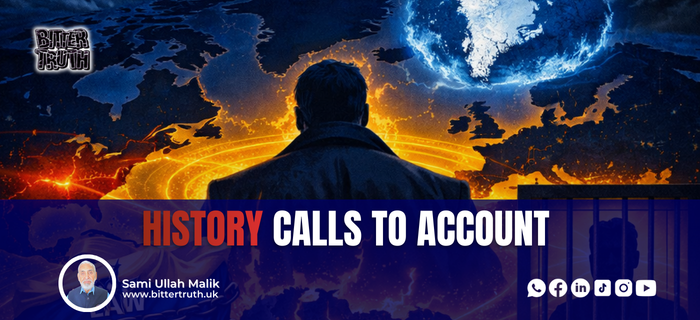
History Calls to Account
Power on Trial

History is never mute; it writes incessantly with the ticking of the pen, and at the appointed hour its judgements are unveiled before the nations. Today, history once more turns the leaf of its vast chronicle, and the world finds itself at a juncture where competing claims to power, the webs of ideology and the clash of regional interests have shaken to the core the delicate balance of global peace and security.
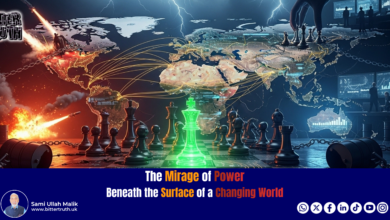
World politics resembles a mighty river whose swelling currents scatter before them the colours of power and influence. Time and again, the annals of history remind us that the chargers of power which gallop triumphantly beyond their borders are often undone by the fissures within their own walls. No nation-state, however formidable it may appear, can stand secure unless it is girded by inner cohesion, resolute leadership and disciplined order. Power is never merely a matter of battalions and armaments; without internal concord and national unity, it remains transient, brittle, and ultimately evanescent.
True strength is not confined to the physical or the military; it is woven with faith, wisdom and reason. In this backdrop, the recent initiatives of President Donald Trump have stirred a fresh tempest in international politics, whose first tremors have been felt in Venezuela and may yet reverberate across other lands. According to reports, in early 2006 President Trump undertook a dramatic and contentious military operation in Venezuela, detaining Nicolás Maduro and casting into harsh relief the new perils of foreign intervention within American foreign policy. This was no mere regional episode; it was a thundercloud gathering upon the firmament of world affairs, pregnant with danger and laden with grave questions about the use of power, the international order, the law of nations, and the destinies of other states yet to be named.
It is a sobering reminder that might, if divorced from prudence, leadership and inner order, is but a house of cards. As the Qur’an enjoins:
وَأَعِدُّوا لَهُم مَا اسْتَطَعْتُم مِّن قُوَّةٍ وَمِن رِبَاطِ الْخَيْلِ تُرْهِبُونَ بِهِ عَدُوَّ اللَّهِ وَعَدُوَّكُمْ﴾ (الأنفال: 60)﴿
And prepare against them whatever force you can command, and lines of steeds of war, whereby you may strike terror into the enemy of God and your enemy.
Yet the same sacred text teaches us that the foundations of endurance lie within the moral and civic fabric of a people:
إِنَّ اللَّهَ لَا يُغَيِّرُ مَا بِقَوْمٍ حَتَّىٰ يُغَيِّرُوا مَا بِأَنفُسِهِمْ﴾ (الرعد: 11)﴿
Indeed, God does not change the condition of a people until they change what is within themselves.
Trump’s venture emerged at a moment when, having failed to secure the Nobel Peace Prize in 2025, he sought to restore his international standing. It revealed that he had embraced the very hard-line doctrines against which he had once campaigned, provoking fears that other countries might in due course become the targets of similar designs and casting a pall of anxiety and uncertainty across the global community.
In early January 2026, the arrest of Venezuelan leader Nicolás Maduro in a controversial military operation served, ostensibly, as an intervention in the domestic affairs of a sovereign state, but in substance it amounted to a warning to the world at large. It signalled that the foreign policy of the Trump administration had turned once again towards the iron hand. The repercussions of this operation rippled outward, generating apprehension especially in Colombia, Cuba and Greenland, where the spectre of becoming the next target loomed large. Colombia’s relations were already strained; President Gustavo Petro had been branded an illegitimate leader of the narcotics trade, under the shadow of a threatened intervention. Cuba, too, found itself caught between contradictory pronouncements: declared a failure on one hand and, on the other, told it would collapse of its own accord, though not without hints of prior intent. Such rhetoric sowed a harvest of uncertainty in the soil of international affairs.
After Venezuela, American foreign policy appeared to cast its gaze towards Colombia, Cuba and beyond. Threats, intimations of military action and economic pressure combined into a single, unmistakable message: that great powers can no longer ignore the resistance of local populations, the constraints of law, or the boundaries of ethical obligation. The Venezuelan episode rekindled the old American desire to absorb Greenland, a notion firmly rebuffed by the Danish Prime Minister, Mette Frederiksen. Britain and France, too, rejected the proposal. The British Prime Minister, Sir Keir Starmer, affirmed that the destiny of Greenland rests with its own people and with Denmark, and that Britain stands with Copenhagen in this regard. France reiterated an ancient principle of international life: borders are not playthings to be altered by force of arms.
Greenland’s Prime Minister, Jens Nielsen, spoke with unmistakable clarity: enough was enough; further pressure would not be endured, and any negotiations must proceed through proper channels and in the spirit of mutual respect. Such statements recall to us a cardinal truth—that international law and the sovereignty of states, even in the shadow of military might, possess prior claim and higher dignity. Where the centres of power fail to restrain themselves within the confines of order and law, their undertakings become fleeting, unstable and fraught with peril. Declarations of grandeur, when set against the will of local peoples and the dictates of justice, breed not stability but crisis, not tranquillity but danger to the peace of the world.
The Secretary-General of the United Nations, António Guterres, declared the American action against Venezuela to be a violation of international law, urging all parties to honour the Charter of the United Nations, to embark upon comprehensive and democratic dialogue, and to permit every section of society a voice in determining its future. He emphasised that the preservation of peace and security requires respect for the sovereignty, political independence and territorial integrity of states, and that both the threat and use of force must be renounced.
His stance casts a sharp light on a fundamental reality: that global peace is not secured by sabre-rattling or coercion but by law, transparency and inner concord. As the Qur’an reminds us of the ebb and flow of human fortune:
وَتِلْكَ الْأَيَّامُ نُدَاوِلُهَا بَيْنَ النَّاسِ﴾ (آل عمران: 140)﴿
And such are the days which We alternate among mankind.
Thus does history, with a steady hand, draft its verdicts. Nations that forget the restraints of justice and the discipline of order may roar for a season, but their echo fades; those that cultivate wisdom, integrity and unity endure beyond the tempests of their time.
This account reflects an abiding truth: that no power may lay unilateral claim upon international law or the sovereignty of states, and that every action, if it is to endure, must carry the imprimatur of legality and moral justification. In the aftermath of President Trump’s venture in Venezuela, many nations—most notably Colombia and Greenland—began to be regarded as potential targets. This posture of American policy sowed disquiet across the international community, provoking the uneasy question of how far the movements of the mighty may imperil the fragile fabric of world peace.
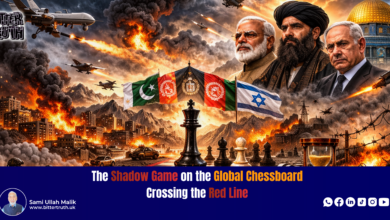
The operation was not circumscribed by the frontiers of Venezuela alone; its tremors have been felt throughout the region and upon the broader international stage. The strong reactions of Britain and France regarding Greenland, and the emergency session of the United Nations Security Council, testify that great powers, whatever their reach, remain answerable not only to their own ambitions but to the imperatives of international law and the moral framework that girds it. Trump’s actions made plain that the engines of power are still very much alive; yet when force is wielded beyond the boundaries of law, the outcome is instability, global anxiety and the loom of escalating tensions. The episode underscores that the use of power must remain within legal, ethical and geographical bounds, and that centres of power must conduct themselves in conformity with domestic and international order.
The balance of global politics and the primacy of internal order
The Venezuelan affair has driven home a familiar but often neglected lesson: power does not subsist in battalions, arsenals and military hardware alone. It endures only when yoked to inner discipline, the farsightedness of leadership and the transparency of governance. The pages of history bear solemn witness to this truth. Great empires—whether Rome, the Ottoman Caliphate or the Soviet Union—fell not merely beneath the blows of external enemies but through the dry rot of internal weakness. Somalia, Afghanistan and Iran supply contemporary testimony that robust institutions, national cohesion and internal order outrank the mere accumulation of military strength.
Potential global risks and other target nations
After the Venezuelan intervention, several states—especially Colombia and Greenland—were increasingly perceived to stand in the crosshairs of American ambition. This raised grave anxieties: to what extent do the movements of the world’s power centres threaten the peace of mankind? The lesson is stark: the deployment of power must be circumscribed by law, ethics and geography; those who wield it must govern themselves in accordance with both domestic discipline and international restraint.
Trump’s initiative seemed to herald a blunt message: the United States would no longer rest content with a doctrine of non-intervention but was prepared to avow a policy of domination. For Colombia, Cuba and other nations, this was a sobering admonition that power does not operate solely through the rattle of arms; its political and economic reverberations are also felt upon the world’s stage. The arrest of Maduro in Venezuela, the pressure of American arms and the breach of international norms conjure a landscape in which the central question presses itself forward: does power undermine freedom and sovereignty, or does it merely add to the burdens of external pressure? History answers that states are not sustained by cannon alone; they are upheld by order within and the unity of their people.
If one casts an eye across the galleries of history, one perceives that its pages do not lie silent. They record every deed and, at the appointed hour, read their verdict aloud. Power struggles bereft of law and transparency place the very future of the state under a question mark. Leadership, internal order and respect for international law are therefore indispensable to the survival of the polity. These parables and metaphors remind us that no power—however advanced its technology—can remain secure upon weak foundations at home.
The lesson of inner strength
The historical experiences of Venezuela, Afghanistan, Somalia and Iran indicate with crystalline clarity that nations do not prevail by military strength alone when their inner institutions are frail. External conspiracies may abound, yet the gravest breach is usually within. As the Qur’an declares:
وَفِي أَنفُسِكُمْ أَفَلَا تُبْصِرُونَ﴾ (الذّٰاريات: 21)﴿
And within your own selves—will you not then behold?
This verse reminds us that the fountainhead of power lies not in external conquest but in inner cohesion and unity. Where the chain of command is secure and steadfast, even the most sophisticated weaponry cannot bring a nation to its knees.
The Venezuelan operation, the claims upon Greenland and the American posture toward Colombia have given new momentum to the theatre of world politics. The event offers a stern lesson to every nation: it is essential to understand the motions of power, to honour international law and to preserve domestic order. The words of the Secretary-General of the United Nations emphasise that international law already possesses effective instruments for addressing narcotics trafficking, disputes over resources and the violations of human rights. The report lays bare a fundamental reality—that global security, regional stability and the protection of human rights cannot be secured by military might alone. Without the firm pillars of law, morality, leadership and transparency, no power can claim durable stability.
This historic episode teaches us that power is not confined to steel and gunpowder; it rests also upon law, order and ethical leadership. States are not sustained by artillery; they are upheld by inner unity, resilient institutions and the trust of their peoples. Without respect for international law and national sovereignty, the security of any country remains precarious. True victory is not the conquest of territory, but the winning of hearts, the establishment of justice and the strengthening of inner strength—rather than coercion or naked aggression.
Let it be remembered: history does not remain silent. The victors of today may stand tomorrow in the dock of accountability. Real power is that which endures the scales of justice. The Venezuelan episode, American foreign policy and the chorus of global response together instruct us that genuine success in international politics is wrought by internal stability, public loyalty and the resolute functioning of national institutions.
Conclusion: the reflective lesson
This report reveals a single commanding truth: that global security, regional equilibrium and the defence of human rights are not secured by power or threat alone, but by the sturdy columns of internal order, principled leadership, the rule of law and the dictates of morality—without which no nation, however mighty, can long endure.