After Separation, the Season of Reunion
Hearts Reunited, a New Dawn Unfolds

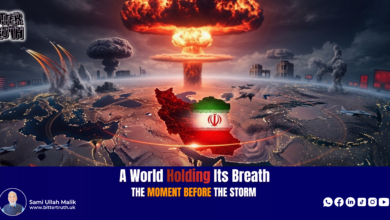
This article is an analytical study of Bangladesh’s internal politics, electoral landscape, India’s changing concerns, and new emerging trends in Pak-Bangladesh relations. It not only examines the current situation but also sheds light on the possible future regional scenarios and policy options.
The history of South Asia is not a text written on a solid marble slab, it is the story of beating hearts, wet eyes, and memories scattered in the soil made of blood. The history of South Asia in particular and of Pak-India and Bangladesh in general is not just the story of borders, treaties, and power struggles, it is also a story of relationships of hearts, colors of accents, and tears of eyes. South Asian politics is once again at the crossroads of rapid change.
The emerging political landscape in Bangladesh, a key country in the region, has not only affected the dynamics of domestic power but has also had profound effects on regional balance, diplomatic priorities, and future economic and strategic relations. In these circumstances, the bilateral relations between Pakistan and Bangladesh are emerging with new intensity, where the long-standing aspirations and mutual closeness of the people of both countries seem to be taking on a new chapter. Despite the bitterness of the past and historical events, the feelings of friendship and brotherhood between the two countries at the public level have not diminished. During the days of separation, the people of both sides endured severe emotional trauma and are still well-wishers for each other today.
The two Muslim states of the subcontinent, Pakistan and Bangladesh — these are not just two countries, two bodies of one soul, these are two branches of the same tree, whose roots are rooted in the soil of common faith, civilization, harmony of languages and mutual love. These are two songs of the same melody, two hands of the same prayer. Partition drew borders, but no wall could be erected on the paths of love. The separation of 1971 divided the state map, but the heartbeats of hearts could never be separated. In the moments of this separation, not only lands were divided, dreams were also shattered, the lights dimmed in the homes of both sides; mothers cried, daughters were shocked, and a void was created in the hearts of brothers that words cannot fill.
And such silences descended in the homes of both sides that history has also written with respect and today, once again, these public sentiments are now reflected in state policies and diplomatic attitudes. History is witness that the journey of the prayers of this separation never stopped. From the waving paddy ears of Bengal to the fields of Punjab, there was only one cry—O Lord! Bring hearts closer together again. Hatred never settled in the hearts of the common people, nor did enmity take root. Be it the villages of Bangladesh or the streets of the cities of Pakistan—in the days of separation, countless eyes were moist, prayers were clasped in trembling palms, and there was only one supplication that Allah would turn this path of destiny into closeness again. Even today, the same yearning is alive in the hearts of the people that we should come closer to each other again, share each other’s sorrows and be a support and strength for each other.
Today, the scene is changing. A new wind is blowing in the desert of politics, the burdens of the past are being lightened, the walls of misunderstandings are cracking, and the old lamps of love are about to be rekindled. Today, when the politics of the region are taking new turns, old narratives are melting and the scattered pearls of relationships are starting to come into hands again, it feels as if the revolving wheel of time has taken a new turn. The lamps of love are about to be relit, and both nations are again praying the same old prayer—let us be with each other, even if the maps are different, but the hearts are one.
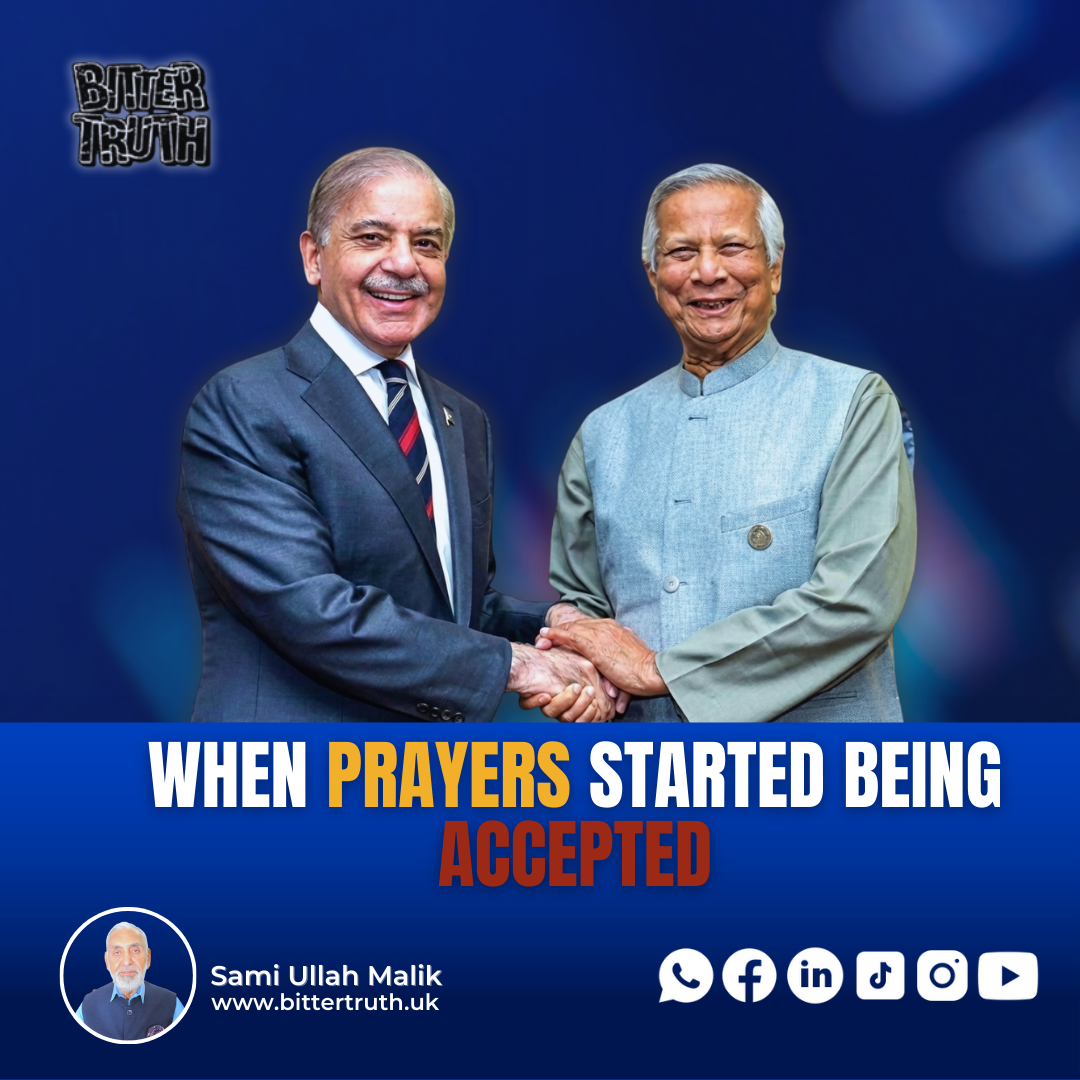
The people of Pakistan and Bangladesh have always prayed for each other, wished each other well, and kept the doors of their hearts open for each other. Now those long-standing prayers are starting to feel close to acceptance. The youth of both countries are seeking a new world—where the past is not a subject of hatred but a lesson, and the future becomes a highway of cooperation, brotherhood, and common development.
This article is the story of this changing weather and wave of feelings—an attempt to heal the wounds of history, a strong voice of friendship amidst the noise of politics, and the conviction that prayers for love sought in the court of Allah do not go in vain. A narrative of a history that contains politics but more love; analysis but more hope; and a desire that the two nations stand side by side, as if they were once one soul and one body, and today, hearts beat again for this unity.
It should be remembered that South Asian politics has never been stagnant. This is a river where the waves never calm down. Bangladesh stands today at a juncture where the houses of power are shaky, public anxiety is awake, the entire calculation of regional powers is being rewritten, Tariq Rahman’s return has put a new move, a new game, a new question on this board. Finally, under the sky of Dhaka, the moment of resurrection has arrived, which the pen and eyes had been waiting for for years. When Tariq Rahman stepped on the soil of Dhaka after seventeen years of exile, it was as if history had opened a new chapter in its book. This return was not just the return of a person, but a declaration of question against the political status quo, an indication of a shift in the center of gravity in Bangladeshi politics, and the starting point of a new calculation for the diplomacy of the region.
BNP Executive Chairman Tariq Rahman left the prison of seventeen years of self-imposed exile and stepped into the beloved homeland on December 25, 2025. The night of poverty lost in the fragrance of that soil turned into the pure voices of thousands of workers, as if a mournful evening had given birth to a morning of hope. His arrival gave the impression that the desert of migration had ended, and now the city of trials was ahead. This very return sent a wave of concern through the Delhi government—because after Sheikh Hasina, the face of India’s traditional pillows has changed in Bangladesh. There, from the rooftops of the offices in Naya Paltan, the heart of the capital, his voice echoed that if God wills, we will all build the Bangladesh of our hopes together.
This was not only a political slogan, but also a promise of action, whether it is still related to the memories of the exiles or to the public’s thirst. Thus, while Tariq Rahman’s return to his homeland is the dawn of hope for a new political era, there is also a knock on the door of history that could prove to be a new turning point in India’s unrest and South Asian politics.
After overcoming seventeen years of self-imposed exile, political cases, illness, distance from the country, and the wilderness of memories of the homeland, when Tariq Rahman stepped into Dhaka, the public crowd made this return a metaphor for a new era. The slogans of the party workers echoed the heartbeat of hope, while waves of concern ran through the hearts of the opponents because this return is not just the return of one person, it is the return of history. Return after seventeen years — this journey from the desert of exile to the lap of the motherland, where his declaration of determination is, could also prove to be a prelude to a test.
What Tariq Rahman said at the Dhaka public meeting was not words but a promise, an intellectual narrative of the future, the weight of which was evident in his words that we will work hard, build our Bangladesh, accept the leadership of the coming leader. This explicit hope of the BNP president has turned the general elections to be held on February 12, 2026, into a historical milestone, where every intellectual tone, every political stance, and every leader’s step is being seen towards the paths of democracy and stability.
Tariq Rahman said that I have a plan for the people and the country, for the development of the country and to change the destiny of the people, the details of this plan have not yet been revealed to the public; as if there is a secret, the curtain of which can only be opened by time. This phrase, as if it were the first destination of a spiritual journey, has contained two voices of hope and concern within itself. This tone points to collective leadership, moving away from personal centering, and this is the essence of democratic thought. Tariq Rahman announced his national development plan, saying that his plan is ready, but did not explain the details and the secret still remains. This ambiguity has many meanings, a political strategy to keep opposing forces unclear, a safe card for the election campaign, but of course this question remains. Is this plan for economic revival? Is it a restructuring of foreign policy? Or a balance in power structures? In the context of the February 12 elections, this silence is actually both political wisdom and a cover for policy.
Tariq Rahman said in his speech that if God wills, we will all build a Bangladesh of hopes together. This sentence was not just a crowd of slogans, but an announcement of the recognition of collective leadership. He appealed to avoid violent actions; this tone shows that politics is not just the name of power but also the name of moral responsibility. Bangladesh is in the circulation of a political climate that requires great caution to get out of.
The issue is not limited to domestic politics. Without India and Sheikh Hasina, a new conflict has emerged in the political landscape of Bangladesh. Observers say that India is going through a historic decline, because after thirteen years of Sheikh Hasina’s rule, there is no suitable friend in the new scenarios. Moreover, Indian political analysts have repeatedly repeated the same thought cycle and said that there is now an anti-India wave in Bangladesh, especially the political mindset of the new generation who has not only changed the perception but also started searching for an independent identity in the fast waves of social media. This reality is like a book of political science, where each new chapter has examined friendship, enmity, interest, and autonomy in a new sense.
India’s anxiety is increasing with each passing day and there is also a historical narrative that without a friend, the border seems long. After Sheikh Hasina, Delhi does not see any clear friend in Dhaka. The old doors of communication seem to be closing; the real dilemma of Indian policy is who is the new leadership in Bangladesh? How to trust it? And how to shed the burden of past interference? This is the point where questions of both politics and ethics arise.
After Tariq Rahman’s statement that a plan to change the destiny of the country is ready but has not been detailed. This silence has the following possibilities. The secret of strategy, the wisdom of the election campaign, keeping the opposing forces unaware, in political terminology it is called a silent announcement which is both determination and curiosity.
The new generation of Bangladesh has developed its political sensibilities without a long historical background. The history of independence in 1971 is a blank slate before them — neither old, nor studied, nor do they want to access its deeper meaning. If there is any political reaction from this new generation, it is the attraction of hostility and questions over the transparency of Indian strategy, as local observers say that this generation is taking politics beyond the limits of mere leaders and leadership speeches to a socially effective movement, where concepts and perceptions merge and new ideas are born, and they do not care about the Indian propaganda that India helped them in the creation of Bangladesh.
The question is, why is the day of the February 12 elections decisive? In fact, the February 12 general elections are not just a change of power, but a day to determine the direction of national thought. These questions will be decided on this day: who will lead? Who will have foreign policy in their hands? What will be the new alignment in South Asia? Votes will be kept in the balance of power as well as consciousness. On this day, India’s interference in the internal affairs of the region, the possibilities of future reconciliation or hostility and the status quo will be decided. We are all aware of the reasons for India’s displeasure with Muhammad Yunus’s interim government, namely Hasina’s humiliating escape from Bangladesh to India, and the demand for Hasina’s return from Bangladesh is now the first demand of the people of Bangladesh. On the other hand, India is dissatisfied with the interim government, afraid of religious parties, and wary of BNP and student groups. Indian analysts even said that Jamaat-e-Islami is a nightmare for the Indian establishment.
The term itself is an admission that India fears religious identity and only pursues its own interests in the name of secularism in the region. Today, when two Muslim states — Bangladesh and Pakistan — are defining new political realities, India is left with few options. A free, fair election can be sabotaged through its infamous intelligence agency “RAW”, in which the strong roles of Jamaat-e-Islami and BNP, whose mutual relations can lead to a certain victory in the elections, and both countries can move towards peace in Pakistan and Bangladesh. In addition, India will try its best to increase tensions by going on separate paths, the consequences of which both countries may have to suffer in the future. If we look at it from the perspective of Hindutva’s ego and stubbornness, it seems that perhaps India has limited its options on the international political stage, and now every decision depends on the fine lines between its political interests, moral reasoning, and regional peace, which is constantly being seen as a threat to regional peace.
Sheikh Hasina was convicted by the court, the Awami League was banned from participating in elections outside the country, her proximity to India had made her the main pillar of Delhi’s policy. Now that pillar has fallen. After this, India’s policy seems like an orphan, looking for friends but no friends are available. Therefore, the chapter of Sheikh Hasina is not yet completely closed. On the other hand, the new generation and the anti-Indian atmosphere in these elections have also changed the mood of ongoing history. Pakistan, Bangladesh and India will influence these elections as a triangle of interests. The new generation of Bangladesh is not emotionally attached to the history of 1971. This young generation, captive to social media and dissatisfied with Indian attitudes, has been the cause of this revolution in Bangladesh.
When India repeatedly says that your existence is our religion, the human soul rebels. This same rebellion has become a voice on the streets, in universities, and in political debates today that the Hindu bigot can never help anyone without his own interests and we have paid a heavy price to this Hindu bigot that he has not only dominated our economy but has also made us slaves. Moreover, India did not give importance to student organizations, did not keep in touch with the youth leadership, while in Bangladesh the student wing is the political laboratory, the future leadership comes from there. If trust was not given, distrust reached its peak and India’s biggest mistake was that it badly ignored student politics in comparison to Hasina Wajid and ultimately suffered its humiliating consequences.
Now India’s dilemma is who to support and whom to support? The question before India now is that if not Sheikh Hasina – then who? Reconciliation or competition with the BNP? How to relate to the interim government despite dislike? New Delhi’s politics is today surrounded by this hesitation, and the fear is that the cunning Hindu can become a part of any aggressive action or conspiracy in this anxiety. The changing mood of the new generation has decided to give a clear message against India to the world through elections against the India wave. The new generation of Bangladesh is free from the emotions of 1971, self-aware, and has grown up on the vast canvas of social media. When they are told, “You are indebted to us,” they reply, “We are independent—we are not indebted to anyone.” This is the wave that has created problems for India and changed the course of Bangladeshi politics. India was slow to understand that the student wing in Bangladesh is the real political laboratory, that the youth are the leadership of tomorrow. When students were ignored, the seeds of distrust were sown. Those same seeds have now become trees.
What a strange sight that as time has changed, Delhi now finds BNP acceptable. The goodwill message with Khaleda Zia was part of this wisdom, but look at the coercion of history, Khaleda Zia has left, now the leadership is in the hands of Tariq. India is now looking for a new basis for relations, but it is too late and the atmosphere is not as favorable as before.
Hasina Wajid, a refugee in India, sentenced to death, her statements under pressure from parties can refresh the wounds of the nation and complicate future relations. This is the lesson for India. The market of statements is also the field of diplomacy, here even an ignorant word becomes an accident. The sword and dangerous edge of Sheikh Hasina’s ongoing rhetoric are also increasing Indian opposition.
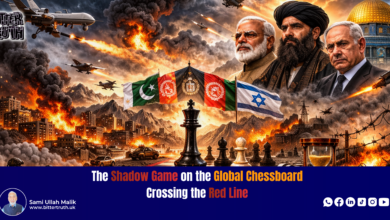
After fifty years, the revival of Pak-Bangladesh trade relations, military cooperation, and cultural and religious relations is coming back to the scene. If this closeness goes beyond prudence, it can change the balance of the region. India’s monopoly may be a challenge. According to Indian analysts, Bangladesh’s proximity to Pakistan is increasing day by day. A large number of elements are also emerging who support strong Pak-Bangla military and economic relations. This process is natural because the bond of languages, the bond of civilization, the bond of faith and history, the fragrance of these relations remains for a long time. The situation has made the BNP a political center, a diplomatic axis, an electoral force. India is now knocking on the doors of reconciliation with it, but it is too late, the tone has changed, the atmosphere has changed. The death of Khaleda Zia has also added an emotional chapter to politics and now the leadership is in the hands of Tariq.
In such an environment of violent incidents before the elections, anti-India demonstrations, accusations of interference in each other, India itself has become an election slogan and perhaps Delhi’s policies have given birth to this slogan itself, and this fruit of Indian policy is also costing India dearly.
Now the real question is, what should Pakistan do? If we learn from history, the answer is not to pour oil on the flames, but to apply ointment to the wounds, and to light the lamp of unity of the Ummah. Appropriate measures for Pakistan are the fastest and strongest diplomatic cooperation, restoration of trade corridors, educational and cultural exchanges, dignity of defense ties but with caution, a foreign policy based on mutual respect. Avoid unnecessary rhetoric and above all, create an atmosphere of mutual goodwill, not confrontational politics. The right path for Pakistan is to adopt the path of wise understanding instead of confrontation. Avoiding anti-Delhi provocations, a prompt and reasoned response to Indian propaganda, effective responses in many world languages through highly experienced people on social media, which are disseminated to the world. Dignity-based relations with Dhaka, economic cooperation is the first priority, educational and cultural exchanges, defense cooperation but with courtesy, along with politics, civilization should also be spoken because the dialogue of civilizations is older than politics. The purpose of writing practical recommendations and suggestions for the current ruling institutions is that we urgently need these measures to prevent the kind of fire that India is spreading against Pakistan every day through its social media.
Avoiding undeclared interference, activating regional cooperation organizations, promoting responsible narrative in the media, contacts with student and youth leadership, economic cooperation as the top priority, not inciting anti-India sentiments, and the wisdom of handling it. Islamic brotherhood should not be considered a political weapon, but a civilizational relationship. Wise diplomacy, avoiding undeclared interference, forming a joint economic commission, contacts with youth leadership, responsibility in media narrative, active use of OIC and SAARC platforms, and increasing establishment-civil harmony should be prepared and put into action, as time is very short.
Looking at the possible situation in the future electoral scenario, it is very important to say that if the BNP wins a clear majority, Delhi will be cautious and forced to form a new alignment in the region due to the strengthening of Tariq Rahman. If the BNP wins, Tariq Rahman will be the central figure. India will apparently adopt a cautious understanding, but for a new alignment in the region, it will certainly continue its secret operations to spread political chaos and anarchy in Bangladesh. If a coalition government is formed, it will try to increase pressure on its supporters to disrupt Pak-Bangla relations in order to bring balance to policies. If the conflict increases, both the economy and peace will be affected and India will certainly try to take advantage of this and this is its objective that political chaos, violence and anarchy continue in Bangladesh. The brightest possibility is that Bangladesh is moving towards a new social contract where the new generation will decide who it will stand with. And the most likely is that the new generation will determine its own direction and the wheel of history will turn on a new path.
Today, Bangladesh is going to enter a new chapter in its bilateral relations with Pakistan, its love, military and trade ties. In this political scenario, Pakistan should strengthen the historical and cultural milestone between the two Muslim states, formulate a common strategy to deal with India’s political intrigues and interferences, and establish a strong civil-military coordination that promotes regional security and development. This is the time when the principles of political independence, foreign policy, and multipolar cooperation need to be adopted as a new era — otherwise, those forces that are walking on the paths of selfishness and greed can throw the peace of this region into turmoil.
This report is not just based on news and politics, but it is a new wave in the river of history, an important attempt to bring the currents of history and politics into an intellectual balance. The return of Tariq Rahman, the circulation of the political climate in Bangladesh, India’s dilemma policy, and Pak-Bangla relations — all are tied into a thought-provoking thread that is not only a echo of the past but can also become a source of insight for future generations. In this context, this report is a literary, historical, cultural and political analysis — in which facts and interpretations are woven into a philosophical, research and spiritual harmony so that the interpretation does not remain merely literal but creates a new literary impression and political understanding. This story is not just a struggle for power, it is an awakening of political consciousness. It also contains a game of power, the pain of civilization and the hope of the nation. Remember, when nations learn to light the lamps of their own destiny, then history does not become an obstacle in their path, but a guide. When nations draw lessons from the past, awareness from the present, and hope from the future, then the era becomes theirs.
The current situation bears witness to the fact that the elections and political changes in Bangladesh will not be just an internal matter of one country but will affect the political balance of the entire South Asia. The closeness, economic cooperation, and feelings of friendship at the public level in the relations between Pakistan and Bangladesh have laid the foundation for a new diplomatic phase. The historical, religious, and cultural ties between the two countries have provided a favorable environment to further strengthen this relationship. Wise decisions at the state level, balanced strategies at the diplomatic level, and feelings of goodwill at the public level—these three elements will determine the direction of Pak-Bangladesh relations in the coming years. If both countries demonstrate responsibility and foresight, vast possibilities for cooperation, trade, security, and development can arise in the region.
In the end, the matter ends where the journey began. This story comes to a point where the relationship between hearts and the heartbeat speak louder than the calculations of reason. The cultural and spiritual closeness of Pakistan and Bangladesh is not a temporary state, it is a truth rooted in the depths of history. Despite the separation, our faith has not changed, nor have our prayers for each other diminished. The people of both countries have seen suffering and suffered deprivation, but in a corner of their hearts, they have always kept alive the feeling that we belong to each other. The relationship between Pakistan and Bangladesh is not broken by the mistakes of the past, nor shattered by the conflicts of politics—that relationship is one of faith, one of civilization, one of shared tears and shared prayers. We may have been separated, but we can never become strangers. Time has testified that hearts recognize their own, no matter how many borders are erected between them.
Today, when new lights are shining on the political horizon of Bangladesh and signs of change are visible. The lamps of love and goodwill are burning again in the hearts of Pakistan, as if someone has slowly cast a shadow after the harsh sun of history. The bitterness of the past is now becoming a lesson, the shadows of enmity are felt to be receding, and the gentle breeze of brotherhood is touching the hearts. As the region moves towards a new electoral and diplomatic scenario, another welcome reality is also emerging — a new chapter of warmth is about to be written in the relations between Pakistan and Bangladesh.
The desire has reawakened within the people of both sides to reduce the distance, put aside the grudges, and move forward on the journey of love and cooperation. This is a sentiment that is stronger than state policies, because it is born in the hearts of nations and grows there. If both nations move forward with prudence, sincerity and mutual respect, not only will misunderstandings be removed, but a new era of peace, trade, politics and cultural harmony in South Asia can begin. The coming era can bring them the tidings of new loves, new agreements and new achievements. Perhaps the time is not far when the people of Bangladesh and Pakistan will again be able to say with full confidence: We are not separated – we were only tested.
This is the time to forget bitter memories and lay the foundation for a common future – a future in which there are no walls of hostility, but bridges of trust; in which there are no slogans of hatred, but the voice of brotherhood; and in which the prayers of the people can be heard saying only:
We were one, we are one, and we will live together as brothers.
In this context, it would not be out of place to say that the closeness, brotherhood and mutual respect in the hearts of the people of Pakistan and Bangladesh can become the real foundation of future diplomatic policies. This is the spirit that survived despite the separation and which is once again becoming a means of bringing the two countries closer.
This is not the end, but the prelude to a new covenant of friendship. History is turning, prayers are being answered, and hearts are flowing towards each other again. This article is a written expression of that desire, that dream and that prayer. The river of history had once separated us, but now it seems that the tides are turning. Perhaps the time is not far when the two nations will be able to come closer again and say that the distances were only in maps, but the hearts were never separated.