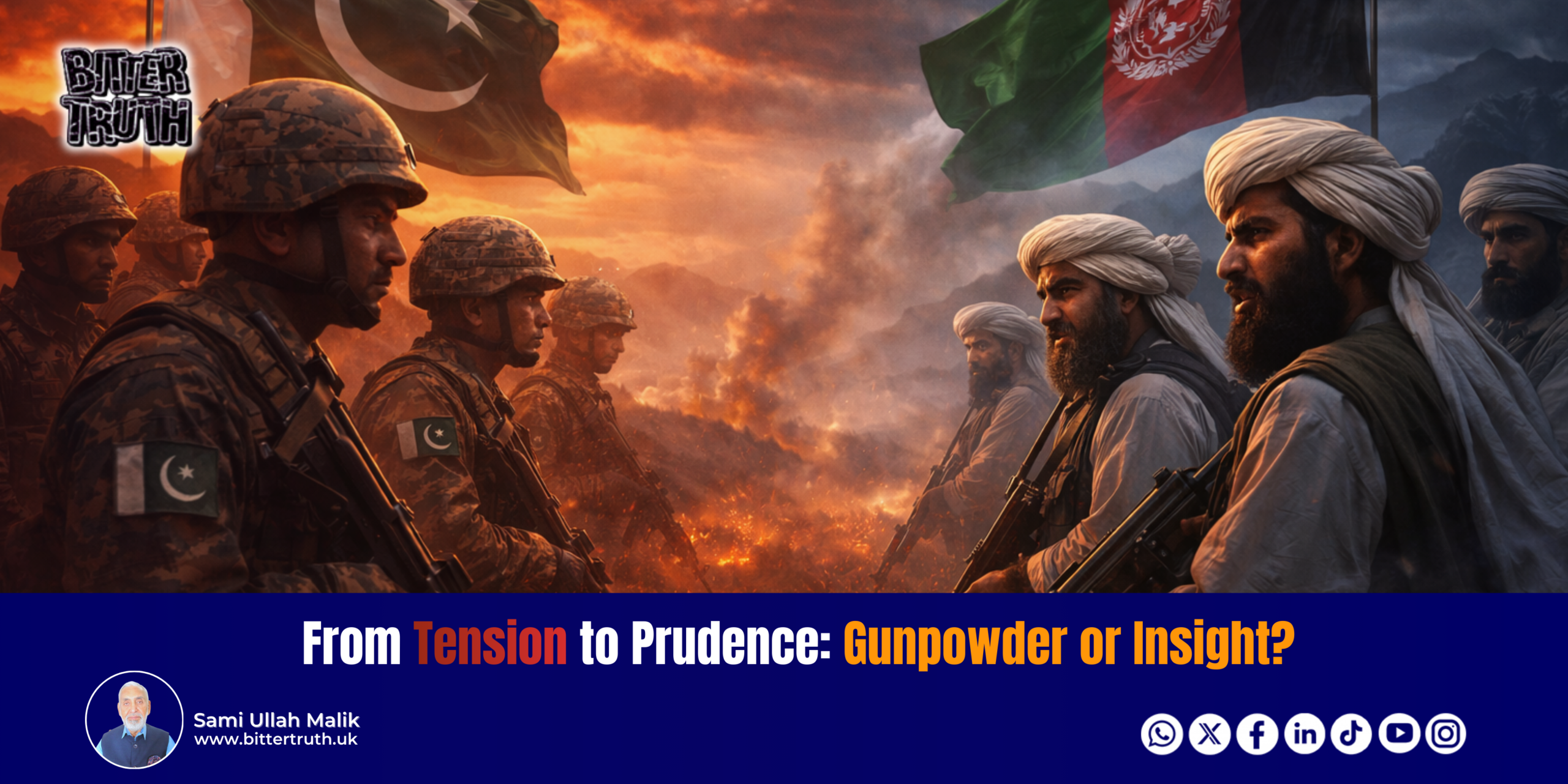
From Tension to Prudence
Gunpowder or Insight?

Frontiers in Flame: History, Sovereignty, and the Burden of Judgment
Frontiers are seldom mere lines traced upon a map by the cool geometry of surveyors. They are the burnished inscriptions of history itself—etched not in ink alone but in migration, mingled civilisations, covenant and betrayal, and in the austere alloy of blood and iron. The Pakistan–Afghanistan border belongs to that stern and storied category of boundaries which refuse to be reduced to cartographic convenience. Its mountains do not stand in mute indifference; they bear witness to oaths sworn and broken, to empires assembled and undone. Even the wind that sweeps through its passes carries more than dust: it carries remembrance.
Now, at a moment when diplomatic tension has hardened into open military confrontation—when Afghanistan’s overt assaults upon Pakistan have marked the formal commencement of war—the crisis can no longer be dismissed as a transient dispute between two neighbouring states. It has become a question that weighs upon the entire region’s future. This is not merely a bilateral quarrel; it is an ordeal for a civilisational space long bound together by religious affinity, cultural interdependence, and the unchosen intimacy of geography. Gunfire may deliver an immediate and brutal pronouncement; history, however, renders its verdict in a more exacting tribunal—where prudence, moderation, and statesmanship carry greater authority than indignation.
What follows, therefore, is neither apologia nor indictment. It is an attempt at sober examination: a search for clarity amidst the fog of accusation and counter-accusation; a refusal to treat this crisis as ephemeral newsprint, and instead to consider it as part of a longer, unfinished chronicle—particularly now, as flames burn on both sides of the frontier.
The boundary between the Indian Subcontinent and the lands once known as Khurasan is not simply a geographical divide. It is a smouldering line in the manuscript of history. Here, the echo of power has alternated between the thunder of artillery and the fragile authority of treaties—some solemnly drafted, many insufficiently sustained. When Pakistan conducted aerial strikes in Afghanistan’s eastern provinces—Nangarhar, Paktia, and Khost—it was an action freighted with symbolism as much as with strategy. It declared that the state would not remain a silent spectator where the preservation of its territorial integrity was concerned.
The operations carried out on Saturday, 21 February, were hardly incidental manoeuvres. According to Pakistani security officials, seven sites allegedly linked to Tehrik-i-Taliban Pakistan (TTP) and Islamic State Khorasan Province (ISKP) were targeted in those eastern provinces—locations from which, Islamabad contends, attacks upon Pakistani soil were being orchestrated. It was claimed that approximately eighty militants were killed. To construe such action as merely tactical would be naïve. Domestically, it signalled that the writ of the state remains operative. Externally, it served notice that continued cross-border aggression would invite response under the doctrine of self-defence.
Kabul, however, condemned the strikes as a violation of sovereignty and alleged civilian casualties, including women and children. The interim Afghan authorities warned of retaliation—and that warning has since been translated into action. Thus has the lexicon of diplomacy yielded to the vocabulary of war.
In modern international law, sovereignty occupies an almost sacrosanct status; its breach is seldom regarded as anything less than aggression. A limited strike may, under certain conditions, be contained within diplomatic dispute. But when reciprocal cross-border attacks commence, the matter escapes the realm of diplomatic protest and enters that of armed confrontation—as we now witness.
At the heart of this impasse lies the interpretation of what is commonly referred to as the Doha Agreement. Though formally concluded between the United States and the Afghan Taliban, its implications have radiated far beyond the original signatories. Among its principal undertakings was the assurance that Afghan territory would not be used to threaten or attack other states. Pakistan argues that this commitment has not been honoured in substance—that militant groups hostile to Islamabad continue to find sanctuary within Afghan territory, thereby violating not merely the letter but the spirit of the accord. The Taliban authorities counter that Pakistan’s insurgency is a domestic problem, the burden of which cannot be transferred across the frontier.
Here, the dispute is less about language than about meaning. Interpretation thrives in the climate of trust; it withers in suspicion. This is the point at which the line between “covenant” and “accusation” begins to blur. History instructs us that agreements unsupported by mutual confidence are reduced to paper fragments scattered by the first strong wind. The question, therefore, is not solely juridical. It is moral and political: when intention itself is doubted, words forfeit their authority.
President Asif Ali Zardari has warned that the presence of militant sanctuaries in Afghanistan risks propelling the world towards a catastrophe reminiscent of the attacks of 11 September 2001—an event that irrevocably reshaped global politics. His invocation of a “new 9/11” is not mere rhetorical flourish. It is a calculated appeal to international memory—a reminder that crises which appear regional in theatre may, in consequence, prove global in reach. The trauma of September 2001 altered the architecture of international security; it remains a cautionary emblem of what neglected threats may become.
Yet beneath the rhetoric of sovereignty and counter-terrorism lies another dimension, less dramatic but no less profound: the paralysis of trade, the suffocation of fragile economies, and the mounting anxiety of civilian populations. When border crossings close, it is not only military convoys that are halted; commerce falters, livelihoods wither, and scarcity tightens its grip. Economic contraction breeds social unrest; unrest, in turn, offers fertile ground to extremism. Thus, the cycle of insecurity perpetuates itself.
Pakistan maintains that Tehrik-i-Taliban Pakistan enjoys safe haven across the border. Kabul rejects this claim, insisting that TTP is an internal Pakistani matter. Again, the divergence lies not in vocabulary but in interpretation—and interpretation cannot endure where trust has eroded. When suspicion clouds intention, language itself grows infirm.
The present war, therefore, is not merely a contest of arms. It is a contest of narratives, of principles, and of credibility. Whether the region moves towards prolonged conflagration or halting de-escalation will depend not only upon military calculus but upon political imagination. Statesmanship is most severely tested not in moments of triumph but in moments of anger.
History’s tribunal remains patient, but it is exacting. It does not judge merely who fired first, but who possessed the wisdom to know when to cease.
This is no mere utterance in the theatre of domestic politics. It is, rather, an appeal addressed to the conscience of the world — a reminder that when frontiers grow porous and authority falters, the spark struck in one valley may yet set alight distant capitals. President Asif Ali Zardari, in his recent intervention, cautioned the international community that the continued indulgence of non-state militant sanctuaries risks ushering the world to the brink of another calamity, not unlike the convulsion that followed the September 11 attacks, when the certainties of global politics were so violently undone.
His words are widely interpreted as an attempt to stir dormant will — to awaken that shared historical memory which, after 2001, gave rise to the doctrine of collective action against terrorism. Pakistan, it seems, seeks to rekindle that moment of solidarity, so that Afghanistan’s instability may once more be recognised not as a peripheral affliction but as a matter of urgent global concern. The message, stripped to its essence, is stark: if silence prevails today, tomorrow’s reckoning will not be confined by geography. Yet the question persists — now that hostilities have begun in earnest, will the international community remain content with statements of concern, or will it summon the sterner discipline of practical diplomacy?
Reports emerging of formalised attacks from the Afghan side — artillery fire upon border posts, alleged violations of airspace, and in certain sectors the grim gravity of ground engagements — suggest that the situation has advanced beyond the realm of a limited dispute and stands perilously near the threshold of open war. Wars, as history has taught with weary consistency, begin with a suddenness that startles; they end, more often than not, in protracted exhaustion.
There is, however, another theatre in which this conflict unfolds: that of commerce, sustenance, and the fragile equilibrium of civil society. When border crossings are sealed, it is bread, not bullets, that first bears the injury. Trade routes constricted, supply chains disrupted, fuel and food rendered scarce — these are the slow violences that corrode a nation’s sinews. Economic privation breeds social unrest; unrest, in turn, provides fertile soil for extremism. Thus, does military tension incubate economic crisis, and economic crisis give birth anew to militancy.
For months now, the gravest questions have not been purely martial but humanitarian and economic. The suspension of cross-border trade — once measured in billions of dollars annually — has left commerce nearly paralysed. Border communities grow restless; whispers of a fresh tide of refugees gather force. Economic contraction swells the ranks of the unemployed; unemployment becomes the nursery of radicalisation. One is confronted with a vicious cycle in which insecurity feeds destitution, and destitution, insecurity. How long can either state sustain such a burden? Does a window for dialogue yet remain ajar, or are we witnessing the slow rehearsal of that familiar and hazardous script so often described, euphemistically, as “regime change”?
Pakistan presents itself as a bulwark against the advancing tide of terror — a “front-line state,” the wall upon which the first blow falls. The metaphor is deliberate and freighted with post-2001 resonance, when Islamabad cast itself as the foremost bastion in the global war on terror. A wall, however, if subjected to unrelenting assault, will in time develop fissures; and should it crumble, the debris may bury more than its immediate custodian.
Islamabad’s contention is that the threat does not end at Quetta or Lahore; its shadow stretches toward Western capitals. This assertion finds reinforcement in reports of the United Nations Security Council, which have acknowledged the continued presence of extremist organisations in Afghanistan, among them Al-Qaeda. More recent assessments have likewise drawn attention to the activities of Islamic State – Khorasan Province, deepening anxieties across the region.
Neighbouring states — China, Iran, Tajikistan, and Uzbekistan — have voiced their unease, each for reasons rooted in its own strategic calculus: frontier security, the movement of foreign fighters, the spectre of unrest spilling across borders. The matter has thus transcended the confines of a bilateral quarrel; it has become a question touching the collective security architecture of Central and South Asia alike.
The wider international tableau is scarcely more tranquil. The world remains entangled in the attritional conflict between Russia and Ukraine, while tensions in the Middle East — not least the fraught exchanges involving Iran, the United States, and Israel — have further crowded the global agenda. Afghanistan has slipped, almost imperceptibly, down the list of international priorities. Yet history bears austere witness: the neglect of Afghanistan has seldom come cheaply, whether in the era of Soviet intervention or in the aftermath of the American campaign.
Should the present confrontation between Pakistan and Afghanistan lengthen into a sustained war, the region may once again command the uneasy attention of the great powers. A research fellow in Hong Kong observes that as the Syrian theatre cools, certain militant currents appear to be redirecting themselves toward Afghanistan — a silent migration that may presage a more turbulent season. The world, preoccupied elsewhere, may fail to notice the gathering storm until it has already broken.
This, then, is the abiding peril: that in an age distracted by multiple crises, the slow-burning fuse in Afghanistan is permitted to smoulder unchecked. To disregard the warning would not be an act of prudence, but of perilous complacency. History has seldom been kind to those who mistook the rumble of distant thunder for the passing of a harmless cloud.
Even before the recent escalation, remarks attributed to Pakistan’s Defence Minister, Khawaja Muhammad Asif, had given rise to the impression that should the present administration in Kabul fail to discharge what are deemed its international obligations, alternative possibilities might be contemplated. The outbreak of hostilities has rendered that discussion infinitely more intricate. What might once have been couched as strategic conjecture now stands exposed to the harsher scrutiny of war.
Yet within diplomatic circles, such a course is regarded as fraught with peril. The doctrine of “regime change” appears deceptively tidy upon paper; in the untidy theatre of lived history, it has more often proven combustible. The experience of Iraq, Libya, and indeed Afghanistan itself offers sobering testimony: externally induced transformations rarely yield durable stability. The architecture of imposed order seldom survives the withdrawal of its architects.
Military action, therefore, cannot be mistaken for settlement. It may silence guns; it does not reconcile grievances. Experienced observers of Pak–Afghan relations concede the presence of foreign fighters within Afghanistan yet insist that force alone will not extinguish the embers of extremism. They advocate instead the subtler arts of back-channel diplomacy — for the quiet word exchanged in confidence has, at times, altered the course of history more profoundly than the thunder of artillery.
At the same time, the wider geometry of the region must not be ignored. Evidence, according to Islamabad, has accumulated suggesting that India has lent support to anti-Pakistan elements operating from Afghan soil — an allegation New Delhi emphatically denies, even as Pakistani officials maintain that their evidentiary submissions remain unanswered in substance. Such claims, whether vindicated or refuted, contribute to the slow drift toward proxy politics, where confrontation is waged obliquely and the battlefield is displaced from declared frontiers. In a region shadowed by nuclear capability, the perils of miscalculation are self-evident.
Pakistan’s endurance, many within the country contend, is nearing its limit. Extremist violence has seeped from remote borderlands toward the capital itself, converting what was once peripheral unrest into a question of national survival. Islamabad professes its desire for stability and increasingly looks eastward — toward China — as though hoping that Asian diplomacy might steady Western anxieties. Meanwhile, the Afghan spokesman Zabihullah Mujahid has demanded the transfer of certain detainees alleged to be affiliated with extremist organisations — a request Islamabad has declined, arguing that prisoner exchanges are governed by the disciplines of international law and bilateral accord, not by rhetorical assertion. The episode has further chilled an already brittle atmosphere of trust.
Diplomatic and commercial relations remain, for the present, effectively frozen. Pakistani officials assert that documentary evidence has been presented in negotiations, only for Kabul to question the very existence of the problem. Yet when an ailment is denied, how shall a remedy be prescribed? Prolonged stagnation risks entrenching suspicion within both societies, rendering reconciliation ever more elusive. Seasoned envoys caution that the military path rarely yields durable peace; only sustained engagement, discreet negotiation, and regional cooperation offer the prospect of de-escalation.
The fundamental question thus emerges with stark clarity: can the two states transcend the reflex of force and rediscover the disciplines of confidence-building and dialogue? History’s verdict is unambiguous. Enduring peace has seldom been born from the barrel of a gun; it has more often emerged from patience, prudence, and political imagination.
It is in this fraught context that the echo of governmental change reverberates once more. Certain official statements have been interpreted as intimating that, should Kabul’s authorities persist in what Islamabad deems dereliction, alternative arrangements might be explored. Yet analysts warn that the remedy of regime change often deepens the wound it purports to heal. A more practicable course, some suggest, would lie in strengthening moderate currents within the Taliban itself — allowing transformation to arise organically rather than be imposed externally.
Those with experience in diplomatic statecraft counsel restraint. Military escalation may breed only further fragmentation; therefore, priority should be accorded to the restoration of back-channel contacts, the establishment of joint border-monitoring mechanisms, and perhaps a regional conference drawing together Iran, China, and the Central Asian republics. These avenues are arduous, yet they are preferable to the blind alley of perpetual hostility.
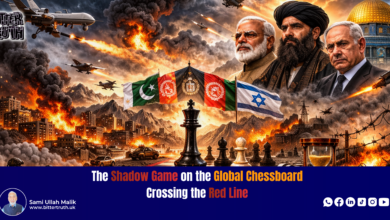
Islamabad has further alleged that Israel, alongside India and other unnamed actors, has supported anti-Pakistan elements from Afghan territory — accusations firmly rejected by the states concerned. Whatever the veracity of such claims, their circulation complicates an already intricate regional chessboard. Central Asian governments, too, express anxiety regarding the presence and mobility of foreign militants. The demand for a coherent regional strategy grows more insistent.
Some analysts contend that sustainable reform is more likely to emerge from within Afghan leadership than from the application of external pressure. Pakistani authorities, however, maintain that the struggle against extremism is inescapable and that national security, together with the protection of citizens, admits of no compromise.
Pakistan’s stated aim, it insists, is not dominion but responsibility: that Afghanistan should honour its commitments as a sovereign state. Heavy-handed military action risks inflaming public sentiment, which hostile powers might then exploit. Hence the argument for restoring discreet lines of communication — to thaw the frost of mistrust before it hardens irretrievably.
At this martial juncture, the decisive issue remains whether the two countries will drift toward total war or arrest themselves after limited engagement in search of diplomatic reprieve. The opening declarations of conflict are invariably impassioned; yet states, in the end, act in accordance with perceived interest. Should hostilities protract, both economies, domestic stability, and regional alignments would come under acute strain.
Certain diplomatic sources suggest that back-channel communications have not entirely ceased. China, along with other regional actors, may yet assume a mediatory role. If so, the present crisis might be contained before it matures into wider conflagration. But should military operations intensify unchecked, the vacuum thus created may invite non-state actors to widen the theatre of conflict — and what began as a border war could metastasise into something far more intractable.
In such moments, prudence is not timidity; it is statesmanship. And history, that stern tutor, seldom absolves those who mistake escalation for strength or impatience for resolve.
Pakistan maintains that national security and the protection of its citizens will be ensured at any cost. Afghanistan, for its part, declares that sovereignty is not a negotiable commodity. Each narrative, taken in isolation, possesses its own internal logic and rhetorical force. Yet wars are not ultimately adjudicated by declarations, however resolute; they are determined by facts upon the ground — and the stubborn truth is that for several years Islamabad has sought, with what it describes as substantial evidence in hand, to persuade the Afghan Taliban to restrain cross-border militancy emanating from Afghan soil. Pakistan contends that these efforts have yielded insufficient practical response, and that Kabul, rather than engaging the matter with due seriousness, has drifted into the orbit of rival regional interests — notably India and Israel — a charge those states reject.
Be that as it may, the present crisis is rendered especially delicate by the internal pressures bearing down upon both governments. Public sentiment runs high; media rhetoric has hardened; social platforms reverberate with appeals to national honour. In such an atmosphere, retreat or compromise is politically perilous. Yet history offers a stern lesson: it is the mark of wise leadership not to allow the vessel of prudence to founder amid the tempest of emotion.
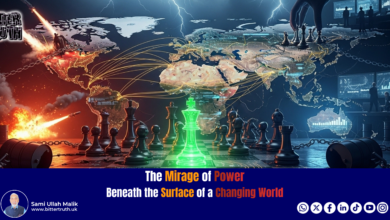
The relationship between Pakistan and Afghanistan is not confined to the parchment of treaties. It is woven from centuries of cultural intercourse, shared memory, and religious affinity. War may invert the chessboard for a season; it cannot wholly sever the deeper fibres of civilisation. The question, therefore, is whether the present flames can be contained, or whether they will spread across the region’s dry undergrowth.
For when trust frays, and politics is stripped of wisdom, even fraternity becomes burdened, and neighbourhood shades into estrangement. The essential inquiry endures: is the remedy to be found in gunpowder or in judgement? Can regime change deliver stability, or will it merely summon fresh disorder? More fundamentally still — can both states rise above the constraints of their internal narratives and undertake the patient construction of a shared future? If the answer be affirmative, history stands ready to open a new chapter; if negative, this tension may metastasise beyond a border dispute into a wider regional conflagration.
In the court of history, nations are vindicated not by strength alone, but by the capacity to marry strength with wisdom, resolve with restraint. Should dialogue be restored, the thunder along the frontier might yet dissolve into the hum of markets and the traffic of ordinary life. Should it fail, the embers now glowing along the boundary may cast a far wider and more enduring glare.
At the heart of the matter lies a question as old as statecraft itself: can durable peace be secured through force? History suggests otherwise. The rifle may clear a path; it cannot reveal the destination. If Kabul were to undertake a demonstrable and serious effort to purge its territory of armed groups, and if Islamabad were to sustain its commitment to diplomatic engagement, the possibility of thaw might emerge. Otherwise, the mountain of mistrust will continue to cast its long shadow across the region.
This is no mere neighbourly quarrel. It is a relationship shaped by centuries of cultural consonance — one easier to recast in the mould of enmity than to sustain in the discipline of peace. Should a renewed sense of mutual responsibility prevail, the present fog of tension may yet lift. Failing that, the crisis risks ensnaring not only two nations but the wider equilibrium of South and Central Asia.
The choice remains. Conflict may be widened, or prudence may be sought. The war has begun; its ending has not yet been inscribed. That decision rests with the present generation of leaders — whether they bequeath another theatre of grievance to posterity or lay the arduous but enduring foundations of peace.
What is required now is balance: to temper the heat of passion with the coolness of judgement; to align military pressure with diplomatic insight; to ensure that the clamour of accusation does not drown the quieter voice of dialogue. If leadership can rise above immediate rhetoric and decide in favour of future generations, this episode may be remembered as a trial weathered — not as a wound unhealed.
Otherwise, the sparks rising from the frontier may refuse confinement. A fire that might have been extinguished by timely wisdom could redden distant horizons. The alternative still stands before us: the widening road of confrontation, or the harder, nobler highway of prudence. History will bear witness to the path chosen.