
From Tehran to Islamabad: Israel’s Widening Threat
Zionism Unleashed: Is Pakistan the Next Target?

There are moments in the annals of human history that transcend the fleeting cadence of news; they emerge not merely as events, but as portents—heralds of civilisational shifts and the prelude to intellectual reckonings. Such moments appear time and again upon the political horizon, where history seems to hold its breath, and the reverberations from the citadels of power echo like the trumpet of judgement.
It is in such solemn intervals that entire civilisations descend into the arena, clothed in the full grandeur of their meaning. Though these words may not belong to a philosopher, they encapsulate, in allegorical precision, the contemporary tension mounting between Iran and the United States—a crucible of cultural contest and geopolitical brinkmanship.
A moment of this very gravity now casts its ominous shadow across the skies of the Middle East. The embers of hostility between Iran and America have begun to flare, no longer cloaked in diplomacy but crackling with open sparks of provocation. On one side stand imperial powers, laying a fresh chessboard under the pretext of economic imperatives, military dominion, and cultural conceit; on the other, ancient nations arise with their heritage, religious consciousness, and civilisational dignity braced for a defence not just of territory, but of identity. To this volatile landscape, the incendiary posturing of Israel and the rising heat of India have now been added, compounding the combustibility of the region.
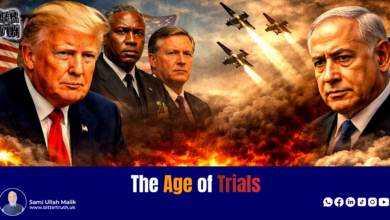
Behold the tragicomedy of American politics: a man who has seldom observed the bounds of constitution or conscience, now demands—armed with the arrogance of unbridled power—a “unconditional surrender” from Iran, a nation whose temperament is steeped in revolution, faith, and civilisation. Prior to the G7 summit, President Trump distanced European allies, as though to say: this is a matter solely for the sagacity of his own vision. And when he declares, “No one knows what I’m going to do,” he affirms—whether inadvertently or otherwise—his own intellectual disorientation, placing a presidential seal upon strategic incoherence.
Such a statement betrays more than mere unpredictability; it is the tremor of an unravelling order. It reveals a West no longer at the helm of its own design—a cry not only of personal confusion, but of a civilisation dislodged from its historical axis. Trump’s demand that Iran capitulate unconditionally is not the proclamation of a rational statesman but the echo of a colonial instinct—one that lingers from the imperial shadows of the twentieth century.
His words, cloaked in the guise of casual bravado, are in fact the emblem of a lost Western leadership—dangling upon the crucifix of its own contradictions, struggling beneath the weight of its abandoned ideals. The existential despair of a superpower’s captain adrift is not a mere psychological footnote; it is the mirror of a broader civilisational decline.
In firm contrast, Iran’s Supreme Leader, Ayatollah Ali Khamenei, rejected this ultimatum not with bluster but with the gravitas of history. He warned that American interference would inflict irreparable harm—culturally, historically, and socially. His voice carried not the bravado of reckless defiance, but the assured cadence of a nation tempered by forty years of resistance, the fire of revolution, and the consciousness of an awakened people.
His response is not merely political; it is ideological, historical, and spiritual. To him, this is not a clash of statecraft but a war for the soul of faith and the survival of civilisation itself. Where Trump’s rhetoric is transactional and petulant, Khamenei’s tone is steeped in the archives of endurance—he speaks as though through the annals of Darious and Cyrus, emerging from the dust of Qadisiya, echoing through the empires of the Mughals, and resonating with the heartbeat of Karbala.
“Iran will never surrender.” This declaration does not emanate from the corridors of transient power, but from the ever-beating heart of an ancient perseverance. Iran, who bowed neither to the Greeks nor to the Mongol horde, remains today a bastion of intellectual defiance and spiritual resilience.
At the United Nations, Iran’s diplomatic mission cast scathing censure upon Trump—a requiem for an institution whose impotence has rendered it little more than a weary drum, struck repeatedly, but producing no melody. Their message—that Iran would not even “wander near the White House”—was not simply a diplomatic rebuke; it was laced with a fragrant aloofness, the quiet defiance of a civilisation that no longer courts Western approval, nor fears its wrath.
This was not mere rhetoric. It was a civilisational rejoinder—a slap across the pallid face of Western politicking, now dulled by its own cynicism. Iran’s diplomatic posture is rooted in a theological soil where dignity is defined not by coercion or currency, but by faith, steadfastness, and justice.
In a bold and telling move, Iran has now delegated full wartime authority to the Islamic Revolutionary Guard Corps. At first glance, this may appear a mere tactical shift. Yet beneath its surface lies a profound declaration: “When the ideological pillars of a nation are under siege, the sword is no longer a tool of defence alone—it becomes a tongue in its own right.”
Thus, Iran has entrusted the battlefield not just to generals, but to guardians of an idea. This is not simply the prelude to war, but the pronouncement of a new dialect: one in which the vocabulary is forged in steel, and the grammar is written in sacrifice.
The Philosophy of the Guard: A Doctrine Forged in Fire and Faith
The doctrine of Iran’s Islamic Revolutionary Guard Corps (IRGC) is not anchored merely in the calculus of military strategy; it is, rather, a confluence of divine discipline and ideological conviction. Their arsenal is not fashioned solely from steel, but from the temper of belief—tempered not in the furnaces of metallurgy, but in the crucible of faith. When conviction enters the battlefield, it is not the roar of cannons but the fire of purpose that secures victory.
Thus, the delegation of wartime authority to the IRGC is no mere tactical adjustment. It is a declaration—firm, historic, and unmistakably civilisational. It heralds the moment when arms are not wielded in isolation but guided by ideals; when defence becomes not merely a matter of territory, but of truth, honour, and heritage. In handing over this authority, Iran has made clear: should aggression befall its soil, the response shall not be confined to the military domain—it will reverberate along the very fabric of civilisation itself.
The embers of conflict have already been kindled. With Israel’s repeated assaults upon Iran, and Iran’s emphatic retaliation, the region teeters upon the edge of conflagration. Yet, this is no mere tit-for-tat—it is a gathering storm, a tempest brewing at the confluence of political arrogance and spiritual defiance. The Zionist mentality that underpins these provocations is not aimed at a solitary nation but directed squarely at the spiritual dignity, historical consciousness, and collective will of the Muslim world.
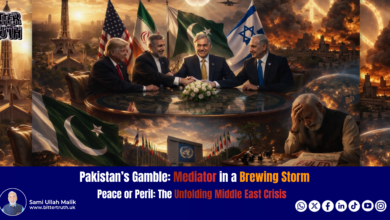
Following Israel’s strikes and Iran’s firm response, the geopolitics of nuclear deterrence has entered a perilous new chapter. Prime Minister Netanyahu’s poisonous threat—that not only Iran but Pakistan’s nuclear capability should be dismantled—is not merely the sabre-rattling of a reckless statesman. It is a cultural affront, an ideological challenge, aimed not just at one state, but at the collective self-respect of an entire ummah. Such words, falling like venom from the lips of a man intoxicated with power, demand more than condemnation—they call for awakening.
The world must now confront a sobering question: shall men such as Netanyahu and Modi—steeped in chauvinism, emboldened by silence—be permitted to draw the world towards darkness? Can the fate of civilisation be left to the whims of such men? This is not a question for statesmen alone; it is a call that echoes across coffeehouses and parliaments alike, in the hearts of scholars and in the whispered prayers of the forgotten.
If the United States were to launch a direct assault on Iran, it would not be a mere military manoeuvre—it would be an attack upon a civilisation, upon a worldview, upon the very idea of resistance. Such an act would be no spark—it would be a volcanic eruption. Iran’s response would not be confined to American installations; it would engulf the strategic interests of the West from the Levant to the Gulf, from Baghdad to Manama. The theatre of war would shift from bunkers and borderlands to the soul of a region long scorned and long awakened.
Nor would Iran’s response be predictable. It may not be limited to missiles or mechanised regiments. It may arrive in the form of an idea—etched in the memory of Karbala, born from the defiance of Hussain against tyranny. The true counterstrike may well be spiritual before it is physical—aimed not only at bases in Qatar, Bahrain, or Kuwait, but at dismantling the illusion of invincibility that the West has cloaked itself in for decades.
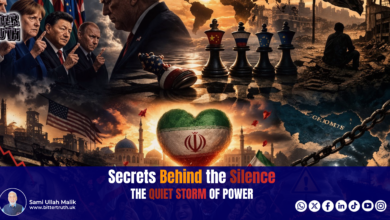
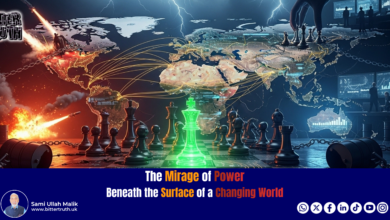
Meanwhile, the studied silence of China and Russia cannot be dismissed as diplomatic inertia. It is the silence before the storm, the strategic quietude of grandmasters poised over a geopolitical chessboard. Russia, seasoned by its entanglements in Syria, reads the pulse of the Middle East with veteran clarity. China, ever reliant on the Gulf for its lifeblood—energy—cannot afford indifference. Their silence speaks; and what it says may shape the coming order.
The Belt and Road Initiative, the Russian military calculus, and the shifting tectonics of Eurasian diplomacy may soon compel Beijing and Moscow to become not mere observers, but architects of a counter-bloc. A new global alignment may emerge—not only to contest Western hegemony but to redefine civilisation itself.
But the question remains: has the Muslim world become deaf to the cries of its own dignity? Will it rouse itself from this slumber of submission, or will it, once again, drown its resolve in resolutions, its purpose in platitudes? Or shall there emerge, from the ashes of apathy, a revival—a confederation of conscience?
Let us imagine a different dawn. Let us conceive of Turkey, Malaysia, Iran, and Pakistan no longer as disjointed voices, but as the harbingers of a united front—politically astute, diplomatically engaged, and intellectually awakened. The hour is ripe not merely for alliance, but for a renaissance.
What is required now is not just a coalition of states, but a communion of civilisations. A bloc not forged merely in defence, but in dignity. Not built upon fear, but upon faith. This would not be a mere political manoeuvre—it would be a clarion call, a heralding of the return of a people who
once shaped the world, and who may yet do so again.
A Clash of Civilisations or a Reckoning of Futures?
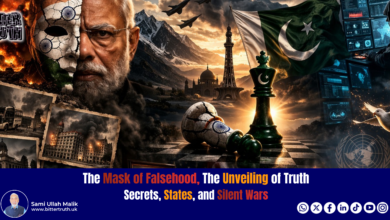
Amidst the turbulent tides of global diplomacy, the recent overtures between Indian Prime Minister Narendra Modi and former U.S. President Donald Trump appear not merely as gestures of protocol, but as calculated manoeuvres in a grand geopolitical chessboard. Modi’s emphatic rejection of third-party mediation in the Kashmir dispute, conveyed in a reportedly curt phone call, seems less a diplomatic stance and more a veiled stratagem — a conscious attempt to sideline American arbitration and preserve India’s own hegemonic narrative over South Asia.
Such a rebuff does not simply bruise the American ego; it threatens to diminish the long-cherished image of Washington as the indispensable global mediator. Will Mr. Trump, once the self-styled herald of ceasefires and détente between Islamabad and New Delhi, now retreat quietly from his grandiloquent declarations? Or will he seek, as is often his instinct, to reassert his presence in the theatre of South Asian politics — perhaps through more subtle but potent recalibrations?
Against this backdrop, the recent high-level engagements of General Asim Munir — Pakistan’s Chief of Army Staff — with U.S. officials, culminating in a private luncheon with Trump himself, deserve more than cursory attention. Though cloaked in diplomatic civility, the subtext of these meetings speaks volumes. The American praise for Pakistan’s role, especially emanating from a figure such as Trump, may well be the prelude to a tacit understanding — that in an era shadowed by the spectres of Afghanistan, Iran, China, and India, Pakistan remains a crucial axis in the wheel of regional stability.
It is not just military relevance that is being acknowledged here, but the rekindling of Pakistan’s diplomatic stature — the articulation of its agency not as a pawn in a global game, but as a stakeholder with its own vision, strategy, and cultural compass. Trump’s commendation could signify the dawn of a new chapter — should Pakistan seize this moment with the wisdom of statesmanship, the acuity of economic foresight, and the prudence of strategic depth.
Yet, one must not be seduced by ceremonial affirmations. History teaches — oft too late — that American overtures, though warm in proximity, have an icy impermanence. When interests shift, allies are forsaken without lament. Pakistan has borne this betrayal more than once. Let us not forget: in the theatre of empires, sentiment is seldom sovereign.
Meanwhile, Modi’s resistance to American mediation not only affronts Trump’s political pride but also projects an unsettling ambition: regional dominance unfettered by external arbitration. And in counterpoint, General Munir’s engagements in Washington appear as Pakistan’s response — subtle but significant — to reclaim its voice in the court of global diplomacy.
Indeed, the world now stands not at the brink of another world war, but upon the precipice of a clash of civilisations. The West, girded with firepower, seems confident in its arms. But the East — bruised yet not broken — possesses something the modern missile cannot extinguish vision. If the West has soldiers, the East holds sages. And history, in its final arithmetic, rewards not the sword but the idea.
The Trumps, the Modis, the Netanyahu’s — they are not harbingers of time, but rather its symptoms; not the custodians of peace, but the echoes of unrest. The real contest is not between nations, but between liberty and subjugation, dignity and domination, spirit and steel.
Should the Muslim Ummah awaken from its long slumber — if it dares to rise not with slogans, but with unity and strategy, then perhaps this century might yet bear its name. But if not, then the tragedy of another missed epoch shall quietly find its place in the ever-growing graveyard of forgotten possibilities.
This world will no longer move forward solely on the basis of gunpowder and declarations. Its axis is the cultural, religious and intellectual force that has not weakened for centuries. Parties like Trump, Modi, Netanyahu are temporal axes, but the real battle is for the survival of this intellectual world. If the Muslim Ummah awakens its consciousness today, becomes steadfast in its unity and protects its cultural dignity, then this century can be its own. Otherwise, this century will remain a part of the oppressed archive of history.
This is not just a disagreement between Trump and Khamenei, but a conflict of civilizations, interests, beliefs and ideologies whose scope extends from the United Nations to the Arabian Desert, Gaza, Palestine and the valleys of Kashmir. If the Muslim Ummah unites at this critical
point by understanding the demands of the modern era, then this century may become its era of awakening. Otherwise, history buries everything in its wake that is unable to recognize itself.