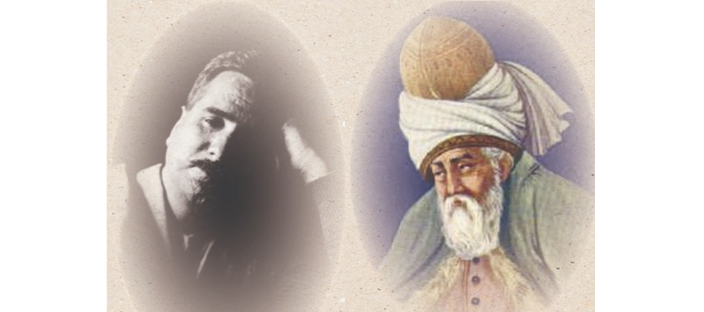
From Rūmī’s Love to Iqbāl’s Khudī
A Journey of Spiritual Awakening

Human history, when reduced to a mere register of empires, wars, and political upheavals, loses its moral resonance. Properly understood, however, it is something far more demanding: a continuous record of the human spirit’s attempt to transcend its own limitations. Rising from dust and aspiring towards the infinite, this quest has found expression at different moments in different idioms—sometimes as love, sometimes as selfhood, and sometimes as a synthesis of both.
The subject before us today belongs firmly to this deeper register of history. It is not an exercise in reverence for the past, nor a decorative homage to two towering figures of Islamic thought. It is, rather, an inquiry into the intellectual unease of the present and the direction of the future. Though articulated through the names of Jalāl al-Dīn Rūmī and Muhammad Iqbāl, its true subject is the condition of the modern Muslim mind—its anxieties, its fractures, and its unrealised possibilities.
This is not a gathering convened for momentary emotional uplift, nor an indulgence in civilisational nostalgia. It is, at its core, an act of intellectual self-examination. The question it poses is both simple and unsettling: what became of that inner vitality of Muslim thought which once emerged from love and matured into a confident sense of self?
The answer is neither sentimental nor merely literary. It lies in the sustained intellectual relationship between Rūmī’s conception of ‘ishq—love as a cosmic and moral principle—and Iqbāl’s formulation of khudī, selfhood as disciplined moral agency. This relationship is not one of imitation but of evolution: a continuity of thought that carries the human being from inward awakening to historical responsibility.
One of the most illuminating chapters in this continuum begins in thirteenth-century Konya, where love appeared not as private ecstasy but as a universal law of being, and culminates in the twentieth-century subcontinent, where selfhood was articulated as a response to political subjugation and intellectual stagnation. Between these two moments lies a journey that is at once mystical, historical, and profoundly political.
It is a journey that moves from the quiet streets of Konya to the contested intellectual terrain of South Asia, absorbing along the way mystical insight, historical consciousness, Islamic theology, and literary refinement. In this synthesis, love, knowledge, history, power, and civilisation cease to be separate categories; they converge into a single, living argument. To speak of this journey, then, is not to recount an episode of the past but to confront a question of enduring relevance.
The contemporary Muslim predicament is marked by a peculiar duality. On one side stands an aggressive materialism that strips life of moral depth; on the other, an emotive religiosity that often lacks intellectual coherence. Rūmī and Iqbāl gesture towards a third possibility—one that neither retreats from the world nor surrenders uncritically to it. Their path is grounded in love and selfhood, not as opposites, but as mutually sustaining principles.
Such a path does not encourage withdrawal, nor does it glorify conflict. It cultivates balance, purpose, and moral intentionality. It insists that inward transformation and outward responsibility are inseparable.
History, if approached merely as a catalogue of events, remains inert—informative perhaps, but incapable of guidance. Read instead as the continuity of ideas, as the narrative of the soul’s search for meaning, history becomes animate. Each century assumes a moral character; each generation inherits both a burden and a choice. Within this living continuum, Rūmī and Iqbāl stand as two luminous markers. Separated by six centuries, they nevertheless confront the same essential problem: how is the human being to recognise his true nature?
Rūmī directs the seeker inward, urging the discovery of a spring of love within the apparent barrenness of the self. Iqbāl, inheriting this insight, demonstrates how that spring may be channelled into khudī—a disciplined selfhood capable of nourishing culture, ethics, and political life.
The enduring appeal of Jalāl al-Dīn Rūmī lies in precisely this universality. He resists easy classification. Neither poet alone nor mystic alone, he is better understood as a teacher of love who regarded the inner life as the proper starting point of all transformation. For Rūmī, love is not an emotional excess; it is a metaphysical principle. It is the force that transmutes the base into the noble and draws the human being towards completion.
To read the Mathnawī is to encounter a voice that seems less concerned with recounting history than with addressing the human condition itself. Love, Rūmī insists, is a fire that consumes without annihilating—a force that strips away illusion while preserving life. It is through this fire that the individual is led from self-forgetfulness to divine awareness.
The Qur’ān gestures towards this inner dignity of the human being in words of striking metaphysical clarity:
وَنَفَخْتُ فِيهِ مِنْ رُوحِي
Wa nafakhtu fīhi min rūḥī
“And I breathed into him of My Spirit.” (Qur’ān 15:29)
This verse underwrites Rūmī’s vision: the human being, bearing within himself a divine trust, is called not merely to exist but to respond.
It is therefore unsurprising that Konya continues to attract seekers from across cultures and continents. Rūmī’s tomb functions less as a monument and more as a moral space—a quiet academy where inherited divisions of creed, language, and ethnicity lose their urgency. One leaves with the recognition that true devotion is measured not by outward conformity but by inward humility.
For Iqbāl, Konya became more than a place; it evolved into a symbol. It represented a spiritual centre from which thought could regain universality. In his imaginative geography, the light of love emanating from Rūmī illuminates the path of khudī, guiding it away from both nihilism and narcissism.
Konya, in this sense, is not geography but metaphor. It signifies the possibility that when love finds its centre, borders dissolve; when thought bows before truth, ego gives way to responsibility. The bowed head at Rūmī’s resting place is not an act of submission to the past, but a recognition that the culmination of thought lies not in self-assertion, but in moral clarity.
From this centre, the journey continues—unfinished, demanding, and urgently relevant. The
passage from Rūmī’s love to Iqbāl’s selfhood is not a closed chapter of intellectual history. It is an open question, addressed anew to every generation willing to think seriously about the relationship between the inner life and the fate of civilisation.
From Historical Crisis to Intellectual Renewal
In Rūmī’s age, the Muslim world was beset by political fragmentation and intellectual inertia. The reverberations of the Crusades, the looming terror of Mongol invasions, and the suffocating weight of religious formalism had together narrowed the horizons of spiritual life. Faith had hardened into ritual; learning had congealed into repetition. It was against this background of paralysis that Rūmī placed love at the very centre of existence, using it as a force to rupture stagnation and restore inward vitality.
In Iqbāl’s time, the crisis assumed a different, though no less debilitating, form. Colonial domination, intellectual subservience, and civilisational inferiority had paralysed the Muslim mind. Where Rūmī confronted ritualised religion, Iqbāl confronted colonised consciousness. And just as Rūmī broke his age’s inertia through love, Iqbāl sought to shatter modern stagnation through the call of khudī—selfhood.
It is often suggested that Rūmī’s love and Iqbāl’s selfhood stand in opposition to one another. The truth is precisely the reverse. Love gives selfhood its purpose, and selfhood gives love its direction. Selfhood without love degenerates into ego; love without selfhood dissolves into unanchored emotion. Together, they form a balanced Islamic personality—at once inwardly illuminated and outwardly responsible.
If Rūmī may be described as the poet of love, Iqbāl must be recognised as its philosopher. Iqbāl loved Rūmī deeply, but he did not imitate him. Instead, he lit his own lamp of selfhood from Rūmī’s flame. For Iqbāl, the end of love was not annihilation (fanā’), but continuity (baqā’)—a form of spiritual endurance that propels the human being towards action, courage, and creative engagement with the world.
It was in this sense that Iqbāl referred to Rūmī as his murshid-e-ma‘navī, his spiritual guide:
پیرِرومیؒ خاک رااکسیرکرد
ازغبارم جلوہهاتعمیرکرد
“The Master of Rūm transformed dust into alchemy;
From my very ashes, he fashioned new forms of radiance.”
This is not a gesture of sentimental devotion; it is the articulation of an intellectual lineage. Rūmī bequeathed love to Iqbāl, and Iqbāl recast that love as selfhood, transforming it into a call for purposeful action addressed to the Muslim community.
For Iqbāl, khudī denotes the inner power of the human being—the capacity that renders him not a slave of destiny, but its architect. It is through selfhood that the individual acquires a sense of moral responsibility. Here, Iqbāl’s mysticism certainly connects with Rūmī’s, but it also advances beyond it. Rūmī is the poet of love; Iqbāl is its combatant.
Iqbāl’s conception of selfhood is emphatically not a celebration of narcissism. It is, rather, an ethic of responsibility. It is the self that bows before God yet refuses to submit before falsehood. It is the self that restores to the human being his true identity—the identity of God’s vicegerent on earth.
In this synthesis, Iqbāl appears simultaneously as mystic and reformer, poet and philosopher. His verse carries both intellectual gravity and historical dignity, while its deeper resonance is unmistakably Islamic. Selfhood, in his thought, is not a psychological abstraction but a comprehensive theory of the human being—one that situates man as an active agent within the cosmos.
This is where Iqbāl parts company with forms of mysticism that sever the human being from action. His ideal human being prostrates in prayer and struggles in the world; he supplicates and he plans; he trusts in God and he acts with resolve. In this harmony of devotion and endeavour lies the distinctive power of Iqbāl’s vision.
Though centuries separate Rūmī and Iqbāl, the spiritual dialogue between them has never ceased. Rūmī’s love, transfigured through Iqbāl’s selfhood, gives birth to a renewed civilisational spirit. Their conversation teaches a lasting lesson: love without consciousness is mere emotion, and consciousness without love is barren rationalism.
For Rūmī, love is never a private episode; it is a comprehensive philosophy of life. He places love at the centre of knowledge, ethics, politics, and worship alike. Knowledge that fails to illuminate the heart, he regards as a burden; worship that does not bind one human being to another, he dismisses as empty form.
The Mathnawī is therefore not simply a work of poetry, but an intellectual document—one that elucidates the relationship between the inner self, society, and the cosmos. Rūmī’s human being is not static; he is dynamic, perpetually becoming, breaking, and renewing himself. Love is the fuel of this creative process.
In Rūmī’s vision, love is not a subjective sentiment but a law of the universe. It is the force that draws the inanimate towards life, life towards consciousness, and consciousness towards humanity. His Mathnawī is not merely verse; it is a science of the soul. Rūmī insists that the true homeland of the human being is the soul itself, and that love is the language of that homeland. This is why his words retain their freshness across centuries. His love reconciles human beings to one another and, ultimately, to God.
As Rūmī himself declares:
”مادل اندرراہ جاں انداختیم
غلغلہ اندر جہاں انداختیم
ما ز قرآن برگزیدم مغز را
استخوان پیشِ سگاں انداختیم
We lost our hearts.
I laughed somewhere
After the Quran, I chose the mind.
I threw the dog a bone.
In plain terms, Rūmī states that he extracted the very essence of the Qur’ān and poured it into the Mathnawī, leaving the husk for those content with appearances alone. This, indeed, is the secret of the enduring vitality of his work. It is for this reason that the Mathnawī has been honoured above other poetic compositions, and why Jāmī famously observed:
Mathnawī-ye ma‘navī-ye Mawlawī
Hast Qur’ān dar zabān-e Pahlavī
“The spiritual Mathnawī of Mawlānā
Is the Qur’ān in the Persian tongue.”
Yet, despite this profound devotion, Iqbāl is never a mere echo of Rūmī. He loves Rūmī, but he does not dissolve into him. He translates love into selfhood, fully aware that ecstasy alone cannot awaken a community. Consciousness, action, and purpose are indispensable. It is for this reason that Iqbāl repeatedly addresses Rūmī in his poetry—not as a relic of the past, but as a living interlocutor in a dialogue that spans centuries.
Finally, no account of Rūmī would be complete without reference to Shams of Tabriz. The arrival of Shams in Rūmī’s life was not a meeting; it was an earthquake. Shams was more than a person—he was a condition, a blaze of love. He set Rūmī’s frozen learning into motion, shattered his intellectual complacency, and ignited a storm within his soul that carried him from the silence of the madrasa into the dance of love.
Shams, Awakening, and the Moral Imperative of Thought
Shams transformed Rūmī’s learning into love and transmuted scholastic knowledge into experiential insight. He taught Rūmī that God is not merely to be studied, but to be lived. He questioned inherited certainties, challenged intellectual complacency, and made Rūmī realise that truth does not dwell in guarded cloisters, but in hearts that burn.
It was at this decisive moment that fire entered Rūmī’s pen. His verse acquired a heat that continues, even now, to warm the cold interiors of the human soul.
Here lies a profound intellectual lesson: every great movement of thought requires its own Shams—someone willing to ask unsettling questions, someone capable of shattering the comfortable shell of prevailing ideas. Without such a catalyst, knowledge remains inert, and tradition ossifies into reverence without renewal.
Iqbāl’s conception of khudī is not confined to individual moral reform. It is simultaneously a political consciousness and a civilisational prescription. His central argument is uncompromising: spiritual weakness gives birth to political servitude. When hearts are free, nations follow suit. Subjugated peoples, Iqbāl insists, are enslaved first in thought before they are conquered in territory. It is for this reason that he places such relentless emphasis on education, philosophy, and religious renewal.
Here we encounter Iqbāl’s acute sense of history—the conviction that nations are not forged by slogans, but by ideas.
Iqbāl did not merely adopt Rūmī as a spiritual guide; he embraced him as an intellectual model. For Iqbāl, Rūmī represents a form of Sufism that rescues love from passive ecstasy and anchors it in purpose. This is why he reveres Rūmī as his guide while simultaneously rejecting blind imitation. Iqbāl knew that his true struggle was with the Muslim of the subcontinent—resigned to fate, addicted to imitation, and intimidated by foreign dominance. Accordingly, he recast Rūmī’s love within the mould of selfhood and forged from it a coherent ideological programme.
It is for this very reason that one of the great contemporary Islamic thinkers has likened Rūmī’s love, Iqbāl’s selfhood, and collective consciousness to links in a single chain. This is not mysticism as escape, but mysticism as responsibility; not worship as withdrawal, but worship as the reconstruction of life. Selfhood, if it fails to translate into a collective order, remains limited in effect.
The concealed majesty of Rūmī’s Mathnawī, the intellectual dignity of Iqbāl’s thought, and the trajectory of their shared spiritual journey together constitute a mode of expression that is not merely heard but felt.
Modern man, entangled in machines yet severed from himself, stands in desperate need of this balance. Rūmī calls him back to the heart; Iqbāl summons him to action. It is precisely this equilibrium that our age lacks most acutely.
Throughout this journey, the Urdu language itself emerges not merely as a vehicle of expression, but as an intellectual tradition in its own right. Our civilisation teaches us that thought, when stripped of refinement, degenerates into extremism—and that the dignity of language is, in truth, the dignity of thought itself.
Distinguished listeners,
Rūmī’s love and Iqbāl’s selfhood are, in essence, two aspects of the same reality. One ignites the heart; the other forges character. When these two converge, the individual transcends individuality and enters history.
If there is a single lesson to be drawn from today’s reflection, it is this: transform love into selfhood, and dissolve selfhood into the pleasure of God. This is the journey of spiritual awakening—from Konya to our own hearts.
When the thought of Rūmī and Iqbāl is clothed in prose, their style reveals itself almost instinctively: the same grandeur of expression, the same dignity of tone, the same dialogue with history. Their purpose was never the mere transmission of information, but the awakening of consciousness.
O people of thought and learning,
This conversation does not end here. The real question is this: what do we become after reading Rūmī, and what do we do after understanding Iqbāl? If love does not awaken compassion within us, and selfhood does not stir responsibility, then all of this remains an academic exercise. Living thought must culminate in action, and blessed action must be illuminated by love.
Today’s intellectual gathering is not concluding with words alone; it is issuing an invitation—to move from the heart into the arena of responsibility. If Rūmī has softened our hearts, and Iqbāl has awakened our moral courage, then this journey has succeeded.
Selfhood without love is blind; love without selfhood is directionless. When the two unite, the human being becomes a confidant of the Divine.
O Allah of insight,
Grant us hearts that burn with Rūmī’s fire, and minds illuminated by Iqbāl’s selfhood.
Deliver us from intellectual servitude.
Endow our language with truth, our thought with balance, and our action with purpose.
Do not consign us to the margins of history; grant us a place within its living text.
Amen, O Lord of the worlds.
O Sustainer, kindle within our hearts the fire of Rūmī, grant our thought the selfhood of Iqbāl, bestow truth upon our speech, sincerity upon our action, and insight upon our community—so that we may become not spectators of history, but its architects.
Ameen, Ya Rub of all creation.